
Read More
How Bird Jewelry Spread Its Sparkling Wings From Royal Courts to Red Carpets
If you’re a bird, I’m a bird.
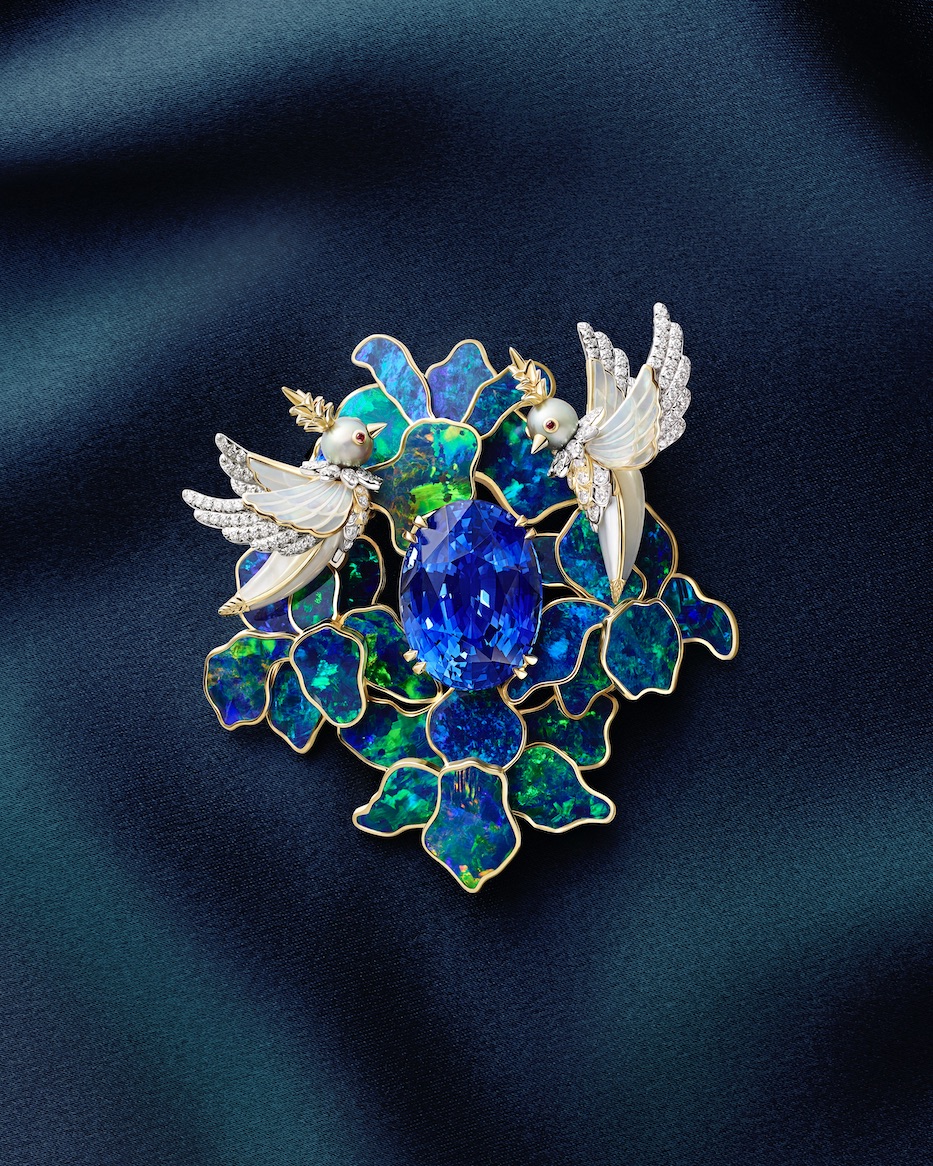
Tiffany & Co. debuts a one-of-a-kind creation, Legendary Bird: The Sapphire Edition. (Courtesy of Tiffany & Co.)
Summer is finally here, bringing nature to its brightest and most beautiful. Diamond bird jewelry catches the season’s light like few other motifs can, sparkling against the skin and taking flight on lapels, necklaces, and brooches. But these jeweled creatures are hardly a modern fascination. From the royal courts of the Mughal Empire to the sentimental jewelry of the Victorian era and even the resistance movement in Nazi-occupied Paris, bird jewelry has long served as a symbol of love, power, freedom, and beauty. Today, the world’s great jewelers continue to pay homage to the winged creatures.
According to Carol Woolton, author and podcaster of If Jewels Could Talk, bird jewelry “combines visual beauty with rich symbolism and can be used to deliver an entire narrative.” She tells Only Natural Diamonds, “They are enduring symbols of freedom, and different birds carry distinct meanings: doves deliver a message of peace and love, swans symbolize gracefulness and fidelity, the peacock represents beauty and pride, or the appearance of birds with their young could herald the arrival of spring. Birds challenge the jeweler to demonstrate movement because they are rarely still. Depicting outstretched wings, swooping forms, and feathered plumage showcases a jeweler’s artistic and technical skill.”
Meet the Expert

Carol Woolton is an author, broadcaster, and jewelry historian. The founder and host of the podcast If Jewels Could Talk, she released her latest book of the same name in 2024. Woolton was Jewelry Editor at British Vogue for over 20 years and remains the magazine’s Contributing Jewelry Director. She is credited with initiating the role of Jewelry Editor at Tatler and Vogue magazines. She’s written for publications like Vanity Fair, Air Mail, The Financial Times, and more.
Fly with us over the aviaries of Tiffany & Co., Cartier, Graff, Boucheron, and more to celebrate some of the world’s most exquisite diamond birds of summer.
Bird Jewelry Symbolized Power and Royalty in India’s Mughal Courts
History will hold the Mughal Empire (1526 -1857) as one of India’s most powerful and influential dynasties that spanned an incredible three centuries-long rule over the subcontinent in a fusion of culture, decadent ornamentation, and spectacular art and jewelry. Steeped in symbolism and the awe-inspiring craftsmanship of Jaipur’s jewelers and some of the world’s most spectacular natural diamonds, gemstones, and pearls, Mughal jewelry is like a language all its own in the art of adornment.
Birds, like the peacock and the Goshawk falcon, were seen as symbols of royalty at the Mughal courts in India. The Mughal Emperor Jahangir was documented to have been gifted a gem-encrusted bird, and Shah Jahan’s legendary peacock throne is thought to have had two jeweled peacocks on top of the canopy.
Both bird jewels were likely made as a pair, originally in the collection of the Nizams of Hyderabad. They were reportedly part of an assortment of bird jewelry that was placed around the throne during durbar ceremonies.
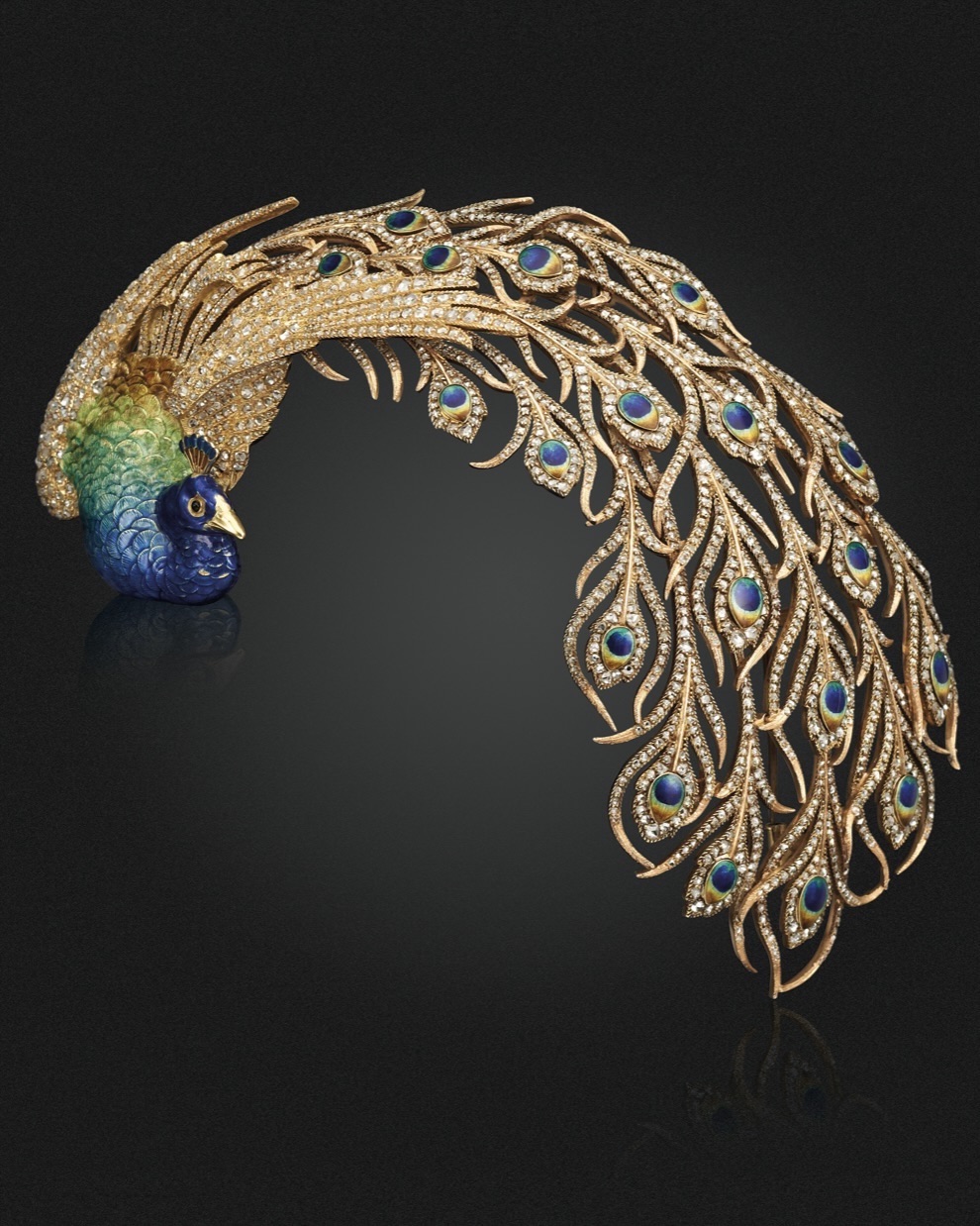
In December 1905, the Maharaja Jagatjit Singh of Kapurthala traveled to Paris before attending the royal wedding of King Alfonso XIII and Princess Victoria Eugenia of Battenberg in Madrid. A connoisseur of the French art de vivre, the Maharaja was a VIP client of the jewelry houses of Place Vendôme and Rue de la Paix. Seeking spectacular jewels worthy of a royal wedding, he patronized the Mellerio boutique, where he discovered the perfect piece of ornamental bird jewelry.
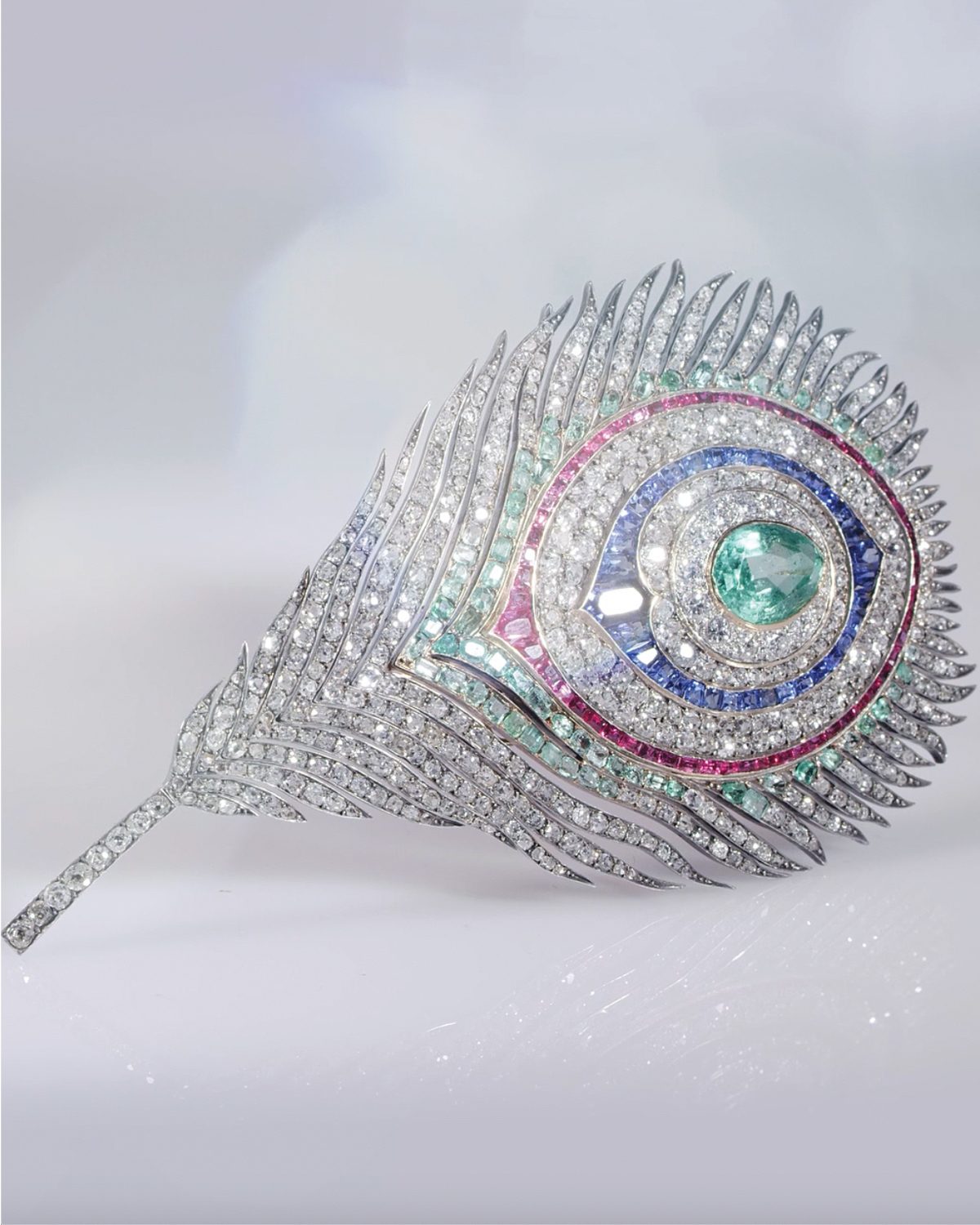
The oldest jeweler in the world, Mellerio, dates back to 1613, with countless links to royal clients, like Queen Marie Antoinette. The Maharaja of Kapurthala acquired a magnificent enamel and diamond peacock aigrette to wear at the royal wedding as the perfect blend of Indian influence with a Western vision. Crafted with rose-cut diamonds, blue, green, yellow, and golden brown enamel, the peacock was set in 18-karat gold.
The mythical peacock was venerated by many civilizations, especially India. Mellerio was known to incorporate peacock motifs throughout its designs ever since a peacock feather brooch was commissioned by Empress Eugenie in 1868. As the lore goes, the Maharaja is said to have worn the aigrette on his turban at the wedding in 1906. During that fateful visit, he met the Spanish flamenco dancer, Anita Delgado, who would eventually come to be his fifth wife. After their marriage, the historic peacock jewel was later spotted on Delgado, who would come to be known as the Maharani Prem Kaur Sahiba.
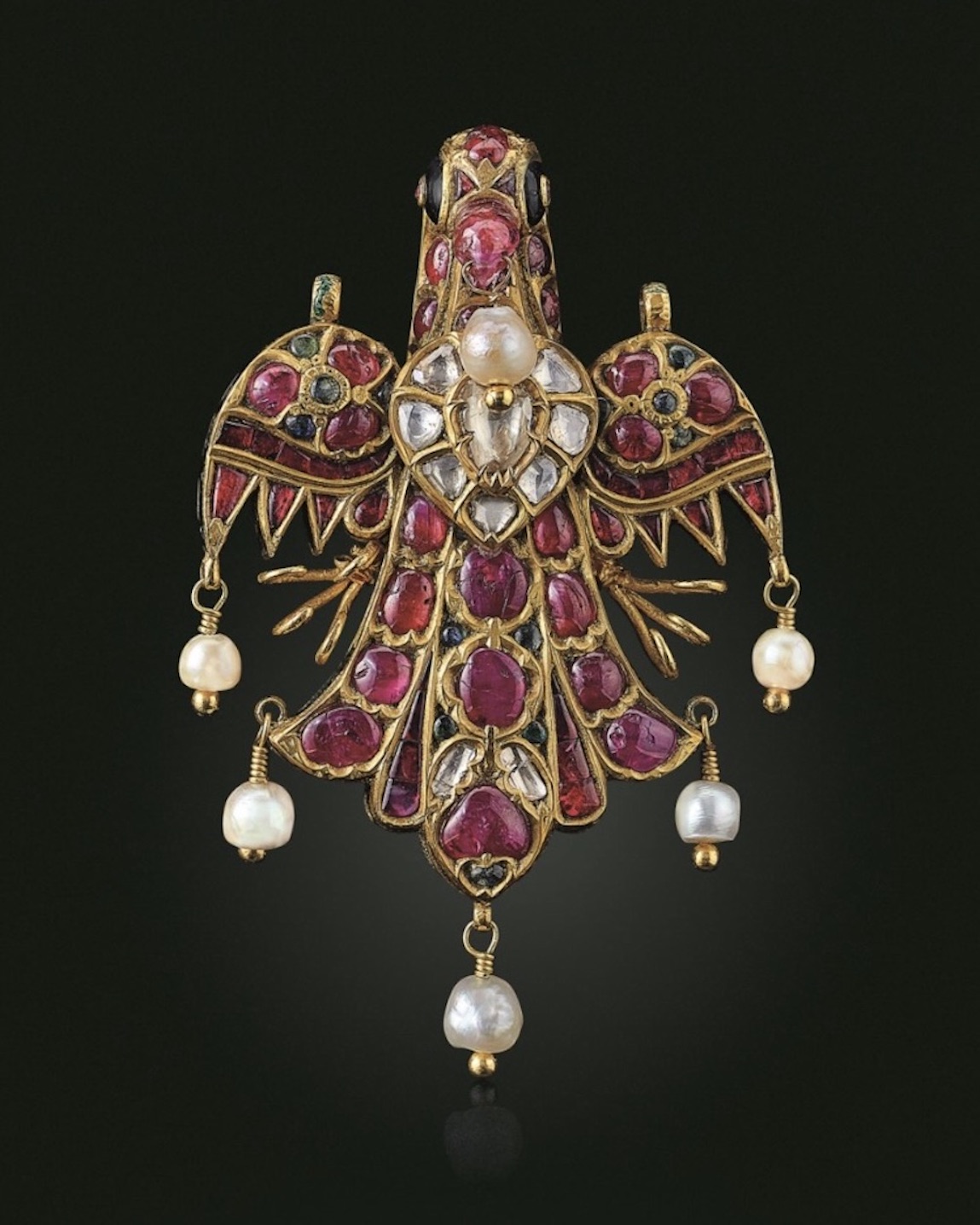
The peacock was included in the 2019 “Maharajas & Mughal Magnificence” sale, which netted $110 million. A sale featuring centuries of royal Indian jewels, it included an antique diamond and multi-gem Bird Pendant from the mid-18th century, featuring variously-shaped table-cut diamonds, oval and triangular-shaped cabochon rubies and emeralds, pearls, black, blue, green, white, red, and yellow enamel, as well as foil and gold on a lac core.
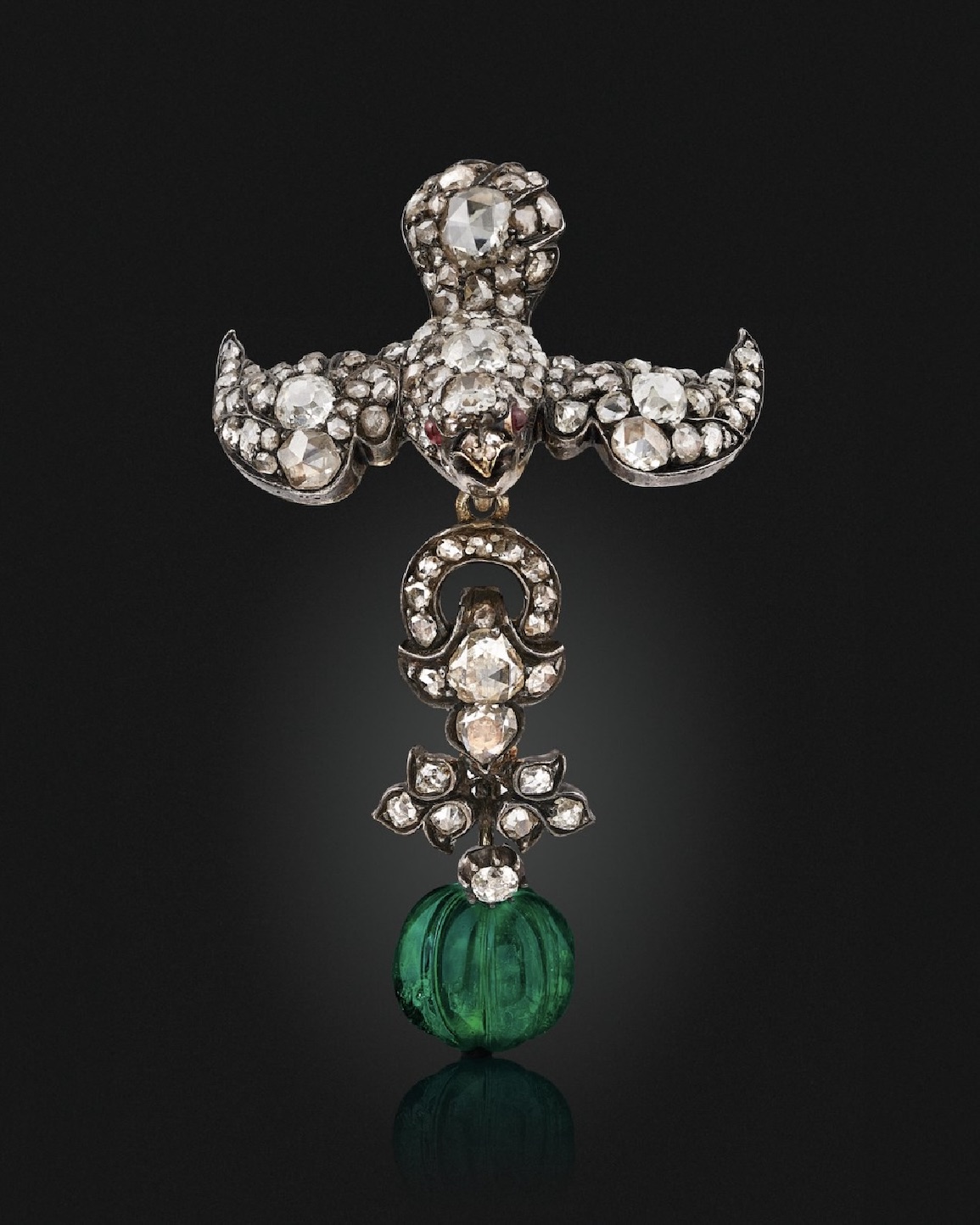
An antique diamond, emerald, and ruby Bird Brooch from the early 19th century was also included in the assortment, masterfully crafted with old and rose-cut diamonds, circular cabochon rubies, and a round carved emerald bead.
The Victorian Era Turned Bird Jewelry Into a Fashion Phenomenon

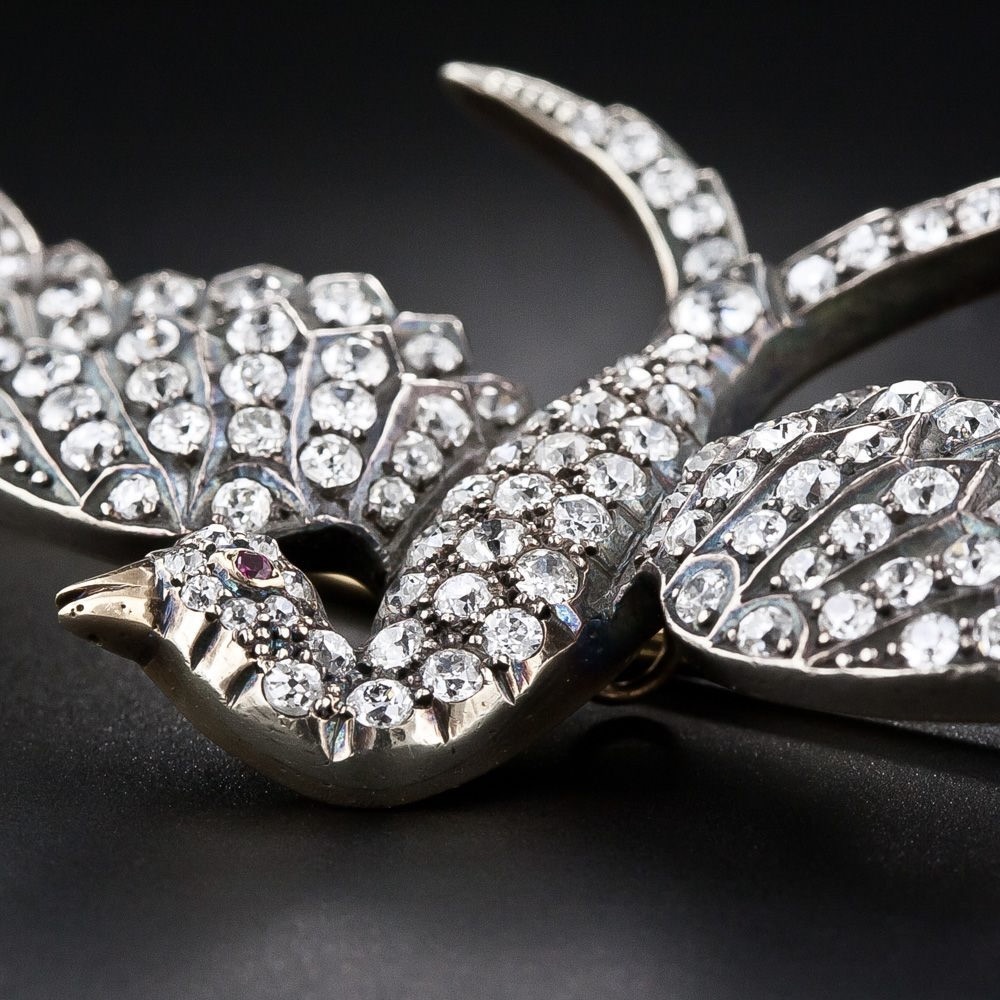
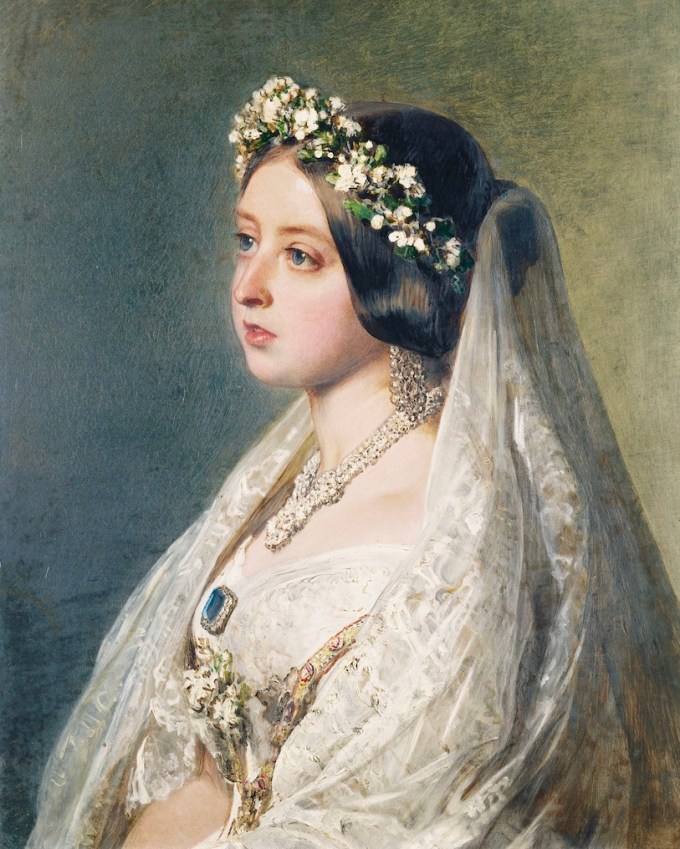
Queen Victoria’s romance with Prince Albert heavily influenced jewelry trends in the Victorian-era. Designs from that time generally featured nature-inspired themes, with diamonds arranged in shapes like florals or birds. Yellow or rose gold were the metals of choice to complement their sparkle. The natural world was a great source of inspiration for Victorian jewelry designers, from an eclectic array of motifs featuring flying diamond insects, butterflies, and bird jewelry.
Certain birds carried deeply personal meanings: swallows symbolized love, loyalty, and the safe return of a loved one, while paired birds often represented romantic devotion and lifelong fidelity.
Cartier’s Bird Jewelry Became a Symbol of Glamour and Resistance
Wallis Simpson’s Iconic Cartier Flamingo Brooch
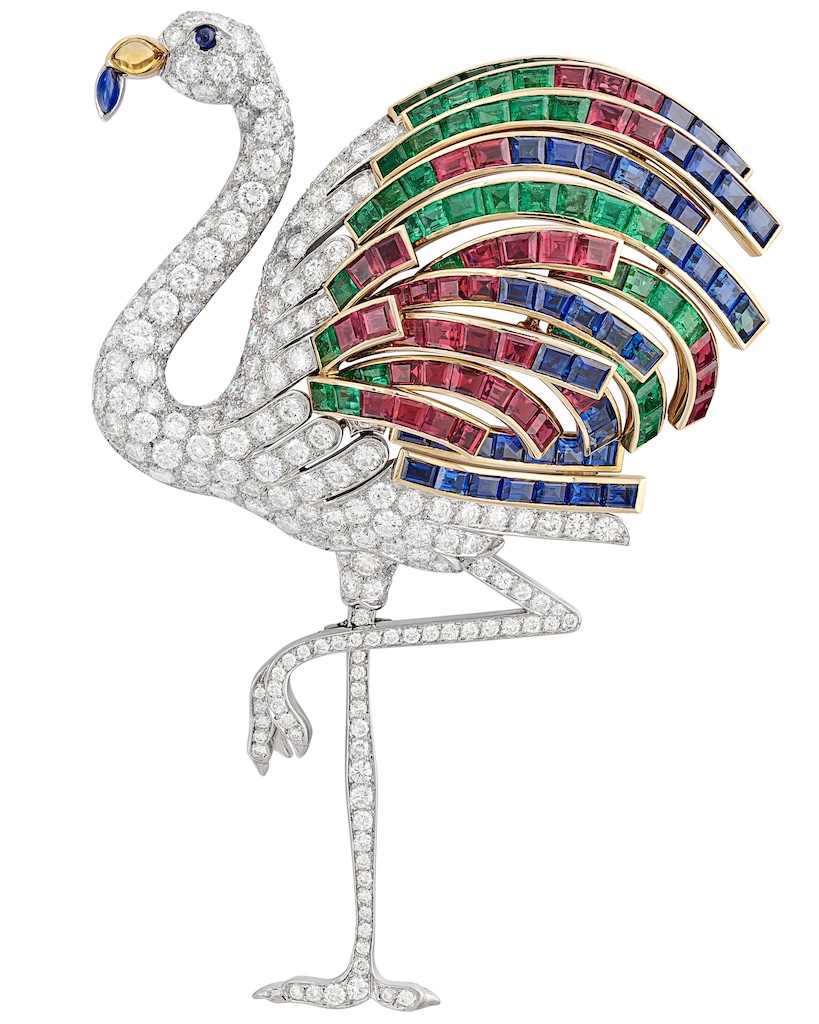

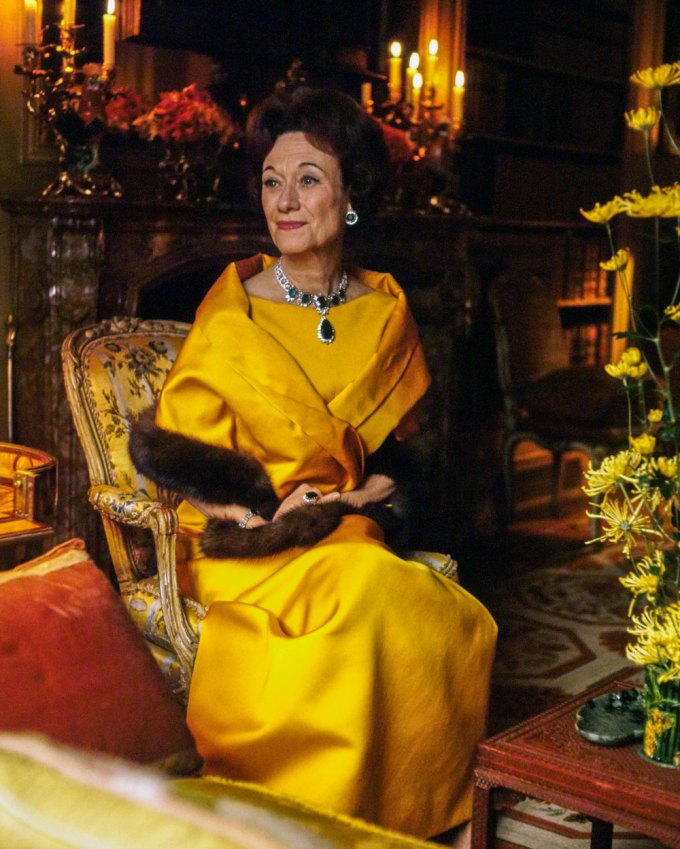
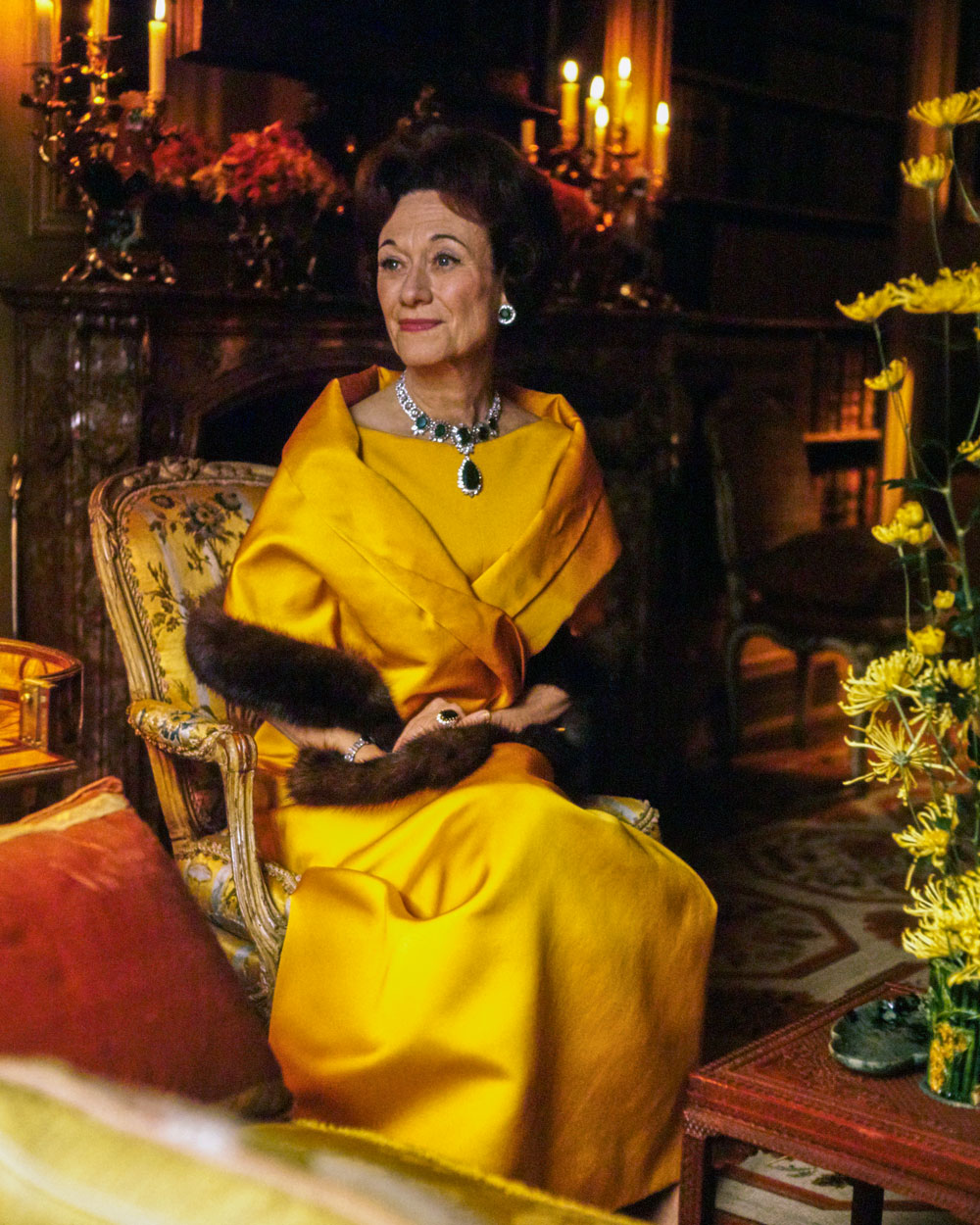
Wallis Simpson, the Duchess of Windsor, was an avid jewelry collector and formed a close relationship with Cartier Artistic Director Jeanne Toussaint, championing her designs like no other. In 1940, Edward VII, the Duke of Windsor, commissioned Cartier to create a flamboyant Flamingo brooch for his bride. Rendered in diamonds, rubies, and sapphires, the brooch swiftly became one of the Duchess’s most recognizable pieces of jewelry and a signature of her post-abdication style.
The brooch was delivered to the Duke and Duchess of Windsor just a few days before they left Paris ahead of the German invasion. The couple traveled to Nassau in the Bahamas, where the Duke took on the role of governor for the duration of World War II. Simpson was photographed wearing the brooch on her lapel on their travels.
The flamingo brooch was one of the stars of Sotheby’s landmark sale of the Duchess of Windsor’s Collection in 1987. Today, the original flamingo brooch is part of the Cartier heritage collection, appearing in exhibitions all over the world.
Jeanne Toussaint Used Birds to Defy the Nazis

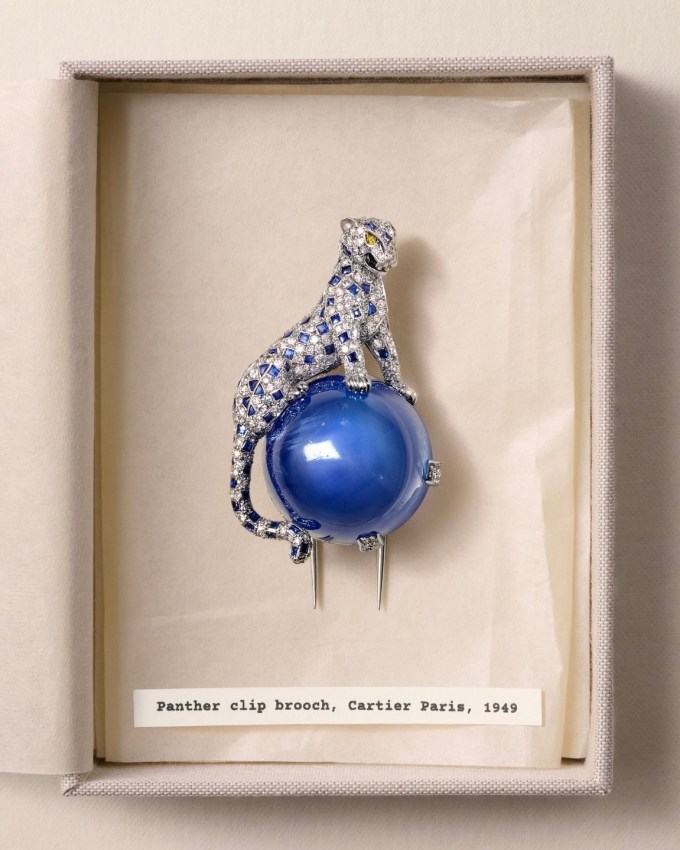
During the Nazi invasion of Paris in 1942, Cartier defiantly created a diamond caged bird motif as an emblem of resistance. The subversive brainchild of Cartier designer Pierre Lemarchand and Jeanne Toussaint, the bird represented France, trapped under German occupation.
Toussaint boldly displayed the pieces in Cartier shop windows. The daring act did not go unnoticed. It’s been said that, as a result, Toussaint was summoned and dragged in for questioning by the Gestapo.
A pendant iteration of the caged bird was made in 1944, shortly following the liberation. This version, crafted with natural diamonds, coral, sapphire, blue enamel, and lapis lazuli, is seen spreading its wings, flying free from its gilded cage. One of these models, dubbed the “Liberated Bird,” was even offered at the famed 2006 auction of Princess Margaret, Countess of Snowdon.
Mia Farrow Wore The Cartier Diamond Love Bird Brooch in The Great Gatsby

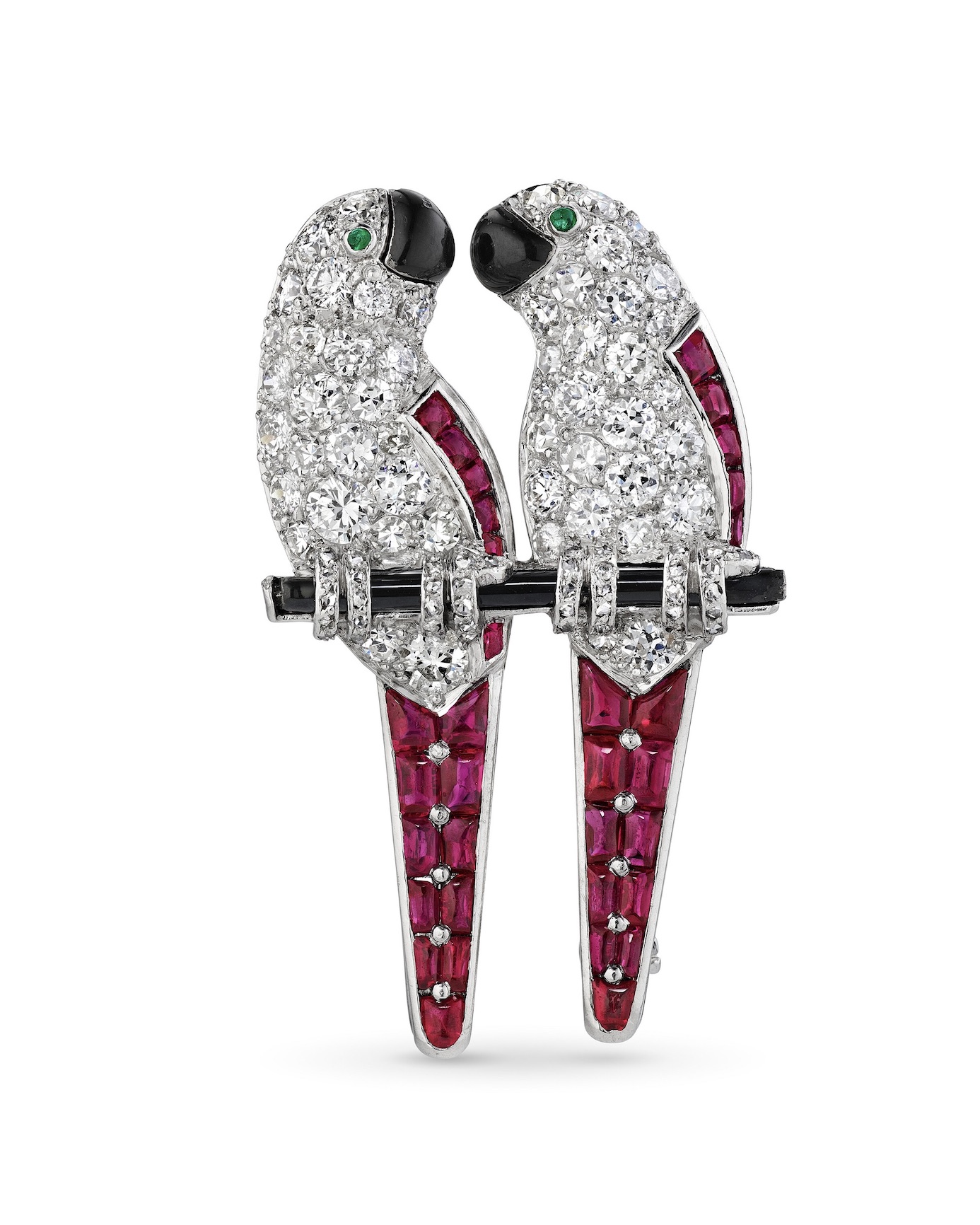
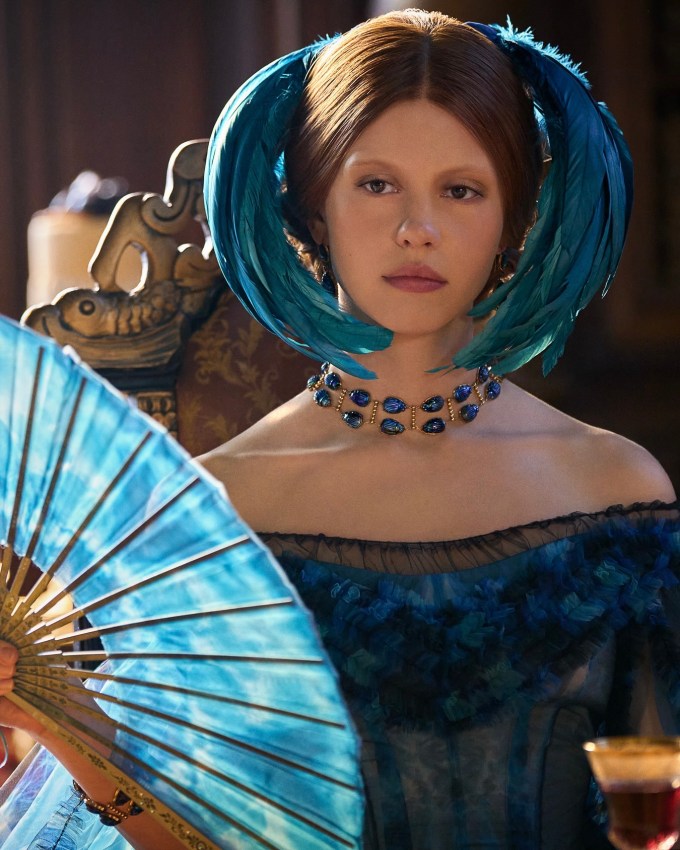
In the 1974 film adaptation of F. Scott Fitzgerald’s The Great Gatsby, Mia Farrow embodied the glittering Jazz Age as Daisy Buchanan, the wealthy socialite at the heart of the story. To capture the opulence of the Roaring Twenties, she was adorned in Cartier’s Art Deco creations, including Cartier’s 1928 Love Bird brooch, featuring two perched parrots crafted in rubies, round emerald cabochons, black enamel, with round, single, and rose-cut natural diamonds, set in platinum. Just two years after the movie’s release, Cartier celebrated its heritage with the Louis Cartier Retrospective exhibition in New York, where many of the jewels worn in the film were showcased.
The Verdura Swan Embodies the Elegance of Bird Jewelry
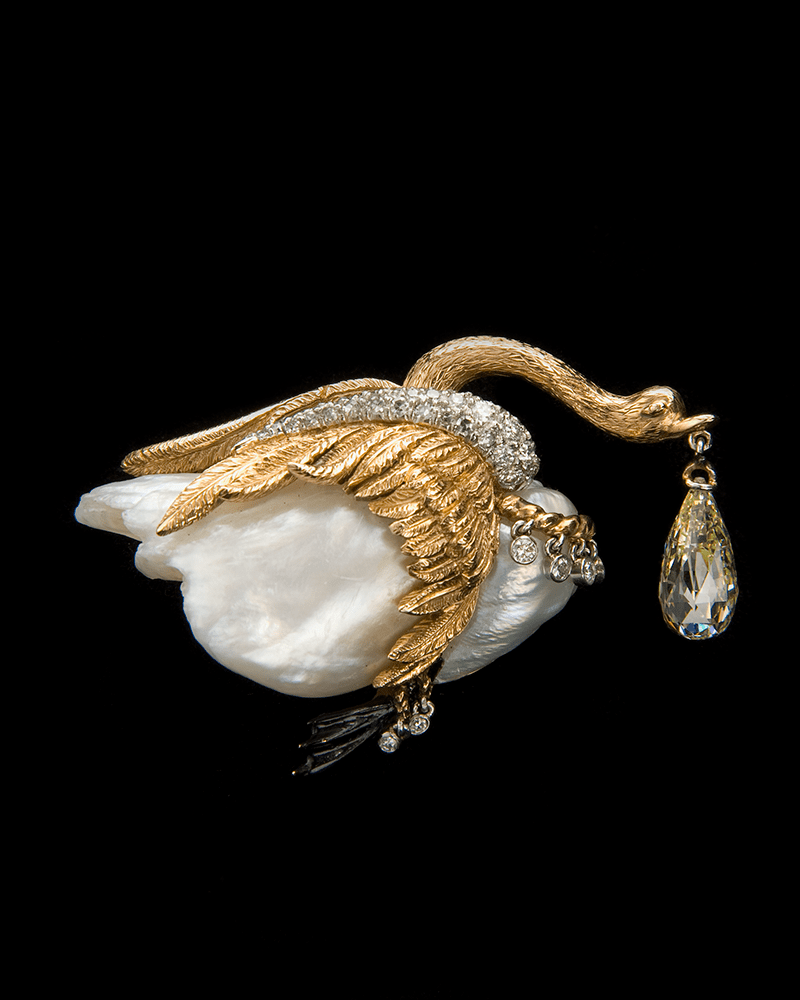

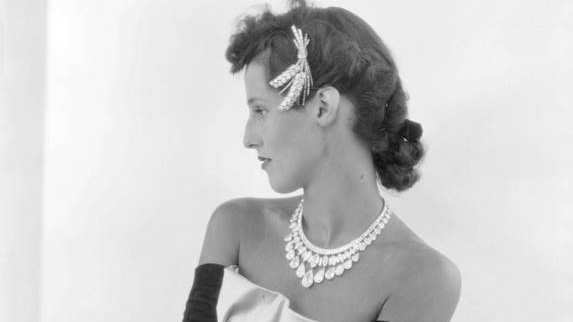
Bird jewelry was among Duke Fulco di Verdura’s most favored animal motifs, appearing throughout the designer’s oeuvre in both whimsical and elegant forms throughout the late 1940s. Worn by some of the era’s most stylish women—including Marella Agnelli, Gloria Guinness, and legendary tastemaker Babe Paley—the swans helped cement Verdura’s reputation for transforming nature into wearable art.
The brooches became tightly entwined with mid-century high society; they would later inspire Truman Capote’s famed Swans. A luminous baroque pearl forms the body, with pavé diamond wings, and a diamond collar, with a faceted diamond briolette suspended beneath its beak. Like much of Verdura’s work, the brooches drew upon the designer’s fascination with classical history and symbolism, referencing both Renaissance iconography and Greek mythology.

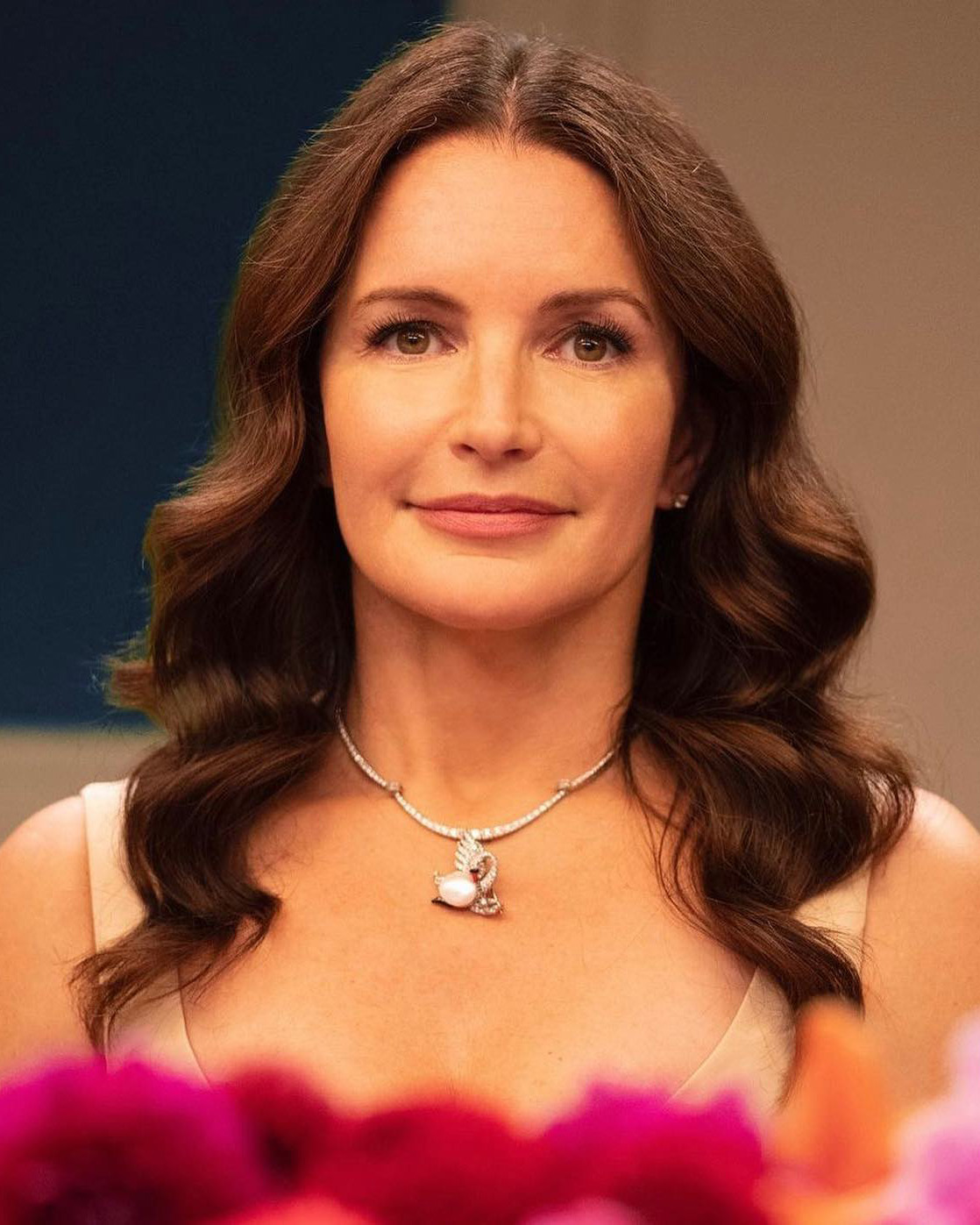
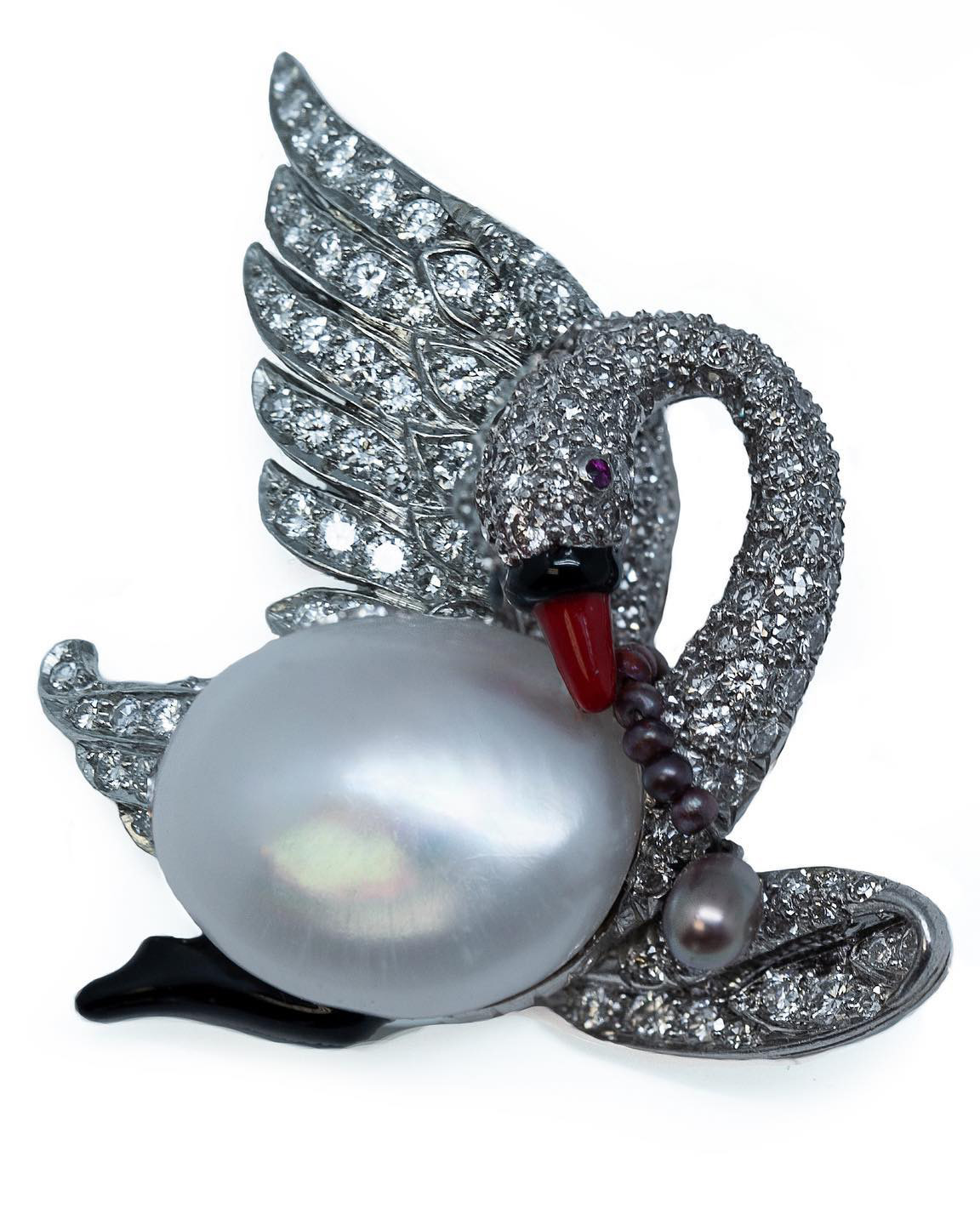
While portraying the ever-elegant Charlotte York in the Sex and the City reboot, And Just Like That, actress Kristen Davis wore a Verdura vintage swan brooch as a pendant to a dinner party. Crafted from natural pearl, diamonds, ruby, and red enamel and set in platinum, the jewel was designed in 1959.
Tiffany & Co.’s Bird on a Rock Became the World’s Most Famous Bird Jewelry
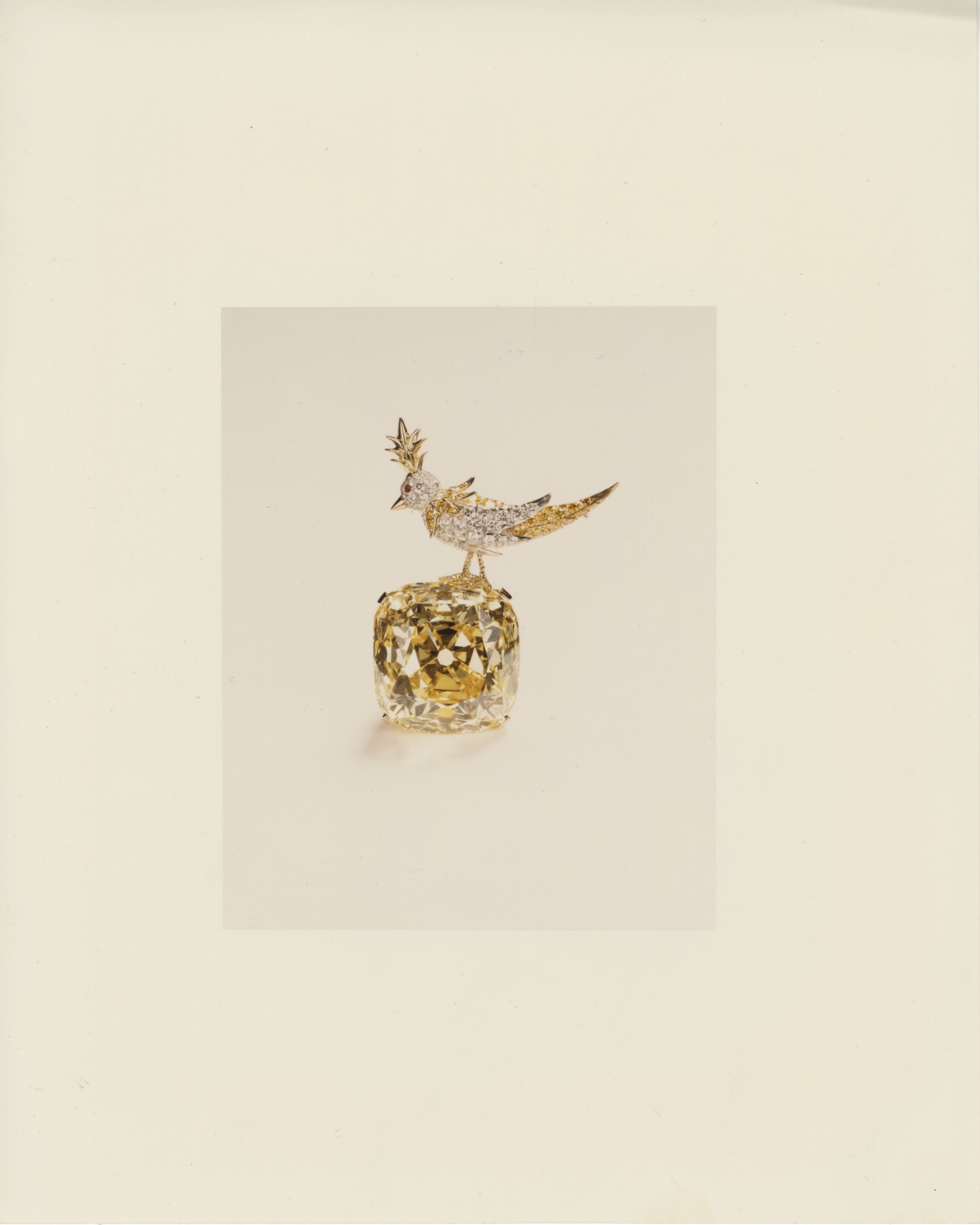
For nearly six decades, Tiffany’s Jean Schlumberger Bird on a Rock brooch has spread its diamond-embellished wings, perching on the lapels of Hollywood’s brightest stars. First sketched in 1965, the whimsical design has long since taken flight as one of Tiffany & Co.’s most iconic creations. You don’t need to be a bona fide birdwatcher, binoculars in tow, to have spotted the omnipresent brooch.
Inspiration sparked when Schlumberger encountered a yellow cockatoo outside of his home in Guadeloupe. He dreamt up a whimsical pavé diamond feathered creature with sapphires for eyes, daintily perched upon a large gemstone. His debut iteration included the signature diamond bird sitting on a large light brown topaz.
One of the first Bird on a Rock brooches was purchased by socialite and philanthropist Rachel “Bunny” Mellon. The canary and white diamond bird with an emerald eye stands atop a cabochon lapis lazuli stone. The Listerine fortune heiress accumulated about 142 Schlumberger jewels throughout her life, leaving it all to Virginia’s Museum of Fine Arts upon her death in 2014.


Bird on a Rock went on to be one of Tiffany & Co.’s most recognizable motifs to date, reaching new heights in 1995, when the Maison mounted its famed 128.54-carat yellow Tiffany Diamond onto the designer’s unique setting. The piece was revealed at the Musée des Arts Décoratifs Jean Schlumberger retrospective in Paris that year, gaining notoriety as it traveled the world on exhibition.
With its sparkling natural diamonds and playful silhouette, the Bird on a Rock remains a beloved icon—one that honors its storied past while effortlessly keeping pace with the present.
Tiffany & Co.’s Paradise Bird Reimagines Bird Jewelry for Today
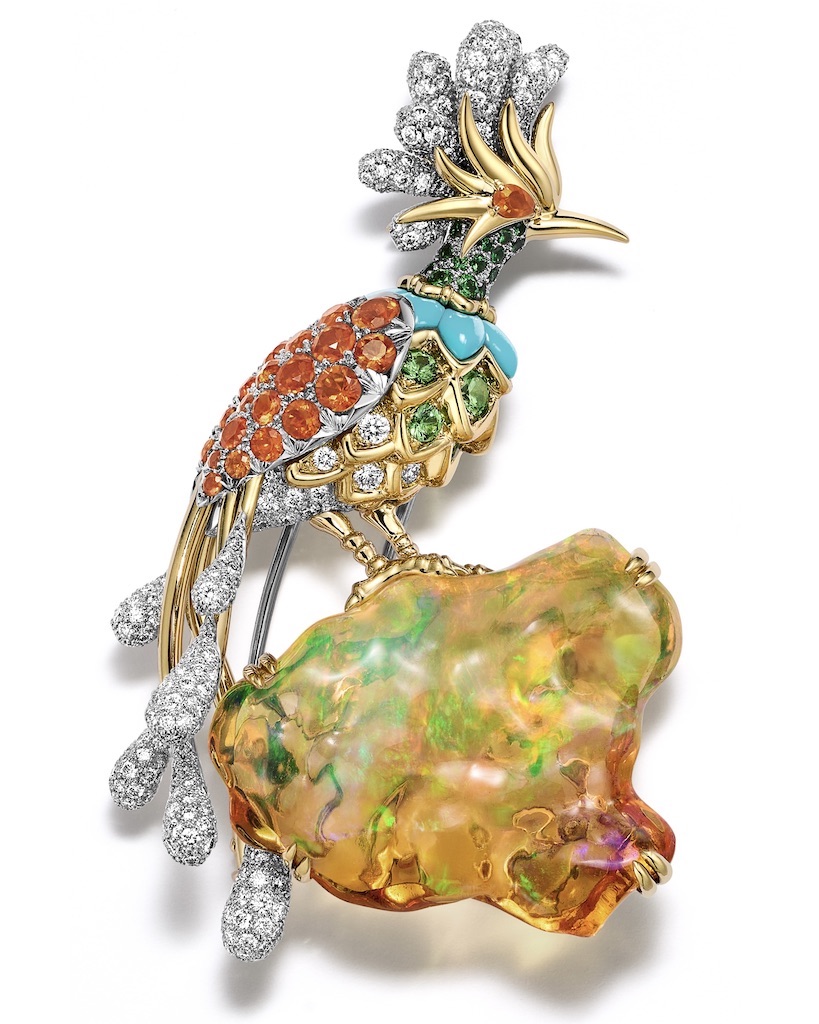
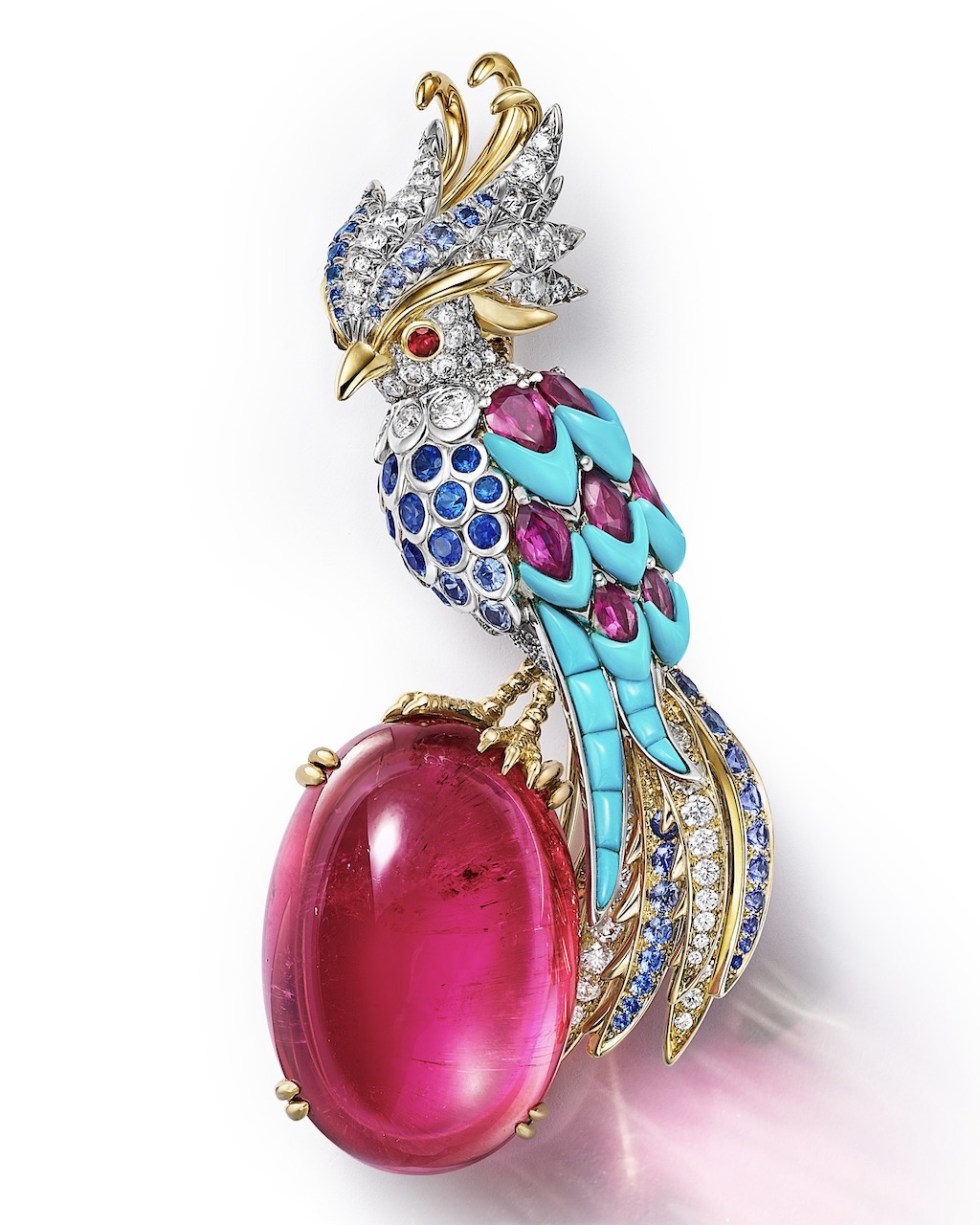

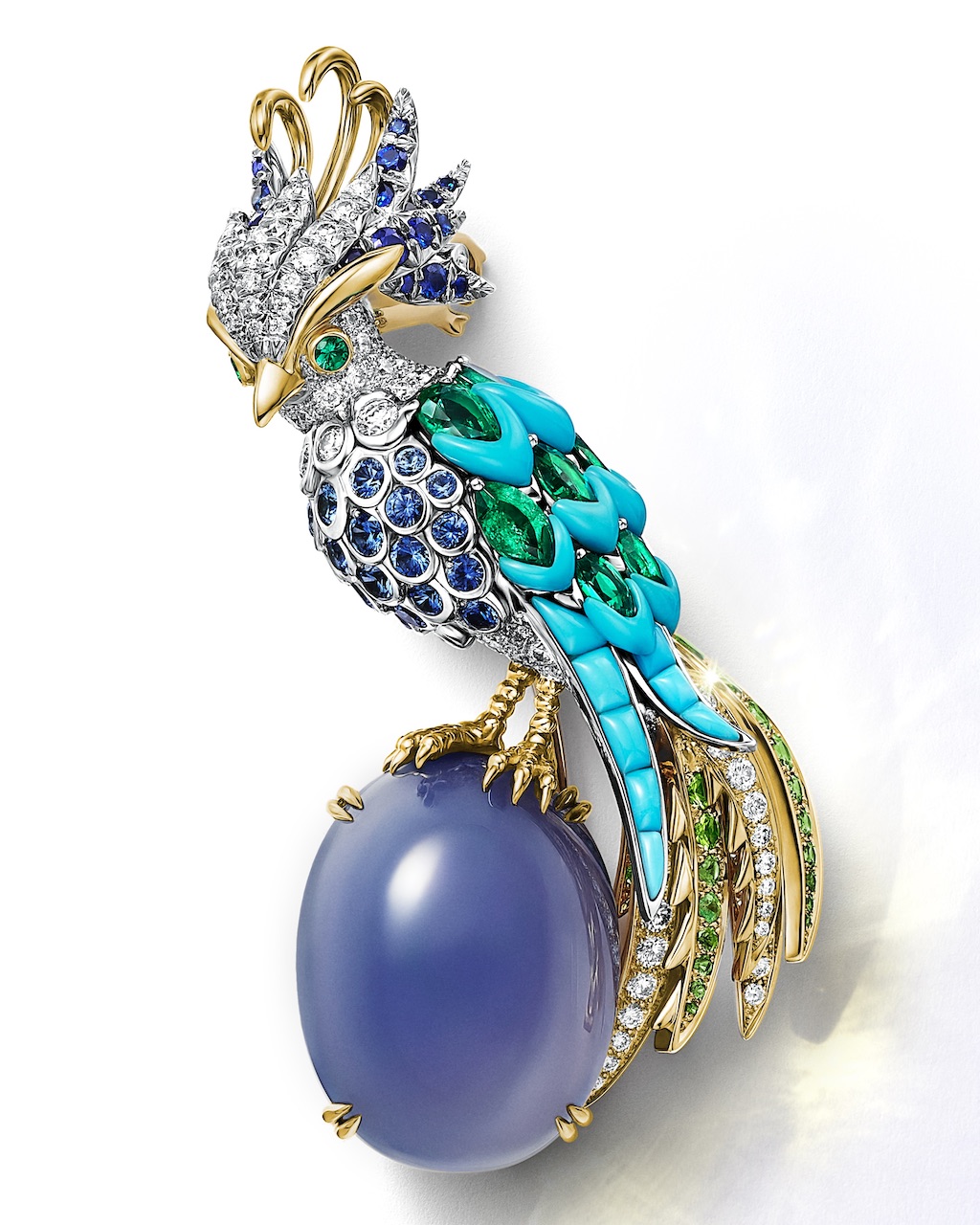
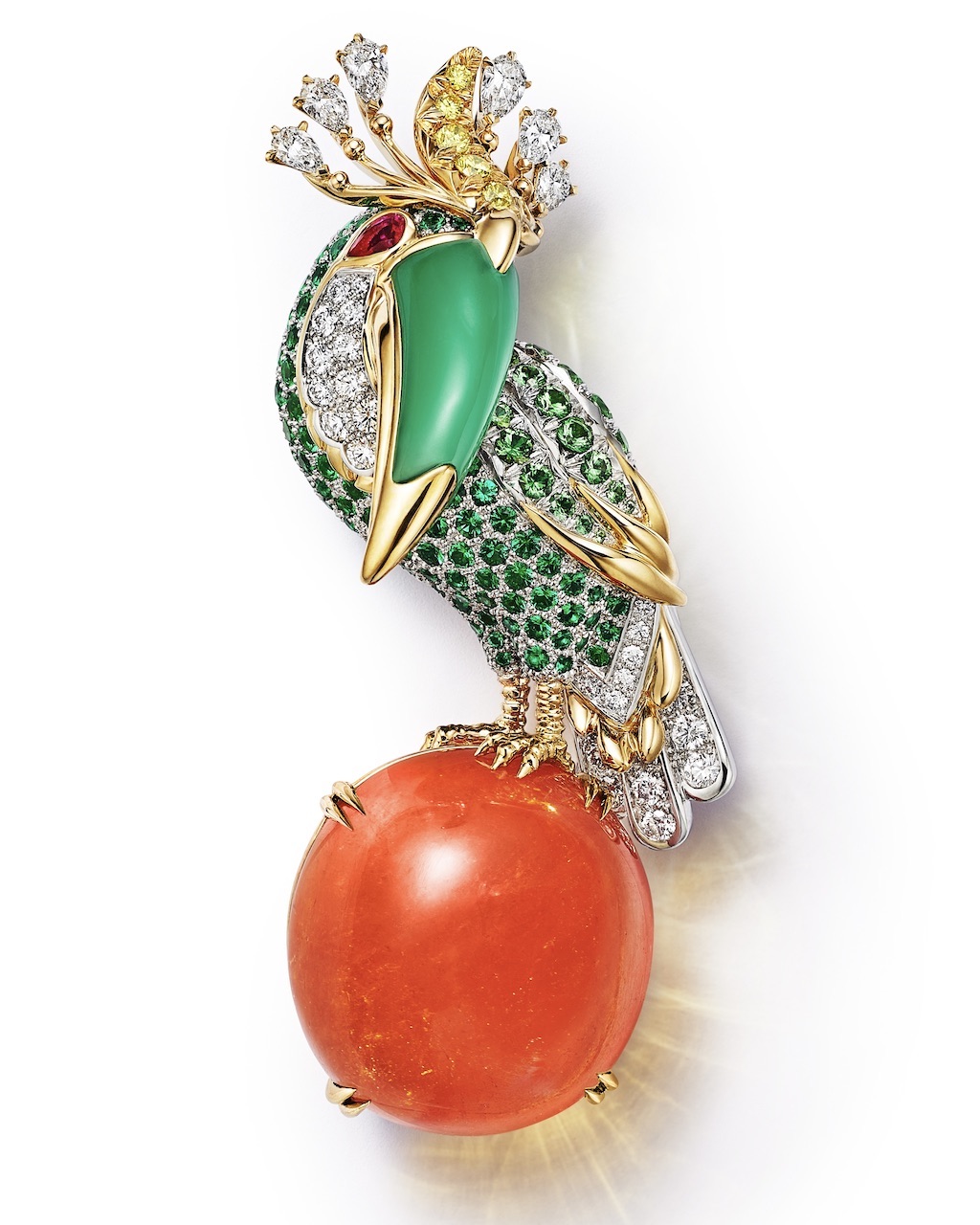
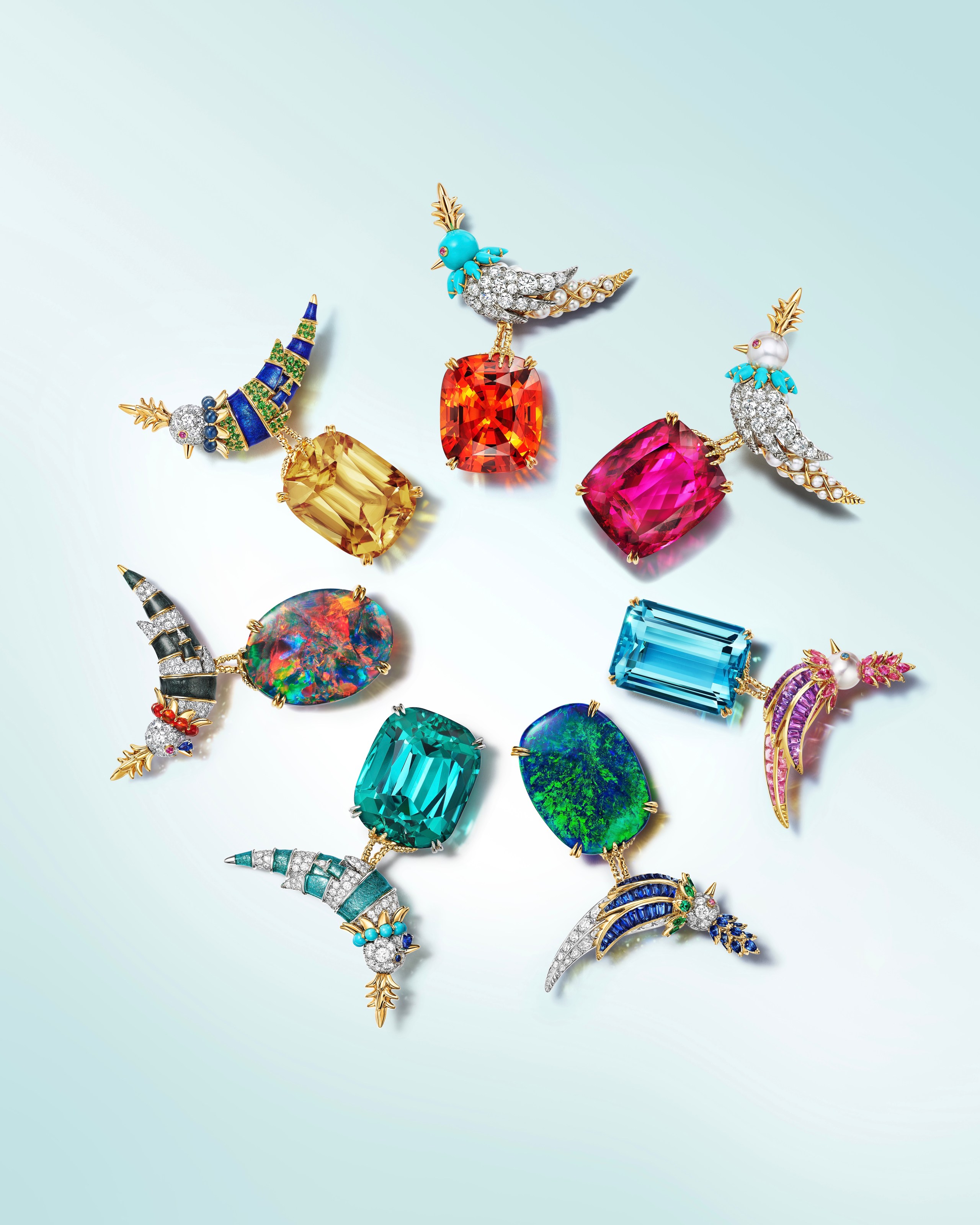
In the Tiffany & Co. Blue Book 2026: Hidden Garden collection, the Paradise Bird continues the avian theme, reimagining and breathing new life into the classic Bird on a Rock motif through an array of fantastical brooches, celebrating the brightest of colors and exotic silhouettes.
Imaginative diamond birds find themselves perched atop vibrant, captivating gemstones, like Mexican fire opal, Australian boulder opals and chrysoprase, Brazilian rubellite, Ethiopian blue, and Namibian purple chalcedony, Madagascan and Nigerian spessartine, or even American chrysocolla.
Diamond-encrusted, fanciful feathers unfold with resplendent arrangements of richly hued gemstones to complement their center stone. Some brooches can even transform into a pendant to experience the full versatility the Paradise Bird has to offer.
These glistening, feathered creatures are the embodiment of creative freedom and wanderlust. With a myriad of new, vivid beaks, their wings bear emeralds, turquoise, tourmalines, paillonné enamel, and, of course, natural diamonds to bring each bird to life.
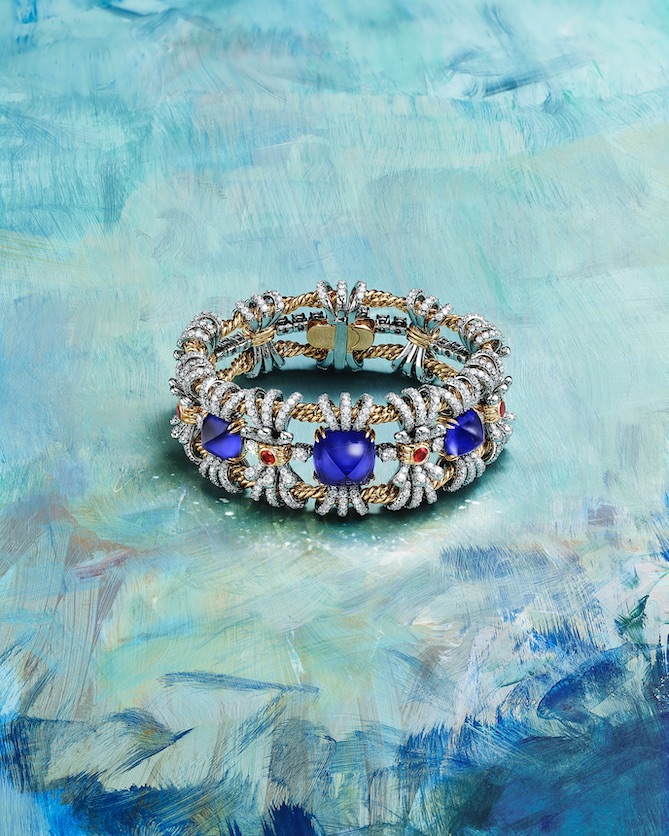
Tiffany & Co.’s Annual One-of-a-Kind Legendary Bird: The Sapphire Edition
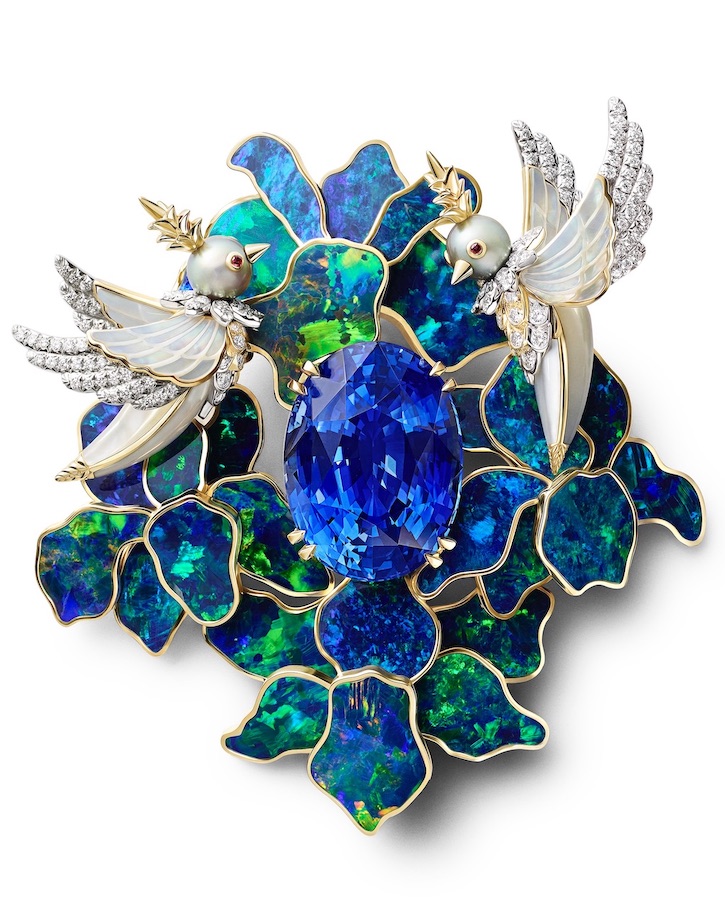
This week, Tiffany & Co. debuted the release of the Legendary Bird: The Sapphire Edition. Rooted in tradition, Tiffany & Co. releases a one-of-a-kind creation each year. The jewelry house introduces a single bespoke high jewelry masterpiece in the form of a Legendary Bird design to illustrate the enduring legacy of the Bird on a Rock.
Through Tiffany’s quintessential master craftsmanship, the jewel was brought to life by Nathalie Verdeille, Senior Vice President – Chief Artistic Officer of Tiffany & Co., alongside the Tiffany Design Studio through the unexpected harmony of orchid motif black opal doublets, pearls, mother-of-pearl, rubies, natural diamonds, and a 34.48-carat oval unenhanced sapphire from Madagascar, crafted in 18-karat yellow gold and platinum.
Inspired by the favrile glass Tiffany lamps of the turn of the 20th century, the birds’ feathers are delicately adorned with natural diamonds and mother-of-pearl inlays for a lifelike contrast.
“With this piece, I wanted to evoke a nature in perpetual renewal, shaped by micro-movements and subtle, nuanced details that reveal themselves only to those who take the time to truly observe it,” Nathalie Verdeille, Tiffany & Co.’s Senior Vice President – Chief Artistic Officer of Jewelry and High Jewelry, said in a press release. “The birds hover above an expanding floral composition, somewhere between crocus and orchid. They evoke hummingbirds, the smallest of birds, drawn toward the sapphire pistil at the heart of the flower.”
Bird Jewelry Continues to Inspire the World’s Great Jewelers
Van Cleef & Arpels
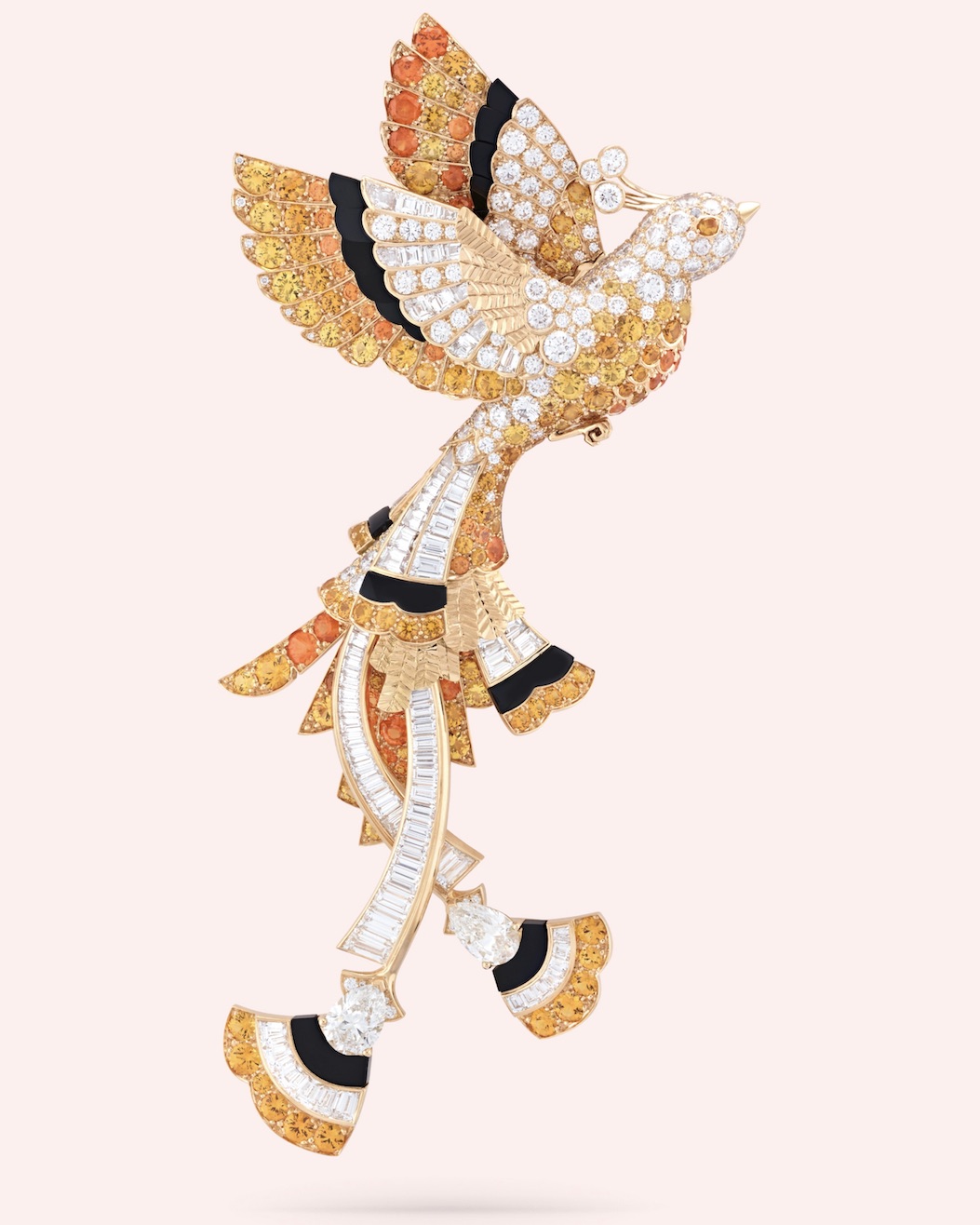
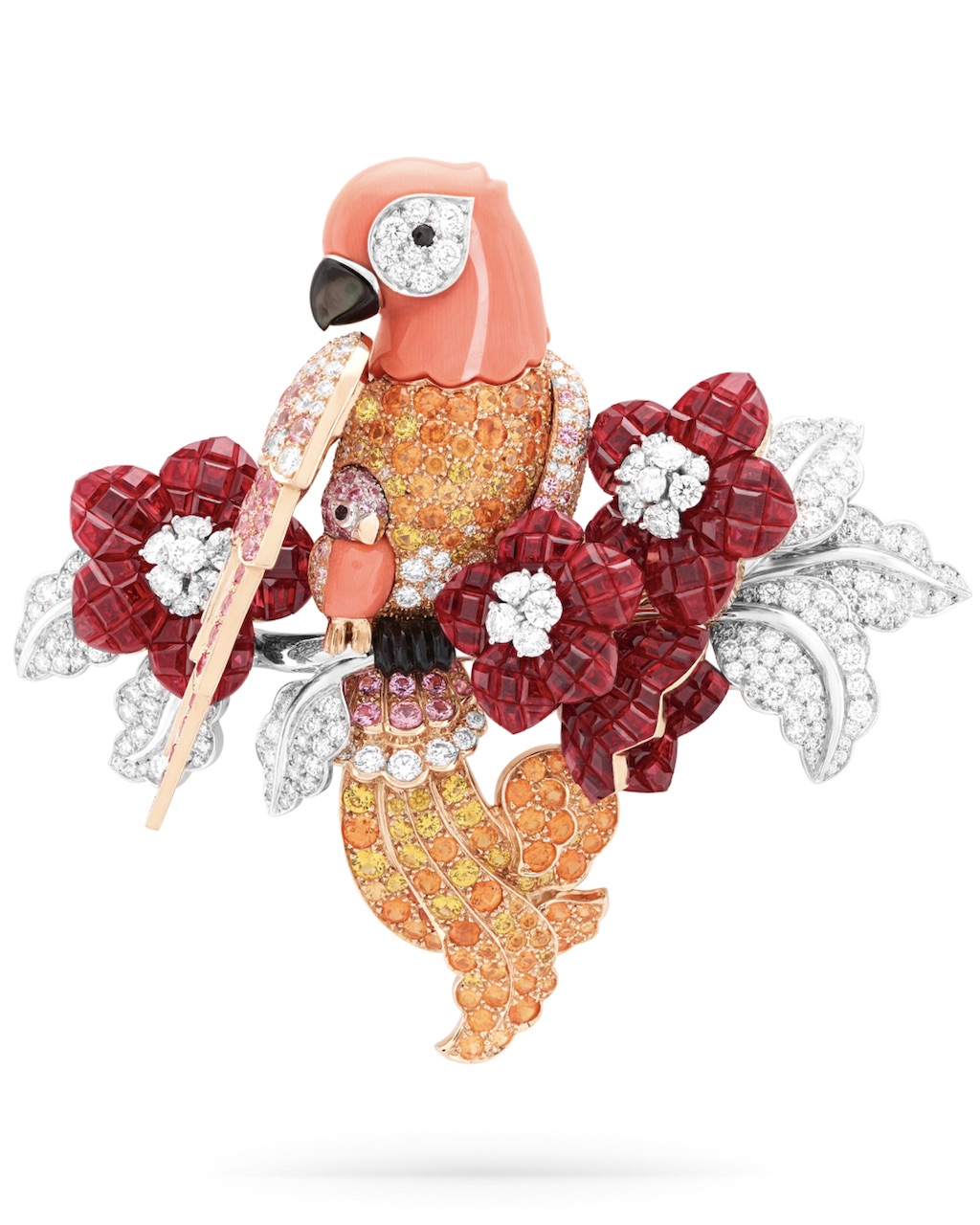
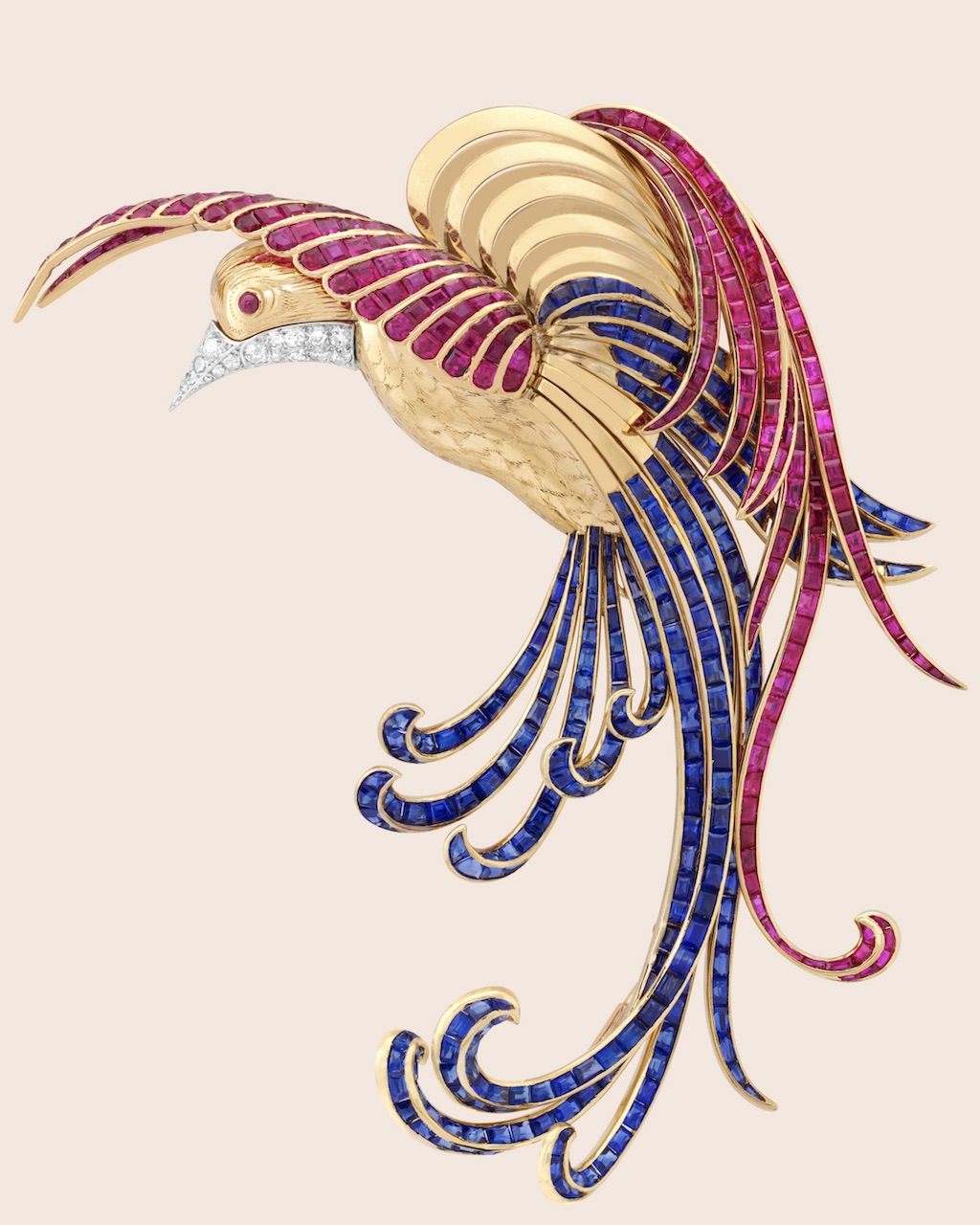
Imaginative and dreamy, Van Cleef & Arpels’ designers know how to stop time itself by capturing nature’s most delicate moments of grace. Les Inséparables, a famous clip from 1945, is an enduring symbol of the brand’s emotional style. Featuring conjoined twin diamond birds on a yellow gold branch, the piece shows how love is about looking in the same direction. Elongated by these shiny swirls, the delicate bodies of the two birds evoke a fantastic choreography.
The brand has always designed with nature’s poetic, ever-changing rhythms in mind. The diamond setting of these curved lines are challenging and incredibly three-dimensional with a remarkable result. Dancing to the rhythm of the summer skies, they are a modern iteration of Van Cleef & Arpels’s recurring theme of ballerinas.
As the fable goes, an enigmatic golden bird steals one of the king’s golden apples from its branch every night. The bird is wily and quick, and so each detail is designed to outsmart those who try to capture the Oiseau d’Or, epitomizing summer’s zest for life at its most poetic.
Boucheron

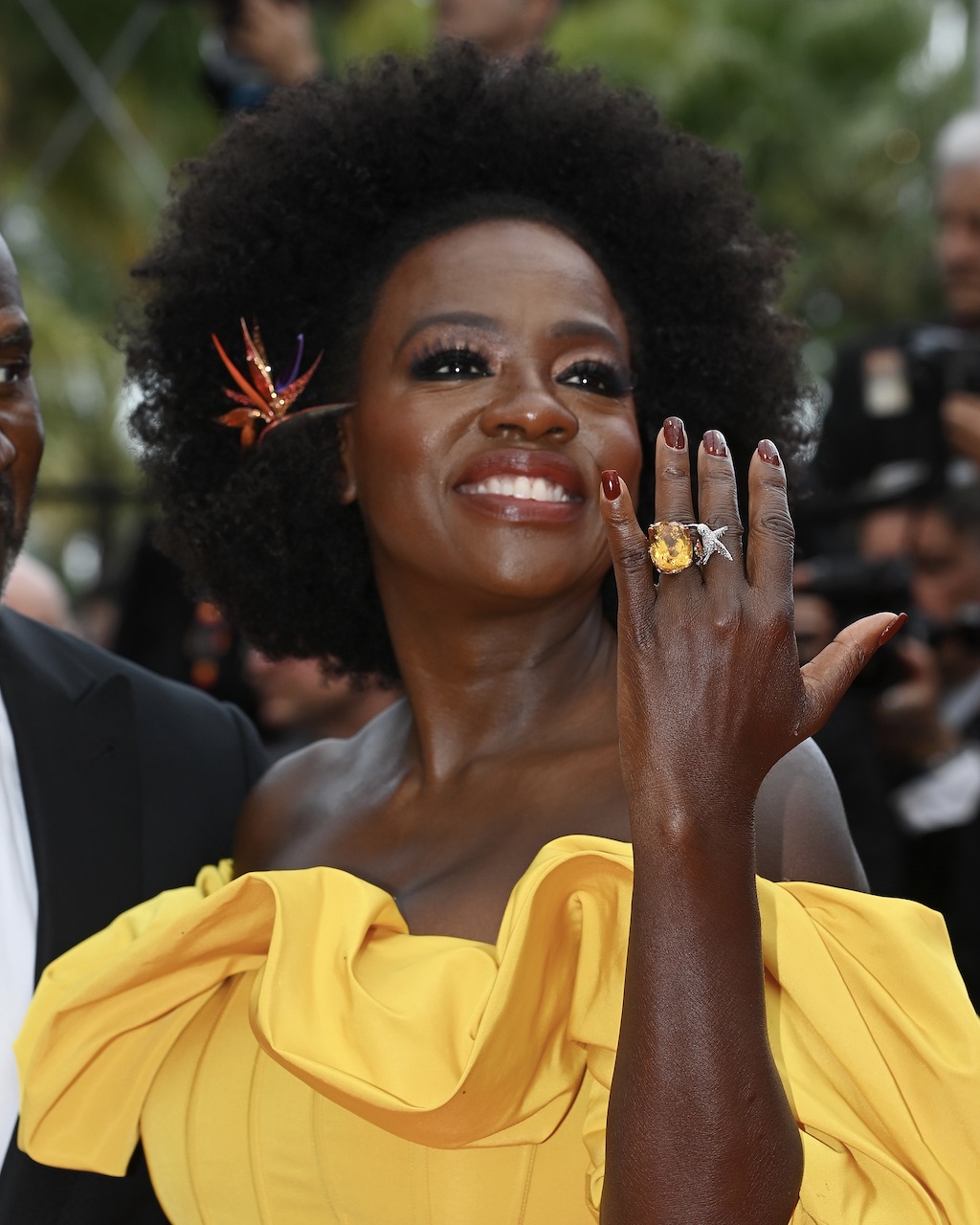
Symbolizing freedom and levity, the hummingbird, the world’s smallest bird, comes to life in diamonds and gemstones, thanks to the expert hands of Boucheron craftsmen.
Viola Davis proudly flashed her Boucheron Hopi the hummingbird ring at the 2022 Cannes Film Festival, featuring a pavé diamond hummingbird, kissing a 35-carat yellow beryl that perfectly matched her sunshine yellow gown.
Jennifer Lopez made an appearance in a petal pink custom Nicole + Felicia couture gown at the 2024 Golden Globe Awards, and dubbed it “hummingbird season” with the impending release of her ninth studio album, This Is Me… Now. In celebration, the star came clad in Boucheron Hopi the hummingbird earrings, set with a morganite stone, sapphires, and, of course, natural diamonds. J.Lo also wore the jeweler’s diamond Plume de Paon bracelet and the Hopi the hummingbird ring set.
Before dropping her single, “Can’t Get Enough,” Lopez teased some hints about her project on the red carpet with her Boucheron Hopi, the Hummingbird diamond jewelry suit. “My earrings have hummingbirds – it’s hummingbird season,” she told Extra. “As you will see, these are little Easter eggs from my project; you will know what they mean when you see the film.”
The star previously shared in her newsletter, On the JLo, “To me, hummingbirds are messengers of love.” She said, “They’re very agile – can fly forward, backward, and up and down. They’re also the fastest bird, but they always have time to stop, eat something sweet, and smell the roses.”
Elaine Fattal
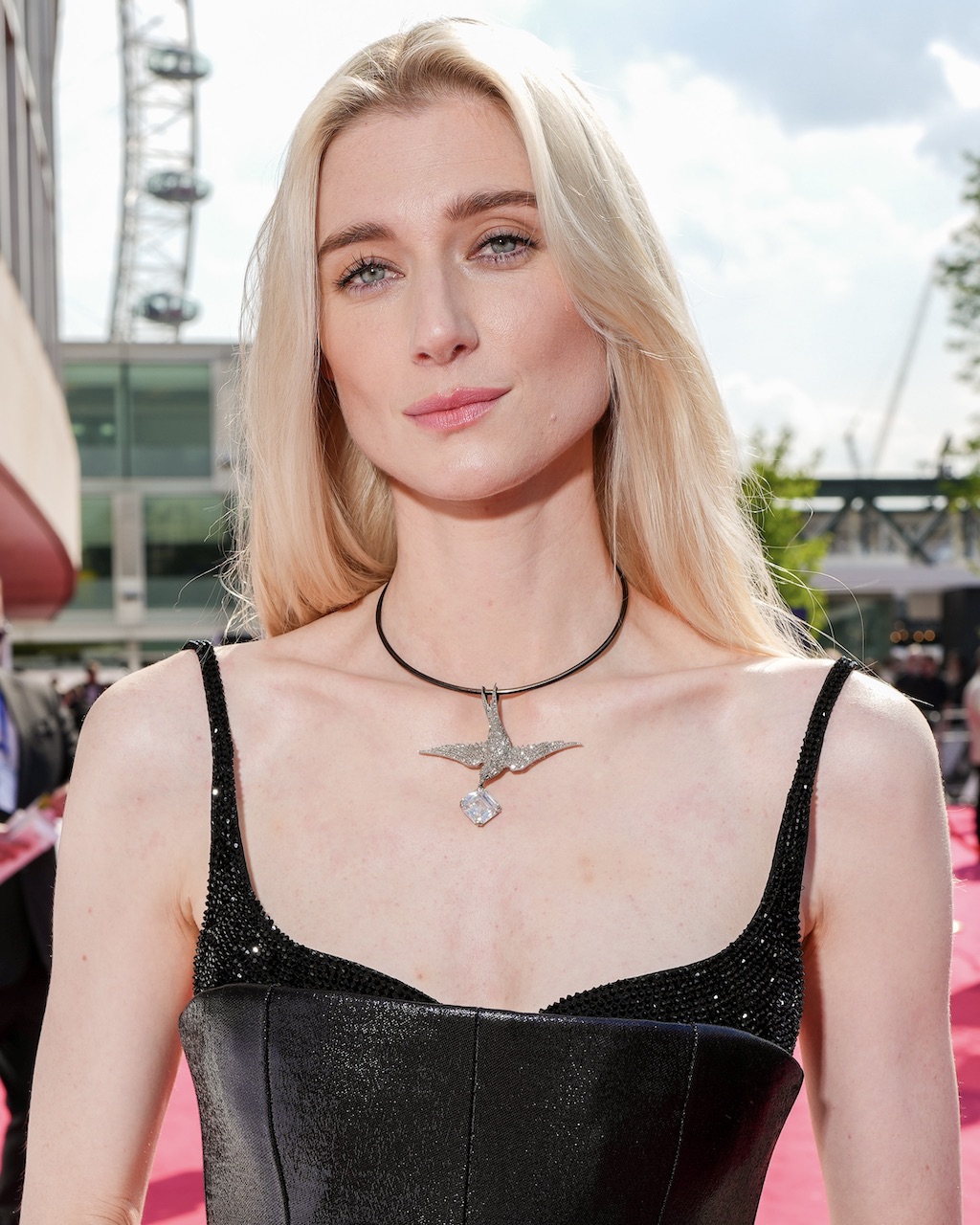
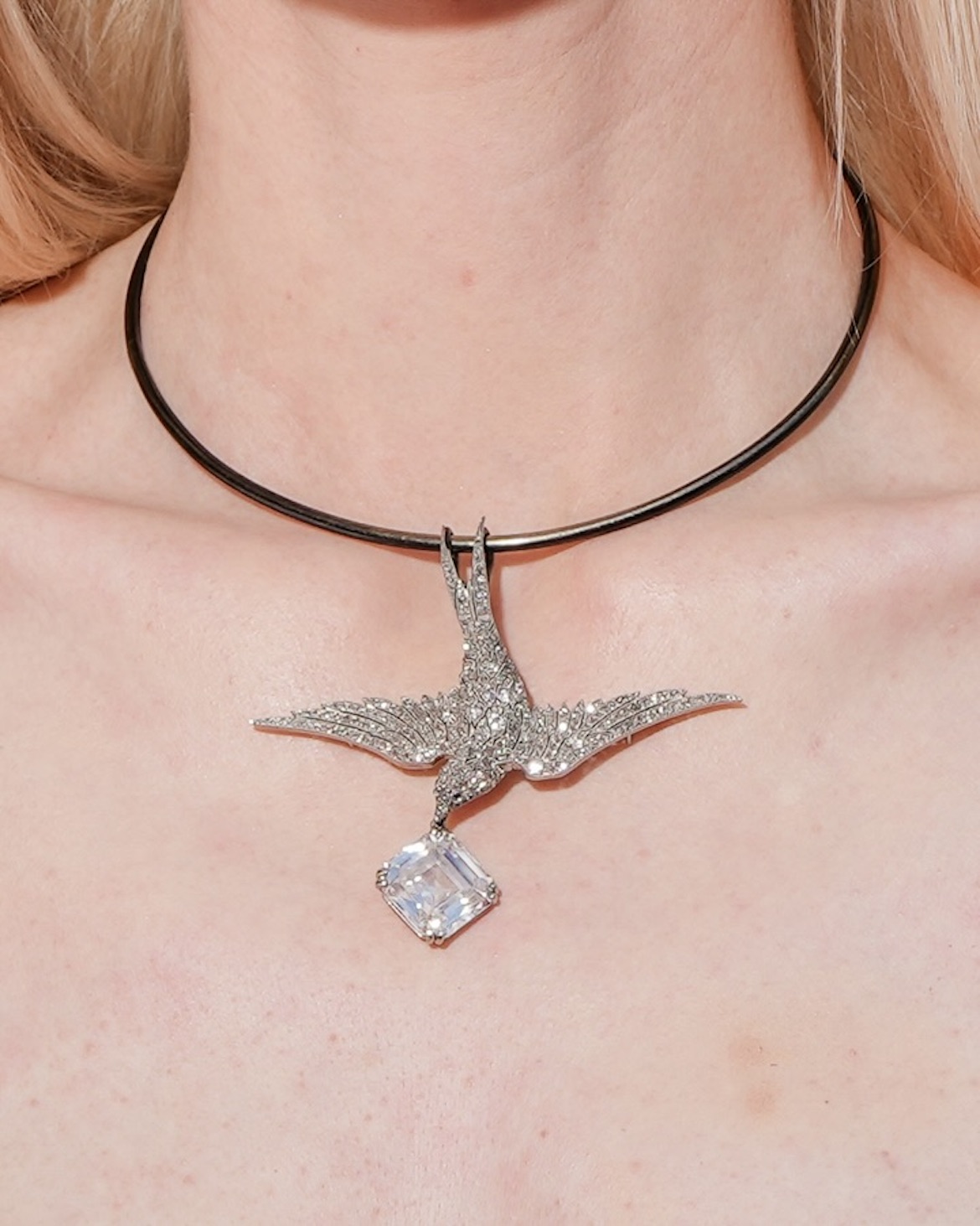
The Crown actress Elizabeth Debicki walked the red carpet at the 2024 BAFTA Television Awards, wearing a 19th-century diamond Flying Swallow necklace with a 20.01-carat diamond clasped in its beak from Eliane Fattal. The diamond and platinum stylized swallow is thread set for its feather pattern, mounted on a blackened white gold torque, with an onyx and diamond clasp. Representing a harbinger of hope and springtime, the swooping swallow symbolizes good fortune.
Graff
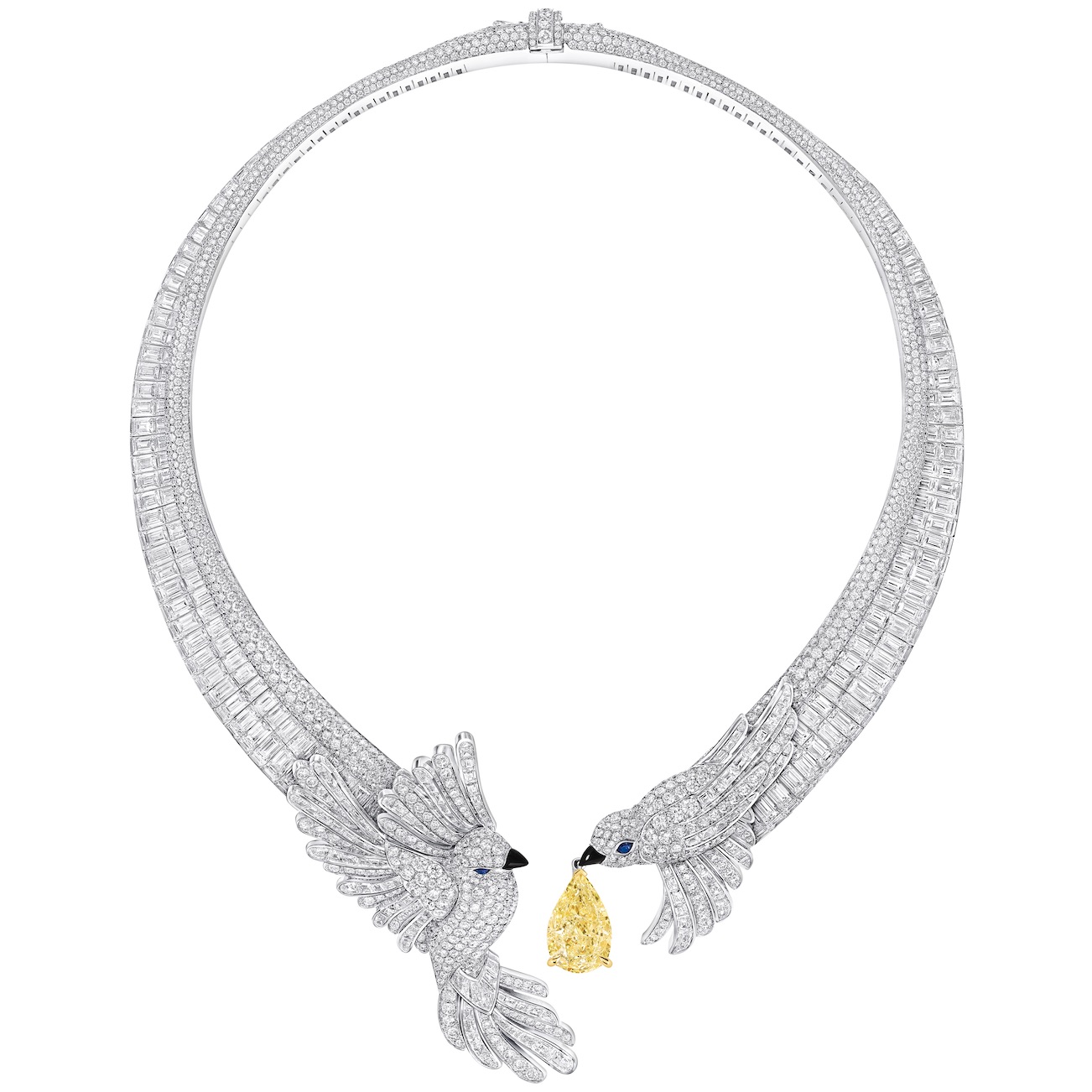
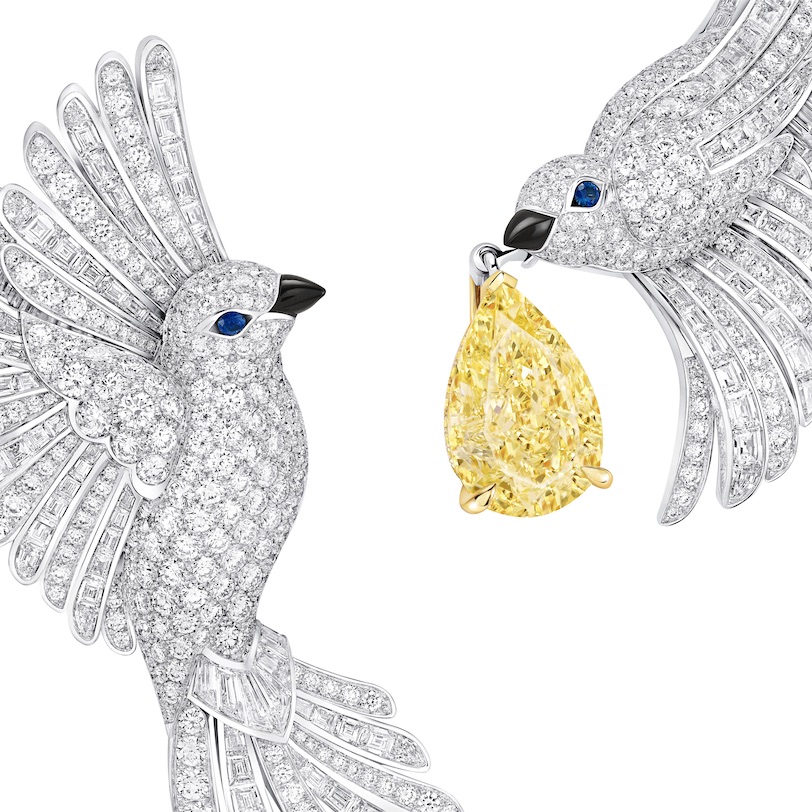
At Graff, the inspiration is naturalistic, and the style is figurative. Design aspires to honor the beauty and grace of nature. The brand has developed an impressive collection of diamond bird clips over the years. “They capture the wonder of nature perfectly,” says Anne-Eva Geffroy, Design Director at Graff.
Among them, the Graff Gift of Love necklace, which debuted during Paris Haute Couture Week 2025, is a work of art, featuring two diamond sparrows meeting in the middle, each reaching towards a 13.51-carat Fancy Intense yellow pear-shaped diamond in a yellow gold mount. Three years in the making, the jewel took over 6,000 hours to create.
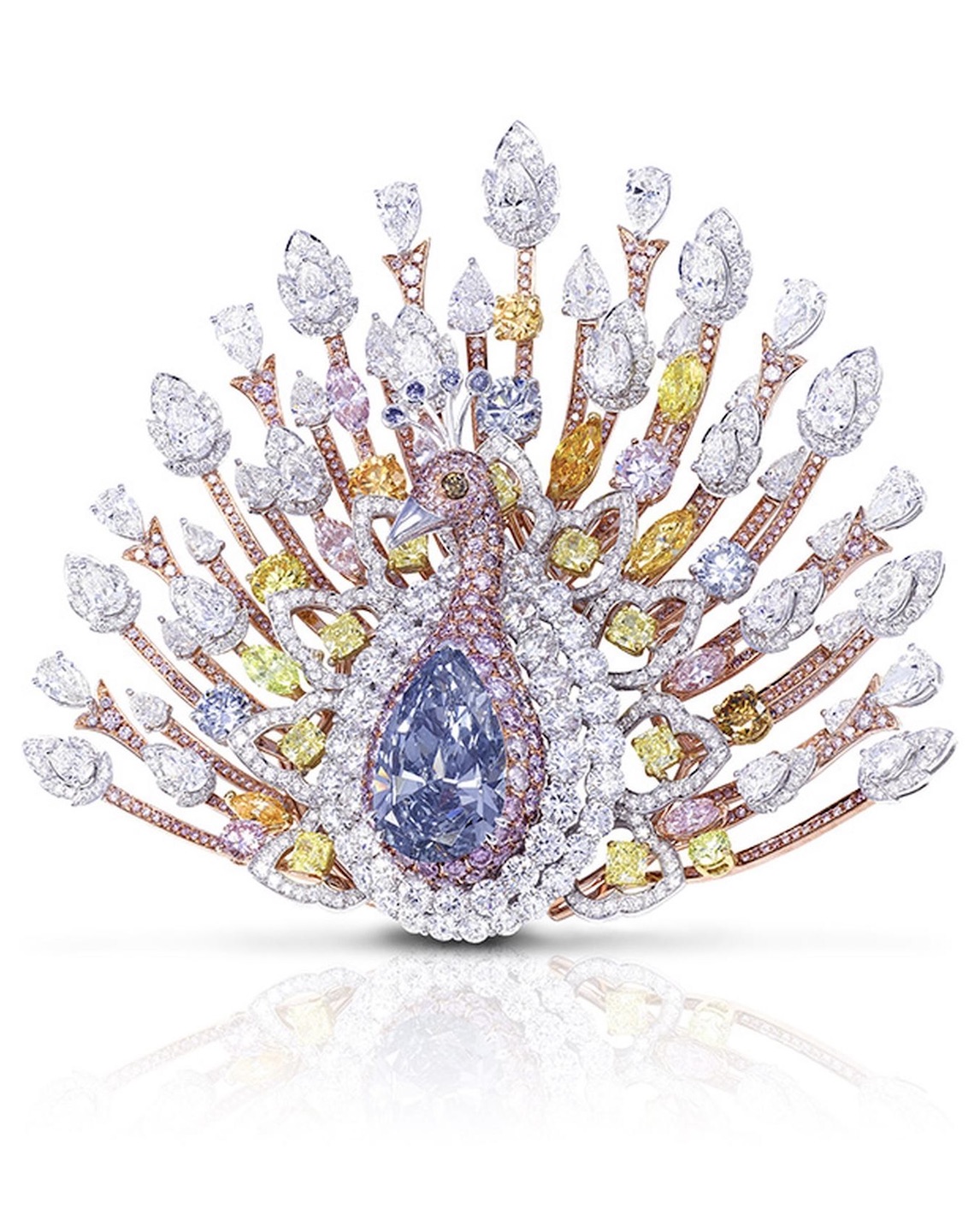
In 2013, Graff Diamonds unveiled one of the most valuable brooches in the world at Maastricht’s TEFAF fair. The $100 million diamond peacock features a 20.02-carat pear-shaped Fancy Deep Blue diamond at the heart of the bird.
Fanning out from this stellar blue diamond body is a myriad of white, pink, yellow, orange, and green diamonds. Should you wish to forego the feathers, the blue diamond centerpiece is detachable and able to be worn separately. 1,305 natural diamonds adorn this majestic piece of bird jewelry, including highly valuable colored diamonds, for a total of 120.81 carats.
Get the Newsletter
Sign up for the latest diamond news, delivered directly to your inbox.