

Famous Diamonds That Vanished Without a Trace
Some diamonds become icons. Others disappear. Inside the wild stories of the world’s most famous lost stones.
What makes a diamond legendary? Is it the carat size, clarity, color grade, or cut – or is it the human stories behind it? Formed deep within the earth billions of years ago, diamonds are witnesses to history—enduring the rise and fall of empires and passing through countless hands along the way. It’s no wonder the scintillating mysteries of lost diamonds continue to captivate us.
“Jewels survive to tell histories when the people who wore them do not,” says Carol Woolton, author, curator, and podcaster of If Jewels Could Talk. “A stone can survive for centuries while the people who owned it, the fortunes that paid for it, and the courts in which it glittered disappear.”
Vanishing into thin air, stolen and resurfaced, recut under a new identity, or discovered sitting safely in a vault after years of speculation, some diamonds have thrilling stories to tell. From the stolen eye of an Indian deity to the missing jewels of the Romanovs and stones lost in the chaos of the French Revolution, the world’s most famous missing diamonds have inspired fascinating lore—even when they eventually reappear.
Meet the Experts
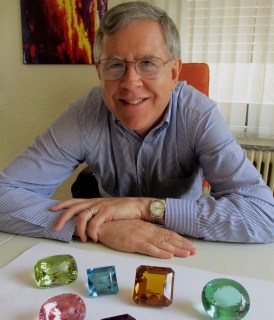
Mineralogist and the Smithsonian’s former Curator-in-Charge of Gems and Minerals, Dr. Jeffrey E. Post‘s areas of research include mineralogy, gemology, and geochemistry. He has published more than 150 scientific articles in these fields. He is the author of The National Gem Collection and the recently published: The Smithsonian National Gem Collection—Unearthed: Surprising Stories Behind the Jewels.

Carol Woolton is an author, broadcaster, and jewelry historian. As the founder and host of the podcast If Jewels Could Talk, she released her latest book of the same name in 2024. Woolton was Jewelry Editor at British Vogue for over 20 years and remains the magazine’s Contributing Jewelry Director. She is credited with initiating the role of Jewelry Editor at Tatler and Vogue magazines. She’s written for publications like Vanity Fair, Air Mail, The Financial Times, and more.
As Woolton sees it, “When a famous diamond vanishes, it leaves an irresistible mystery: has it been hidden, stolen, recut, or simply passed into private hands? Its reappearance offers the tantalising possibility of recovering a piece of that lost world.”
Take the Florentine Diamond that made headlines last year when it was revealed that, after a century of mystery, it had been sitting safely in a Canadian bank vault all along.“It’s always exciting when something like this happens because it reminds you why these diamonds actually have value beyond just the carbon in them and the stone itself. It’s because of the stories – the history they carry with them,” says Mineralogist Dr. Jeffrey E. Post, who served as the Smithsonian’s Curator-in-Charge of the U.S. National Gem and Mineral Collection from 1991 to 2023. He adds, “There’s a specific intrigue that comes with a lot of these legendary stones. People are very invested in their journeys.”
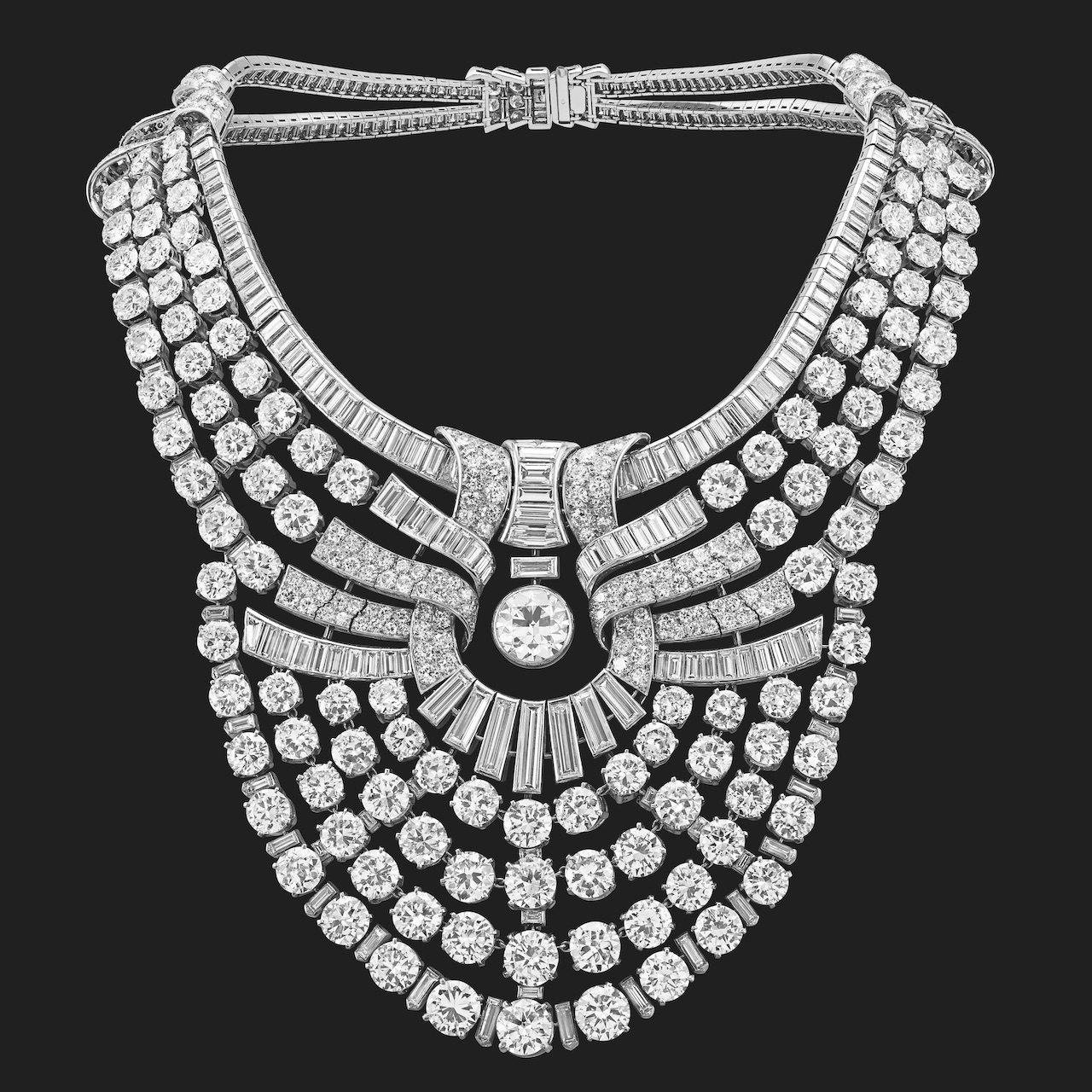
After last year’s bombshell theft of the French Crown Jewels at the Louvre, yet another shocking heist has taken place in Vienna. Last week, an international manhunt was launched for two men who stole a historical Van Cleef & Arpels diamond necklace once owned by Queen Nazli of Egypt.
Woolton says, “We become invested because these are human stories held in something extraordinarily enduring. The same diamond may have been a token of love, a declaration of power, the spoils of conquest, or the means of escape. The stories contain romance or drama, and a jewel’s proximity to people gives it emotional force.”
From diamonds that vanished and resurfaced to stones that were recut, renamed, or never seen again, these are the wildest stories behind some of history’s most famous lost diamonds.
The Florentine Diamond Was “Lost” for 100 Years
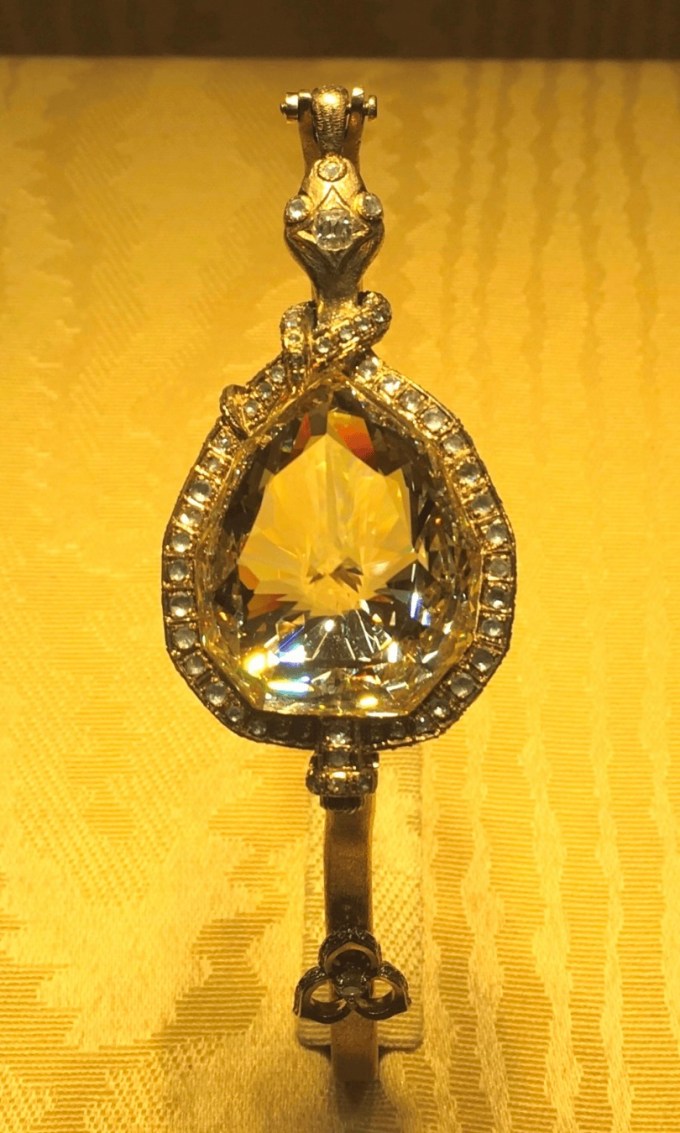
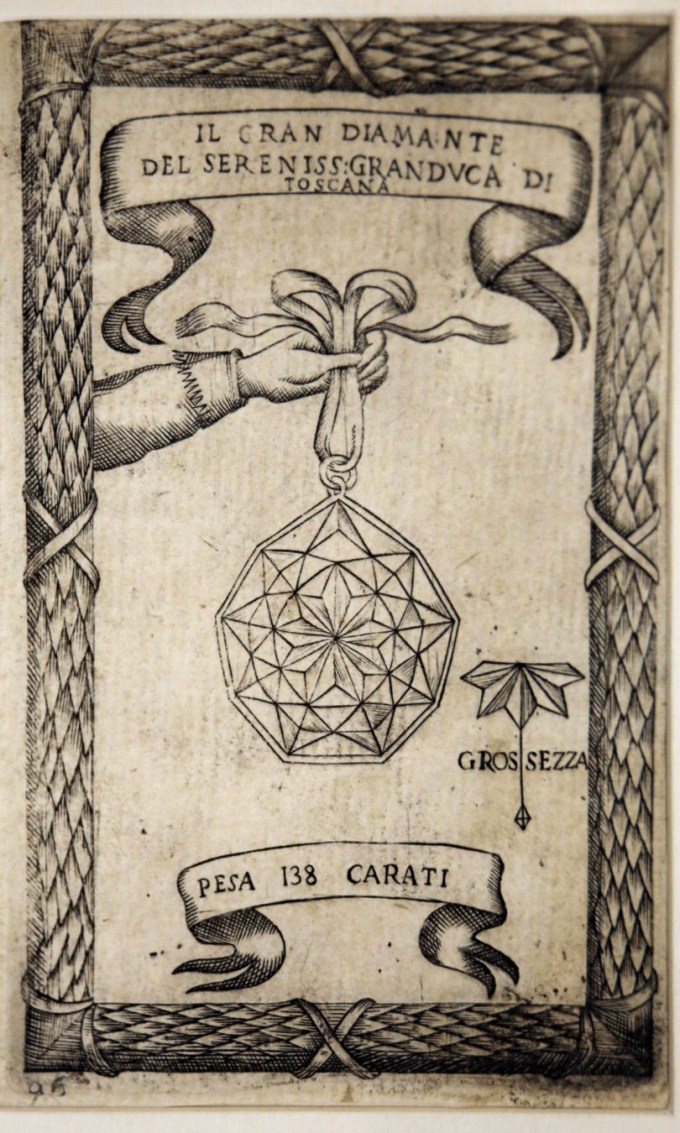
After vanishing for a century, the legendary Florentine Diamond resurfaced in a Canadian bank vault in November 2025, ending one of the greatest mysteries in gem history. For a hundred years, the Florentine Diamond’s fate was the subject of mystery, with whispers questioning whether the diamond had been stolen, recut, or simply hidden away.
The pale yellow irregular nine-sided double-rose-cut 137.27-carat natural diamond has captured attention since the 15th-century. Discovered in India’s Golconda region, the Florentine Diamond soon became a prized possession of the European courts. In 1657, French jeweler and explorer Jean Baptiste Tavernier saw it among the treasures of Ferdinando II de’ Medici, Grand Duke of Tuscany.
Upon the death of the last of the Medici line, the diamond was given to the Habsburg family and integrated into the Habsburg crown jewels. The Florentine Diamond found a home in the Hofburg Palace in Vienna, adorning the crown of Francis Stephen of Lorraine when he was crowned Holy Roman Emperor in 1745.
In 1918, as World War I neared its end, Emperor Charles I of Austria-Hungary feared that the end of the empire was coming. With revolution and confiscation on the horizon, he covertly arranged for the royal jewels to be moved to Switzerland for safekeeping. It was then that rumors began to swirl regarding the whereabouts of the Florentine Diamond. Those questions would circulate for decades.
Roughly 107 years later, The New York Times would release bombshell information, finally revealing where the Florentine Diamond had been all this time. In November 2025, the outlet reported that the legendary natural diamond, once thought to be lost forever, was safely locked inside a Canadian bank vault for nearly a century.
As it turns out, the diamond never left the family’s possession. According to The New York Times, Empress Zita, the widow of Emperor Charles, fled Belgium during the rise of fascism and the onset of World War II, escaping to the United States in 1940. With her eight children in tow, Zita carried the family’s most precious heirlooms, including the Florentine Diamond, tucked inside a small cardboard suitcase.
Once the family settled in Canada, Zita secured the jewels, including the Florentine Diamond, in a local bank vault, ensuring their safety for generations, only ever telling two of her sons where the diamonds were stored. They then passed on the information to their own children when the time came, ensuring the diamond remained hidden and safe from theft, politics, and the speculation of the outside world. “The resurfacing of any lost jewel is great news,” says Woolton.
The Habsburg family has announced that the Florentine Diamond and accompanying jewels will remain in Canada, where they hope to display them in a museum as a gesture of gratitude to the country that sheltered Empress Zita and her children during the war.
The Stolen French Blue Diamond Became the Hope Diamond
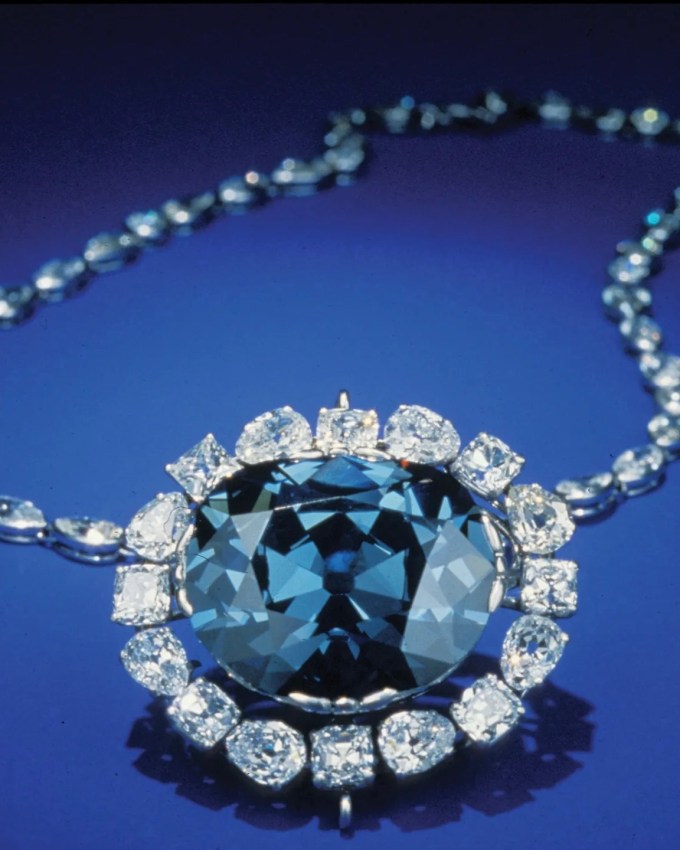
The story of the Hope Diamond takes a long, winding, and unexpected road. In 1673, the famed fancy deep grayish-blue diamond was recut into the 69-carat French Blue Diamond and set within the French Crown Jewels.
When the French National Convention officially abolished the monarchy in 1792 during the French Revolution, Louis XVI was forced to give up all the crown jewels when a major burglary led to the disappearance of the French Blue, the Regent Diamond, Le Grand Mazarin, and more. The thieves were captured and sentenced to death, but many of the stolen diamonds were never returned.
By the early 1800s, a smaller 45-carat diamond of the same blue hue appeared in London – but was named the Hope Diamond. It appeared just a few days after the twenty-year statute of limitations for crimes committed during the French Revolution had passed. Coincidence? I think not.
Owned and sold by the Hope family, then Washington mining heiress Evalyn Walsh McLean and Harry Winston, the Hope Diamond was donated to the Smithsonian Institution, where it remains to this day.
The Hope Diamond may be famous for its supposed curse, but science has spent the last two decades unraveling some of its biggest mysteries. Researchers have used computer modeling to convincingly trace the stone back to the legendary French Blue, while other studies have explored the science behind its eerie phosphorescent glow and the boron that gives the diamond its distinctive blue color. “We’ve been able to use some modern modeling technology and computer work to look back at how the cutting history all fits together,” explains Dr. Jeffrey E. Post. “It all matches up very nicely. “
Was the Great Mughal Diamond Hiding in Plain Sight?
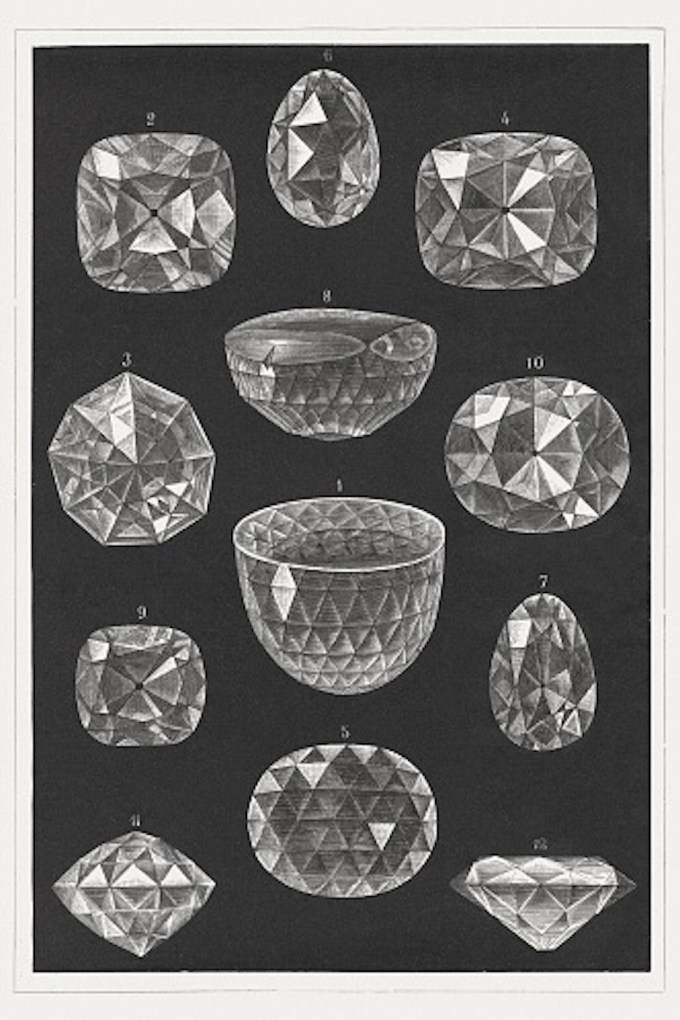
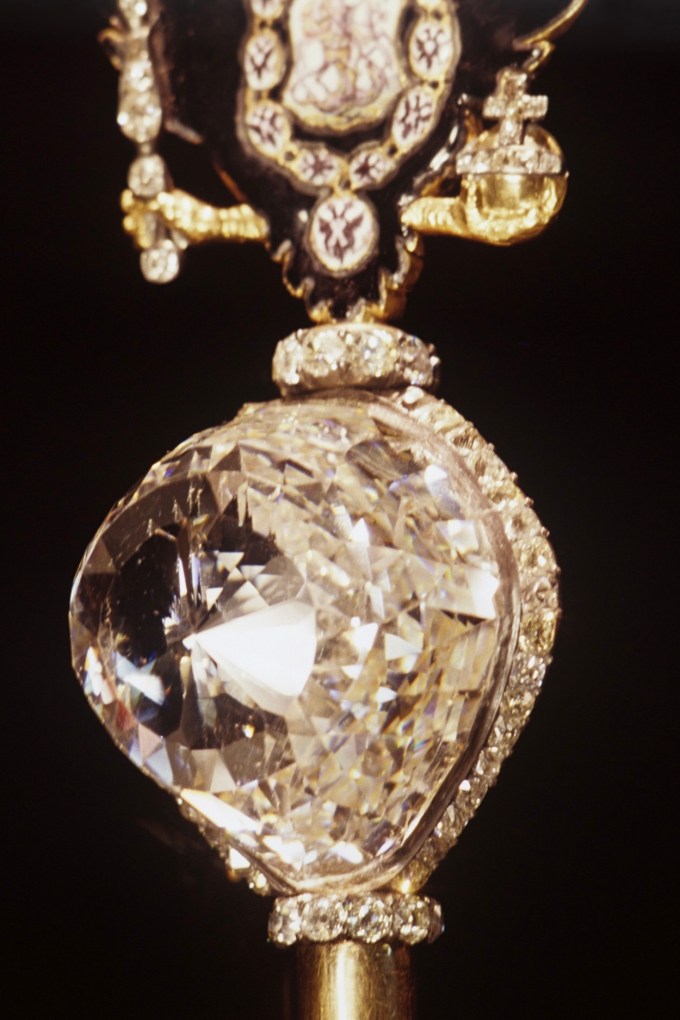
Regally perched within the Russian Imperial scepter, the famed Orlov Diamond might be the answer to one of the most mysterious cold cases in the diamond world: the disappearance of the Great Mughal Diamond. Historians widely believe the Orlov to have been cut from the Great Mughal, a legendary 787-carat Golconda stone long thought to be lost forever.
Discovered in the 1600s, the Great Mughal Diamond was presented by Emir Jemla to Shah Jahan, the fifth Mughal emperor and builder of the Taj Mahal, as an act of diplomacy. After the emperor assigned a Venetian lapidary named Ortensio Borgio to cut it, he was horrified by the results. Borgio dramatically cut the diamond down to a disappointing degree and was fined 10,000 rupees for his mistake. Nearly 500 carats were lost, according to Jean-Baptiste Tavernier, who documented the diamond in detail when Shah Jahan’s son Aurangzeb showed him the stone around 1665. After that, the stone seemed to have vanished from history.
Tavernier’s meticulous notes on the diamond might be one of the last recorded mentions of the Great Mughal, but they’re also how historians have compared its distinctive dome and identical faceting details so closely to the Orlov Diamond.
Shaped like half an egg and distinctly Indian in cut, the Orlov Diamond is said to have once served as the eye of a deity in the sacred Hindu temple at Srirangam. When a French soldier deserted his post at Pondicherry, he pretended to convert to Hinduism to get closer to the deity, stealing the diamond eye from the statue and fleeing the scene.
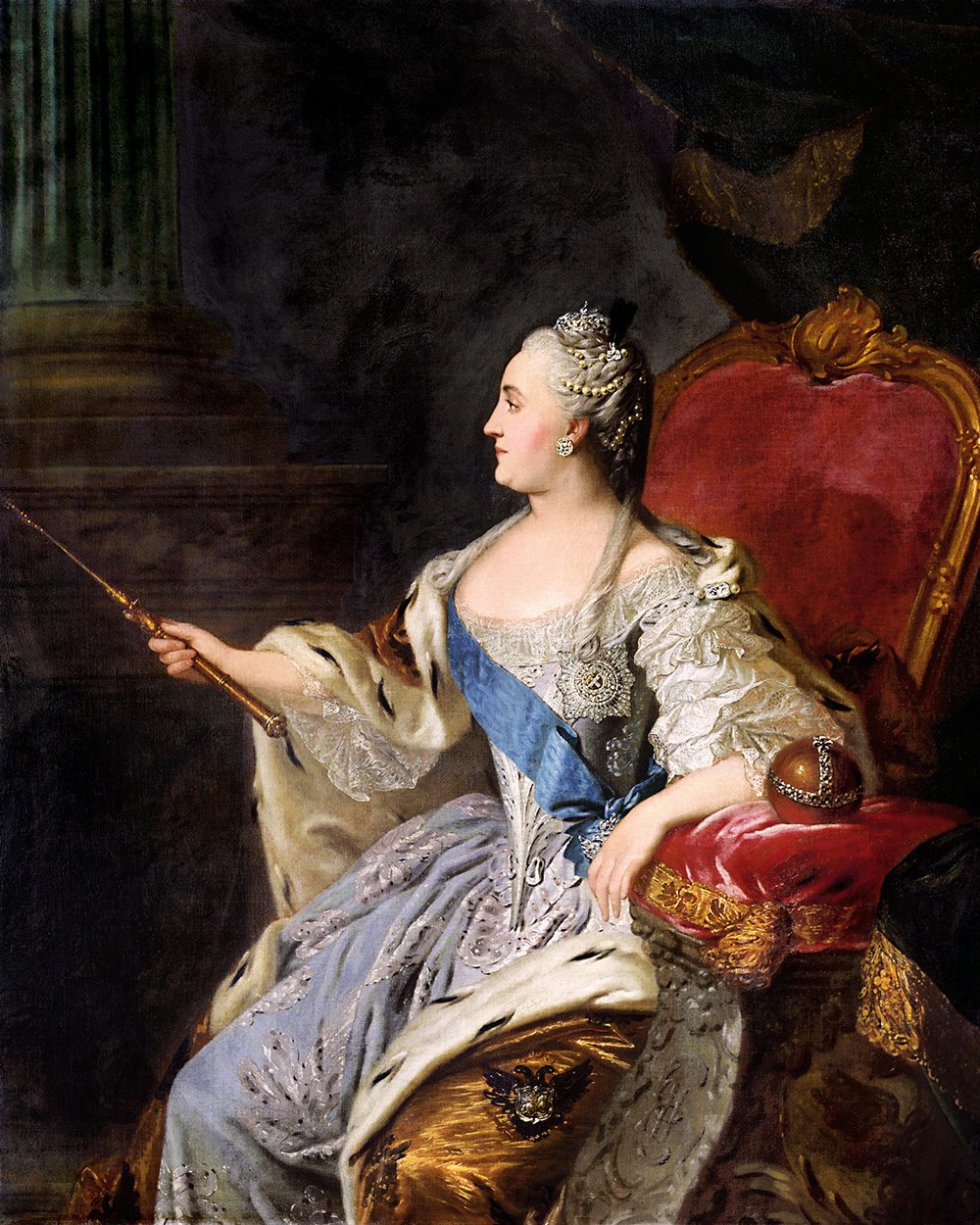
After he escaped to Madras, the thief sold the diamond to an English sea captain before he vanished. Once the captain brought it to London, the diamond changed hands several times before finding a home with Catherine the Great of Russia.
The Orlov takes its name from Prince Gregory Orlov, who played a crucial role in the 1762 insurrection that overthrew Catherine’s husband, Peter III, and made her Empress of Russia. After falling out of favor with the empress, he attempted to win her back with the dome-like diamond. While she may have accepted the diamond, Orlov did not win her affections. In 1774, Catherine had it mounted atop the Imperial Scepter, where it has remained ever since. When Napoleon invaded in 1812, the Russians evacuated the diamond and the rest of the imperial treasures deep into the interior, keeping them safe while Moscow burned.
If the Orlov truly is the Great Mughal Diamond, one of the great lost treasures of the gem world was never lost at all. The Orlov Diamond currently sits in the Diamond Fund collection at Moscow’s Kremlin Armory.
The Daria-i-Noor Could Solve the Mystery of the Great Table Diamond
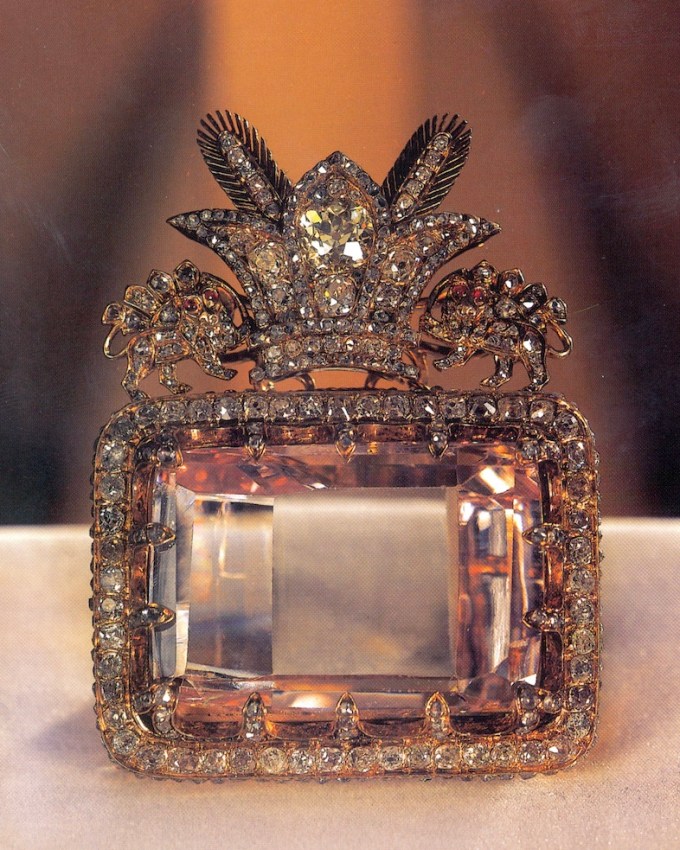
Translated as “Sea of Light,” in Persian, the approximately 182-carat pale pink Daria-i-Noor Diamond is considered the largest known pink diamond on Earth. Believed to have been discovered in the early 1600s at the Kollur Mine in the famed Golconda region of India.
Possibly carved from the legendary 242-carat Great Table Diamond, the Daria-i-Noor could simply be a lost legend, recut and hidden in plain sight. Before it vanished, the Great Table Diamond was recorded by the legendary gem merchant Tavernier, who described the stone in detail.
In 1965, a Canadian research team studied the Iranian Crown Jewels and concluded that the unusual rectangular table-cut Daria-i-Noor Diamond may have originally been part of that massive 242-carat Great Table. The scholars focused on the Daria-i-Noor (Sea of Light) and the 60-carat Noor-ul-Ain Diamond (Light of the Eye). While the Daria-i-Noor Diamond was worn by successive rulers of Iran since Nader Shah, the equally pale pink Noor-ul-Ain was set within a new custom tiara in the Iranian collection, designed by Harry Winston in 1958.
But that’s only half the nearly lost story of the Daria-i-Noor Diamond. Historians also believe the stone once formed part of the Mughal Empire‘s opulent treasury. It may have been one of the gems mounted into the Mughal Peacock Throne, the extraordinary seat of power created for Emperor Shah Jahan.
In 1739, Persian ruler Nader Shah invaded northern India and occupied Delhi, taking tribute from the Mughal court and seizing the empire’s famed treasury, including the Koh-i-Noor Diamond, the Peacock Throne, and the diamond now known as the Daria-i-Noor. From that moment forward, the diamond became part of the royal jewels of Persia.
Changing hands throughout its life, the Daria-i-Noor diamond currently resides in the Iranian National Jewels collection in Tehran, largely unseen and remains the crown jewel of Iran’s royal treasury, mythical status intact.
The Sancy Diamond Needs Its Own Lost & Found
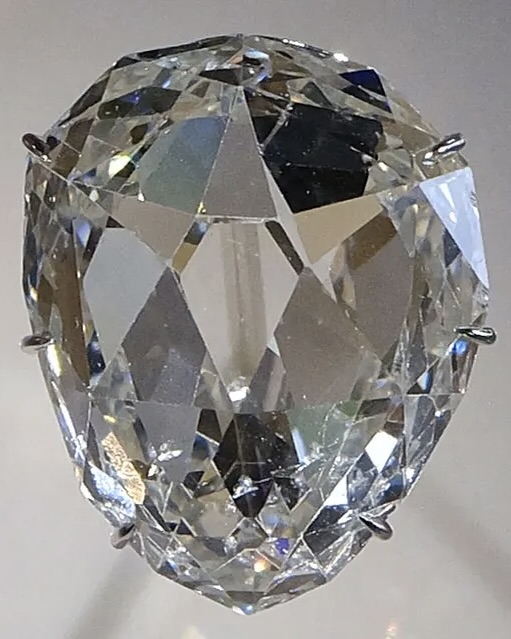
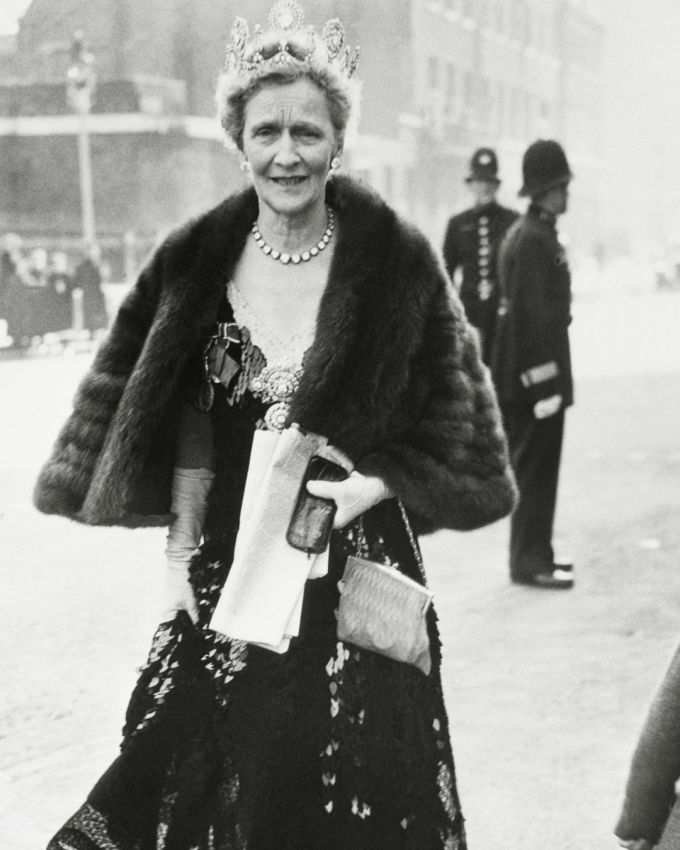
Throughout its long and historic journey, the Sancy Diamond can’t seem to catch a break. Surviving scandal after scandal for over 500 years, the 55.23-carat pale yellow pear-shaped diamond has quite a story to tell.
Believed to have originated in India, the diamond can be traced back to Charles the Bold, Duke of Burgundy. After he died in 1495, the stone was passed on to his cousin, King Manuel I of Portugal. Decades later, King Manuel’s grandson and heir, Dom António, was threatened by the Spanish, so he fled with the crown jewels and pawned them to fund his fight to regain the throne.
Sold to Nicolas de Harlay, Seigneur de Sancy, for whom the diamond was ultimately named, the Sancy Diamond (not to be confused with the smaller Beau Sancy Diamond), was repeatedly used as collateral for loans to raise money for Henri IV’s lavish lifestyle after he named Sancy the Minister of Finance.
With eyes bigger than his wallet, Sancy’s desire for stunning gemstones left him hard for cash, leaving him no option but to sell the Sancy Diamond to King James I in 1605. He sent a loyal servant to deliver the diamond from France to England. While on his travels, the servant was cornered by thieves. Instead of giving up the stone, he swallowed it. Unfortunately, he was killed anyway, and the Sancy Diamond was removed from his body.
Similar to Dom António and Seigneur de Sancy before him, King James I also pawned the Sancy Diamond once it was in his possession, reclaiming it, and pawning it again to maintain his lifestyle. By 1654, the Sancy Diamond eventually made it back into the French Crown Jewels. That is, until the French Revolution, when it was stolen alongside the Hope Diamond and the Regent Diamond.
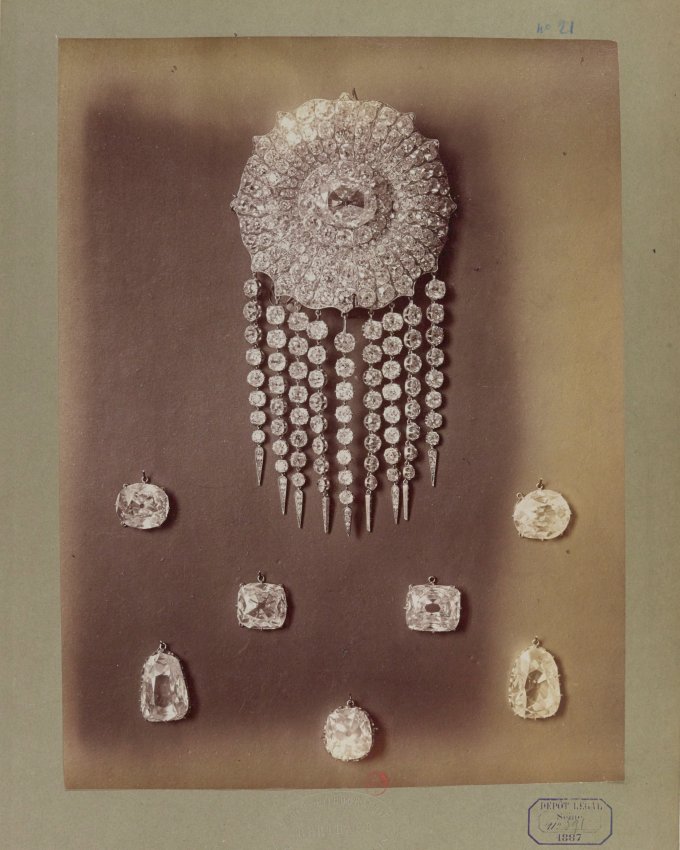
Throughout the 1800s, the Sancy Diamond disappeared and reappeared, with documents showing it was purchased by Russian Prince Demidoff before it showed up in the cases at the 1867 Paris Exposition and was sold to the Indian prince, Sir Jamsetjee Jeejeebhoy. By 1906, William Waldorf Astor, 1st Viscount Astor, bought the Sancy as a wedding gift for Lady Astor, who wore it on a tiara. Safe and sound with the Astor family for about 72 years, the Sancy was sold again to the Louvre for $1 million in 1978.
It’s no wonder some believe the Sancy to be cursed. When it comes to lost diamonds, the Sancy has made a sport out of scandal.
The Regent Diamond’s Survival Skills Must Be Studied
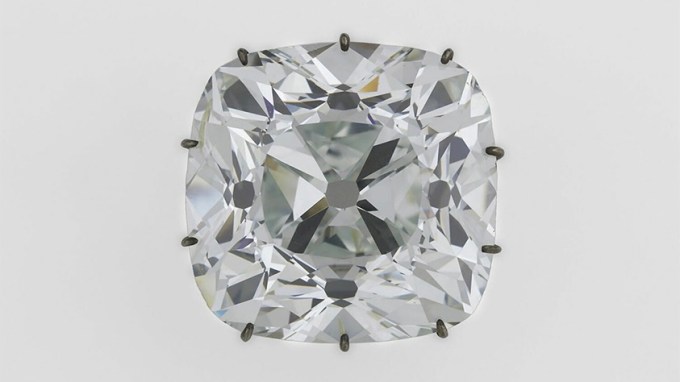
As soon as the Regent Diamond was discovered as a 410-carat stone in 1698, deep in the mines of Parityala, India, it instantly became entrenched in scandal. The worker who unearthed the magnificent stone decided to keep it for himself rather than turn it in to his bosses. Beginning its life as a “lost diamond,” he hid the gem in a leg wound he suffered while fleeing the 1687 siege of Golconda, allowing him to sneakily smuggle the stone past the watchful eyes of the mine’s overseers.
Fleeing to Madras (much like the Orlov Diamond‘s story), the man encountered a cruel English sea captain, who stole the diamond from him and threw him overboard. Once the ship docked, the captain sold the diamond to the famed diamond merchant named Jaychand for £1,000. Thought to be stolen property, Jaychand struggled to sell the stone before the Governor of Madras, Thomas Pitt, acquired it.
Rumors of its dubious origins spread, so Pitt sent the diamond to be cut and polished in London, concealed in the heel of his son’s shoe. The rough 410-carat diamond was transformed into a 140.5-carat brilliant cushion-cut. Rumor has it that smaller stones cut from the original rough were sold to Peter the Great of Russia.
The stone became known as the Pitt Diamond when it was offered to royalty across Europe. No one took the bait until 1717, when Philippe II, acting as Regent of France, acquired it for the crown jewels. The Pitt Diamond was then renamed “Le Régent” and a symbol of French royalty.
Prominently displayed during key formal occasions like state functions, royal weddings, and successive coronations, the Regent Diamond graced the crowns of multiple French monarchs, beginning with Louis XV in 1722, Louis XVI in 1775, and even Marie Antoinette.
During the French Revolution in 1792, the Regent Diamond was stolen along with several other crown jewels. It was remarkably recovered when someone discovered it hidden in the roof timbers of an abandoned attic in Paris. It was risked again when the French Ministry of Finance used it as collateral, acting as a “security deposit” to fund the country’s military expenses.
Berlin and Amsterdam held the diamond as security against France’s national expenditures before Emperor Napoleon Bonaparte finally reclaimed the diamond for France and had the Regent Diamond set into the sheath of his sword belt.
During her exile, Napoleon’s Archduchess Marie Louise of Austria removed the diamond from its mounting and took it to Austria. However, her father insisted that she return the stone to Charles X of France, who incorporated it into his crown. “Le Régent” continued its illustrious journey, adorning the crowns of successive French monarchs, including Louis XVIII, Charles X, and Napoleon III. Today, the Regent Diamond remains in the French Royal Treasury at the Louvre. It has been on display there since 1887.
Le Grand Mazarin Was Stolen, Lost, and Traded for a Life
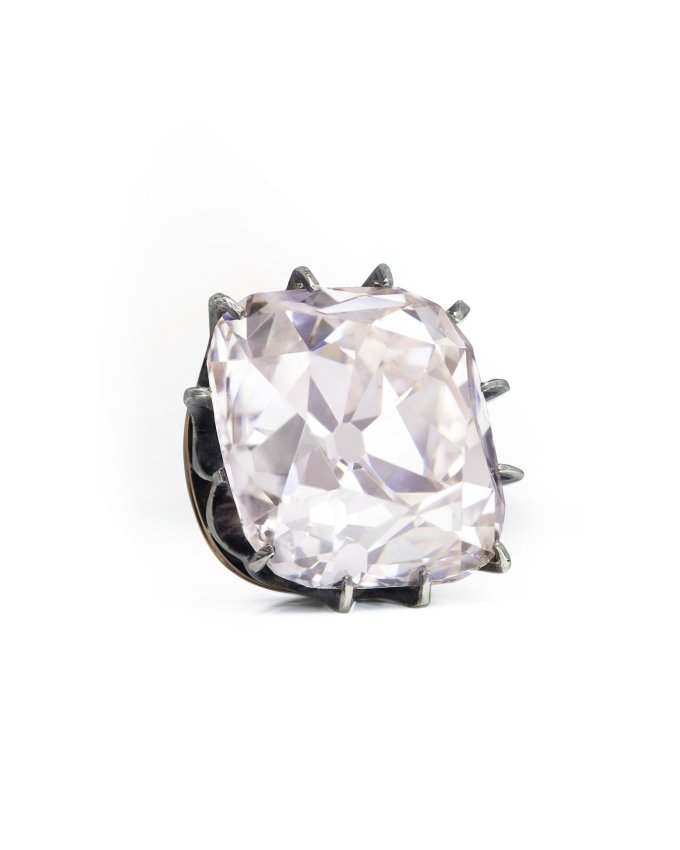
Named after the Chief Minister of France from 1642 to 1661 and bona fide magpie, His Eminence Cardinal Mazarin, Le Grand Mazarin is a 19.07-carat pink diamond with origins rooted in the legendary mines of Golconda, India.
Cardinal Mazarin ruled under two kings and even governed during the regency of Anne of Austria while Louis XIV was still a child. Amassing great wealth and exceptional stones through a network of trusted jewelers, the Cardinal bequeathed 18 diamond jewels, including the priceless Le Grand Mazarin diamond, to the French Crown on his deathbed, ensuring his name would remain intertwined with power for centuries.
When the French National Convention officially abolished the monarchy in 1792, Louis XVI was forced to give up all the crown jewels when a major burglary led to the disappearance of Le Grand Mazarin Diamond. The thieves were captured and sentenced to death, but many of the stolen diamonds were never returned. Le Grand Mazarin, however, was traded in by one of the bandits in exchange for his life.
From Louis XV to Louis XV, self-crowned Napoleon Bonaparte, and Napoleon III’s wife, Empress Eugénie, Le Grand Mazarin Diamond was worn by four kings, four queens, two emperors and two empresses in 225 years.
After the French suffered defeat in the Franco-Prussian War, the country paid its debts with the controversial sale of the French Crown Jewels, where Frederic Boucheron, founder of the eponymous jewelry house, purchased Le Grand Mazarin. In 2017, Christie’s auctioned the diamond 130 years after its first sale, going for $14,463,493.
And Some Famous Jewels Are Still Missing…
Queen Nazli’s Van Cleef & Arpels Necklace
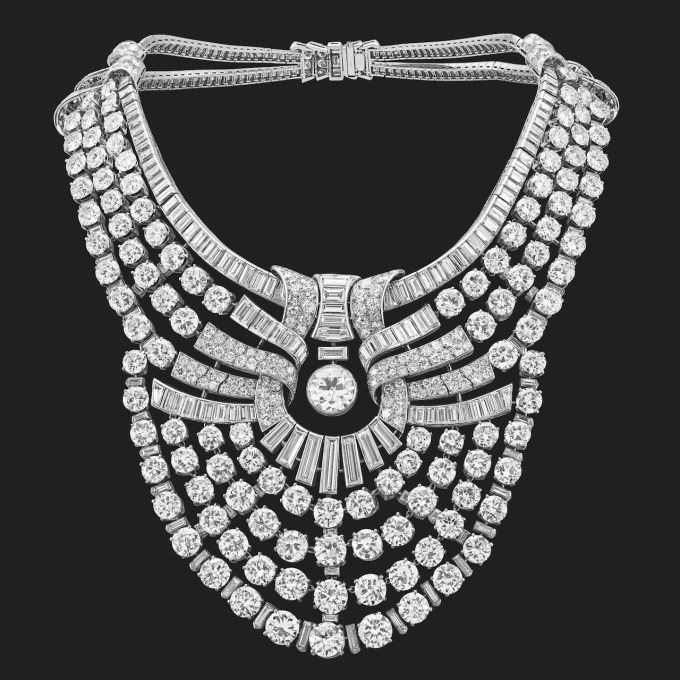
Last Thursday, an international manhunt was launched in Vienna for two men who stole a historical diamond necklace. The suspects bought a ticket for the Van Cleef & Arpels exhibition where the diamond and platinum jewel was showcased at the Vienna Museum of Applied Arts (MAK), which was due to run until September. Police say the pair then smashed a glass display and grabbed the piece, which is believed to be worth over $4 million.
Equipped with 600 glistening natural diamonds weighing in excess of 200 carats, the necklace was commissioned by the Egyptian royal family. In 1939, Queen Nazli wore it with a matching tiara for the wedding of her daughter, Princess Fawzia of Egypt, and the Crown Prince of Iran, Mohammad Reza Pahlavi, the future Shah of Iran.
Unmasked, Vienna police released images of the suspects, who were captured on security cameras in the hopes of appealing to the public to come forward with any information. One of the perpetrators was believed to have carried what was thought to be a firearm. After seizing the necklace, police claim they fled “towards the Vienna Stadtpark” just south of the museum.
Forensic experts are analysing evidence and CCTV footage while units of police dogs were deployed in Vienna and the province of Lower Austria. The exhibition has now been reopened.
The French Crown Jewels
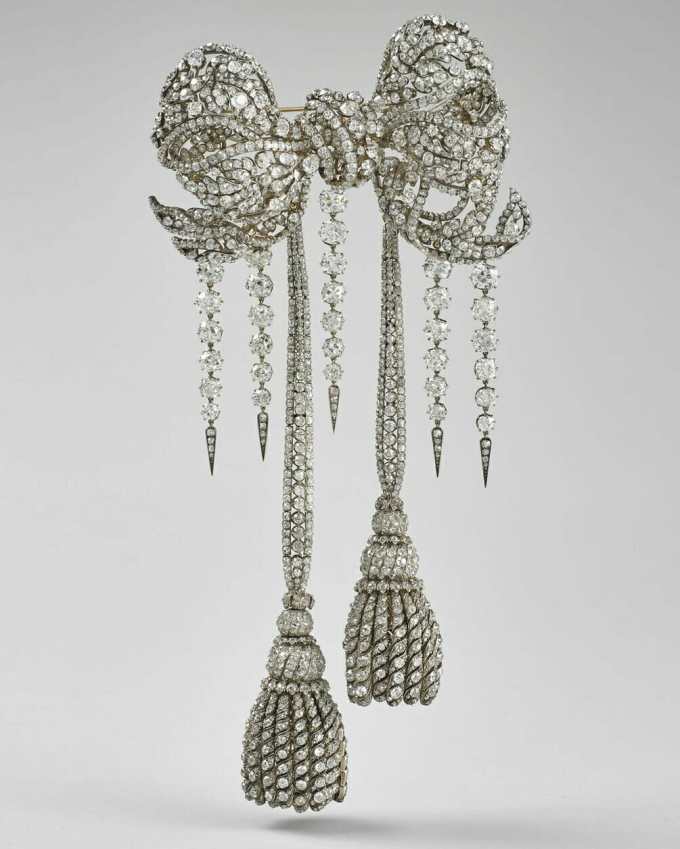
On October 18, 2025, many pieces of the French Crown Jewels were brazenly stolen by thieves from the Galerie d’Apollon (Gallery of Apollo) at the Louvre Museum, where they have been housed for decades. The culprits broke in through a balcony and seized pieces adorned with thousands of diamonds, each considered a priceless treasure.
“I hope in time some of the jewels stolen from the Louvre will appear,” Woolton says. “It’s my belief that a jewel can reveal more about an age, including the passions, ambitions, fashions and beliefs of those who lived through it, than almost any other object.”
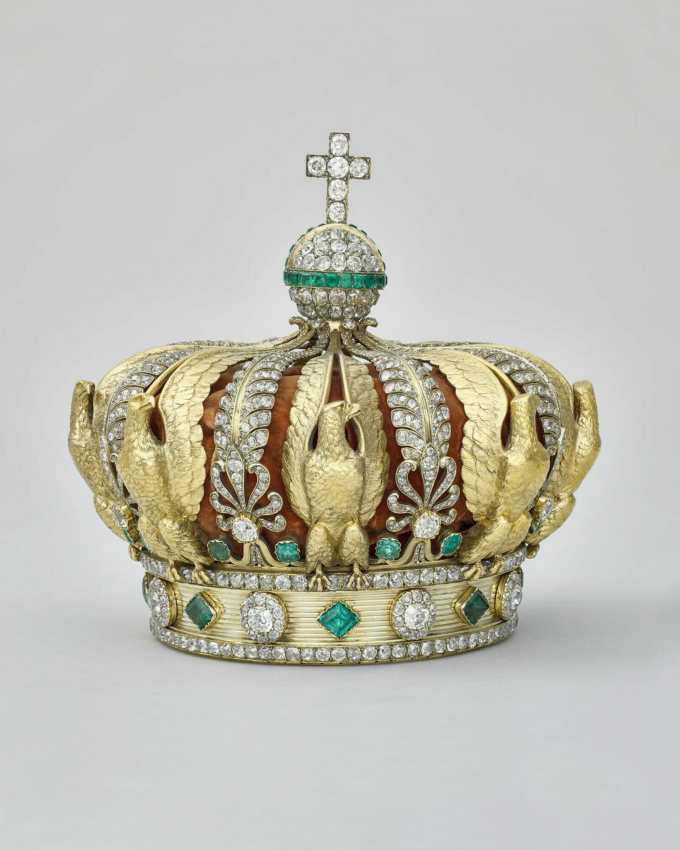
Among the treasures stolen was Empress Eugénie’s diamond-encrusted brooch, along with a diadem belonging to Eugénie herself. Eugénie’s crown, a masterpiece featuring 1,354 diamonds and 56 emeralds, was found outside the Louvre and was damaged.
“The heist of the Louvre pieces is a tragedy because their historical identity of 19th-century French royal life is irreplaceable,” explains Woolton. “It’s a profound public loss, as these objects had passed from the exclusive possession of royalty into a museum, where everyone could encounter them, study them, and take pleasure in their beauty,” she says. “The theft takes that inheritance away from all of us.”
Though the heist was shocking, several pieces from the French Crown Jewels are still secure in the Louvre Museum, including the Regent, the Sancy, and the Hortensia.
Perhaps one of the most famous examples of diamond bows in the world, Empress Eugénie’s spectacular diamond bow brooch, made by François Kramerin 1855, surprisingly wasn’t considered mind-blowing enough for her taste. The Empress had it altered to include five diamond streamers and two large tassels. From top to bottom, the jewel is almost nine inches high and is comprised of 94 diamonds. Eugénie wore it as a stomacher, a decoration pinned to the décolletage.
When the bow was sold at the 1887 auction, it was purchased by a jeweler named Schlessinger for Caroline Astor, the doyenne of New York society during the Gilded Age. The Louvre acquired the jewel in 2008 when it went back on the market.
The Dresden White Diamond
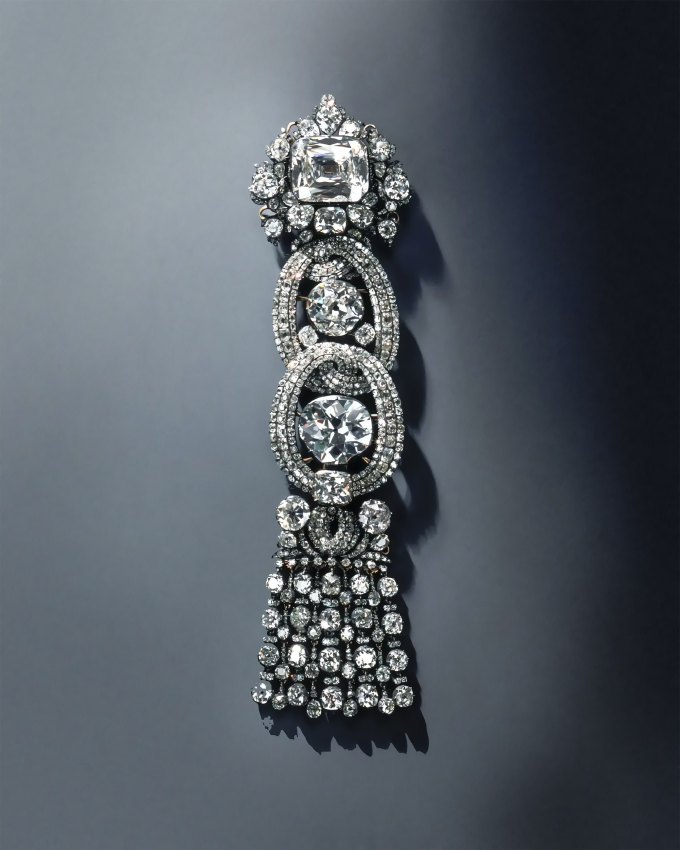
In November 2019, one of the most significant jewel thefts in modern history took place in Dresden, Germany. During the Green Vault robbery, masked thieves shattered the reinforced glass display cases with axes, stealing priceless diamond treasures.
Taking off with dozens of invaluable diamond artifacts, they stole the 49-carat Dresden White Diamond, a sword encrusted with 800 diamonds, and a 1780s diamond hat clasp, estimated at a total of $130 million. In 2021, authorities identified and captured those responsible for the heist. Six members of a notorious German crime family known as the Remmo Clan were arrested.
After negotiations between the Remmo Clan and law enforcement, a significant portion of the artifacts, though slightly damaged, were finally returned. In May 2023, five individuals from the same family were sentenced to years in prison for their role in the robbery. While the return of these treasures is a triumph, some key pieces remain missing, including the Dresden White Diamond, mounted on an epaulet that is yet to be recovered. Finally, in August 2024, after years of being tied up in the legal system, the recovered pieces were back in their original places in the Green Vault, allowing visitors to admire them again, albeit under the watchful eye of much stricter security.