

Read More
How Catherine the Great Made Diamonds Her Greatest Power Move
Catherine the Great did not inherit the Russian throne; she seized it. The jewels she gathered over the next thirty-four years ensured that no one forgot who held them.
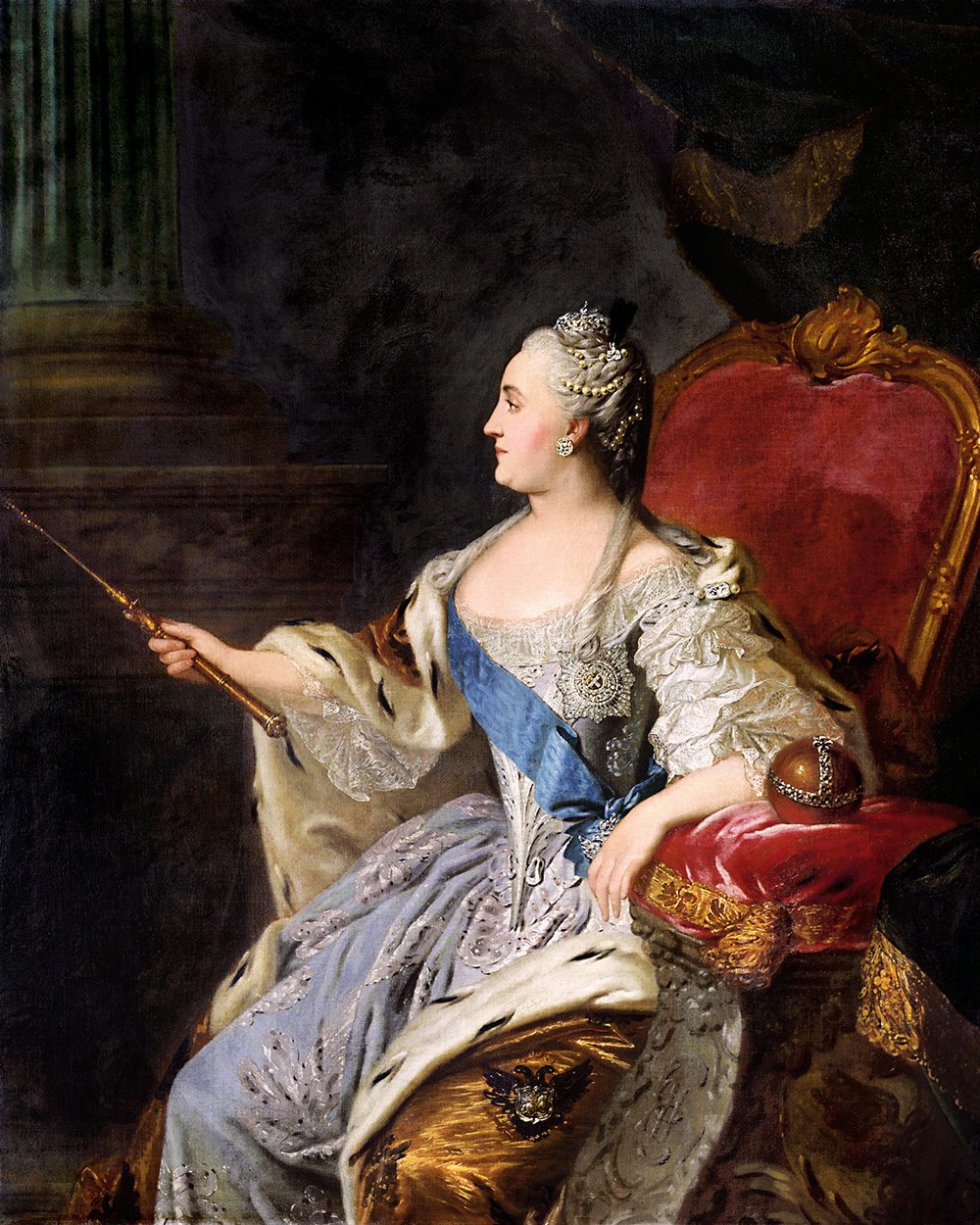
Portrait of Catherine the Great. (Wikimedia Commons/ Public Domain)
On September 22, 1762, Catherine the Great, born Princess Sophie Friederike Auguste of Anhalt-Zerbst, entered the Assumption Cathedral in Moscow to be crowned empress of Russia. Less than three months earlier, she had helped overthrow her husband, Peter III. German-born, without Romanov blood and possessing no hereditary claim to rule in her own right, she needed the ceremony to accomplish more than the recognition of a new sovereign. It had to make rupture look like continuity.
At its center was a newly created crown set with 4,936 diamonds, 75 pearls, and a 398.72- carat spinel. Catherine the Great placed it upon her own head. The crown could not erase the circumstances through which she had reached the throne, but it could give them a different visual meaning. Beneath its weight, the foreign princess and political usurper appeared as the lawful successor to centuries of Russian monarchy.
Meet the Expert

- Archana Thani is the Managing Editorial Associate for Vogue India.
- With over 7 years in the jewellery industry and over 10 in fashion, her writing has been featured in titles including Vogue India (print and digital editions) as well as Conde Nast Traveller India.
- A true jewellery lover, she is dedicated to sharing her knowledge of the global contemporary fine jewellery market with a wider audience.
Catherine the Great returned to this strategy through her thirty-four-year reign. She understood that authority had to be made visible, and that jewelry could do more than display wealth. It could anchor a ceremony, reward loyalty, organize patronage, and give physical form to imperial favor. Two years after her accession, she created a setting in which those functions could operate together.
How Catherine the Great Turned Diamonds Into Political Power
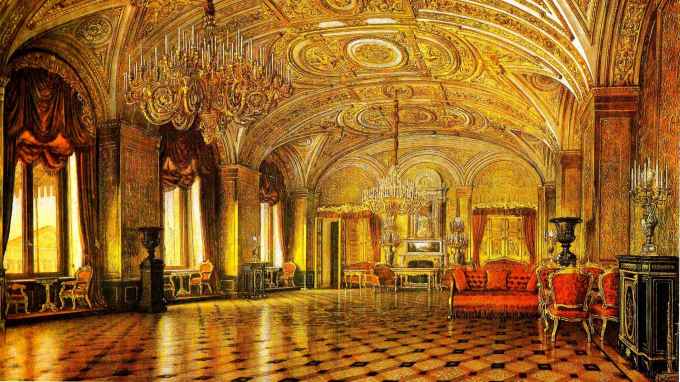
In 1764, Catherine the Great transformed a room in the Winter Palace into a dedicated treasury known as the Brilliant Room. Its glass-fronted cabinets contained regalia, necklaces, bracelets, jeweled orders, watches, sword belts, and other precious objects. It was recorded that Catherine selected pieces from the collection to give away as presents. Jewelry moved outwards from the room as evidence that the empress had noticed, rewarded, or elevated its recipient.
The Brilliant Room was more than a vault. It was part treasury, part theater, and part mechanism of patronage. By placing ceremonial regalia, personal jewels, and diplomatic gifts within the same environment, Catherine turned the collection into a material expression of her authority.
Her court employed leading jewelers, including Georg Friedrich Eckart, Jérémie Pauzié, Leopold Pfisterer, and members of the Duval family. Their work helped establish a visual language through which the magnificence of the court became inseparable from the power of its ruler.
Catherine the Great’s Great Imperial Crown
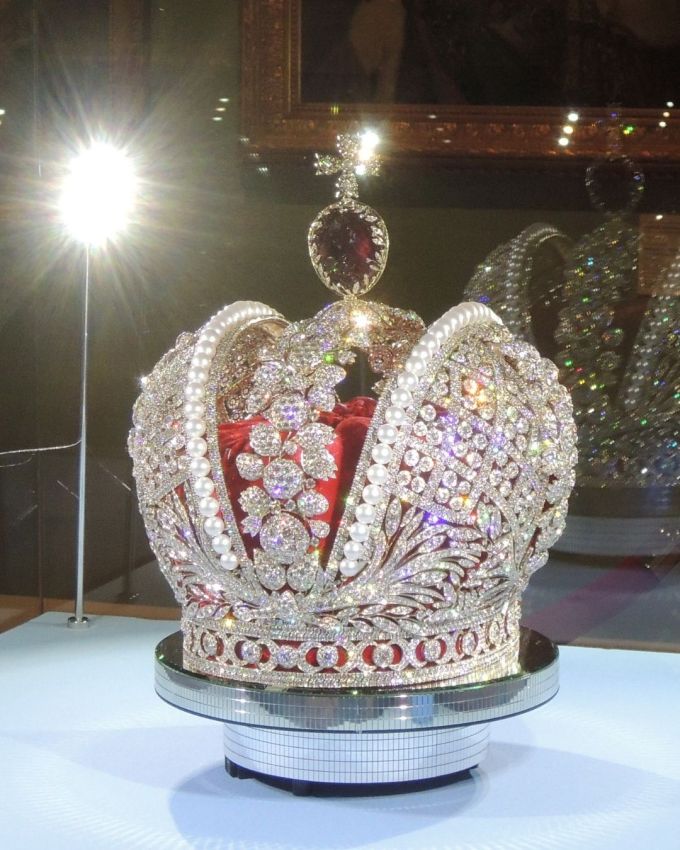
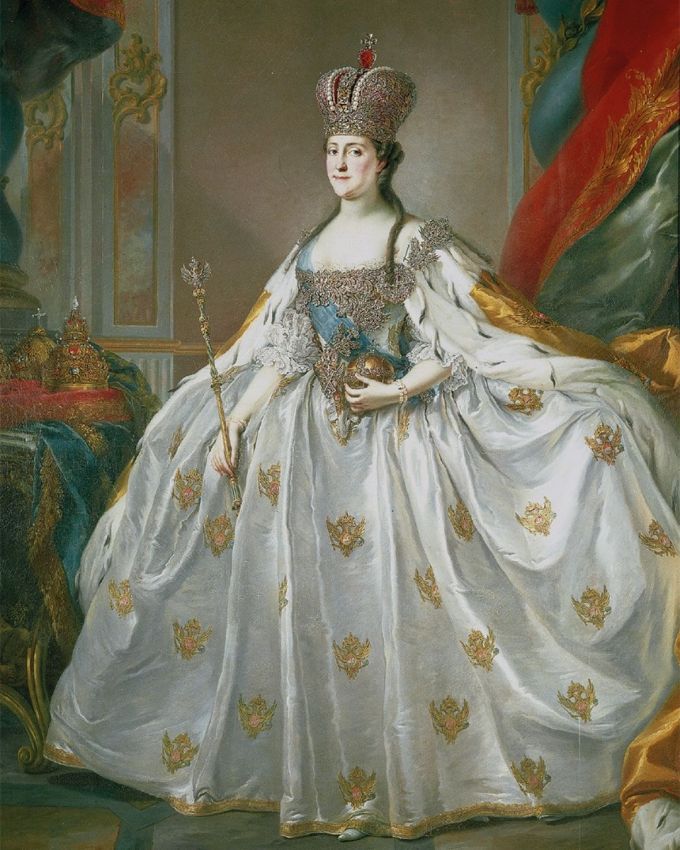
Created by Eckart and Pauzié in approximately two and a half months, the crown was set with 4,936 diamonds weighing a combined 2,858 carats, 75 large pearls, and an immense red spinel of 398.72 carats. Its importance went far beyond scale. The crown placed Catherine’s contested accession within the sacred and dynastic rituals of the Russian monarchy. She might have reached the throne through a coup, but the coronation presented her as a legitimate continuation of imperial rule.
The crown went on to become larger than the reign for which it had been created. Every Russian sovereign who followed Catherine the Great, down to Nicholas II in 1896, was crowned with it. What had been designed to consolidate one woman’s precarious position became the defining regalia of the dynasty.
The Orlov Diamond and the Imperial Sceptre
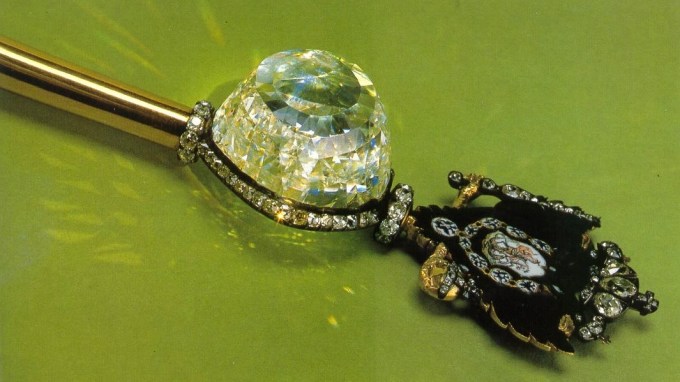
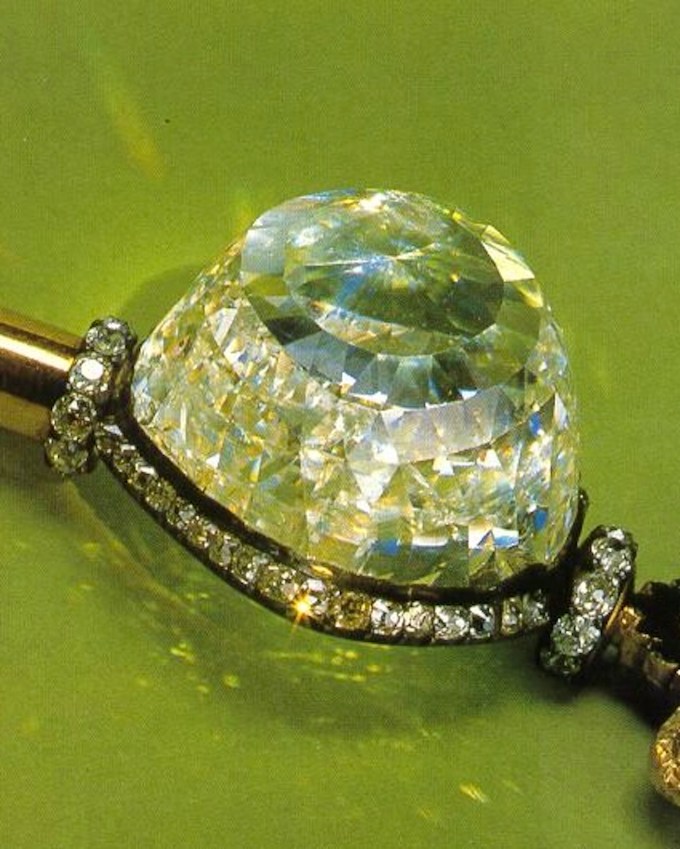
The Orlov Diamond reveals another side of Catherine the Great’s ability to control the meaning of precious objects. The 189.62-carat Mughal-cut diamond is traditionally said to have been presented by Count Grigory Orlov, her former favorite and political ally, in an unsuccessful attempt to regain her affection. It is a compelling story, but archival research has made it considerably less straightforward.
Jewelry historian Anna Malecka has argued that Catherine may have financed the acquisition herself, allowing Orlov to appear publicly as its purchaser and giver. At a time of war and domestic unrest, the fiction of an extravagant romantic gift may have provided useful political cover for an expensive imperial acquisition. The theory remains an interpretation rather than an uncontested historical fact. What is certain is what Catherine the Great did with the stone.
In 1774, she had the diamond mounted in the Imperial Sceptre. A gemstone associated with a private relationship and court gossip was absorbed into the permanent regalia of the state. Whatever its route into her possession, Catherine controlled its final message. The Orlov no longer represented one man’s access to the empress. It represented the sovereignty she wielded.
Catherine the Great’s Diamond Bow-Knot Jewel
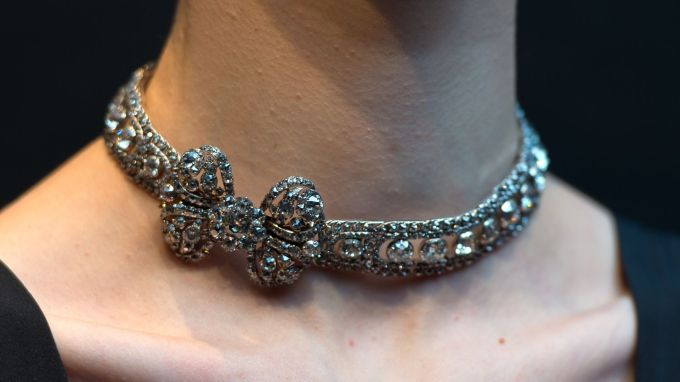
Not all the jewels associated with Catherine the Great belonged to the formal language of coronations and state ceremonies. A diamond band and bow-knot ornament linked to her court reveals how authority was also communicated through dress, movement, and physical presence.
The articulated band was set with graduated cushion-shaped diamonds and bordered by diamond drop motifs. The accompanying bow was made as a ribbon of diamonds in an open, floral, and foliate pattern. The two components were not initially created as a single necklace. They were listed separately in a 1922 inventory of the Russian jewels, and differences in their manufacture indicate that they were made at different moments. The bow has been dated stylistically to the 1760s and the band to around 1780.
The band may originally have been tied with fabric ribbon or stitched directly onto a court gown. It could later be combined with the bow, reflecting the adaptability expected of important 18th-century jewelry.
Unlike the monumental stillness of the crown, such jewels animated the wearer. Their articulated settings responded to movement, allowing the diamonds to catch the light during audiences, ceremonies, and court entertainments. They made power mobile. The assembled jewel returned to Sotheby’s Geneva in 2016, its exceptional survival offering a rare glimpse into both the splendour and versatility of jewelry at Catherine’s court.
Catherine the Great’s Imperial Emerald
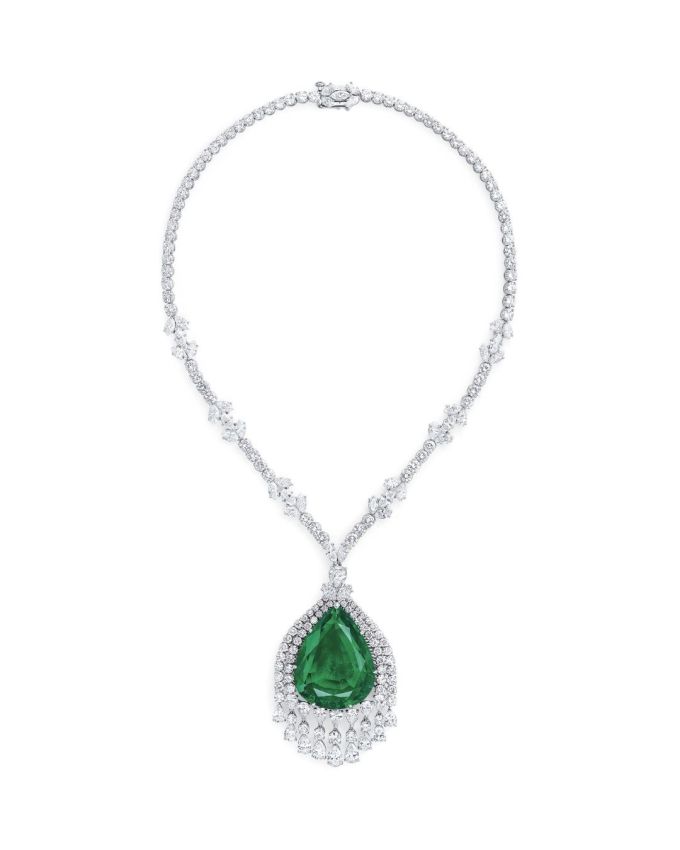
One of the most storied gemstones recorded in Catherine’s collection was an exceptional Colombian emerald. Originally rectangular and weighing approximately 107.67 carats, the stone passed through successive generations of the Russian imperial family after her death. Its provenance continued through Tsars Paul I, Alexander I, Nicholas I, and Alexander II.
In 1874, Alexander II presented the emerald to Duchess Marie of Mecklenburg-Schwerin on the occasion of her marriage to his son, Grand Duke Vladimir Alexandrovich. She became Grand Duchess Maria Pavlovna, later known as the Grand Duchess Vladimir. Following her death, the emerald passed to her son, Grand Duke Boris Vladimirovich, who sold it to Cartier in 1927. The house subsequently combined it with an emerald-and-diamond necklace.
In 1954, Cartier recut the original rectangular emerald into a pear-shaped stone weighing approximately 75.63 carats. It was mounted as a detachable pendant and sold that year to John D. Rockefeller Jr. A later repolishing reduced its weight slightly to its present 75.61 carats. The necklace resurfaced at Christie’s in Geneva in 2019, where it sold to a private buyer for CHF4.335 million.
The Russian Empire had disappeared, the Romanov dynasty had ended, and the emerald itself had been dramatically altered. Yet Catherine the Great’s name remained attached to it. Its journey demonstrates jewelry’s ability to preserve authority as provenance. The stone passed from empresses and tsars to Cartier, Rockefeller, and the international auction market, accumulating new identities without losing the imperial association at the beginning of its history.
Catherine the Great’s Enduring Legacy
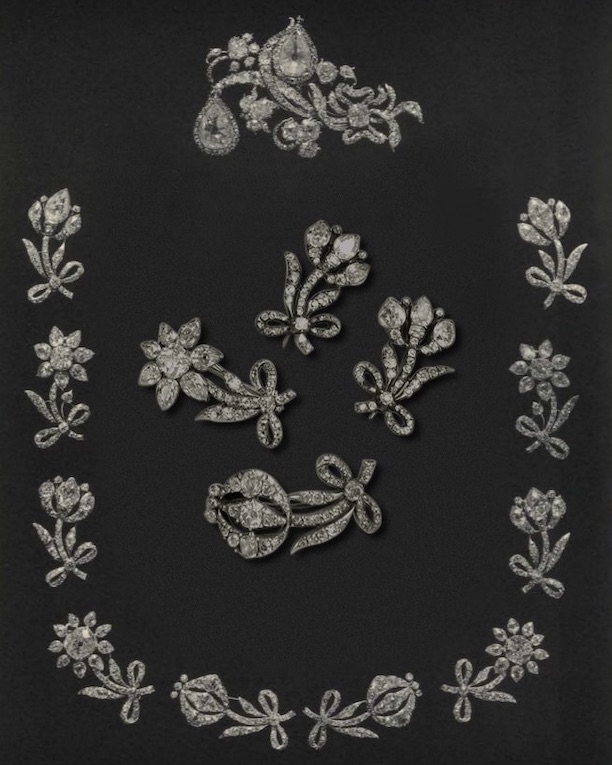
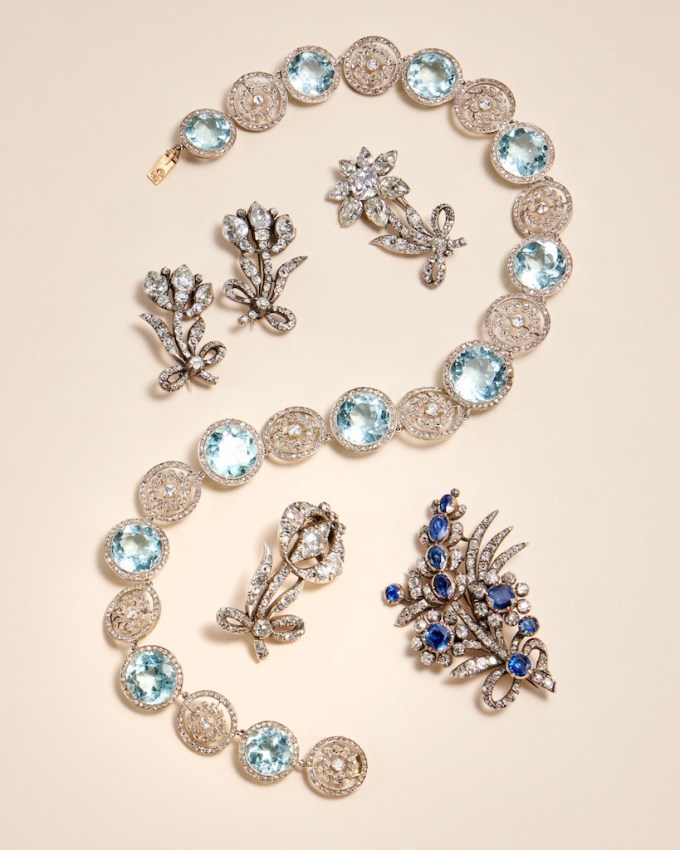
Catherine understood that power had to be seen before it could appear permanent. Across her reign, jewelry moved between ceremony, patronage, private exchange, and dynastic inheritance, acquiring political meaning at every turn. Its significance lay not only in what it displayed, but in turning possession into legitimacy, favor into loyalty, and memory into legacy.
It was the scale of her political, territorial, and cultural achievements that earned her the epithet “the Great.” Her jewels gave that greatness a visible language. Some remain in the Diamond Fund at the Moscow Kremlin; others have passed through private collections and international auction houses, acquiring new owners, settings, and meanings.
They continue to command attention not simply for their rarity or magnificence, but because they carry the imprint of Catherine’s greatness– a testament to jewelry’s power to make authority tangible and preserve it across centuries.


Get the Newsletter
Sign up for the latest diamond news, delivered directly to your inbox.