
The History and Mysteries of Elizabeth Taylor’s Taj Mahal Diamond
The legendary love story surrounding the Taj Mahal Diamond has a few chapters.
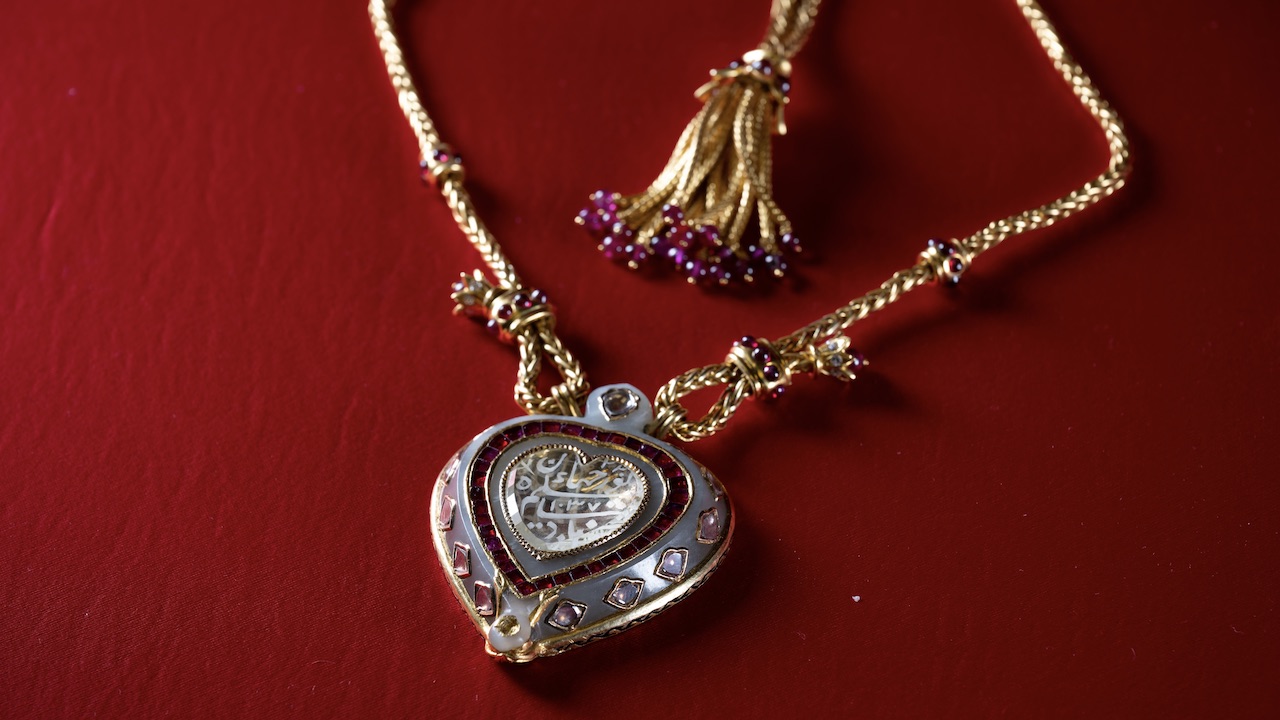
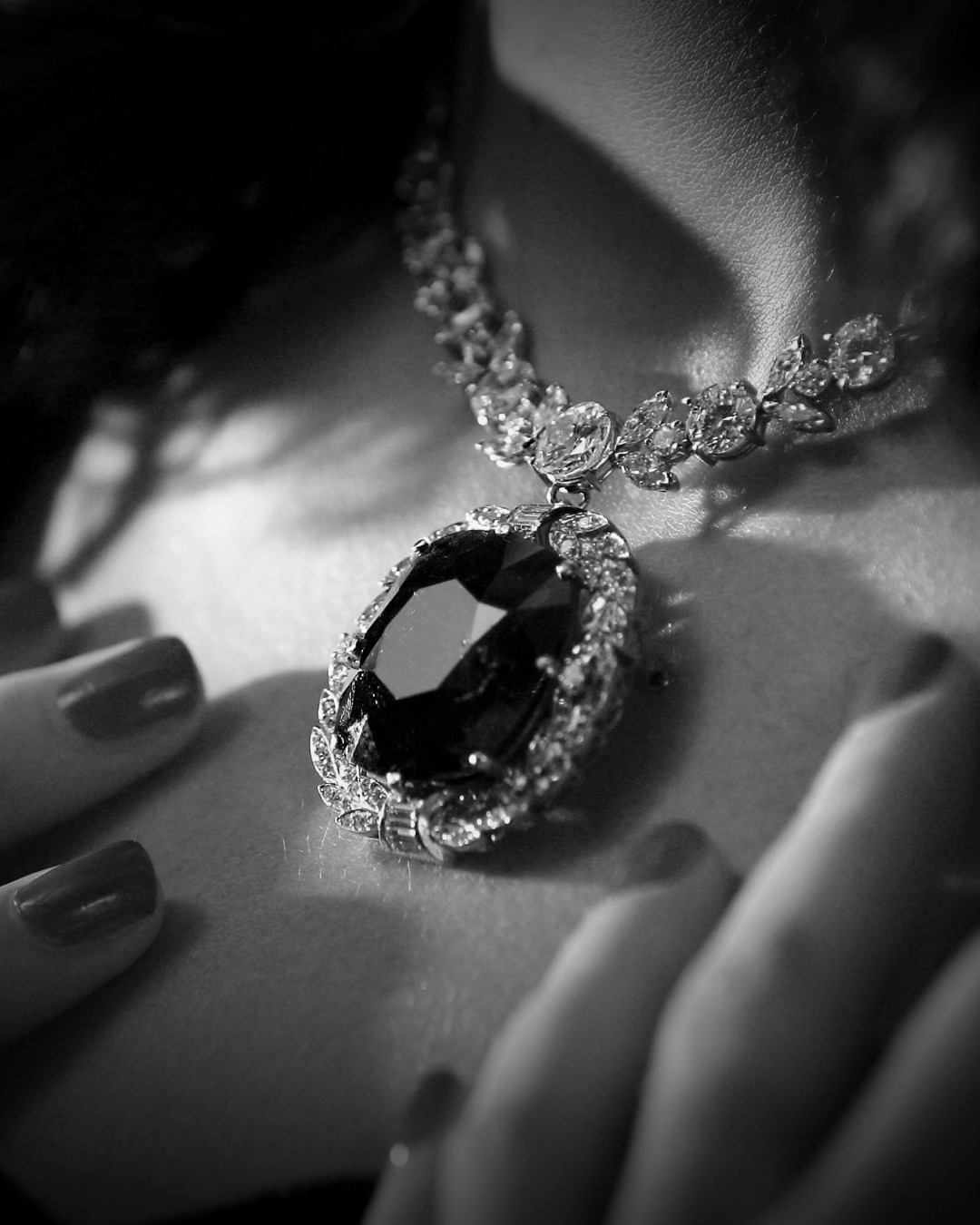
Elizabeth Taylor’s Taj Mahal Necklace (Photographed by Andrew Werner for Only Natural Diamonds)
Margot Robbie ignited worldwide interest in the Taj Mahal Diamond when she wore the famous gem from Elizabeth Taylor’s collection on the red carpet at the world premiere of Wuthering Heights in Los Angeles on January 28. The star shared a few tantalizing sound bites about the gem with journalists on the press line, but people wanted to know more. This essentially reopened what had been a cold case of the diamond’s history.
Part of the Taj Mahal Diamond’s known narrative is legend. In other words, there are clues that point in certain directions and match an oral history, but no smoking gun of proof. This kind of theory is not unusual in the worlds of art and jewelry.
Take, for instance, the speculation surrounding several paintings by the Dutch master Johannes Vermeer. In recent years, several jewels have been linked to Marie Antoinette. Experts theorize about origins and owners based on tangible details. These ideas are then presented with qualifiers such as “research indicates,” “by tradition,” or simply “believed to be.”
Meet the Experts

Courtney Stewart is a New York-based Researcher and Lecturer of Islamic Art History and the History of Jewelry and Gemstones. As a historian, educator, and curator, and Accredited Senior Gemologist with a G.G. from the Gemological Institute of America (GIA), Stewart is focused on the intersections of the cultural significance of gemstones and jewelry, and rituals surrounding jewelry acquisition and wear.
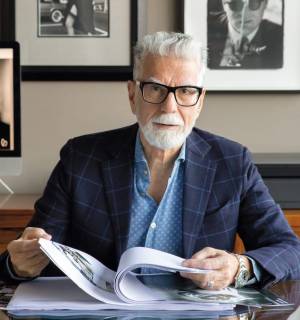
Firooz Zahedi is a celebrated Iranian-born, Los Angeles-based photographer. His friend Elizabeth Taylor took him to Hollywood in 1978 as her personal photographer. Shortly after, he was shooting editorial and advertising campaigns featuring major celebrities. In the early 1990’s, he was placed under contract with Vanity Fair magazine.
The Taj Mahal Diamond Appeared on the Open Market in 1970
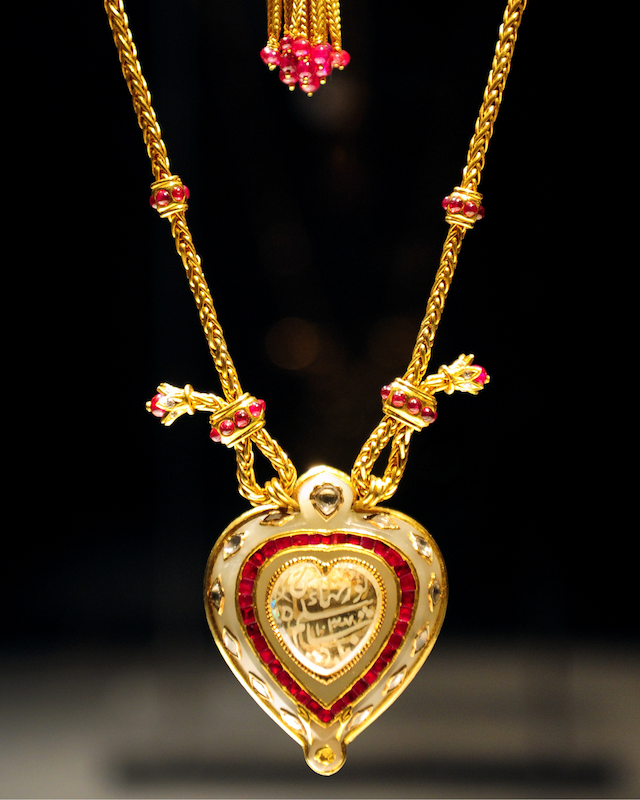
What is known absolutely about the Taj Mahal Diamond is that it was available on the open market in 1970. That year, the Indian government invited the costume jewelry designer Kenneth Jay Lane to visit the nation as a consultant for its handicraft industry. He asked his friend Rosemarie Kenmore to join him. A gemologist who worked at Cartier, Mrs. Kenmore was also the wife of Robert Kenmore of the Kenmore Corporation, which counted Cartier New York and Mr. Lane’s company among its holdings.
According to a January 7, 1971, story in The New York Times, Kenmore acquired 90 antique Indian jewels during the trip. The most valuable piece in the collection was the heart-shaped table-cut diamond, which the article incorrectly states was engraved with Queen Mumtaz Mahal’s name. A picture of Kenmore holding the Taj Mahal Diamond in The Times shows the gem set in the jade mounting accented with table-cut diamonds and red gems. It was suspended from a traditional Indian silk cord necklace with a slide for adjusting the length and a tassel at the back.
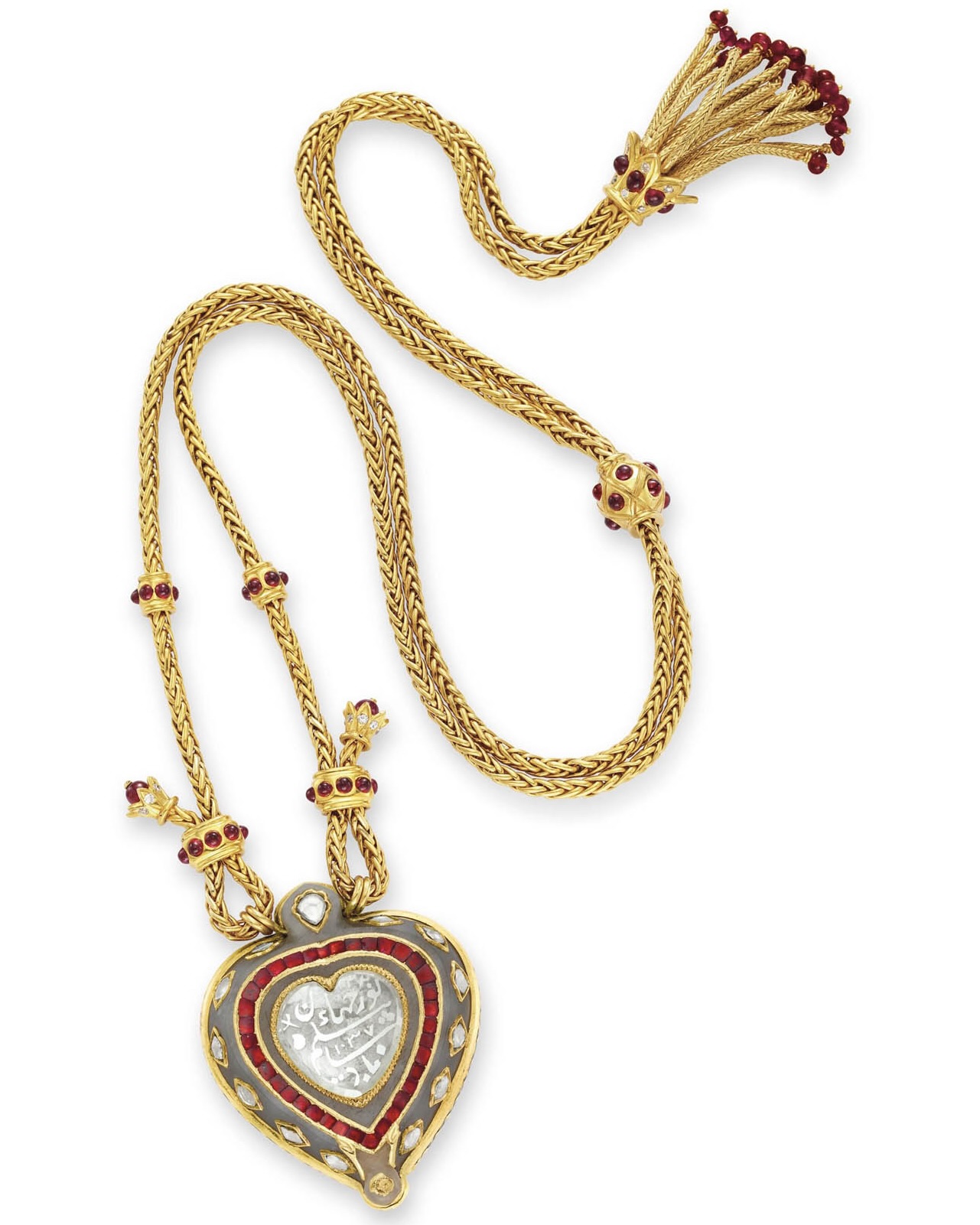
At some point in 1971, Cartier’s renowned designer, Alfred Durante, came up with a woven gold necklace for the Taj Mahal Diamond that echoed the original cord necklace silhouette. Rubies accent the rondelles, punctuating the chain, adjustable slide, and tassel hanging off the back. Cartier priced the piece at $50,000, which is approximately the equivalent of $392,000 today.
The Taj Mahal Diamond Evokes Elizabeth Taylor and Richard Burton’s Iconic Love Affair
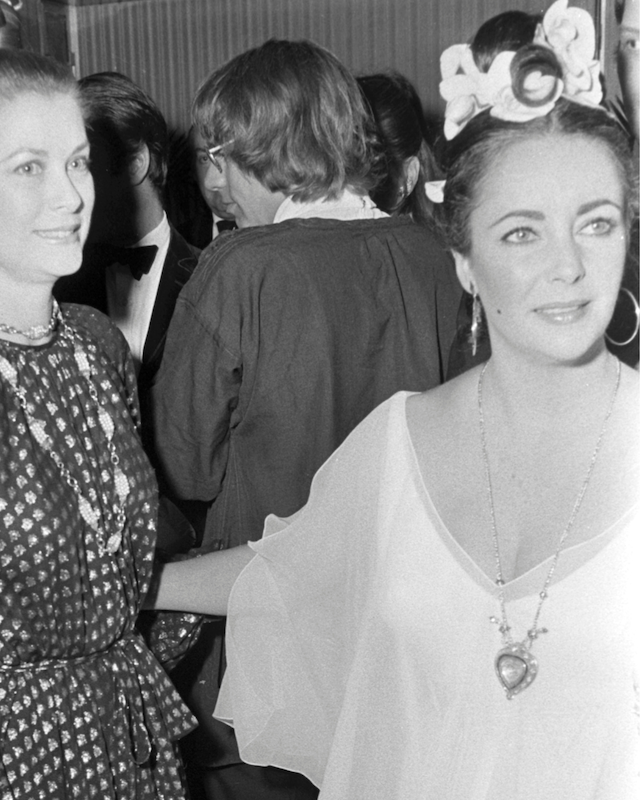
In January 1972, Richard Burton entered the story. He asked Cartier to show him some things that would be appropriate for Valentine’s Day or Taylor’s 40th birthday on February 27th. Cartier’s president, Michael Thomas, brought the jet-setting couple an array of jewelry to review during a layover at the International Hotel at Kennedy Airport in New York. “I love this. Tell me about it,” Thomas recalled Taylor saying when he showed them the Taj Mahal Diamond.
Burton registered her interest in the piece. He gave it to her as one of her 40th birthday presents during a weekend of festivities in Budapest, where they were living while Burton filmed Bluebeard. In Hungary, the actor showed it to the press and even modeled it around his head, a move that displayed his signature wit. On a more serious note, Burton announced that he was donating an amount equal to the jewel’s price to a British charity. It was an underreported custom of the couple to make charitable donations when they acquired a significant jewel.
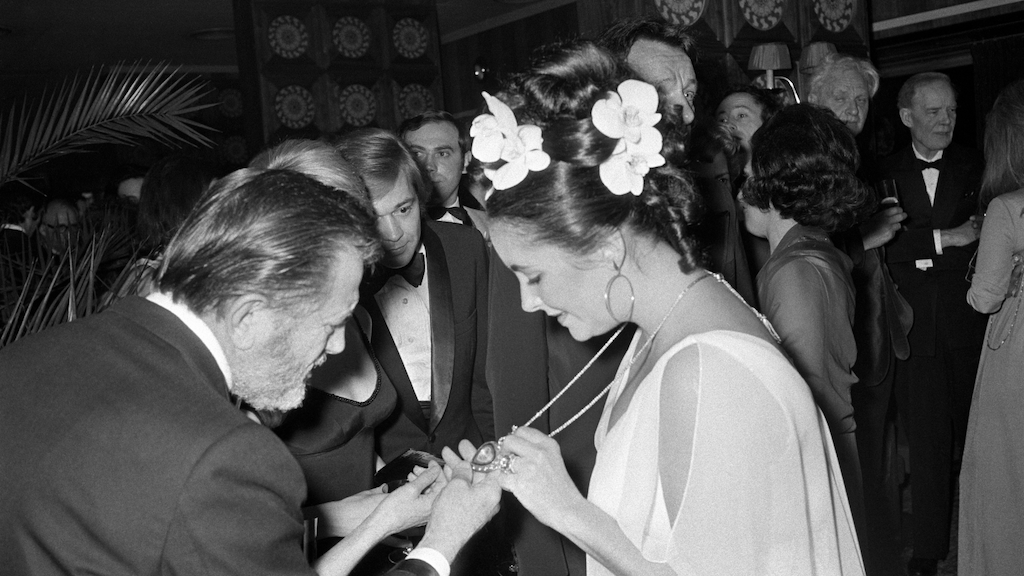
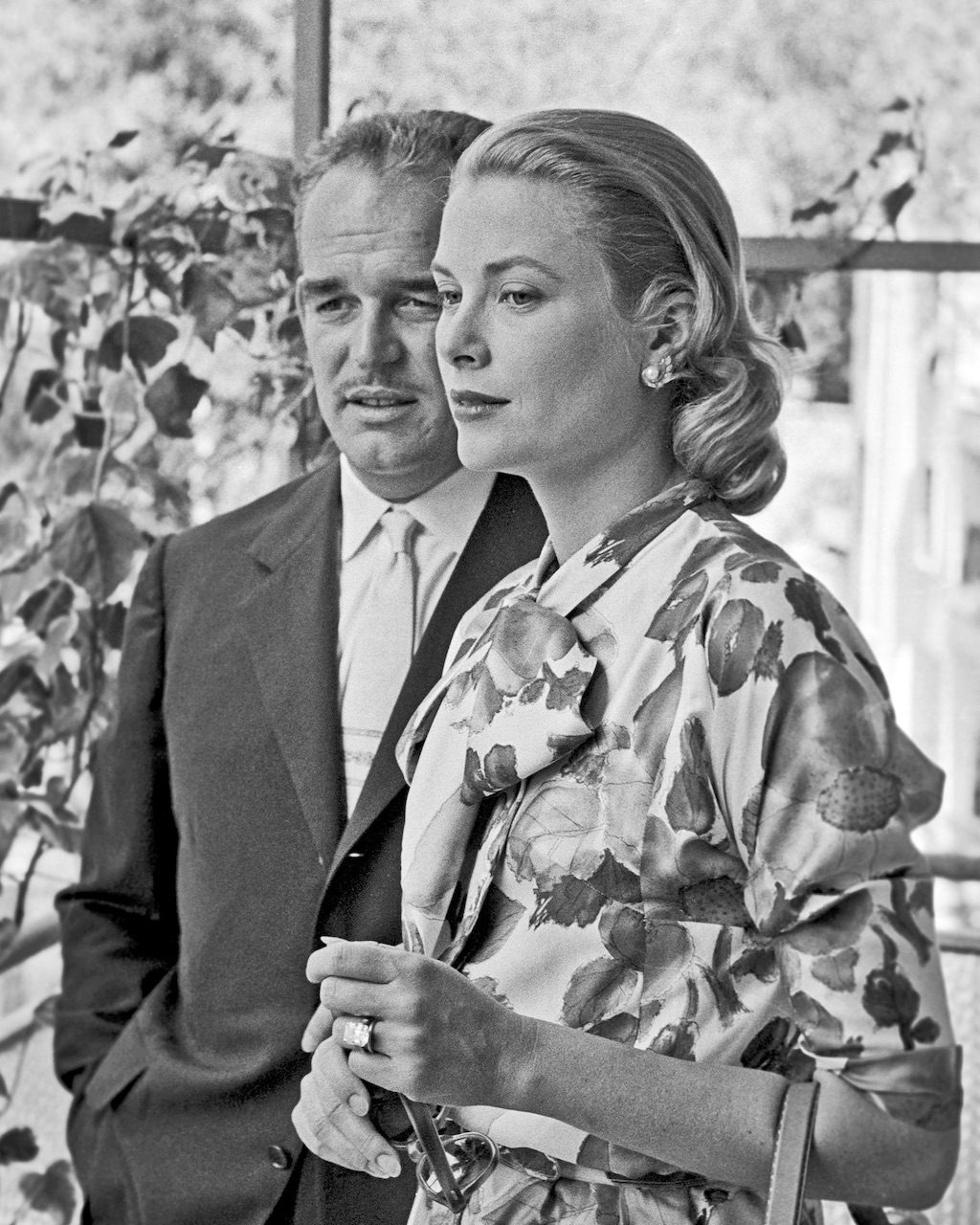
A long list of luminaries flew into Budapest to attend Taylor’s birthday party, including Princess Grace Kelly, Ringo Starr of The Beatles, and Academy Award-winning actor Michael Caine. In the press coverage, there are countless pictures of guests looking at the jewel around Taylor’s neck, which she obligingly held up to show them.
Decoding the Legend of the Taj Mahal Diamond
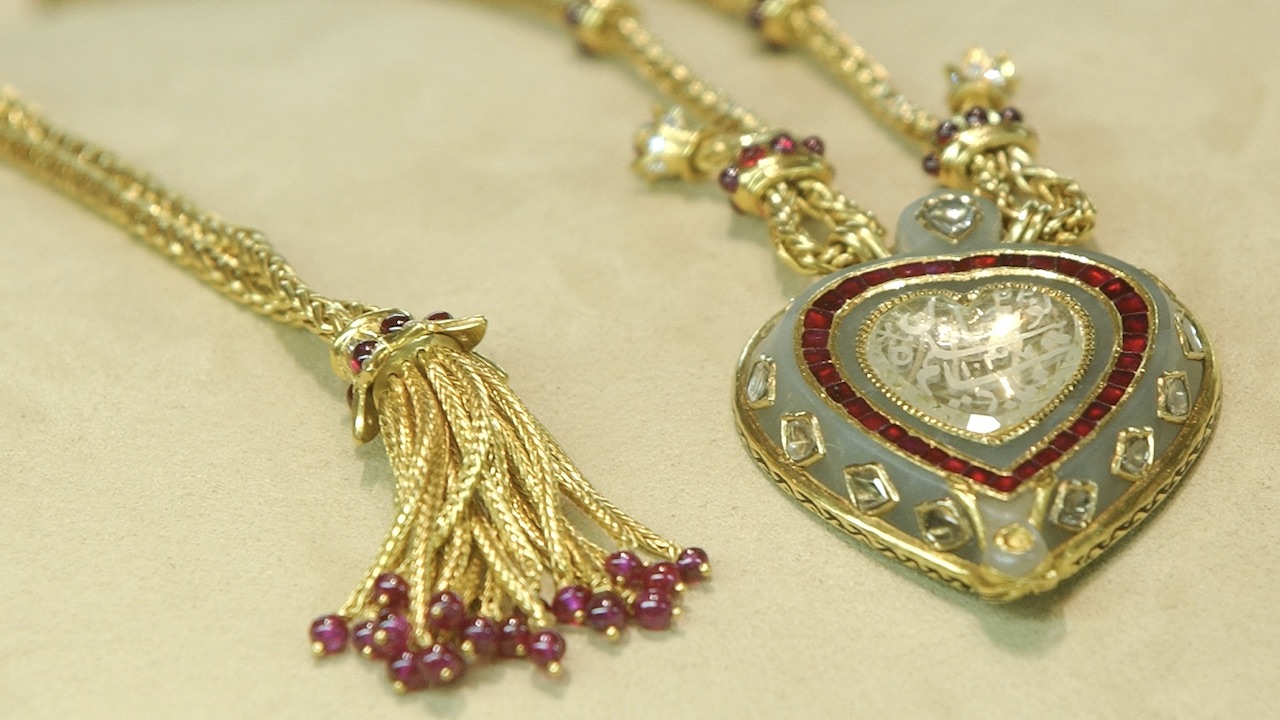
Although The New York Times misreported the details of the jewel’s Farsi inscription, Taylor knew it was engraved with “Nur Jahan,” the chief consort of the Mughal Emperor Jahangir. There are also numbers on the gem. Some experts think the number “23” refers to the regnal year. The number “1037” is thought to be a Mughal date from the Fasli calendar. It corresponds to the Western year 1627, the year of Jahangir’s death.
In all likelihood, the legendary backstory about the diamond was shared with Rosemarie Kenmore when she purchased the jewel in India. The story goes that Emperor Jahangir gave the engraved gem to Nur Jahan. The diamond was then passed down to their son, Mughal Emperor Shah Jahan, who gave it to his true love, Mumtaz Mahal. When Mumtaz died during childbirth in 1631, the emperor had the Taj Mahal built as a memorial to her.
There’s no doubt that the “Taj Mahal Diamond” name was added much later. It doesn’t align with the origin story. The moniker feels like a Western shorthand nod to the history. It is not mentioned in the primary press coverage from the 1970s.
Currently, there is no trace of the Taj Mahal Diamond’s story in historical records before it emerged on the open market in 1970. When we spoke with Courtney Stewart, an Islamic art and jewelry historian and gemologist, about it, she pointed out details that either add to the legend or draw the background into question. She tells Only Natural Diamonds, “There are no other diamonds in existence, or even from what I know in textual references in the Mughal period, that have a woman’s name inscribed on them.”
The scholar made another interesting observation relating to the jade setting. “I believe the diamond was inscribed first. Then, at a later date, it was cut to fit into the heart-shaped opening in the jade setting,” Stewart explains. “The numbers are cut off, like falling off the edge of the diamond at the upper right.”
Elizabeth Taylor Wore the Taj Mahal Diamond On a Trip to Iran
While the early chapters of the Taj Mahal Diamond are not certain, there is no question that Elizabeth Taylor’s acquisition of the jewel added immeasurably to its history. She was photographed wearing the Taj Mahal Diamond at many high-profile events throughout her life. The most striking images were taken during a 1976 trip to Iran with her friend Firooz Zahedi, a budding photographer in his twenties.
“She was in a relationship with my cousin, Ardeshir Zahedi, who was the Iranian ambassador to Washington,” explains Zahedi. “He asked me to escort her around. It was a very good time to be there before the Islamic Revolution.”
Taylor and Zahedi visited historical sites and shopping destinations. At one of the bazaars, she bought many “colorful fabrics and clothing that women from various tribes would’ve worn,” recalled Zahedi. Back in her hotel suite, Taylor asked Zahedi and her assistant, Arthur Bruckel, who also doubled as her hairdresser, to arrange the fabrics across the couch for a picture.
“She came out of the bedroom wearing one of the outfits with the Taj Mahal Diamond hanging from her forehead,” remembers Zahedi. “As an actress, she liked to put on costumes. She created a look somewhat out of the Arabian Nights that you would see in a Hollywood production. The full image I took shows her torso, but I told the guy doing the prints for me to zoom in on her face because it was so powerful.”
Taylor told Zahedi the story of the Taj Mahal Diamond. “It was among all the jewels she brought on the trip,” he recalled. “She had them laid out in boxes from Van Cleef & Arpels, Bulgari, Cartier, and more all over her hotel room. She traveled with so much jewelry, because she didn’t have a home in the States at the time, just her chalet in Gstaad.” It’s an extraordinary memory that might sound like a legend if Zahedi had not been there to witness it and add to it with his photographs.