
Step Inside “Queen Elizabeth II: Her Life in Style,” the New Exhibition
Explore the diamonds, jewels, and fashion inside Buckingham Palace’s new exhibition, Queen Elizabeth II: Her Life in Style.
It seemed almost too timely to be true that, in the same week as the inaugural World Diamond Day, Buckingham Palace opened Queen Elizabeth II: Her Life in Style, its new exhibition celebrating the late Queen’s fashion and legendary jewels.
After all, is there anyone more synonymous with diamond jewelry than Her Late Majesty? Many of her most iconic pieces are displayed throughout the blockbuster retrospective, some alongside the outfits she once wore with them. This offers a dazzling look at the world’s most famous monarch and the signature style that defined her eras.
Meet the Expert
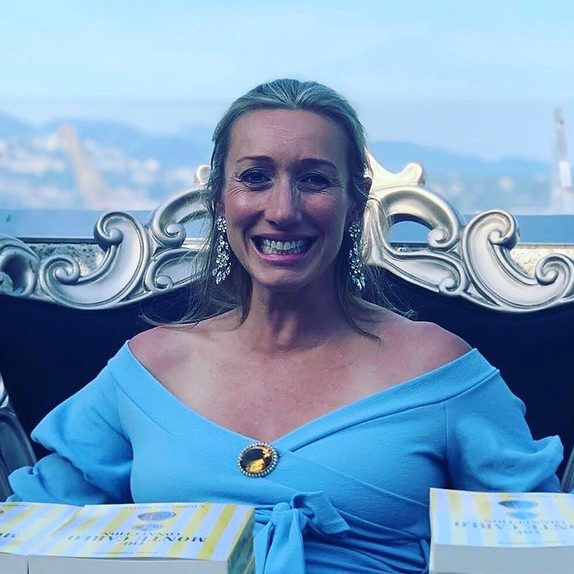
- Josie Goodbody is a jewelry historian, novelist, and communications specialist with a passion for storytelling and the world of high jewelry.
- Goodbody is the author of the Jemima Fox mystery series, blending intrigue with dazzling jewels, and her work has appeared in the Daily Mail and Rapaport.
Queen Elizabeth II’s First Diamond
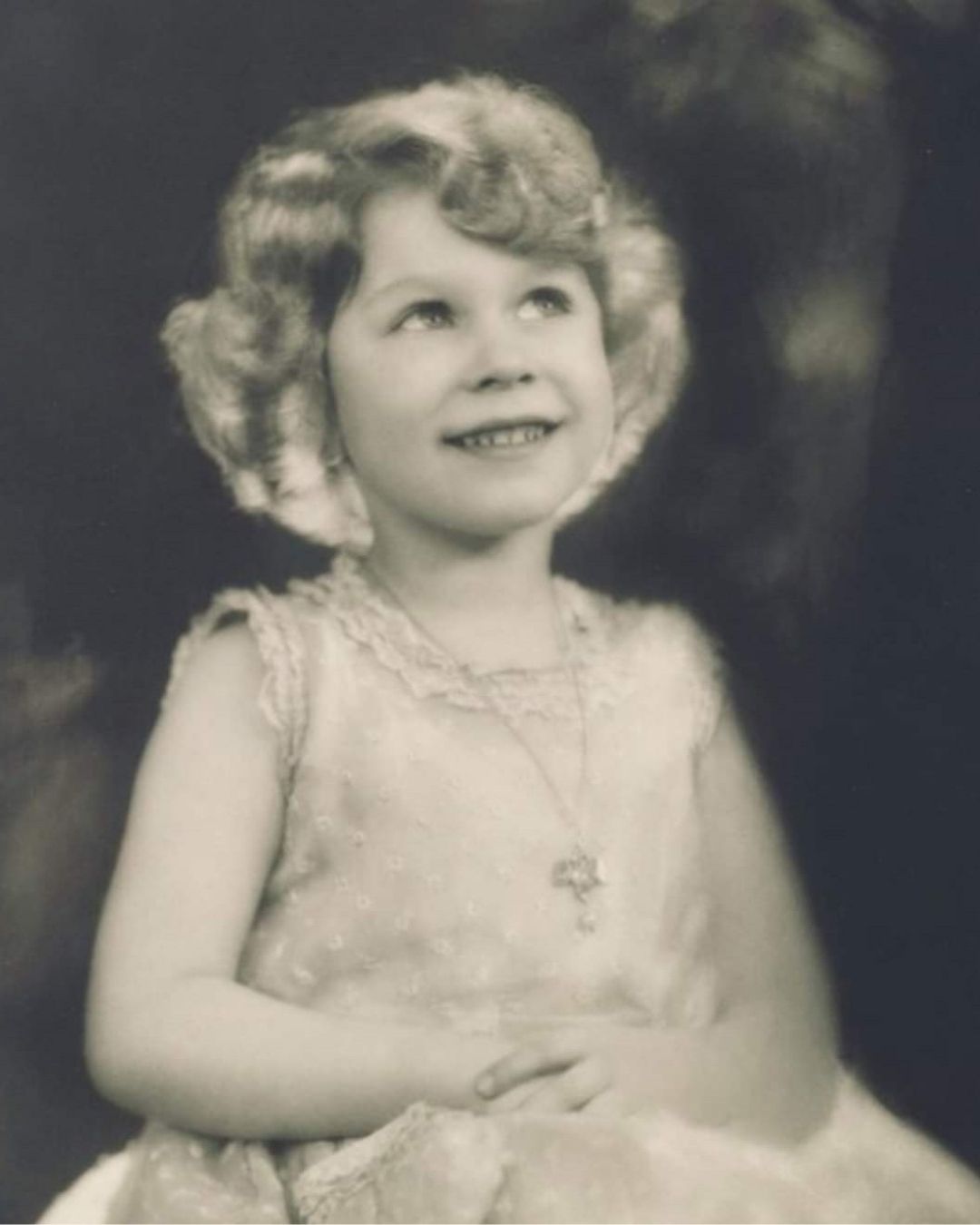
The first piece of jewelry the Queen wore in an official photograph at just nine months old was, unsurprisingly, not diamonds. Though her godmother, Princess Mary, did gift her a diamond and sapphire brooch for her christening, the young princess wore a sweet pink coral bead necklace that had once belonged to her mother as a child. She continued to wear it often until around age ten.
Still, diamonds were never far from the picture. In the official portrait marking her fifth birthday in 1931, Princess Elizabeth is seen wearing a diamond pendant that once formed part of Queen Alexandra’s famed Indian Necklace. This was an early glimpse of the royal jewels that would later become inseparable from her image, many of which are now on display in Queen Elizabeth II: Her Life in Style.
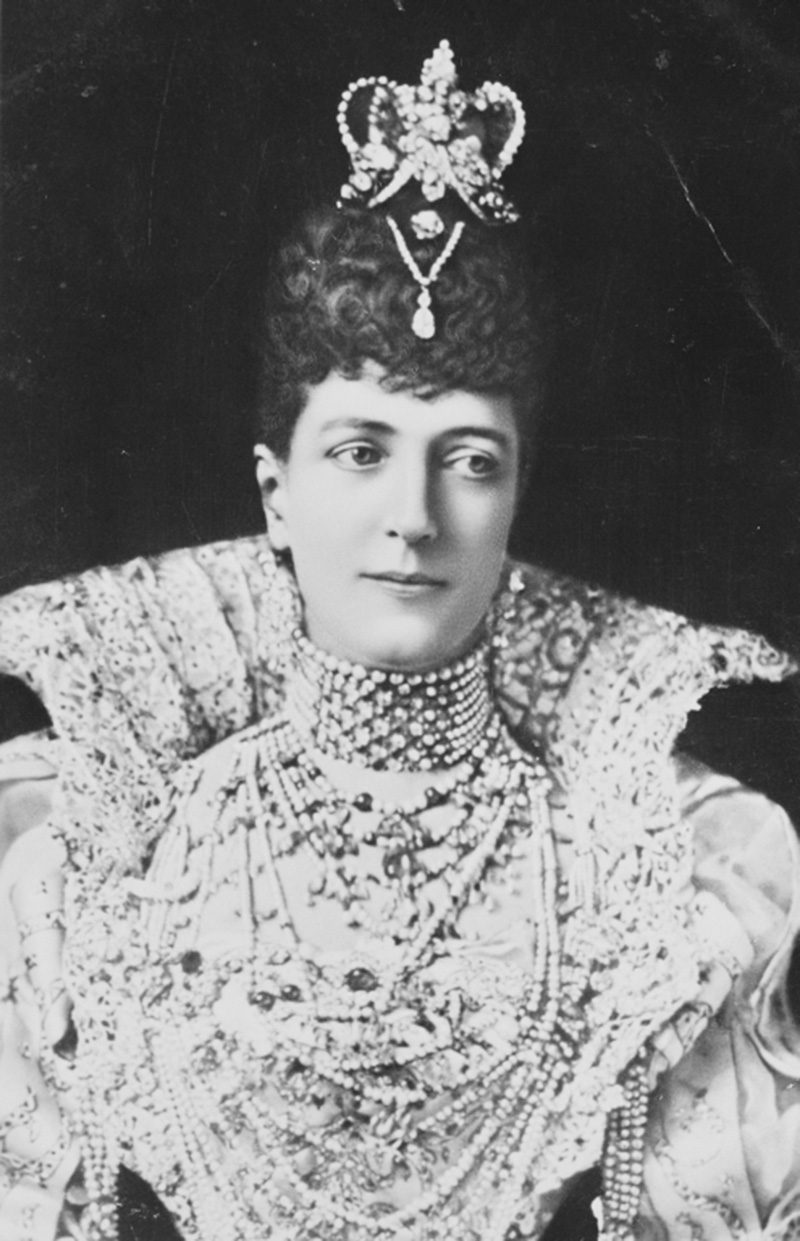
For her 1863 wedding to the heir to the future King Edward VII, Princess Alexandra of Denmark received a parure of Indian jewels from Queen Victoria, her mother-in-law. This gold suite included a dramatic seven-row bib necklace set with emerald and pearl beads, along with a series of diamond pendants.
According to Leslie Field’s 1992 book, when Queen Mary, Princess Elizabeth’s grandmother, later inherited the jewels, she dismantled the necklace and gifted one of the diamond pendants to her first granddaughter, Princess Elizabeth. She would later pass the piece down to Princess Anne.
The Royal Jewels on Display in Queen Elizabeth II: Her Life in Style
The Queen’s very first diamond necklace may not be included in the exhibition, but one of her most fabulous diamond necklaces certainly is: the piece gifted to her by the Government and Union of South Africa.
The South Africa Necklace
This milestone birthday was declared a national holiday in South Africa, where two balls were held in her honor: one at Cape Town’s City Hall and another at Tuynhuys, the government residence where the royal family was staying. It was during the latter celebration that Field Marshal Jan Smuts presented Princess Elizabeth with the supremely special diamond necklace.
To mark the milestone birthday, the platinum necklace was designed with 21 graduated round brilliant South African diamonds, the largest weighing 10 carats. Each diamond was interspersed with a baguette-cut diamond and two smaller brilliants.
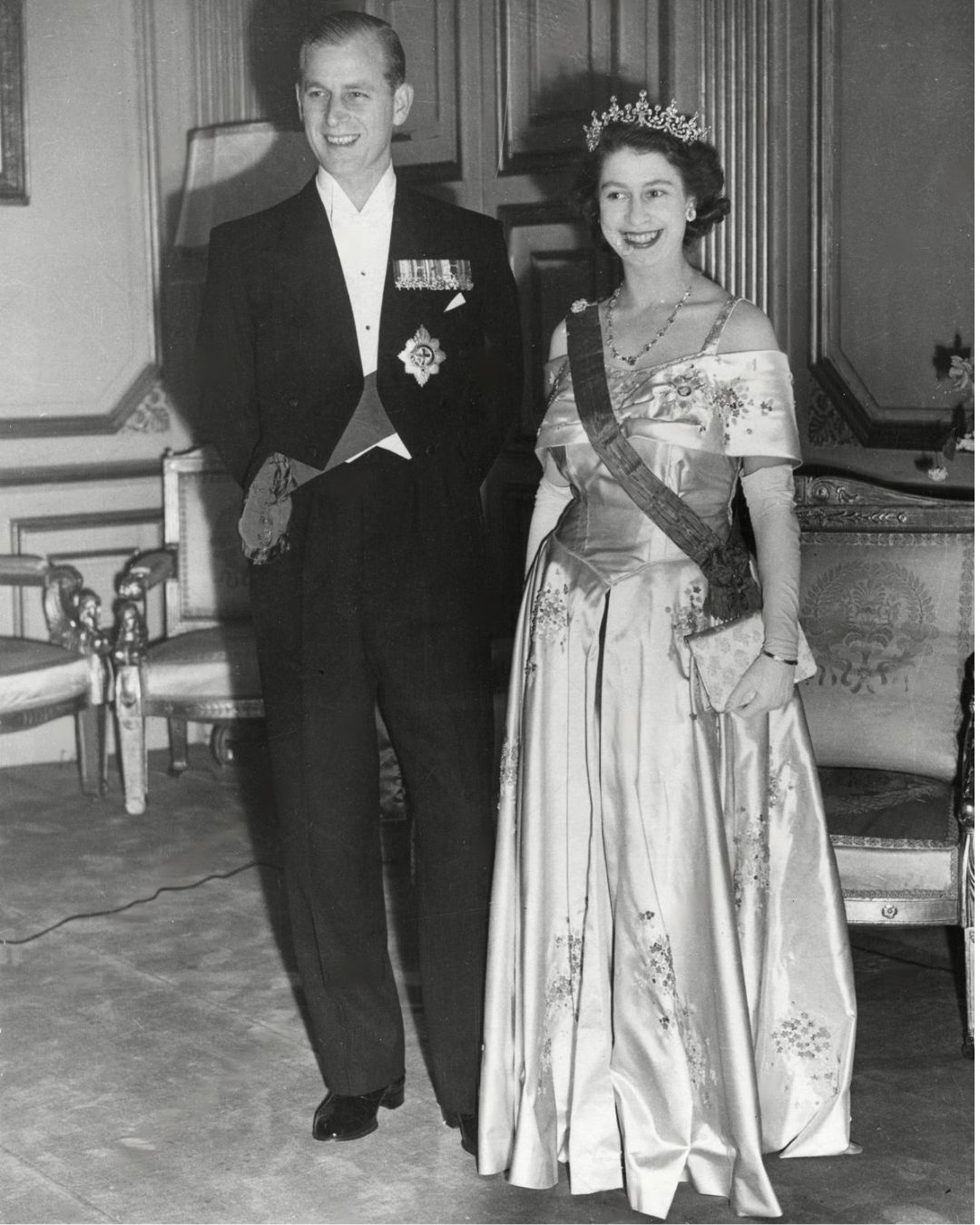
Princess Elizabeth can be seen wearing the piece in a photograph with Prince Philip in Paris shortly after their wedding. In 1952, however, Garrard reworked the necklace into two separate pieces: a necklace set with 15 diamonds and a bracelet featuring the remaining six. Both undeniable standouts are now displayed in the exhibition’s main jewelry cabinet.
She was later presented with a six-carat diamond by Mary Oppenheimer, granddaughter of Sir Ernest Oppenheimer, which was incorporated into the South Africa Necklace as a sparkling snap clip.
The Brazilian Aquamarine Tiara
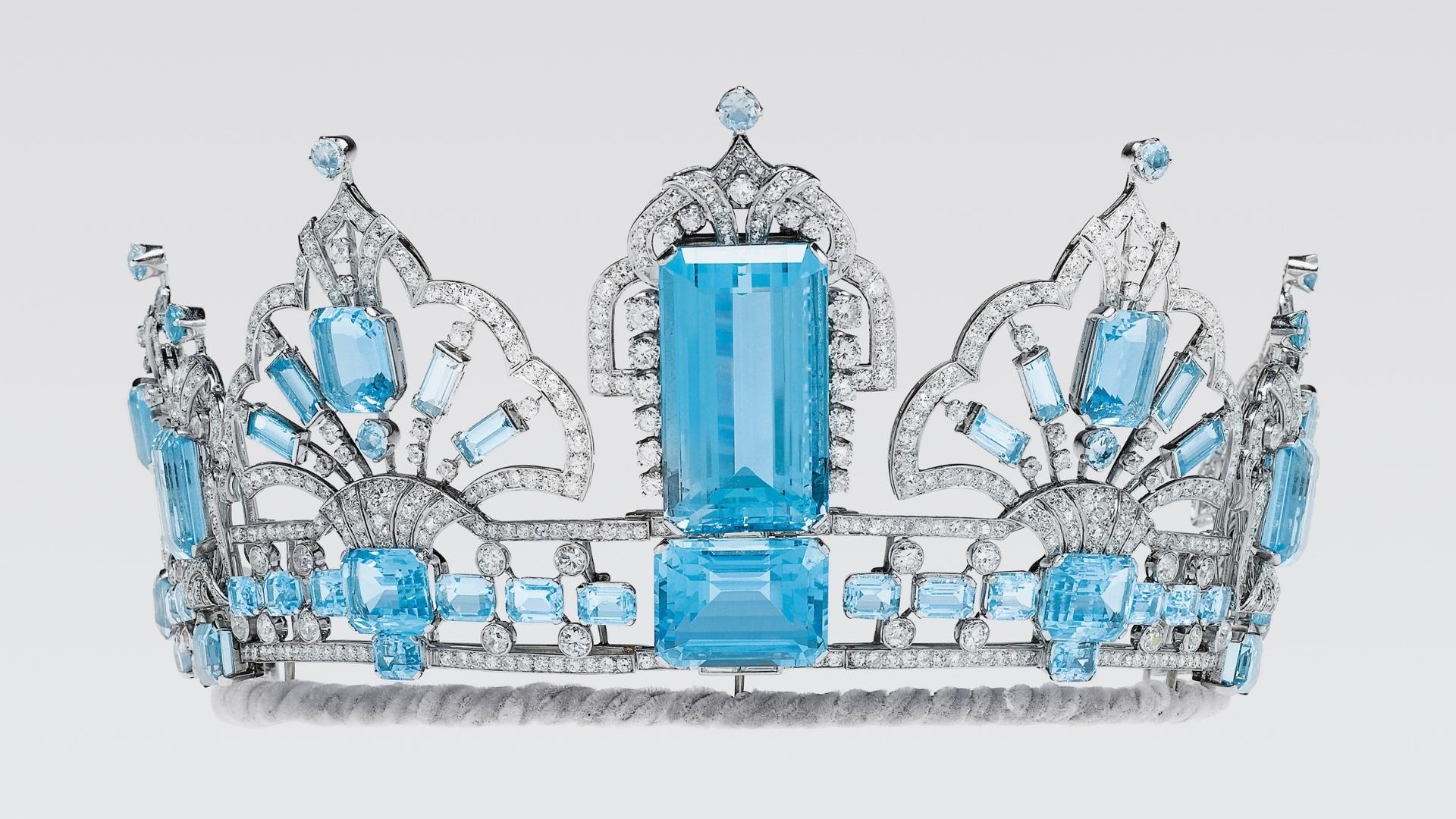
The jewelry cabinet at Queen Elizabeth II: Her Life in Style also features two spectacular tiaras commissioned by the Queen herself: the Brazilian Aquamarine Tiara and the Burmese Ruby Tiara. The former began as a smaller design, created by Garrard in 1957 to complete a full parure with the diamond and aquamarine necklace and earrings given by Brazil for her coronation four years earlier. Queen Elizabeth II first wore the original iteration at the royal film premiere of Les Girls, alongside Jayne Mansfield.

In 1971, Garrard dramatically expanded the tiara using aquamarines taken from a brooch and hair ornament given to Her Majesty during a 1968 State Visit to Brazil. Four scroll-shaped motifs, set with brilliant cut diamonds and topped with striking aquamarines, were added to the original design.
The aquamarines, known as Santa Maria aquas, are prized for their especially vivid blue hue. The late Queen wore the tiara on numerous occasions, including at a 2017 State Banquet for the King and Queen of Spain. It is now worn by Sophie, Duchess of Edinburgh.
The Burmese Ruby Tiara
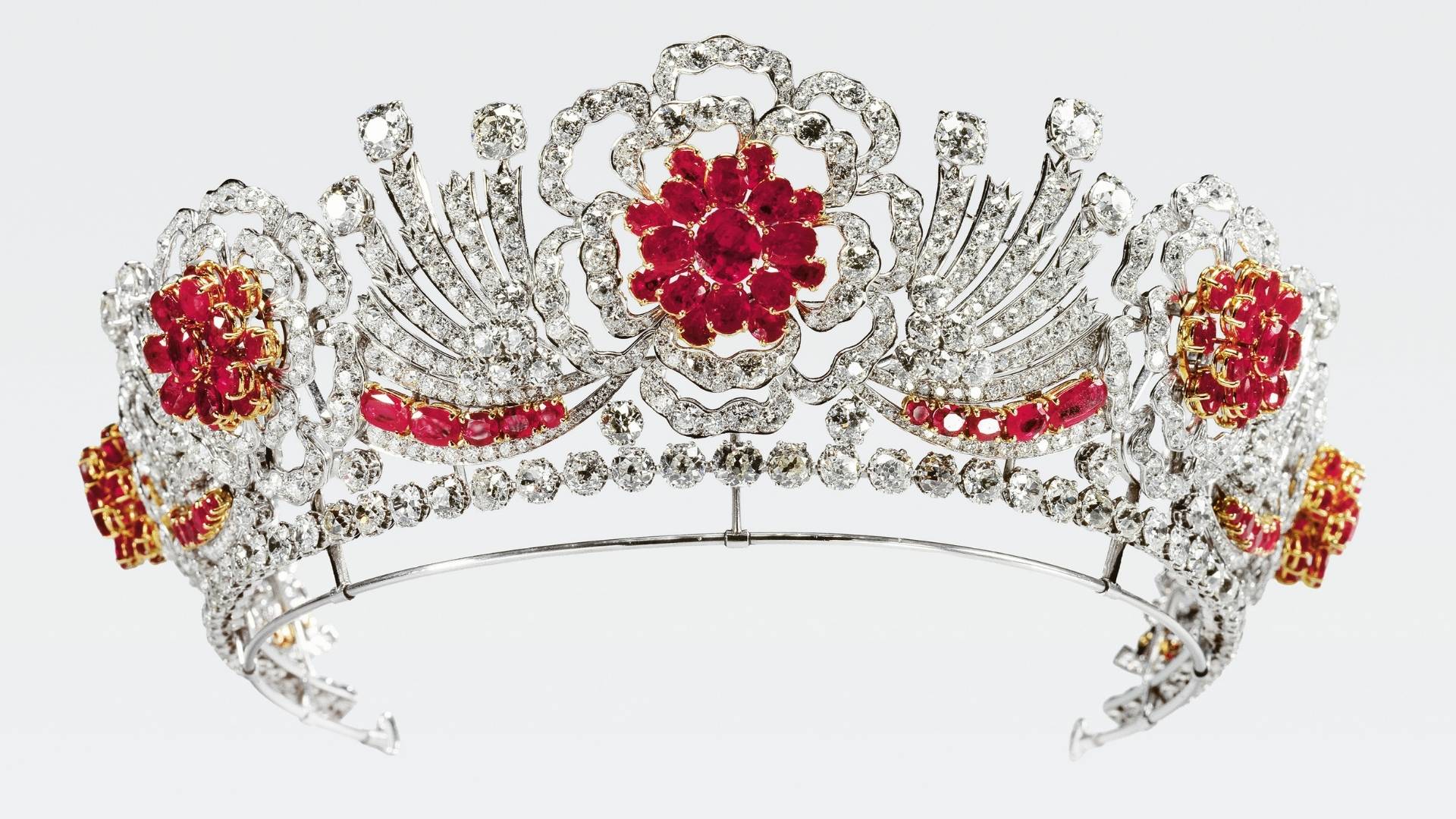
The second tiara featured in the jewelry cabinet at Queen Elizabeth II: Her Life in Style is the Burmese Ruby Tiara, created by Garrard in 1973 using diamonds that had previously been set in Cartier’s Nizam of Hyderabad Tiara.
Princess Elizabeth selected this floral diamond tiara, along with a necklace now included in the exhibition, as a wedding gift from the Nizam of Hyderabad.
Set among the diamonds are 96 rubies gifted to the then-princess by the people of Burma in 1947 for her wedding to Prince Philip. According to Burmese tradition, the stones were believed to protect their wearer against 96 different illnesses.

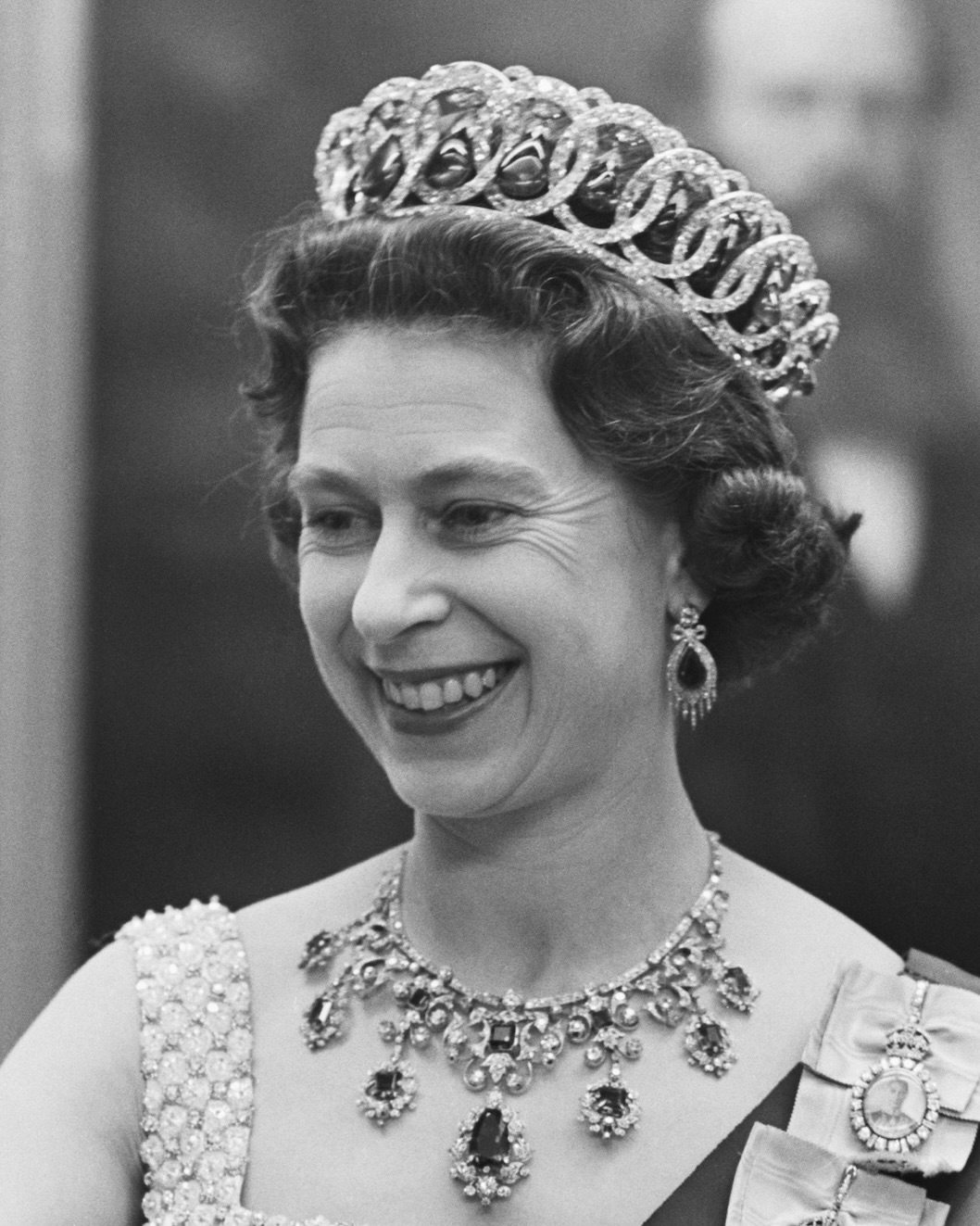
The result was Her Late Majesty’s first and ultimately only true ruby and diamond tiara, one she frequently alternated with another favorite, the Girls of Great Britain and Ireland Tiara. Designed with heraldic rose motifs symbolizing England’s Tudor Rose, the Burmese Ruby Tiara became one of the Queen’s most recognizable evening jewels.
Nizam of Hyderabad Necklace
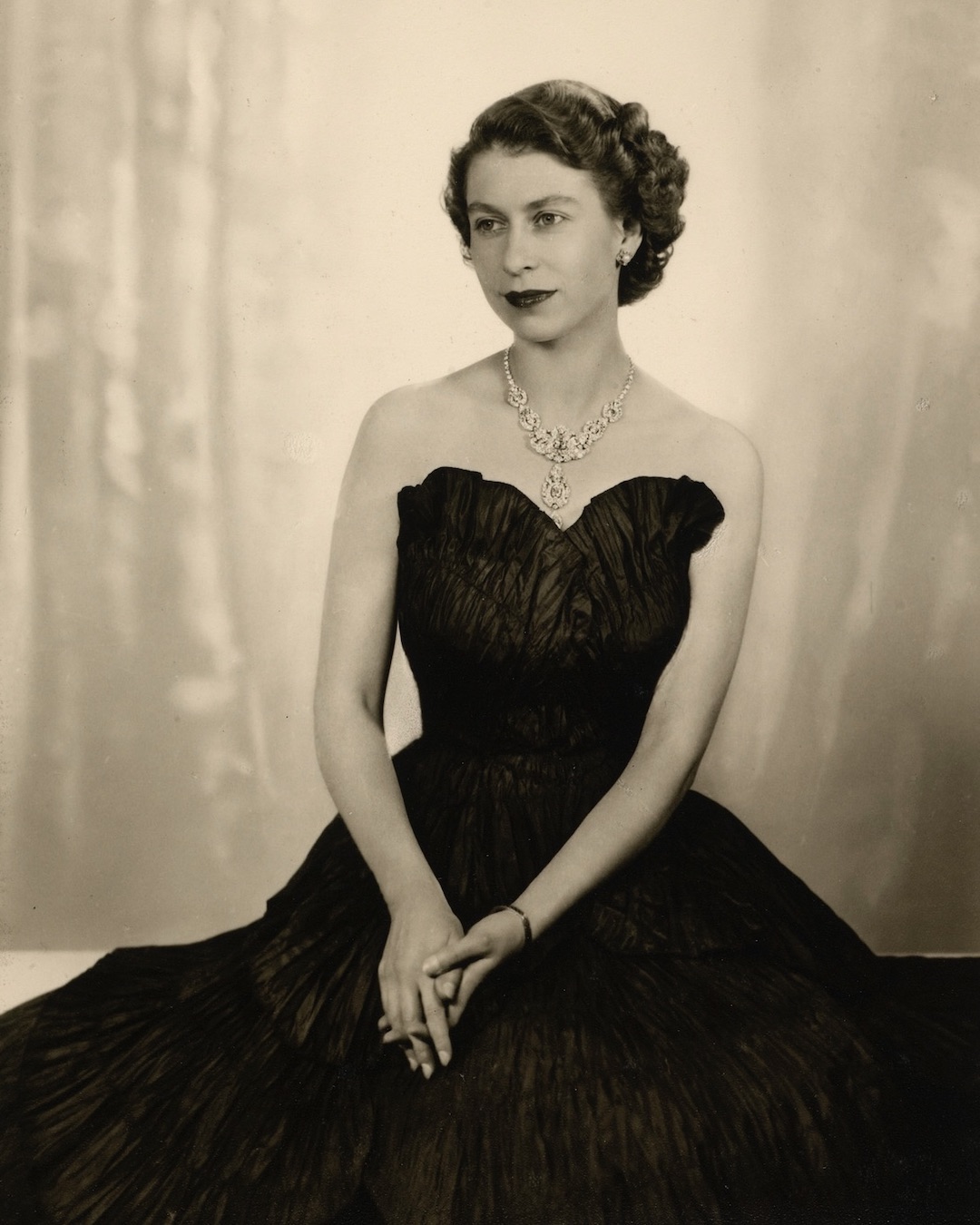
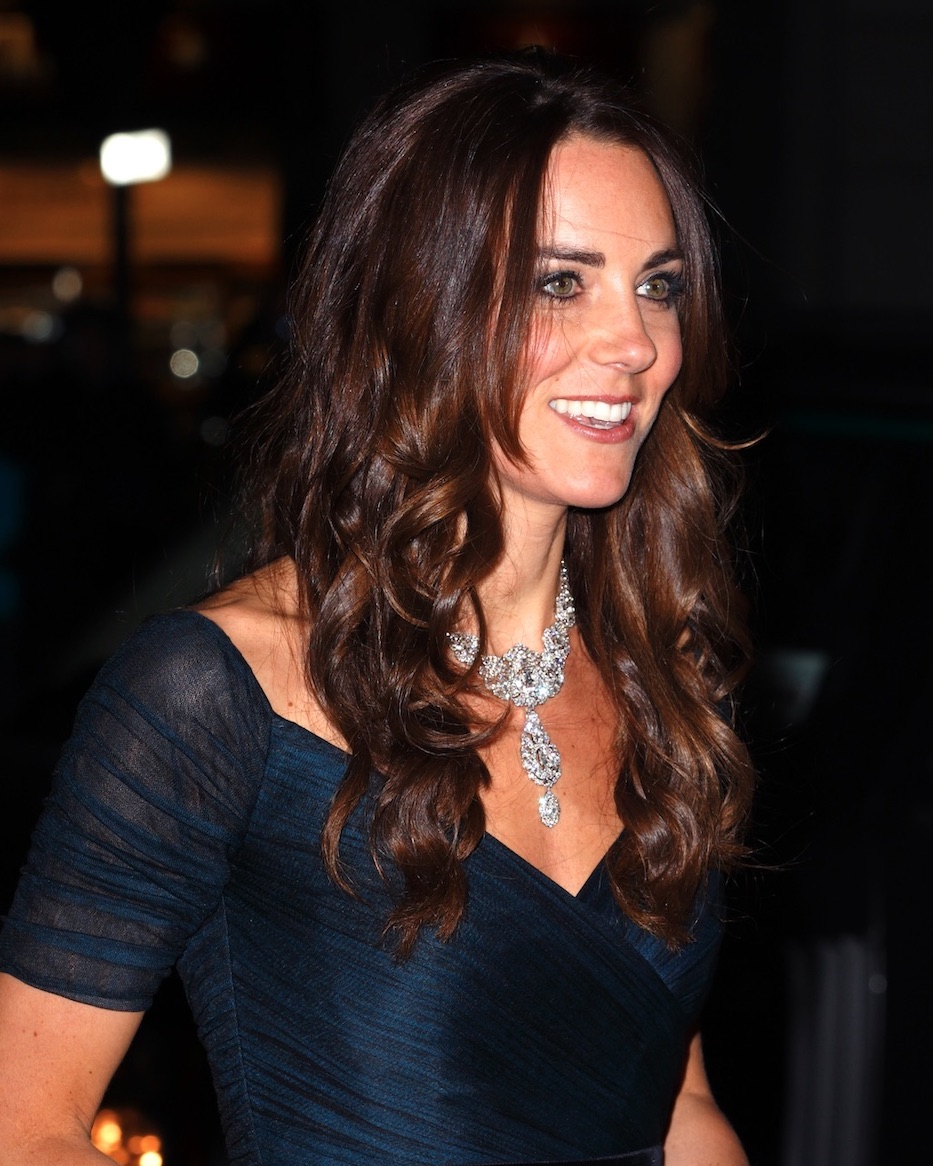
The Nizam of Hyderabad Necklace is one of the most spectacular diamond necklaces in the Royal Collection. Recently, it was worn by Catherine, Princess of Wales. As mentioned above, Princess Elizabeth selected the piece herself from Cartier London as part of her wedding gift from the Nizam.
When Cartier first photographed the necklace in 1937, the design featured four additional pendants, two on either side of the central drop that remains today.
Other Royal Jewels on Display in Queen Elizabeth II: Her Life in Style
Other pieces featured in Queen Elizabeth II: Her Life in Style include a Cartier diamond-and-sapphire bracelet given to Princess Elizabeth for her 18th birthday in 1944 by the King and Queen, as well as a diamond bracelet by Philip Antrobus, given to her by Prince Philip as a wedding present in 1947.
A playful Flower Basket Brooch, set with diamonds, sapphires, emeralds, and rubies, was another gift from her parents for Christmas in 1944. Also on display is the yellow-and-white diamond Wattle Brooch, a gift from the people and government of Australia, which has become one of the Queen’s most recognizable brooches.
As a young princess, Elizabeth would have grown up watching her grandmother, Queen Mary, resplendent in diamonds – ropes of pearls and diamonds layered around her neck, glittering brooches pinned to hats, jackets, and gowns alike. Her mother, Queen Elizabeth the Queen Mother, was not quite so swathed, but was rarely seen without substantial jewels for formal occasions and elegant everyday pieces for everything in between.
As a Queen, Elizabeth II would have understood better than anyone the importance of jewels to the role of monarchy. She would also become the last royal to wear a tiara to a film premiere, thanks (or not!) to changing times. After all, there were famously no tiaras at King Charles III’s 2023 coronation.
Elsewhere in Queen Elizabeth II: Her Life in Style, diamond jewels are displayed on mannequins alongside the gowns they were originally worn with, bringing many of the late Queen’s most memorable looks vividly back to life.
Of course, this superlative exhibition, staged to mark the centenary of Her Late Majesty’s birth in 1926, is primarily fashion-focused. While visitors will immediately recognize the Queen’s most iconic ensembles, there are just as many looks that may prompt a second glance. After a 70-year reign, it is easy to associate Queen Elizabeth II with the later decades of her life; instead, the exhibition traces the many eras of her personal style from childhood onward.
Queen Mary’s Fringe Tiara and the Queen’s Wedding Day Diamonds

Caroline de Guitaut, now Surveyor of The King’s Works of Art and formerly Surveyor of the Queen’s Works of Art, curated the exhibition with the intention of recreating examples of complete ‘outfits’ worn, jewels included. And four standout displays really bring the magnificent jewels to life – beginning with the Queen’s glorious wedding gown.
The first true showstopper appears at the end of a long walkway, surrounded by items spanning the Queen’s life: an adorable buttercup-yellow silk fairy costume with wings, worn when she was just three or four years old and later by Princess Margaret; the robes and coronation dress worn for her parents’ 1937 coronation in Westminster Abbey; and, of course, the small gold coronet created by Garrard that the young princess wore that day – the very first in what would become a lifetime of legendary diadems.
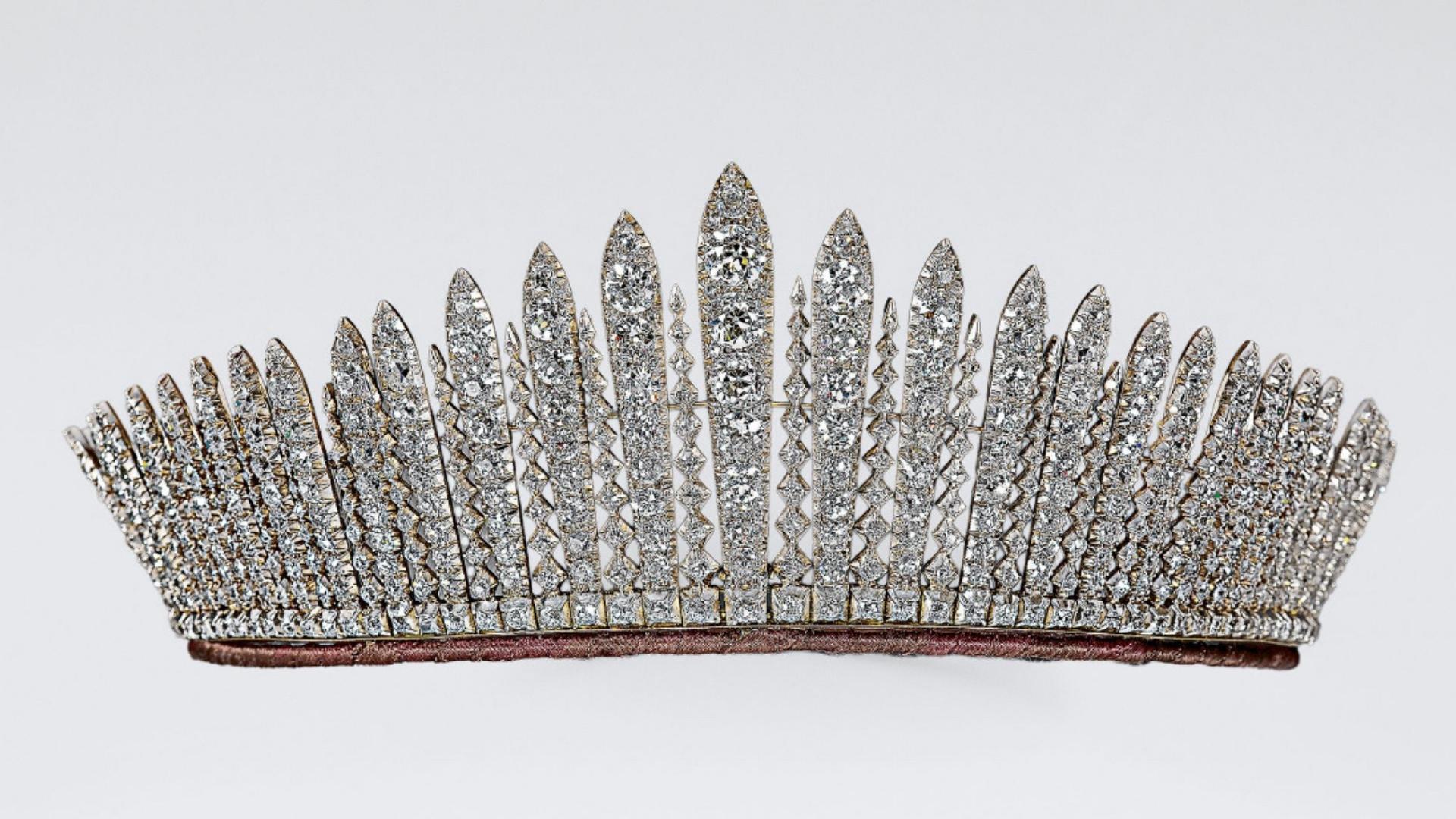
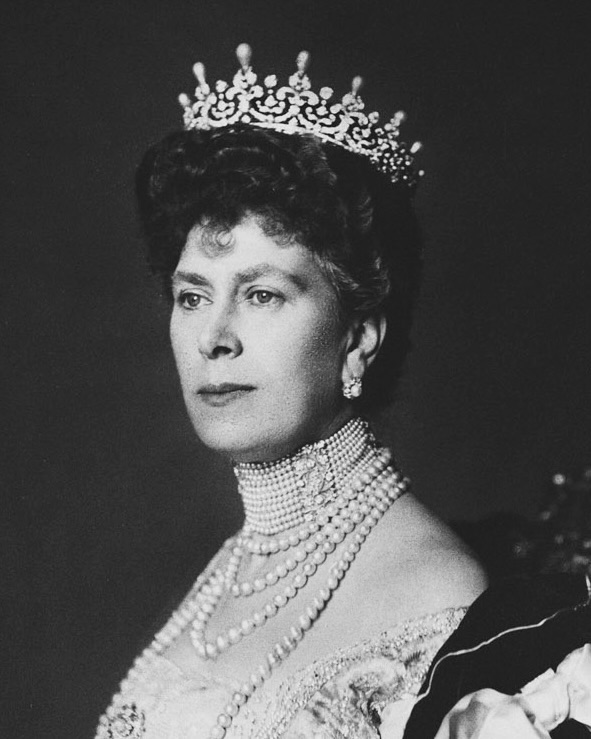
But it is the cabinet containing a mannequin fully dressed in the late Queen’s wedding ensemble that truly draws visitors in. Displayed together are her gown, veil, shoes, and, of course, the utterly splendid jewels exactly as she wore them on that November day in 1947. Most striking of all is Queen Mary’s Fringe Tiara, famously worn by Princess Elizabeth on her wedding day after it unexpectedly broke just moments before she was due to leave Buckingham Palace with her father for Westminster and had to be hurriedly repaired.
Garrard created the tiara for Queen Mary in 1919, using diamonds taken from a delicate fringe necklace/tiara originally gifted to her by Queen Victoria as a wedding present in 1893 from Collingwood & Co. Queen Mary commissioned the tiara in the then-fashionable Russian Kokoshnik style, with Garrard using additional diamonds from a bracelet. In total, 633 brilliant-cut and 271 rose-cut diamonds were set in silver and gold on an adjustable frame, creating the glittering sunburst effect.
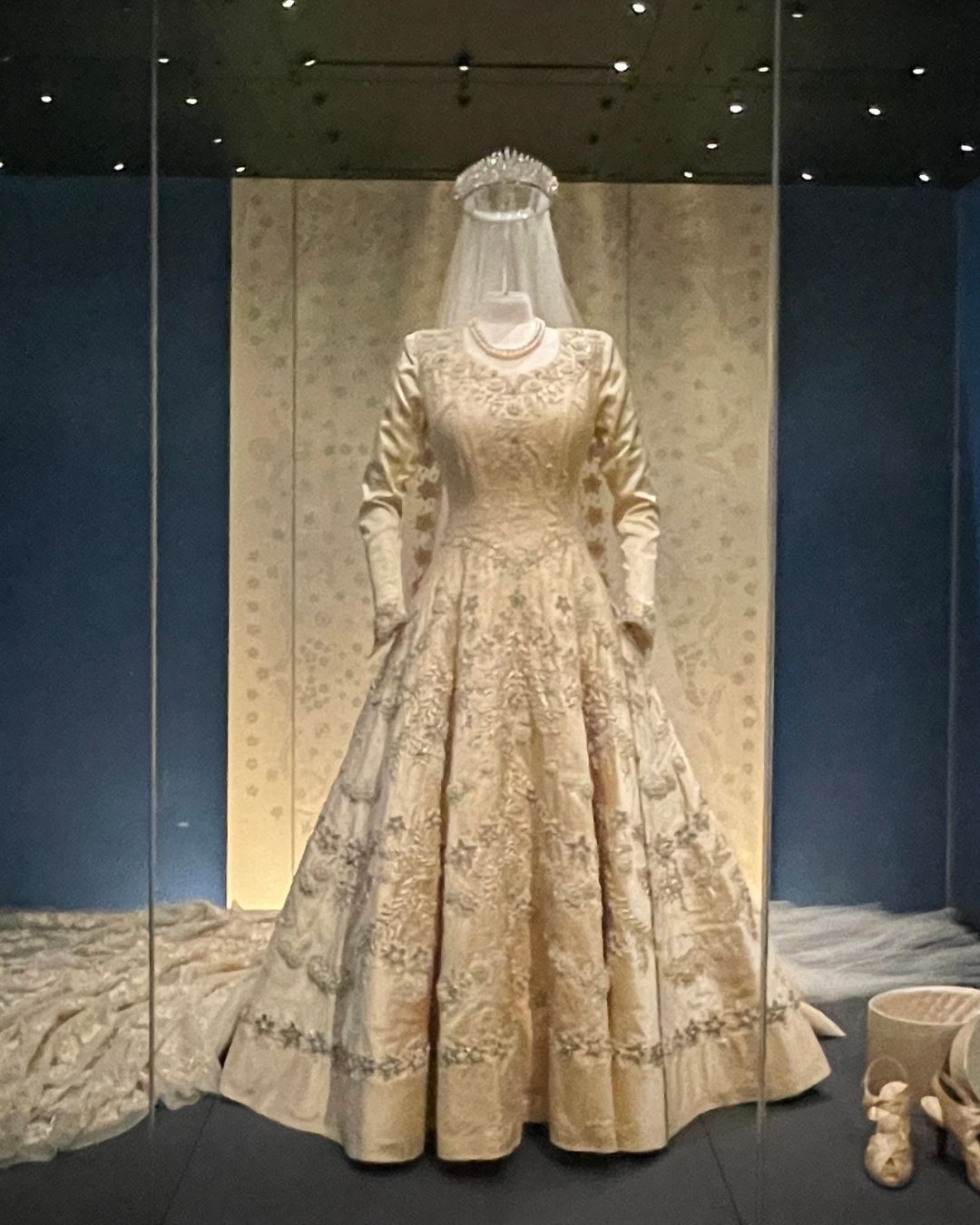
Around the 21-year-old princess’s neck, framed by the square line of Norman Hartnell’s exquisite gown, beautifully embellished with seed pearls, sequins, crystals, and bugle beads, sat two very old royal pearl necklaces, each composed of a single strand. The shorter necklace, made up of 46 pearls, had belonged to Queen Anne, while the slightly longer strand of 50 pearls once belonged to Caroline of Brunswick, the estranged wife of George IV. Both were gifted to Princess Elizabeth by her parents as a wedding present.
The gown’s delicate yet heavily embellished train stretched 13 feet, while the princess completed the look on the day with pearl-and-diamond cluster earrings and her engagement ring, set with diamonds from a tiara owned by her future mother-in-law, Princess Alice of Battenberg.
How Fashion and Jewels Come Together in Queen Elizabeth II: Her Life in Style
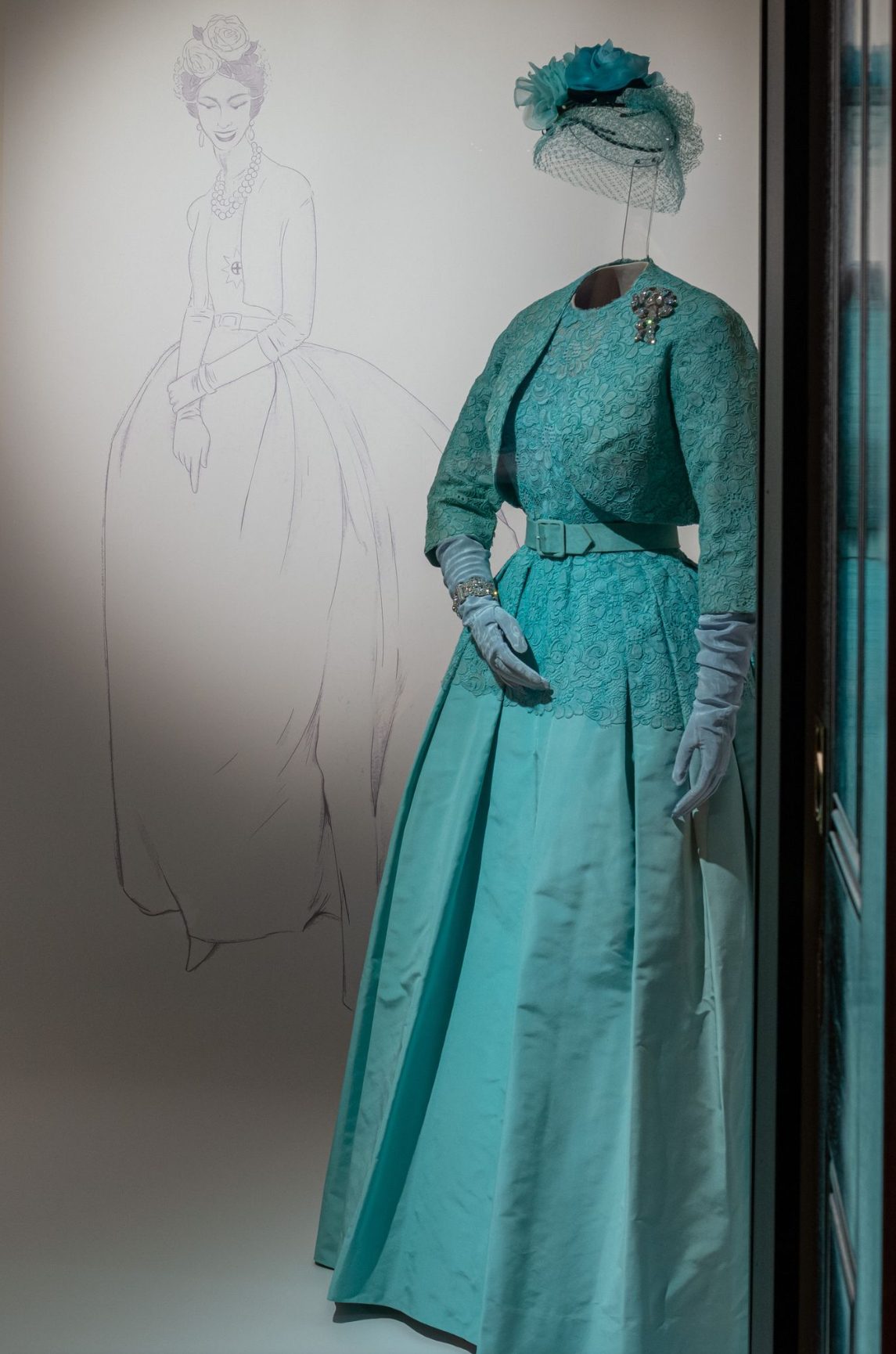
In the next room, filled nearly to the Palace Gallery’s rafters with mannequins dressed in the Queen’s fashions across the decades, visitors are also treated to two additional displays tucked into corner cabinets. The first features a striking sky-blue, almost kingfisher-toned, full-length gown paired with a bolero jacket: the ensemble Queen Elizabeth II wore to the 1960 wedding of her sister, Princess Margaret.
Pinned to the left shoulder is one of the many diamond bow brooches in the Royal Collection, and it is Queen Mary’s Lover’s Knot Brooch. Inherited from her grandmother in 1953, the 19th-century jewel had originally been purchased by Garrard for Queen Mary in 1932. It is possibly the fanciest of the Queen’s bow brooches, distinguished by articulated ribbon tails with scallop-edges that move with the wearer.
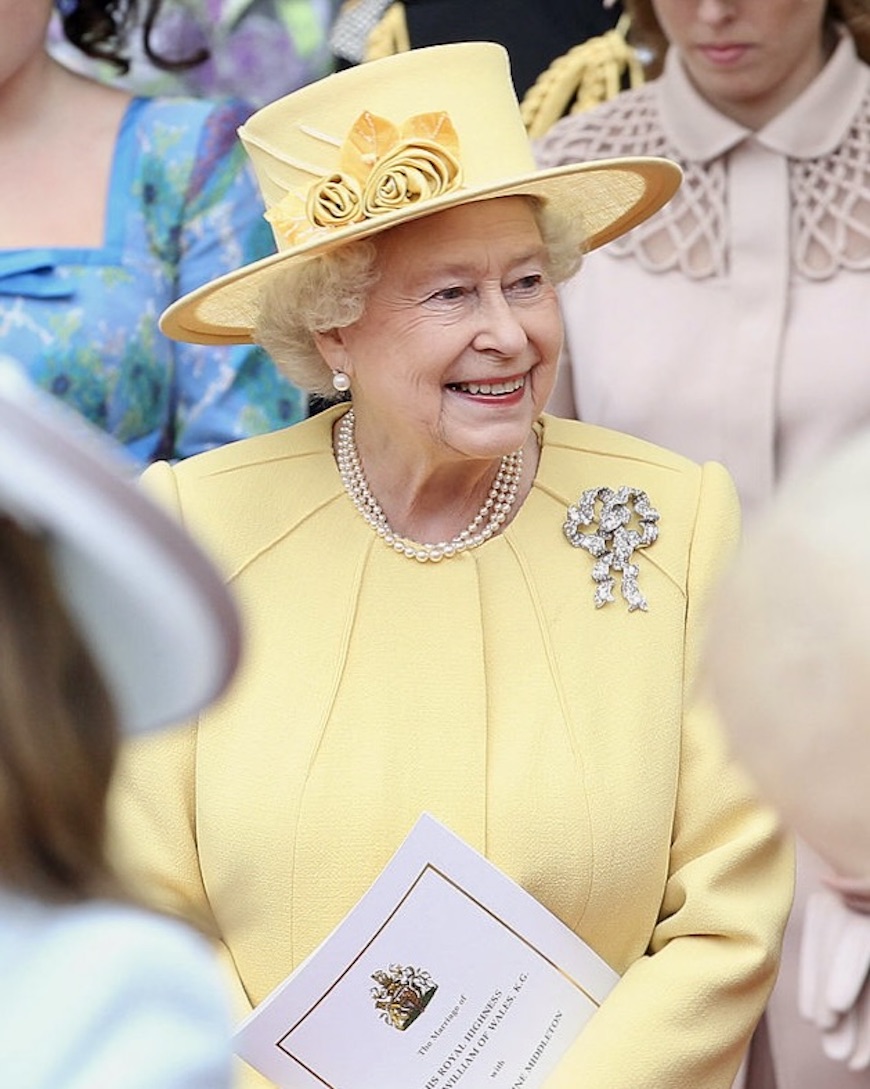
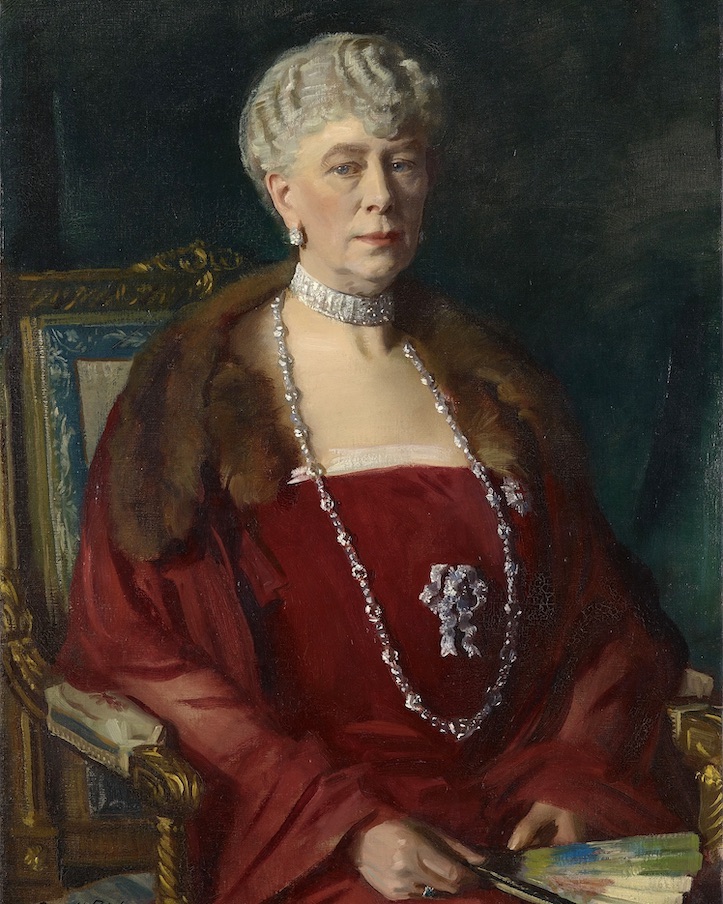
The brooch is set primarily with brilliant-cut diamonds of varying sizes, alongside several cushion-cut gems, which create the illusion of texture across the gold-and-silver setting. Completing the ensemble are two diamond bracelets, including the Antrobus bracelet commissioned by Prince Philip for their wedding in 1947, made with diamonds from the same tiara belonging to his mother that also supplied the stones for Princess Elizabeth’s engagement ring.
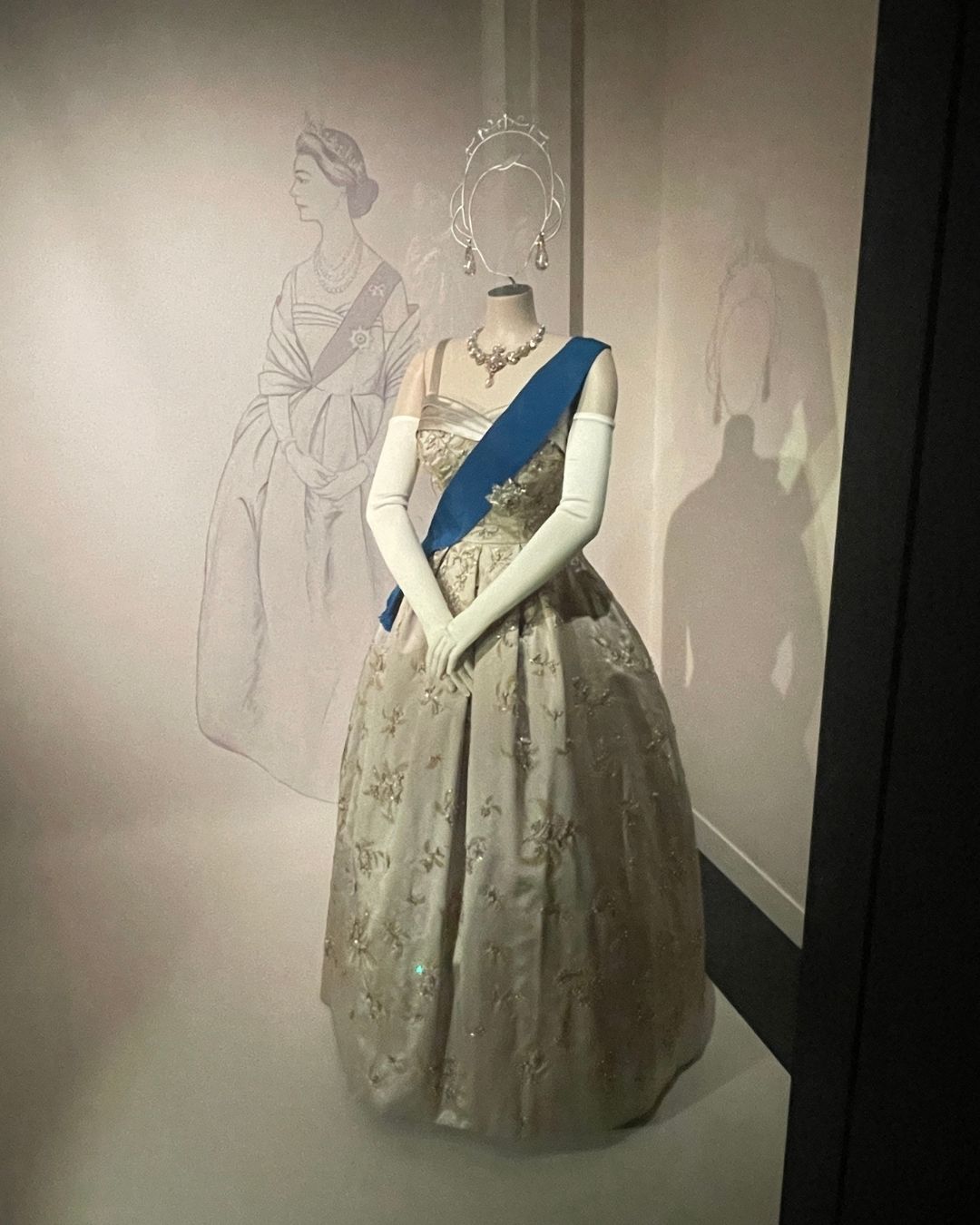
Another standout ensemble in Queen Elizabeth II: Her Life in Style is the pale-green Norman Hartnell gala gown the Queen wore to the 1957 State Dinner at the White House hosted by President Eisenhower. Embellished with crystals and pearls, the satin gown is displayed alongside Queen Victoria’s Golden Jubilee necklace, one of the most sumptuous jewels in the Royal Collection and a designated Crown heirloom beloved by both monarchs.
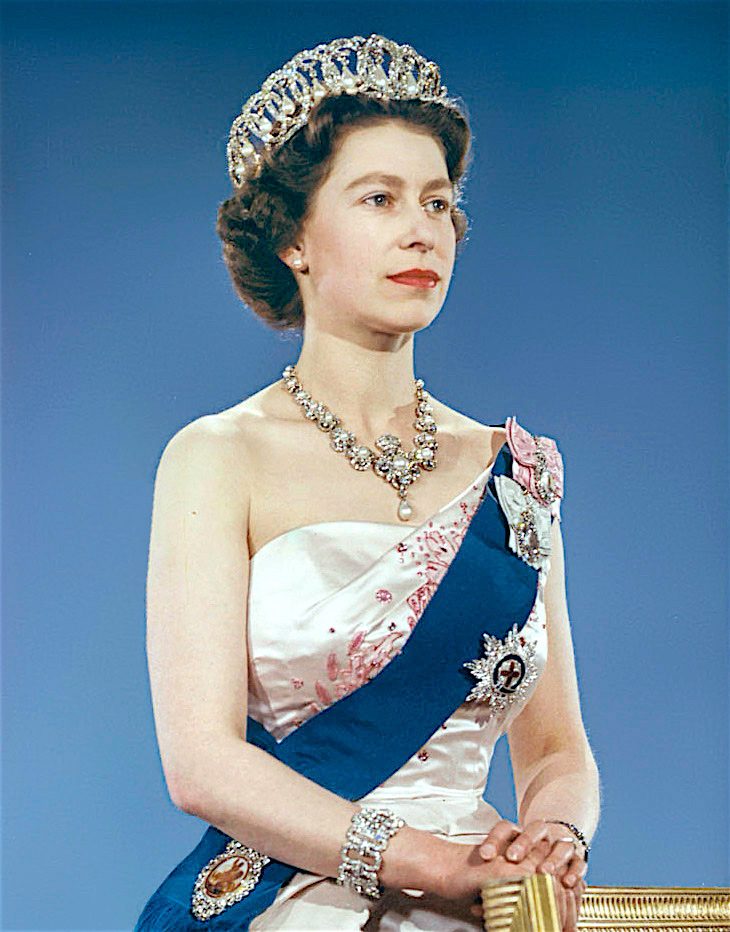
Created for Queen Victoria’s Diamond Jubilee in 1897, the necklace features brilliant-cut diamonds, pearls, and a crown motif suspended above a large pear-shaped pearl drop. Queen Elizabeth II frequently paired it with some of the Royal Collection’s most famous tiaras, including the Diamond Diadem and the Vladimir Tiara.
The display also included the magnificent Gloucester Earrings, pearl-and-diamond drops that originally belonged to Princess Mary, Duchess of Gloucester and Edinburgh. Like many royal jewels, they are transformable, but when worn by the Queen in 1957, huge pear-shaped pearls were suspended from pearl-and-diamond cluster studs within removable diamond frames, nearly skimming the necklace itself. That evening, the Queen also wore the Girls of Great Britain and Ireland Tiara.
The Coronation Treasures Inside the Exhibition
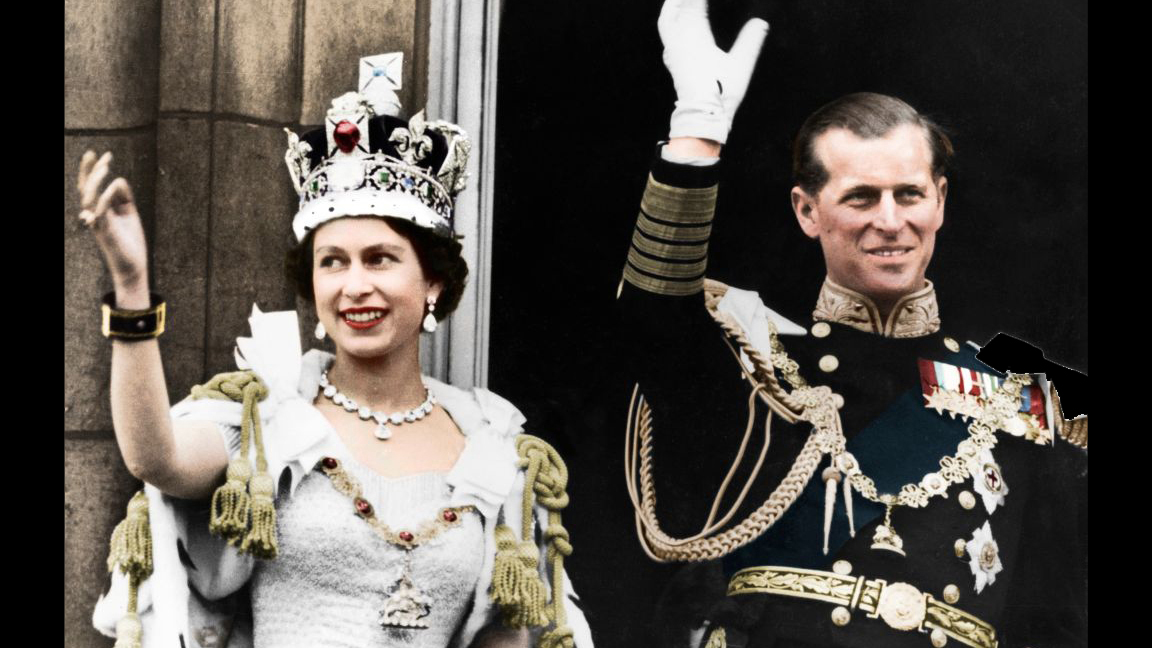
Of course, no exhibition concerning the style of Queen Elizabeth II is complete without her spectacular Coronation attire — splendidly shown near the end of the exhibition as one of its most breathtaking finales.
Norman Hartnell was entrusted with this most important garment of his career: the Coronation dress for the first reigning Queen since Queen Victoria a century earlier, and the first coronation ever televised live.
On June 2, 1953, an estimated 27 million people tuned in to watch the historic ceremony unfold at Westminster Abbey. My father, then 14 and away at boarding school, watched it on a tiny television set bought specially for the occasion, while his parents, my grandparents, were in Westminster Abbey.
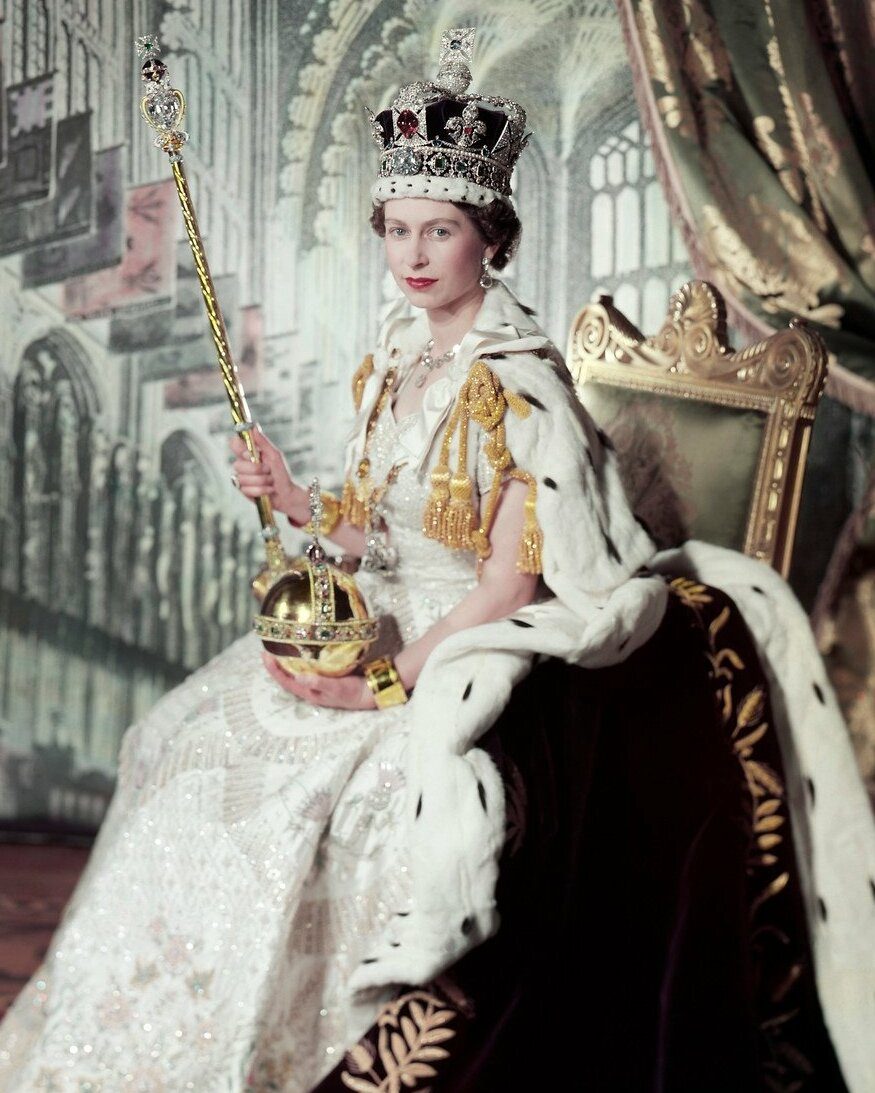
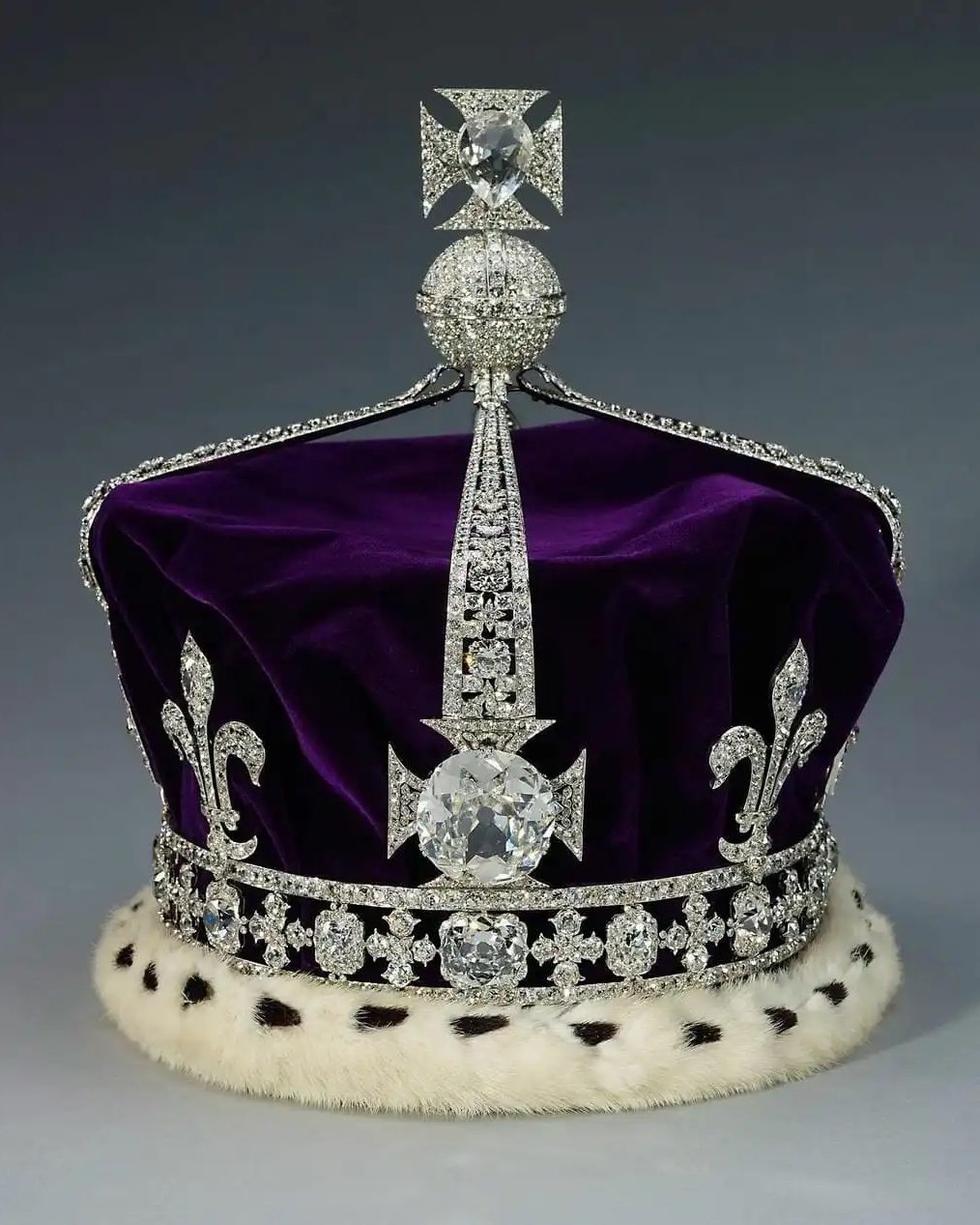
While neither the great diamond-set crowns nor the Diamond Diadem, nor the Coronation Necklace worn by Her Late Majesty that day are included in Queen Elizabeth II: Her Life in Style, the exhibition still offers remarkable coronation treasures.
Sitting almost anonymously alongside the spectacle of the gown is the Coronation fan gifted by the Worshipful Company of Fan Makers. Topped with a plume of ostrich feathers, its tortoiseshell handle is embossed with the royal cipher. Everything from Royal Mail post boxes to military insignia is adorned with this cipher, but here, fittingly, it is set with natural diamonds, a final sparkling tribute to Britain’s beloved “diamond Queen.”