
Inside the Fantastical World of Art Nouveau Jewelry
Diamond-dusted dragonflies, mermaid muses, and moonlit flowers—welcome to the magical world of Art Nouveau.
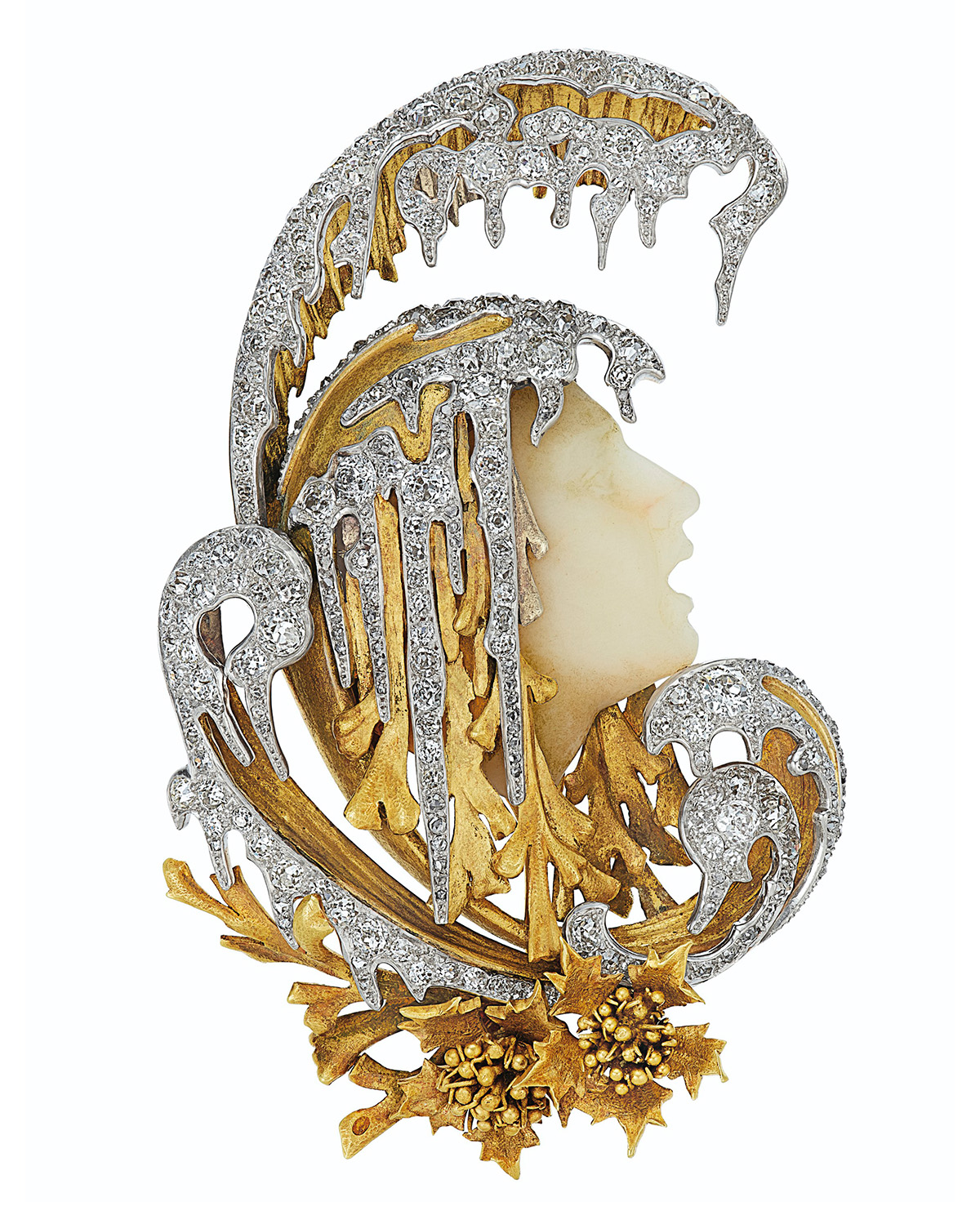
Art Nouveau Diamond and Hardstone Brooch, attributed to Gabriel Falguières. (Courtesy of Christie’s)
If you’ve ever fallen under the spell of jewelry with organic lines, colorful enamel or mythical female figures, you can probably thank Art Nouveau. Though the movement emerged in Europe in the late 19th century, it was heavily shaped by Japonisme, the obsession with Japanese art and design that swept the continent after Japan reopened to international trade in the 1850s. At the time, Art Nouveau felt radically modern. It broke away from the rigid symmetry and ornate formality of Victorian jewelry in favor of fluid lines and fantasy.
Suddenly, jewelry was filled with nature-inspired motifs that felt mysterious and alive. Designers embraced intricate enamelwork and unconventional materials alongside natural diamonds and gemstones, while visionary jewelers like René Lalique, Louis Comfort Tiffany, Georges Fouquet, and Henri Vever pushed jewelry into entirely new creative territory.
Meet the Experts
Elle Spurr is a researcher and writer at M.S. Rau, a legendary New Orleans antiques gallery. With a degree in Arts Administration from Simmons University, Elle honed her expertise through roles at institutions such as the Museum of Fine Arts, Boston, the Portland Museum of Art and the New Orleans Museum of Art.

Zuleika Gerrish is an antique, vintage, and fine jewelry expert as well as a gemmologist and co-founder of Parkin and Gerrish with her husband Oliver. Alongside running Parkin & Gerrish, she lectures on historic jewelry, sharing her expertise with new audiences.
Art Nouveau also transformed the role of natural diamonds in jewelry design. Instead of using diamonds purely as status symbols or formal center stones, Art Nouveau jewelers treated them more like artistic details within larger dreamlike compositions. Rose-cut and old mine-cut natural diamonds were paired with enamel, opals, moonstones, and carved horn to mimic dewdrops, insect wings, and other ethereal elements inspired by nature. For perhaps the first time, natural diamonds became less about perfection and symmetry and more about atmosphere, artistry, and emotion.
What Defines Art Nouveau Jewelry?
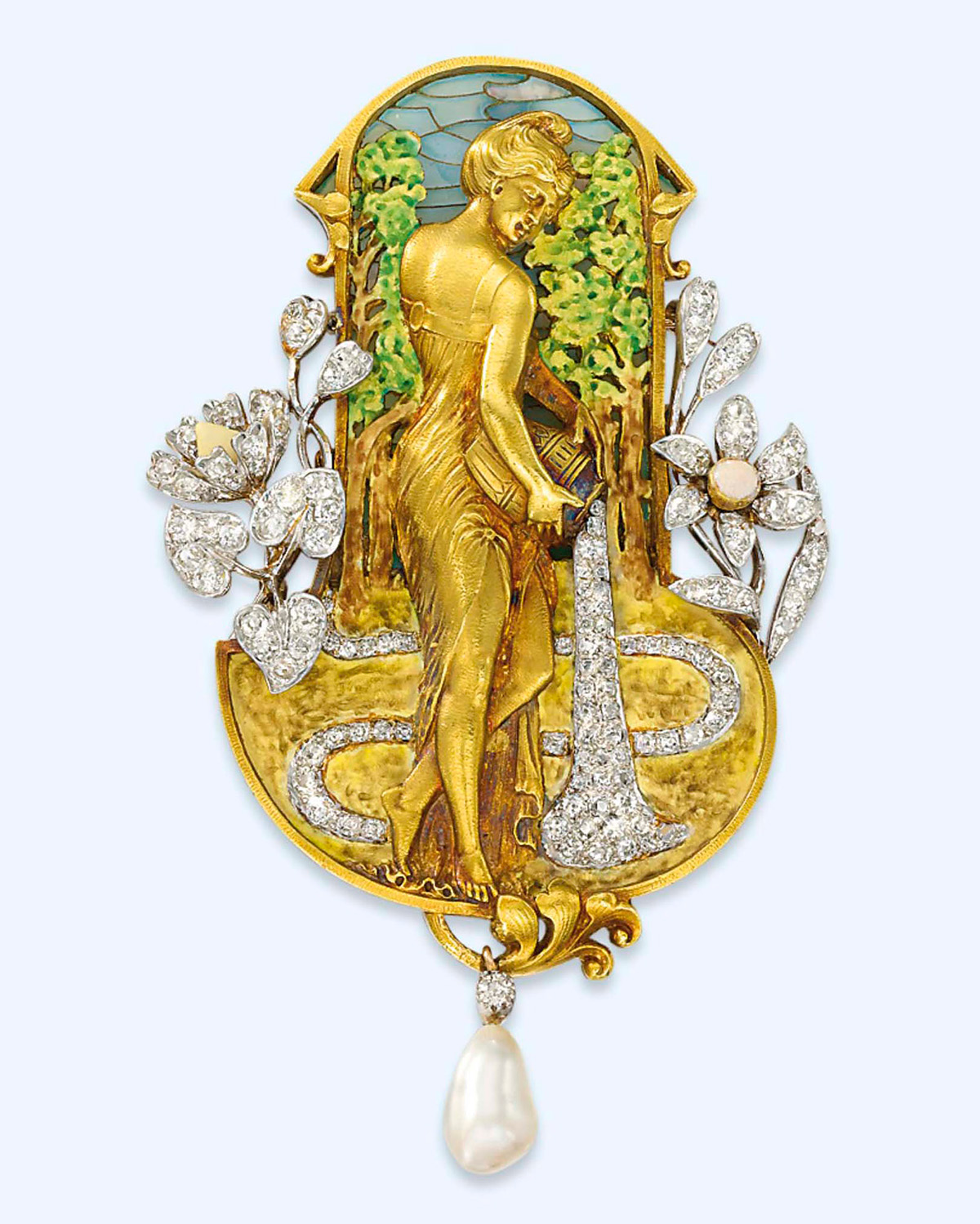
The Art Nouveau period began around 1895 and lasted until 1914, ending with the outbreak of World War I. Though relatively short-lived, the movement had an extraordinary impact. At its core, Art Nouveau jewelry was inspired by nature, favoring elaborate, highly ornate creations. This marked a dramatic departure from the symmetrical, classically influenced designs of the Victorian era, which often drew inspiration from the Renaissance and Antiquity.
“During a time when industrialisation and machine-made products were taking over, Art Nouveau celebrated individual artistry and craftsmanship. Jewels became tiny art masterpieces, featuring subjects such as dragonflies, orchids, bats, peacocks, and flowing female figures, all replacing the simple gemstone arrangements of the past. Even more boldly, designers questioned the old hierarchy of precious materials. While natural diamonds stayed important, they were now complemented by enamel, horn, opals, moonstones, and baroque pearls,” says Zuleika Gerrish, jewelry historian and founder of Parkin and Gerrish.
According to Elle Spur, researcher and writer at M.S. Rau, these gemstones were chosen for their iridescent, shifting, and softly colored qualities, which aligned with the movement’s fascination with the ephemeral, whether atmospheric, natural, or emotional.
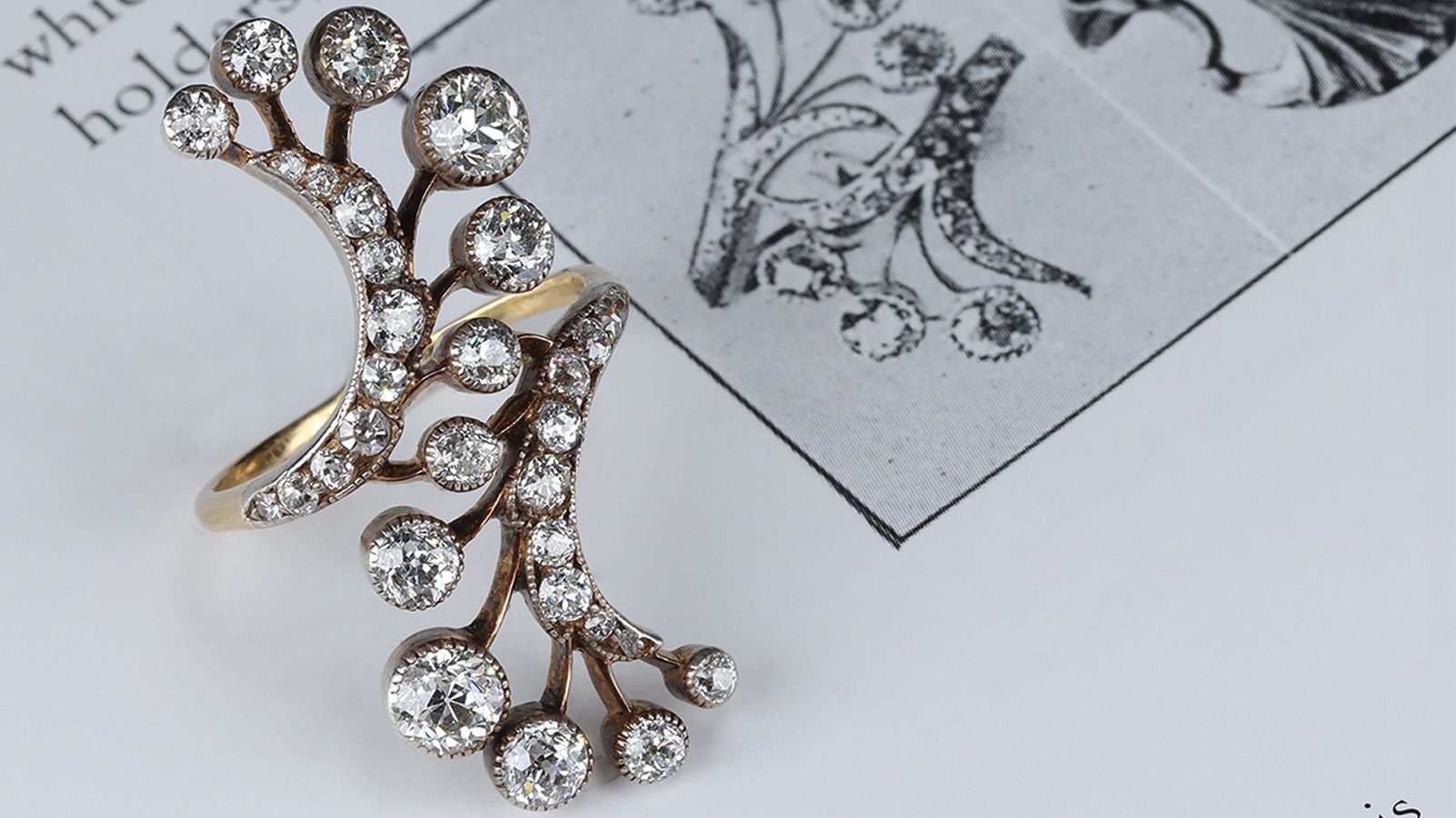
Paris stood at the center of the Art Nouveau movement, already established as a thriving hub for high fashion, luxury, theater, and the decorative arts. Gerrish explains that the 1900 Exposition Universelle provided an important platform for designers such as René Lalique, Georges Fouquet, Henri Vever, and Lucien Gaillard to showcase their innovative work. The movement’s popularity was further fueled by actresses, collectors, and artists, including legendary French stage actress Sarah Bernhardt, who became one of its most influential patrons.
Beyond Paris, Art Nouveau flourished across Europe. In Brussels, architects such as Victor Horta and Henry van de Velde created flowing interiors and intricate ironwork that helped define the movement’s visual language. Prague, Barcelona, and London also became important centers of Art Nouveau design, particularly through the influence of Liberty & Co., the iconic British retailer founded by Arthur Lasenby Liberty.
Nature, Femininity, and Fantasy in Art Nouveau Jewelry
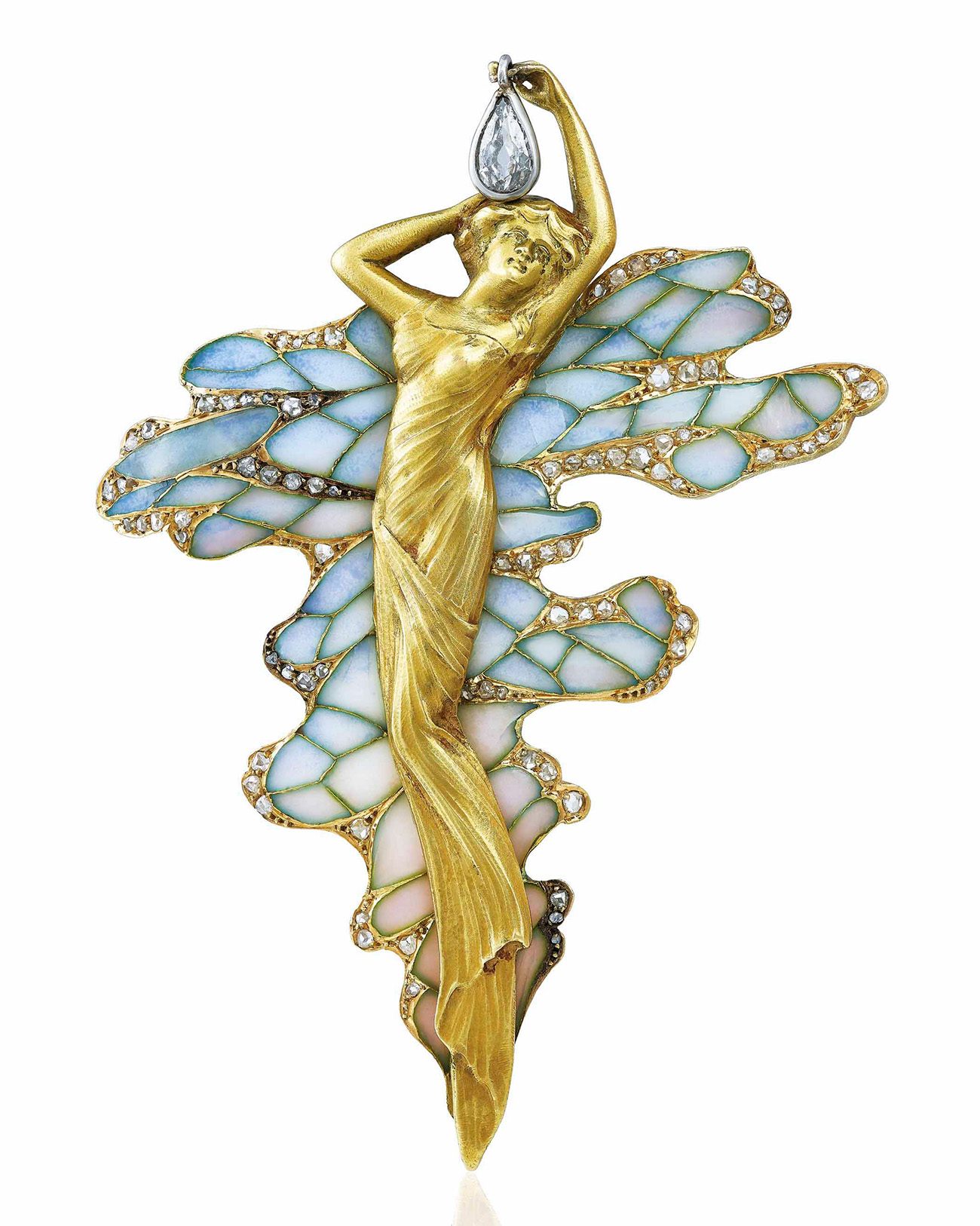

One of the defining characteristics of Art Nouveau jewelry was its symbolic interpretation of nature, expressed through flowing movement, asymmetry, and dreamlike forms. Emerging partly as a reaction against rapid industrialization, the movement embraced imagery that felt alive rather than mechanical.
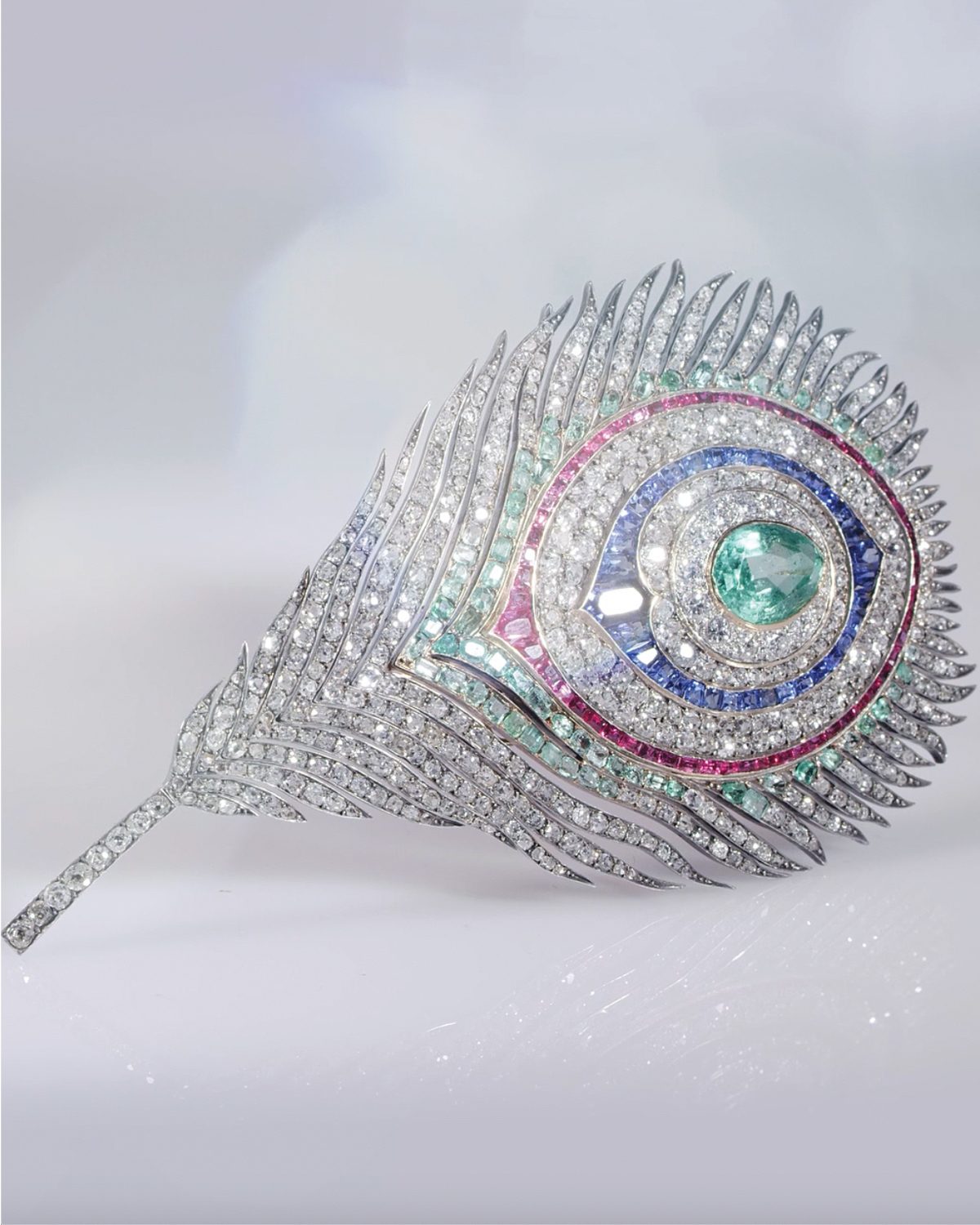
“Dragonflies were favored for their delicate, filigree-like wings, while peacocks perfectly illustrate vibrant iridescence through their layered plumage. Orchids and other flowers introduced sensual, curving forms, often with erotic undertones. Snakes, with their sinuous motion, became natural design elements,” Elle Spur says.
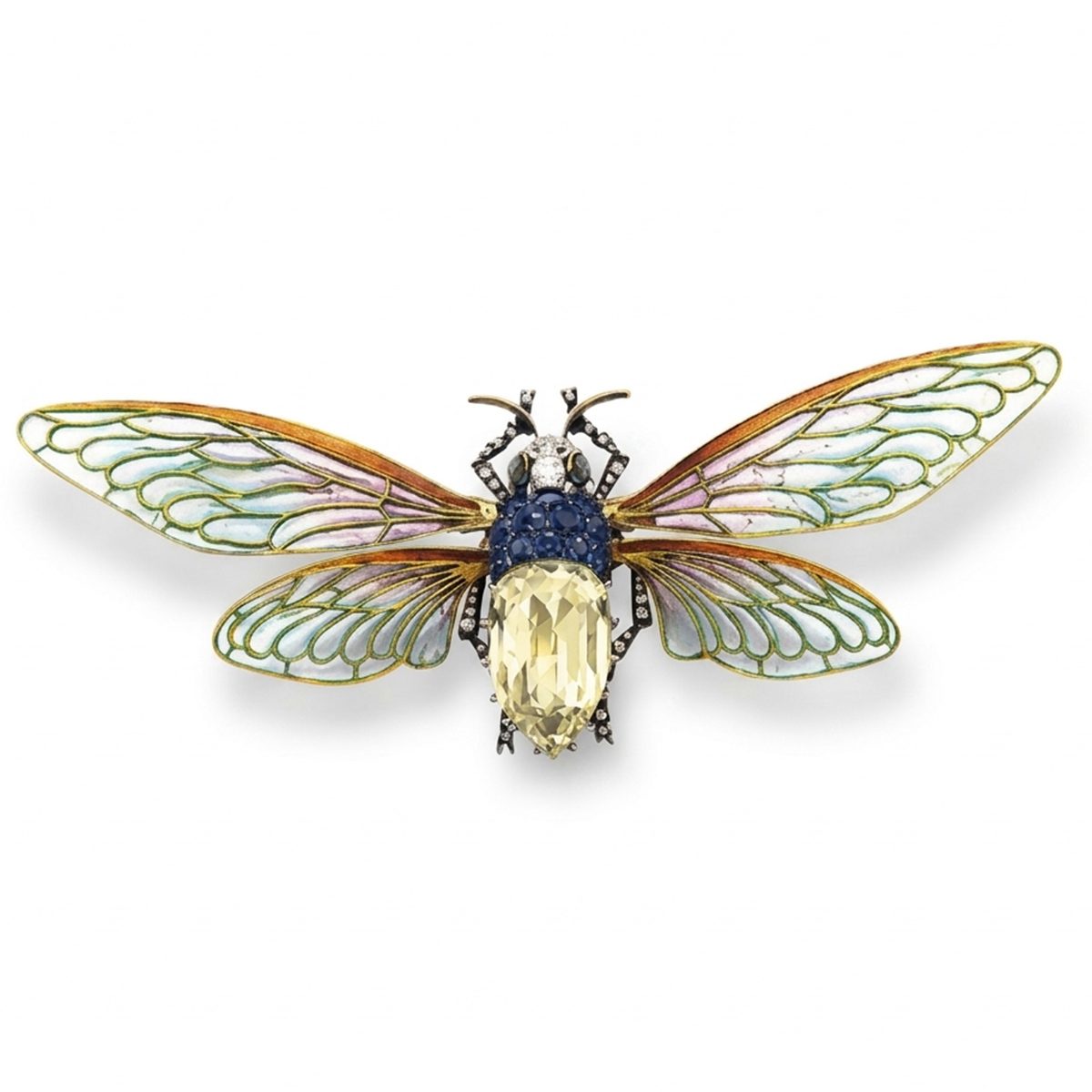
“The natural world offered a visual language that felt more emotional, sensual, and alive than mechanical…Nature became symbolic and fantastical, with a dragonfly merging into a female figure or enamel capturing the shimmering wings of insects. Horn could suggest leaves or barley sparkling with morning dew. This movement truly reflected the mood of the fin de siècle, a blend of fascination and unease with the rapid modern world,” Zuleika Gerrish says.
The female form was equally central to Art Nouveau design and often intertwined with these nature motifs. Women appeared as nymphs, mermaids, muses, and ethereal figures with flowing hair, embodying beauty, transformation, and the cycle of life itself. “These sensual, often ethereal figures reflect both admiration and an unease surrounding shifting gender roles at the turn of the century. Still, the imagery challenged Victorian restraint, embracing eroticism and freedom, particularly within bohemian circles,” Spur says.
René Lalique and Jewelry as Art
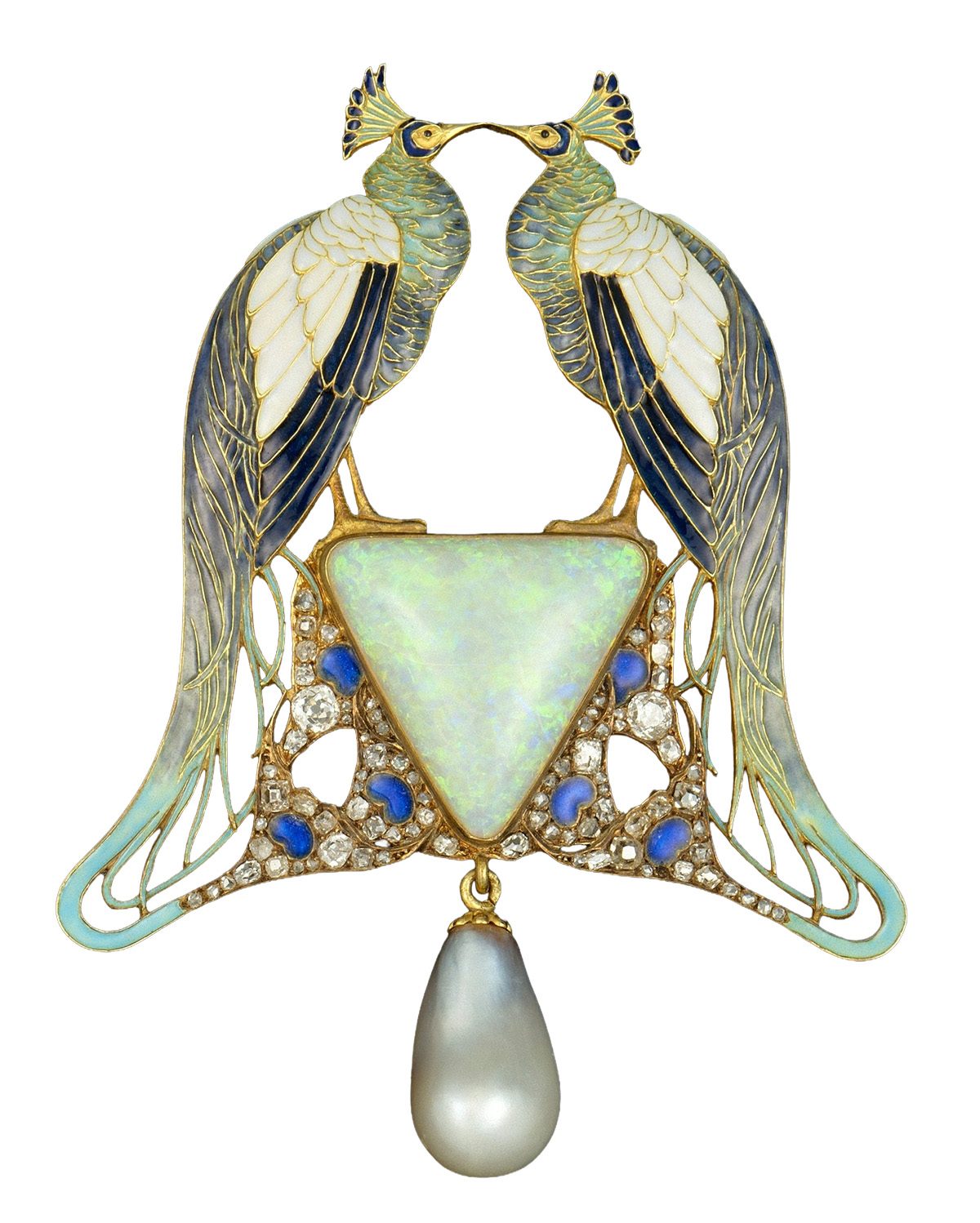
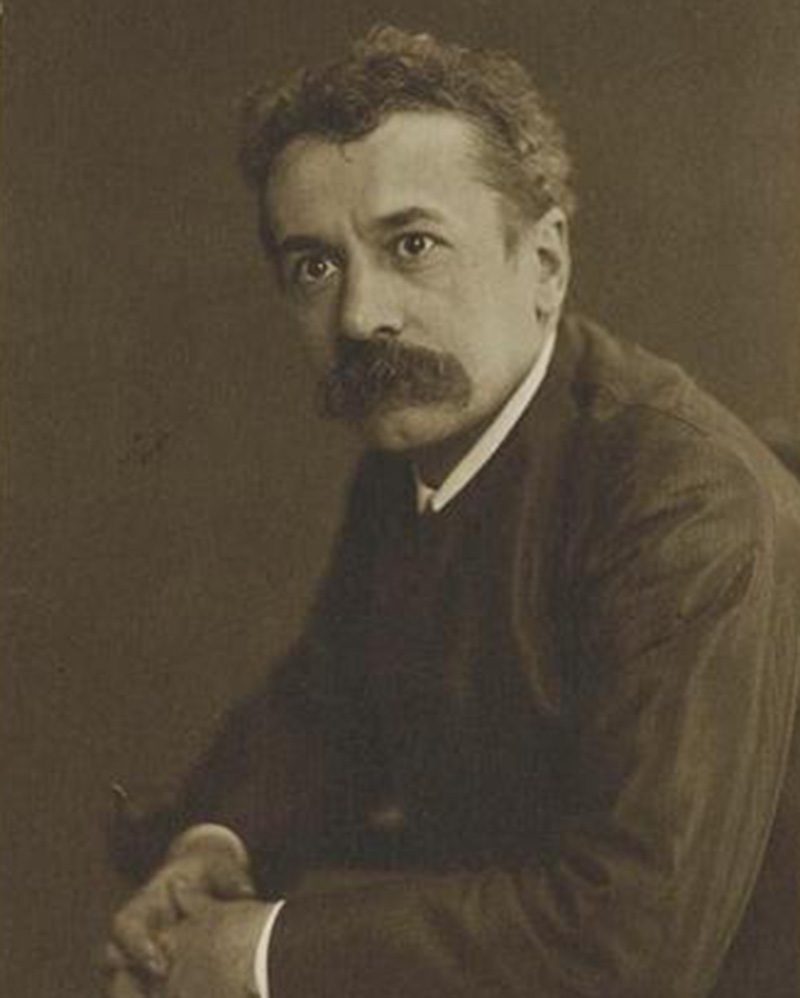
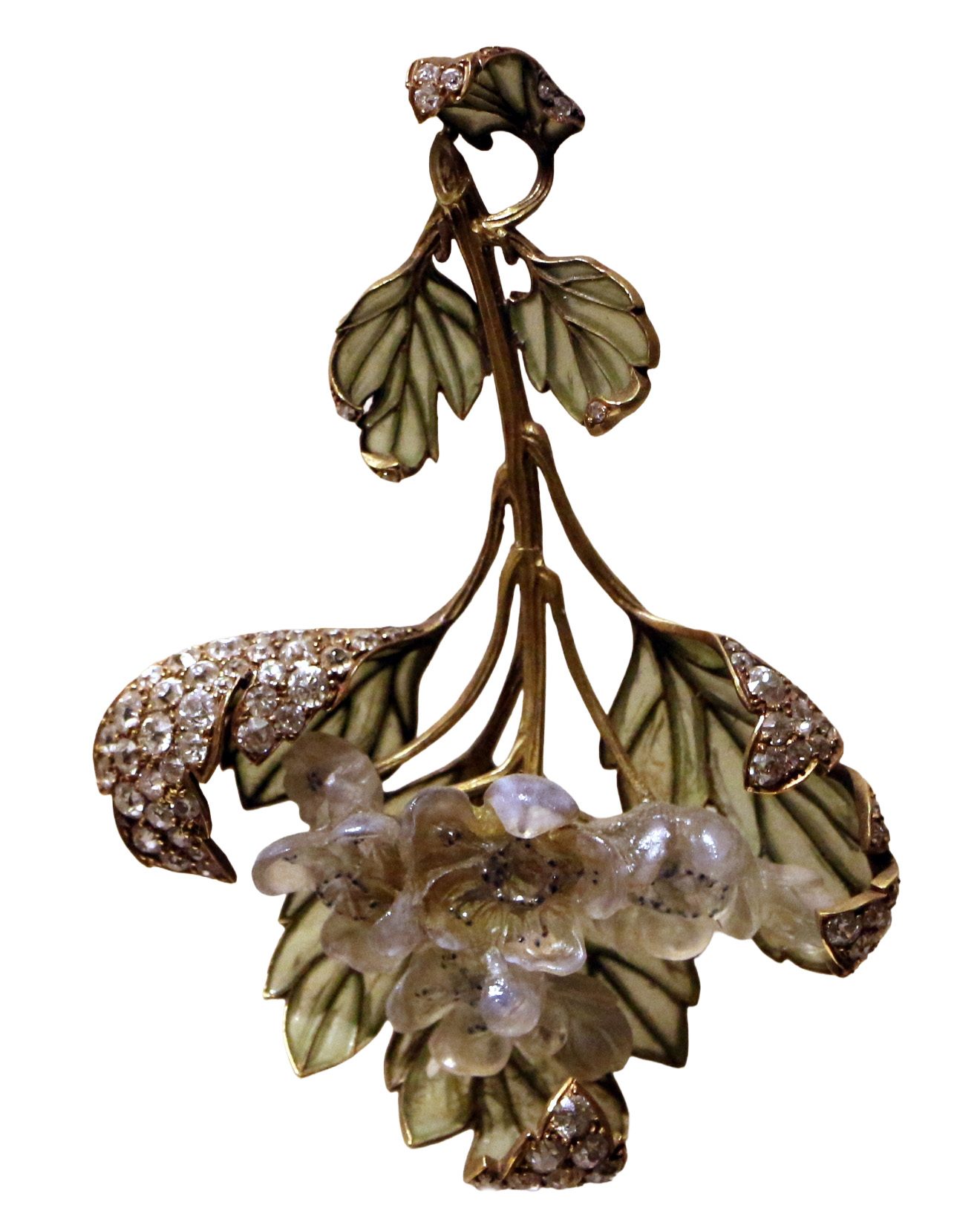
It’s impossible to discuss Art Nouveau jewelry without mentioning René Lalique, who became the defining jeweler of the movement. The French artist was fearless in his use of materials, combining natural diamonds with unconventional elements such as enamel, horn, opals, and baroque pearls at a time when traditional precious gemstones still dominated high jewelry.
“René Lalique brilliantly embraced these influences. His jewelry often breaks away from traditional European symmetry, instead capturing the lively, organic feel seen in Japanese woodblock prints. Dragonflies drift across his compositions, female figures dissolve into orchids and wings, and plique-à-jour enamel creates translucent surfaces reminiscent of Japanese lacquer and screens,” Gerrish says. “Lalique, much like Japanese artists, knew that true beauty derives from atmosphere, imagination, and movement, rather than strict perfection.”
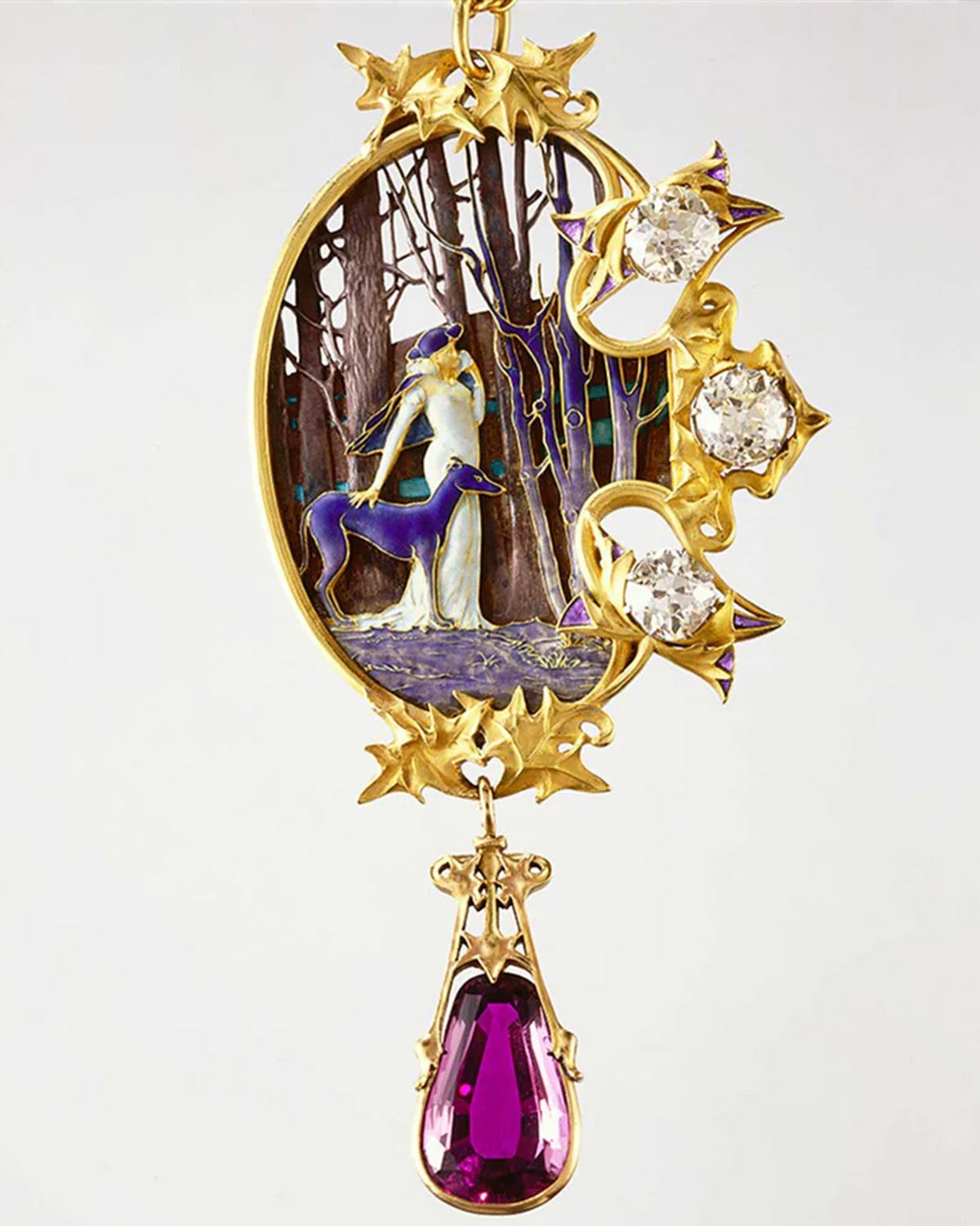
Gerrish adds that Lalique’s technical skill was revolutionary. “He skillfully mastered difficult enamel techniques like plique-à-jour and used carved horn to beautifully imitate insect wings, leaves, and feathers. Sarah Bernhardt famously wore his creations on stage, turning his jewels into cultural icons rather than just decorations. Even today, over a century later, Lalique remains remarkably modern because his work encourages us to cherish artistic vision just as much as material worth.”
Plique-à-Jour and the Art Nouveau Revolution
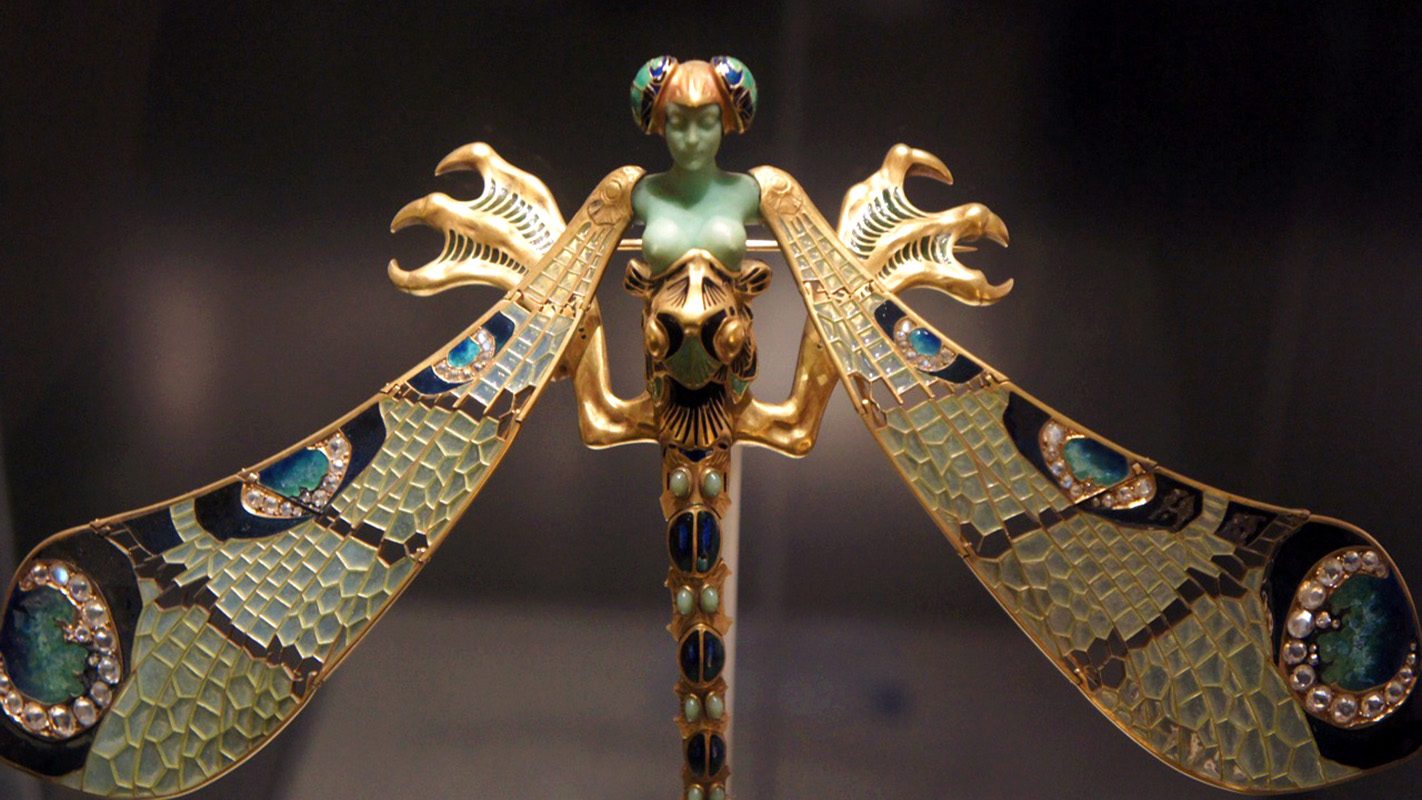
Another defining aspect of Art Nouveau jewelry was the revival of plique-à-jour enamel, a highly intricate enameling technique whose origins date back centuries, with early examples appearing in Byzantine and medieval decorative arts. Translating roughly to “letting in daylight” in French, plique-à-jour creates a stained-glass effect by allowing light to pass through translucent enamel without a metal backing. The enamel is carefully suspended within a delicate framework and fired, creating luminous, glass-like surfaces.
Elle Spur says, “Plique-à-jour is actually considered the most technically demanding enameling technique…Because there is no support structure, the process carries a high failure rate due to cracking, uneven thickness or collapse during firing.”
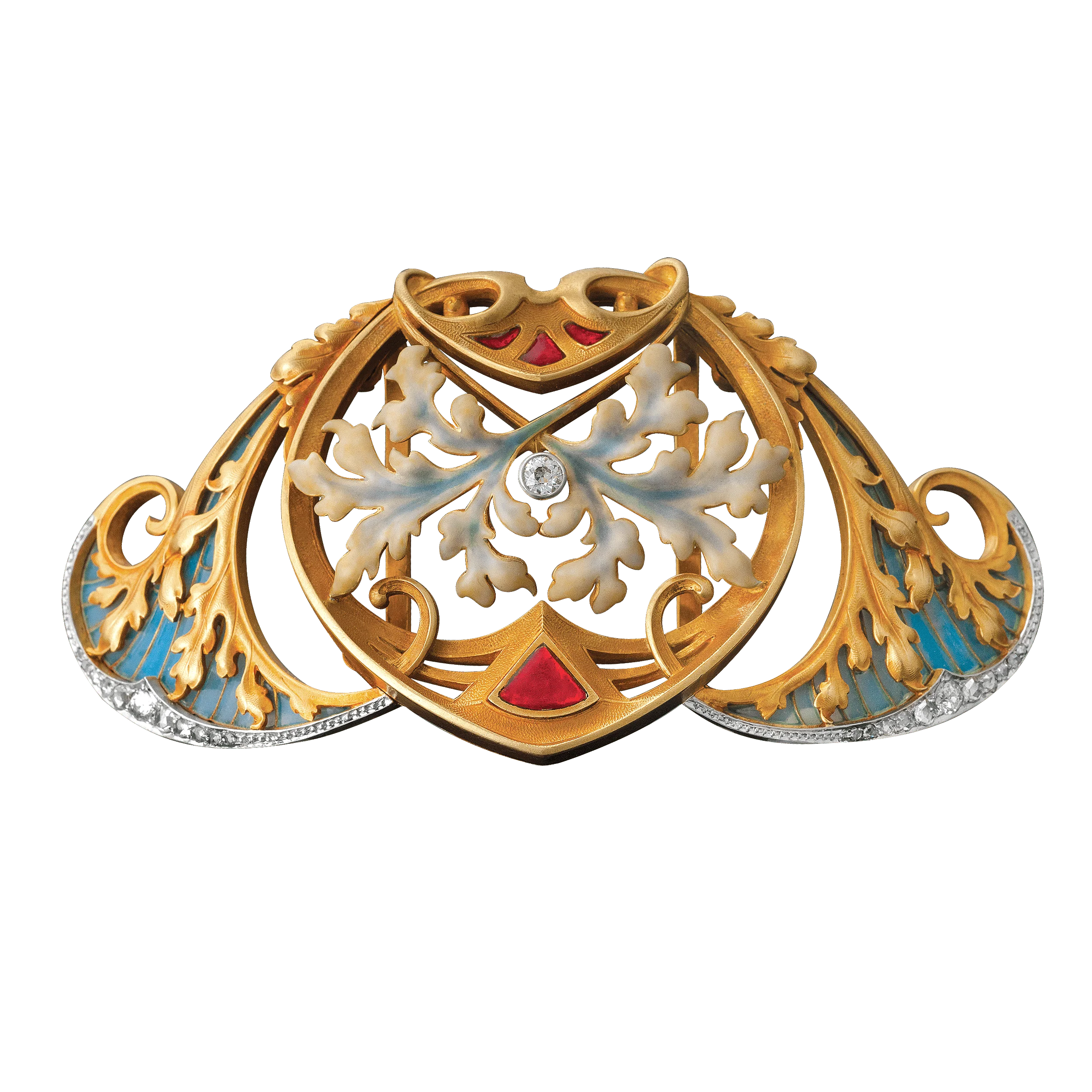
While Europe initially dominated the technique, Louis Comfort Tiffany (son of Charles Lewis Tiffany) helped popularize an American interpretation of Art Nouveau enamelwork through his own distinctive approach to plique-à-jour and iridescent design. “His celebrated Medusa pendant, featuring beautiful opals, enamel, and flowing organic shapes, shows how Art Nouveau could appear more painterly and sculptural rather than just traditional jewelry. Tiffany played a key role in shaping a uniquely American chapter of the movement, one that loved iridescence, rich colours, and creative exploration.”
How Art Nouveau Redefined Natural Diamonds
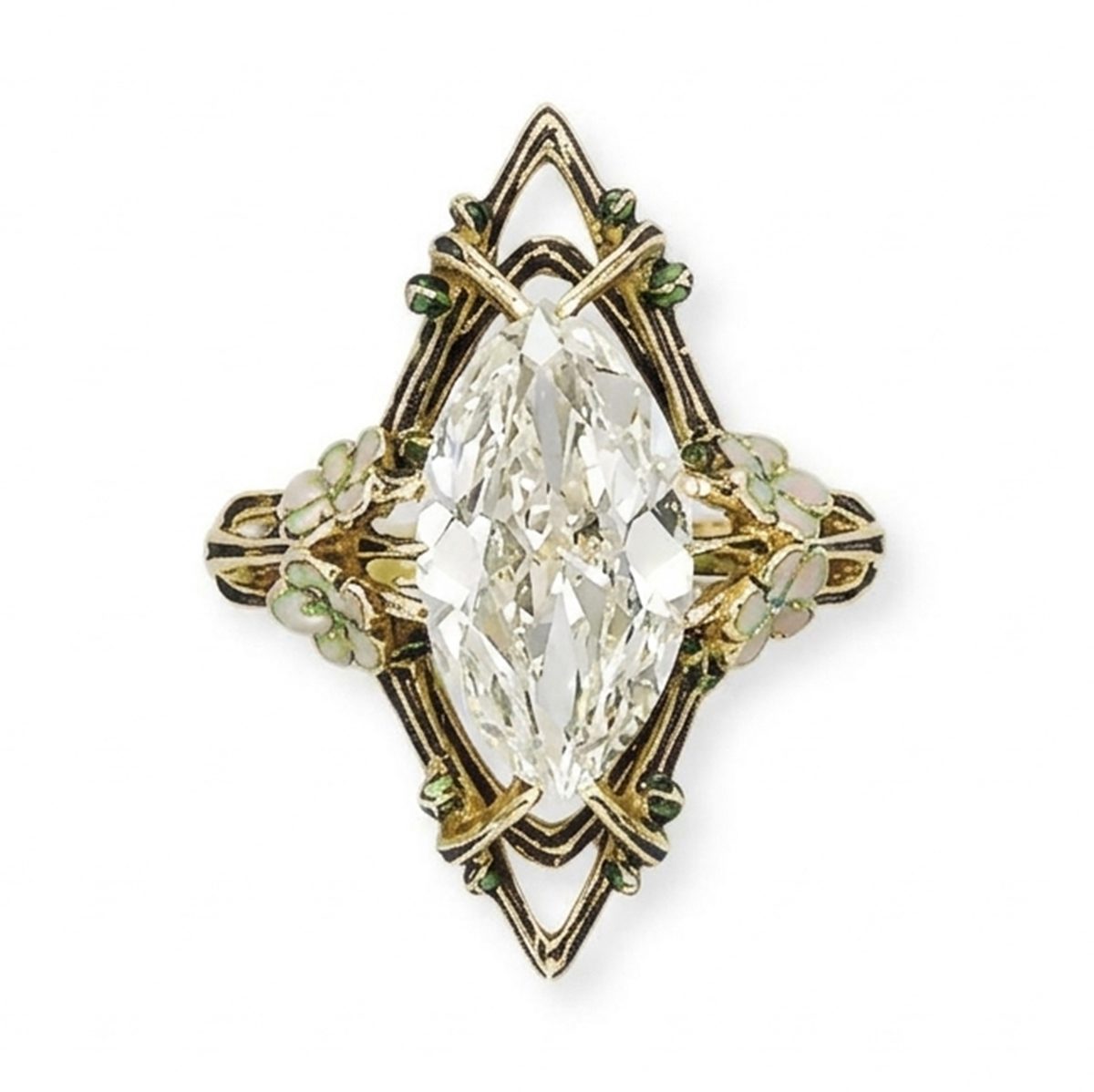
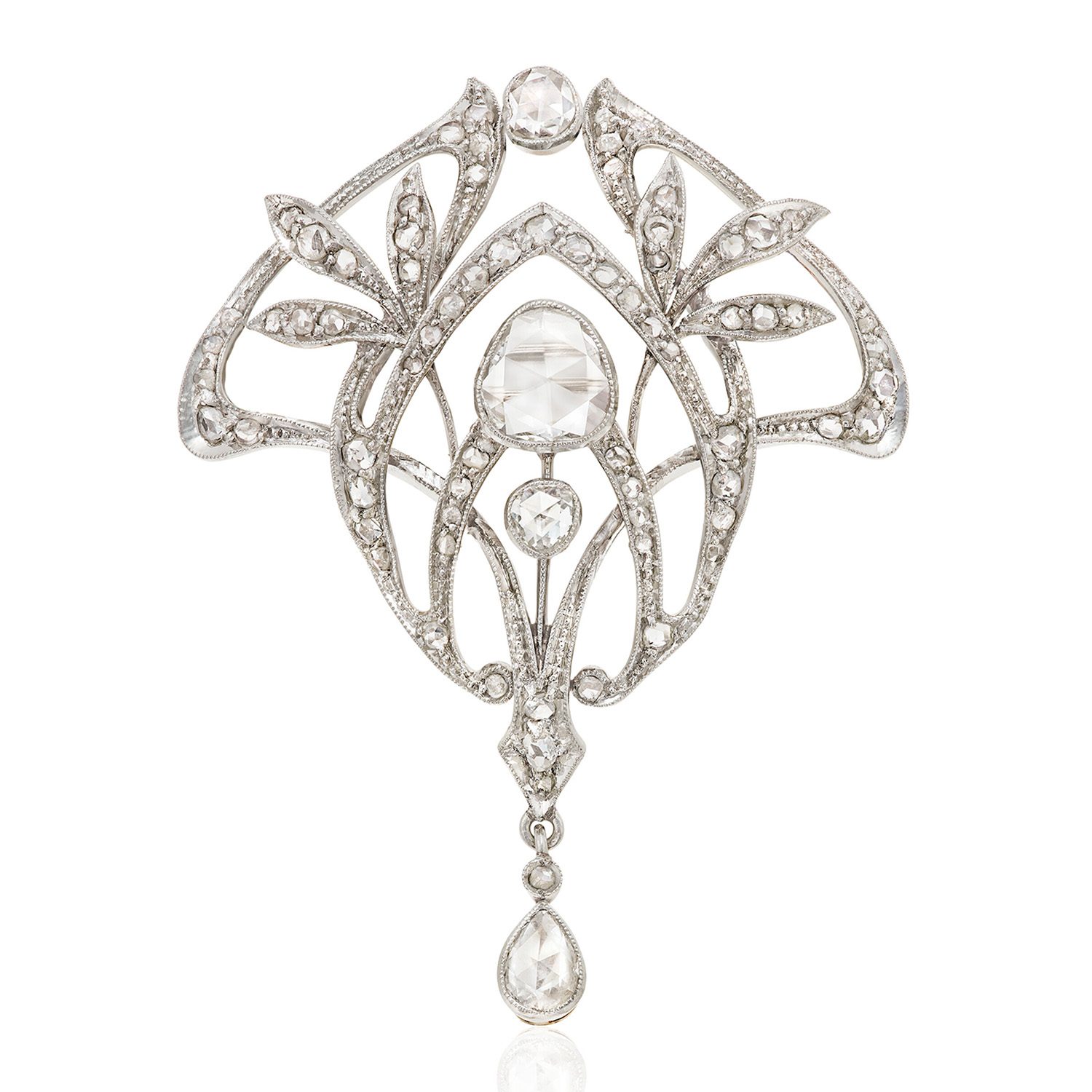
This softer, more atmospheric approach to materials also transformed the role of natural diamonds in jewelry design. During the Art Nouveau period, diamonds shifted away from serving solely as dramatic centerpieces and instead became luminous accents within larger artistic compositions. In Art Nouveau jewels, diamonds often appeared as shimmering dewdrops, insect wings, or delicate details designed to enhance the beauty of opals, enamel, horn, and moonstones.
Zuleika Gerrish emphasized that designers such as René Lalique, Georges Fouquet, Henri Vever, and Louis Comfort Tiffany treated diamonds as one element within a broader visual language of color, texture, and movement. “Old-cut diamonds, with their softer, candlelit sparkle, suited the movement particularly well. In many ways, Art Nouveau liberated diamonds from strict formality and allowed them to become atmospheric and poetic.”
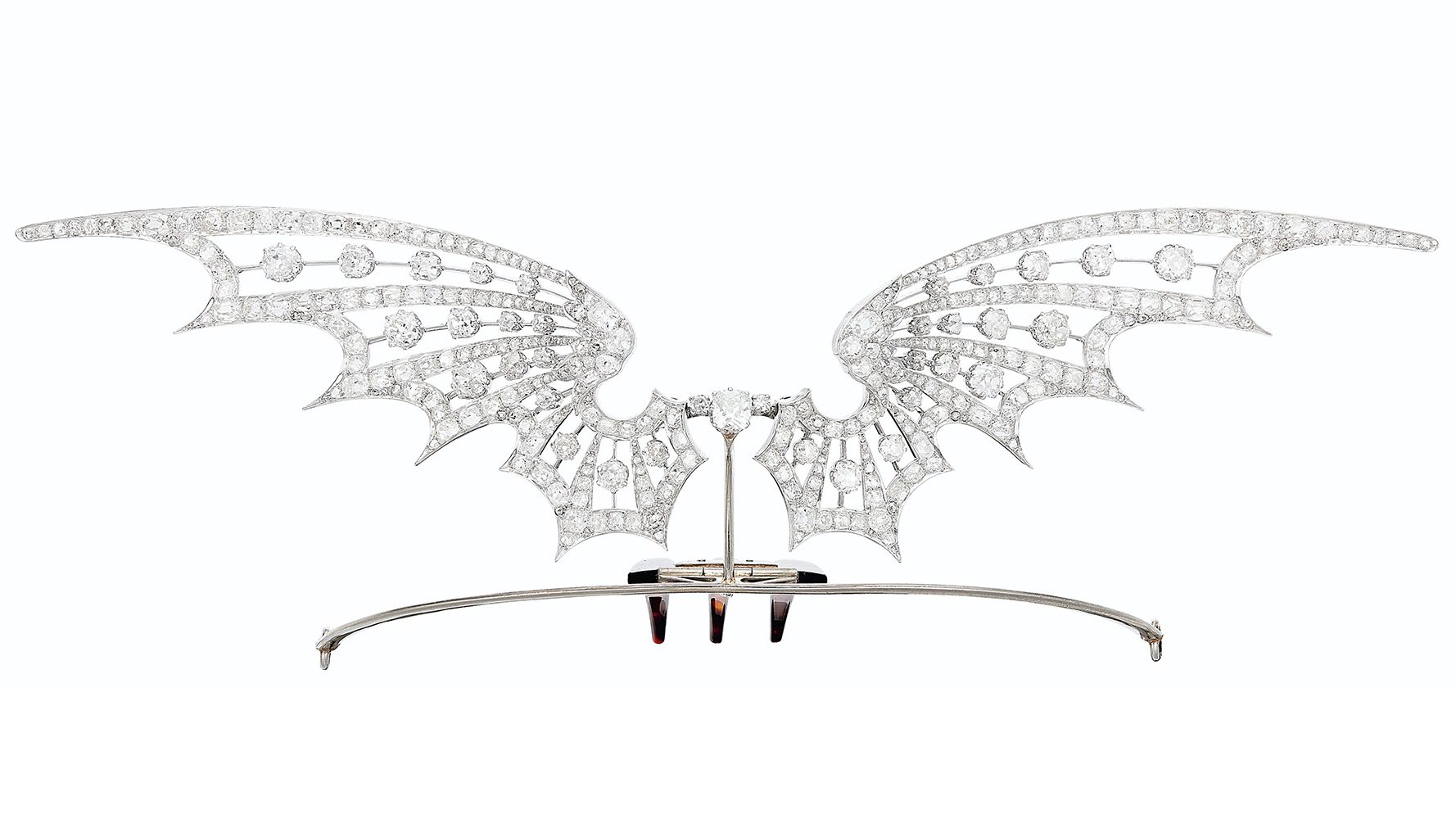
Unlike the Belle Époque and Edwardian jewelry eras, which emphasized refinement and symmetry, Art Nouveau jewelry focused on emotion, sensuality, and imagination, Gerrish explains. “Nouveau is more like stepping into a world of theater, fantasy, or the vibrant beauty of nature itself,” she says.
She also notes that the Victorian era helped spark a fascination with fairies and fantasy, themes that appeared throughout late 19th-century literature by writers such as George MacDonald, Oscar Wilde, Andrew Lang, and E. Nesbit. Art Nouveau jewelers brought those dreamlike worlds to life through winged women, dragonflies, bats, nymphs, and flowing botanical motifs that echoed the fairy realms imagined in Victorian storytelling.
Why Art Nouveau Still Influences Jewelry Today
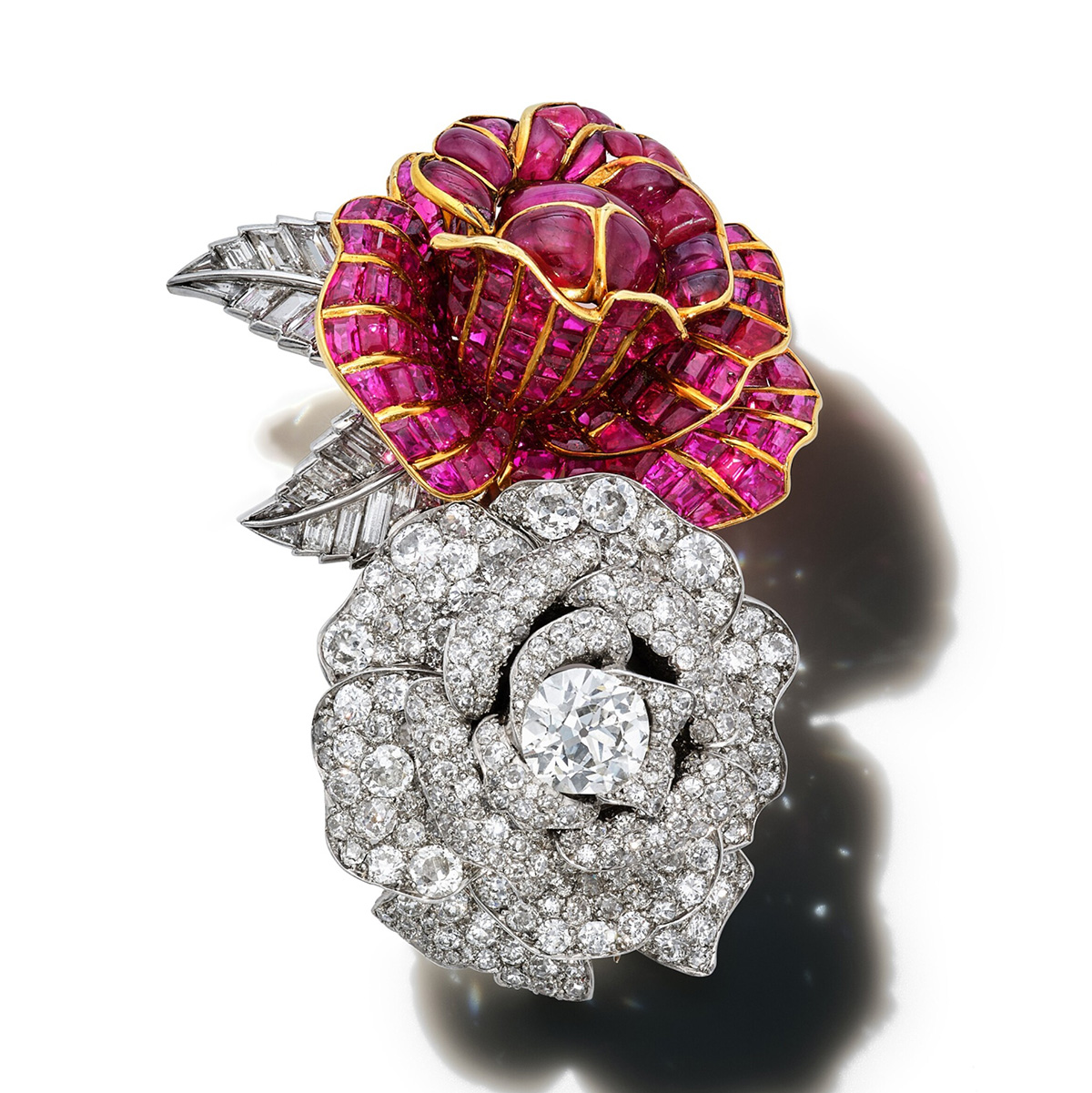
Art Nouveau had a profound influence on the jewelry movements and designers that followed, fundamentally changing the way jewelry was viewed and created.
“The style deliberately rejected mechanized production in favor of individuality and expressive imperfection. More than a century later, in an era once again shaped by rapid technological transformation and questions of authenticity in the machine-made, it is no surprise that the style still resonates today,” says Elle Spur.
Zuleika Gerrish explains that while Art Deco later shifted toward geometric shapes, platinum, and modernist precision, it still carried forward Art Nouveau’s spirit of experimentation and innovation. “Art Nouveau truly revolutionized how we see jewelry. It showed that a piece could be appreciated not just for its gemstones but for its artistic originality, symbolism, and craftsmanship,” she says.
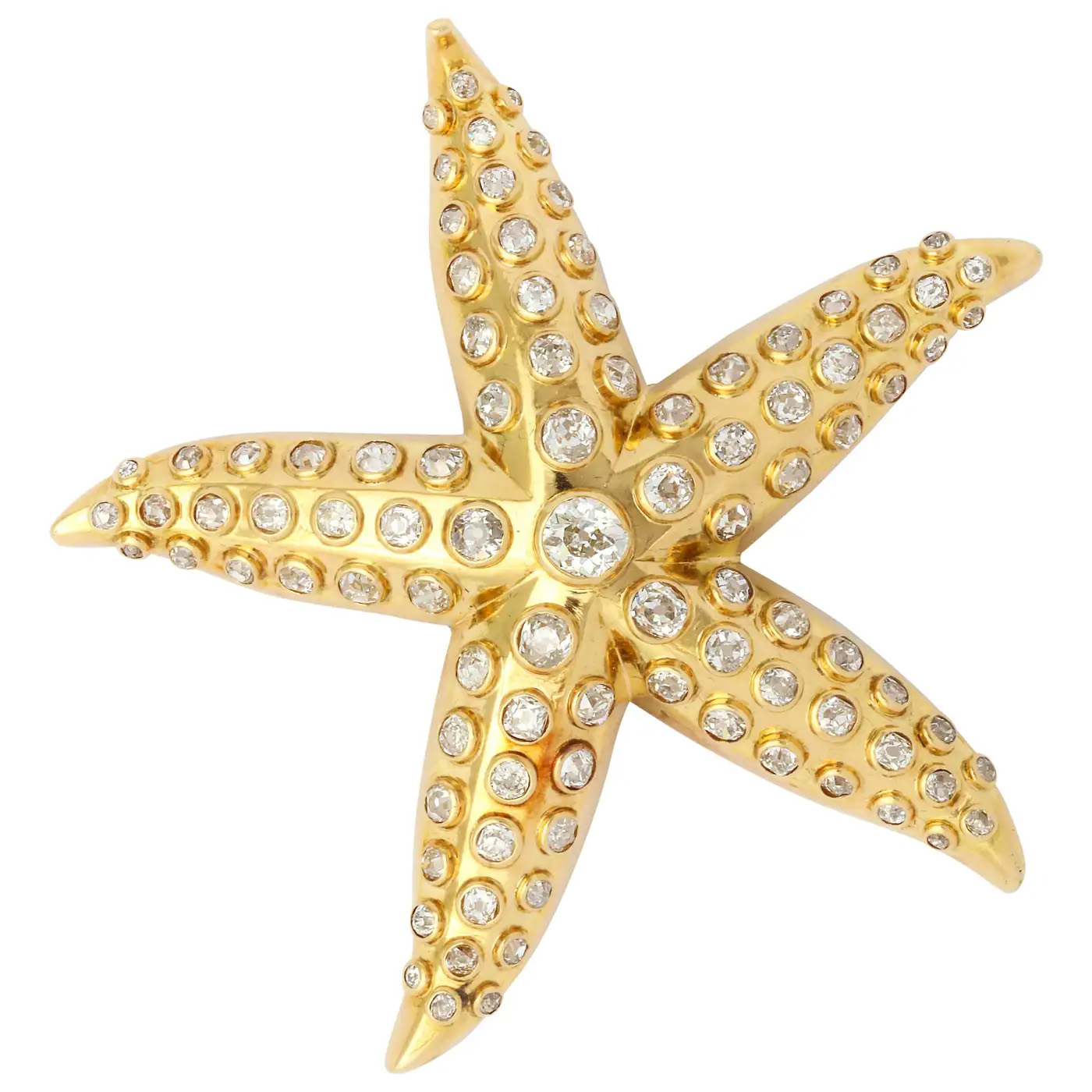
Gerrish also pointed to later designers such as René Boivin, whose sculptural starfish, shell motifs, and textured gold jewelry carried Art Nouveau’s fascination with nature into a bolder 20th-century aesthetic. “Boivin shows us that Art Nouveau’s legacy isn’t just about dragonflies and orchids—it’s about celebrating natural forms, movement, and texture as powerful elements of wearable art,” she says.
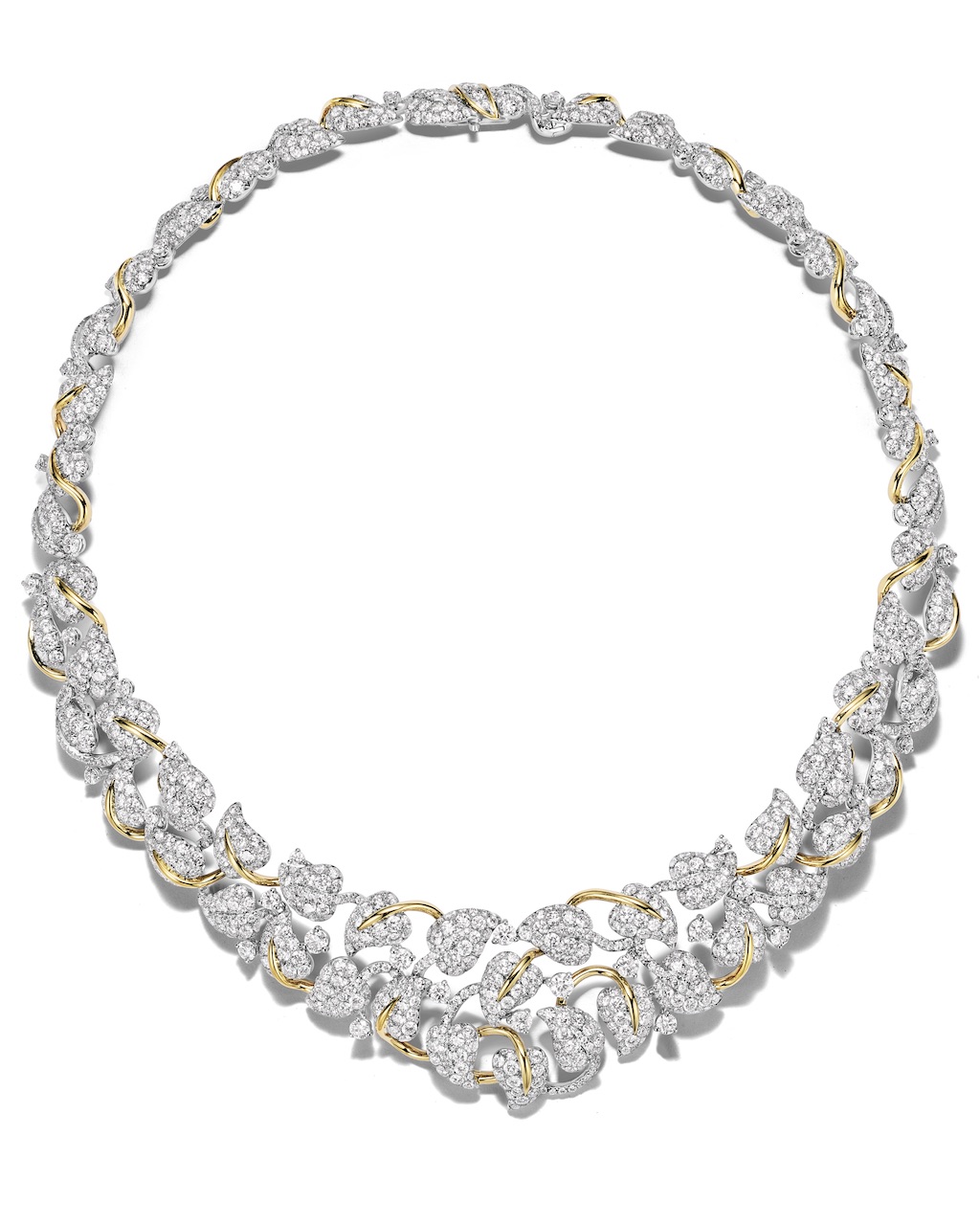
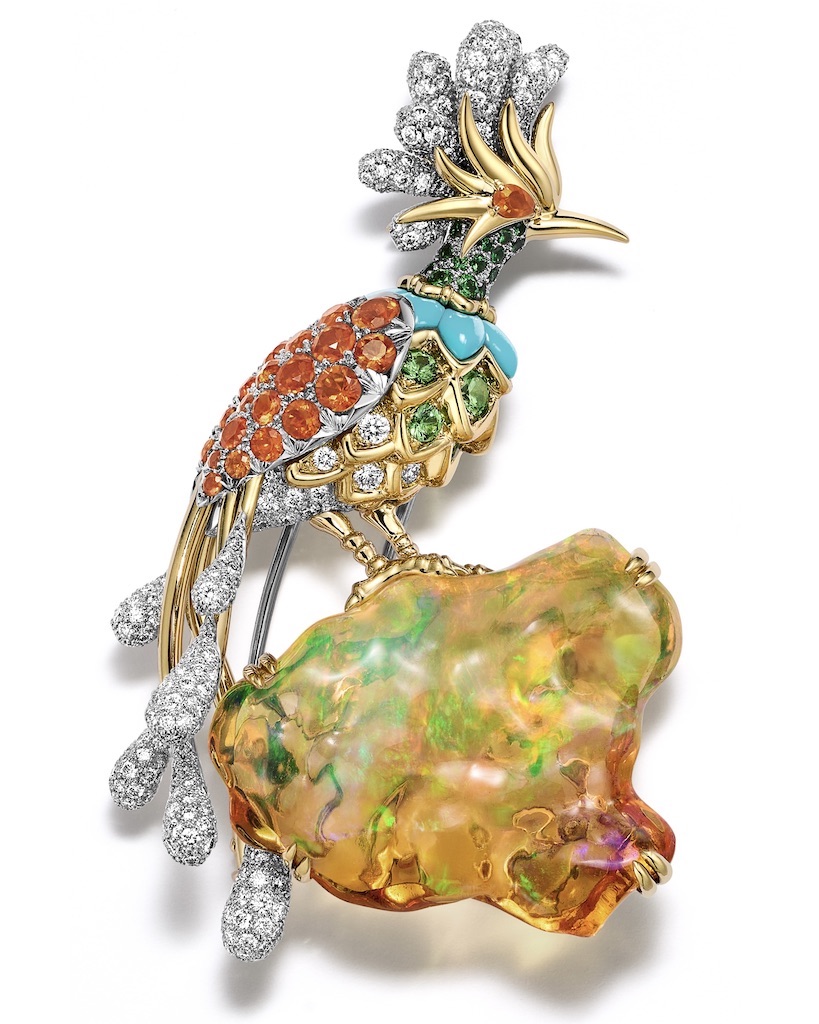
Contemporary designers continue to embrace Art Nouveau influences because the movement still feels remarkably modern. “The way Art Nouveau rejected strict conventions feels especially relevant once again. For example, Tiffany & Co.’s 2026 Blue Book collection, Hidden Garden, explores flora, fauna, and botanical fantasy through exquisite high jewelry designs. Meanwhile, Victoire de Castellane’s Diorexquis collection for Dior highlights luminous lacquer techniques that remind us of plique-à-jour enamel.”
Gerrish draws parallels between today’s rise of AI and automation and Art Nouveau’s original response to industrialization and mass production—both periods marked by renewed interest in artistry, individuality, and craftsmanship.