< Historic Diamonds / Famous Diamonds
The Cora Sun-Drop Diamond: The Largest Fancy Vivid Yellow Diamond Ever Auctioned
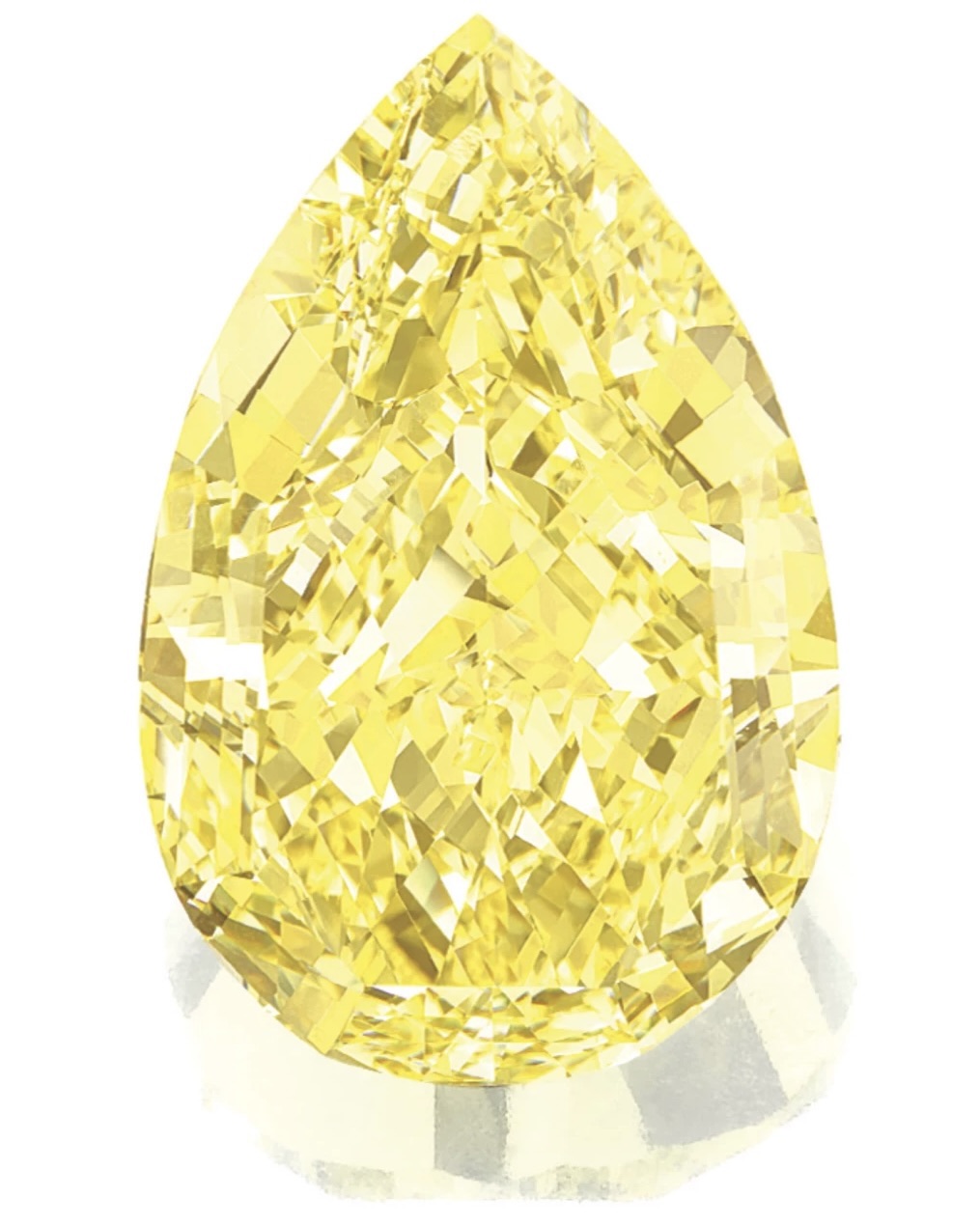
Discovered in South Africa and cut to reveal the strongest yellow color possible, the Cora Sun-Drop diamond remains the largest Fancy Vivid Yellow ever sold at auction.
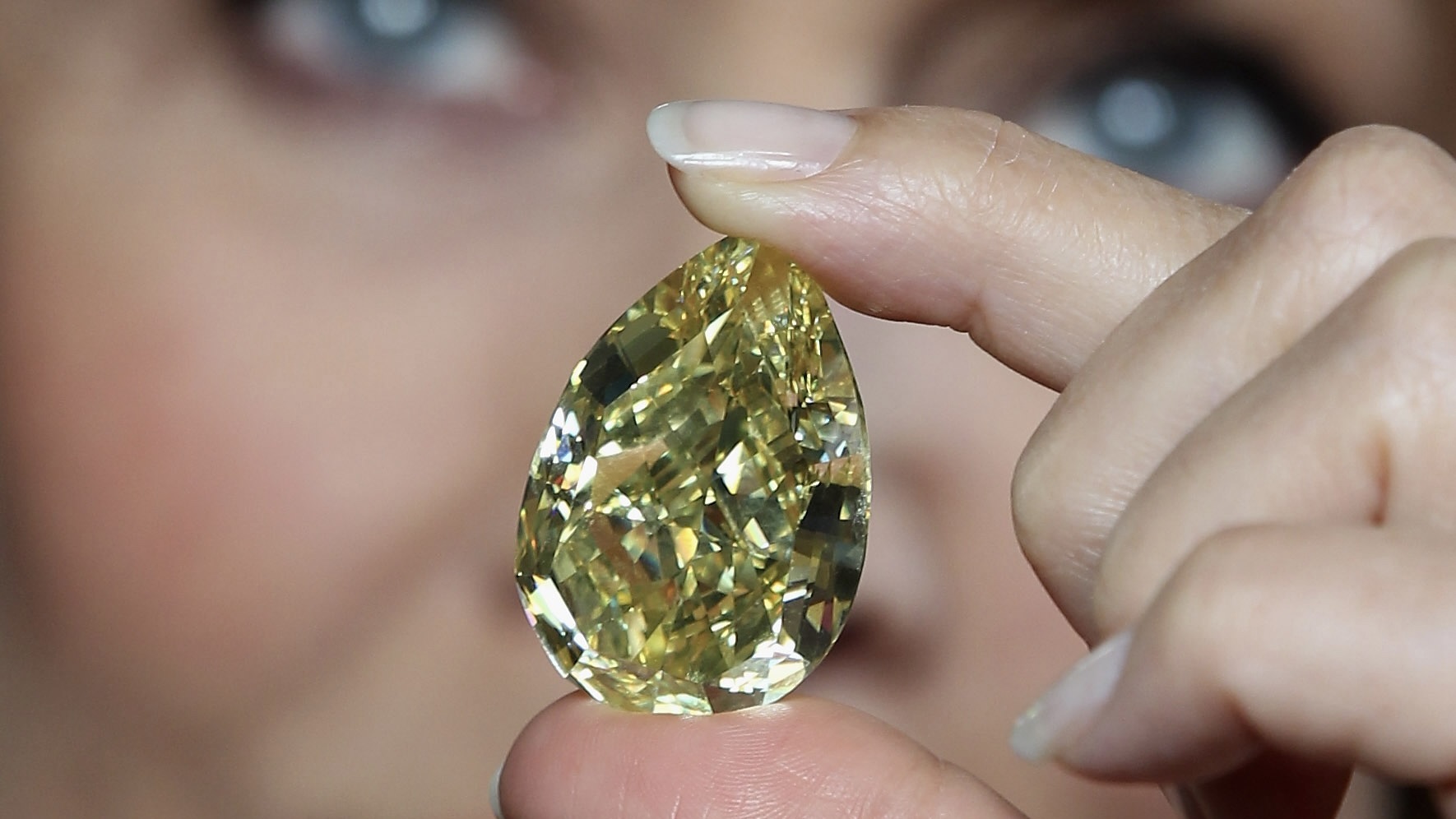
Supermodel Jerry Hall holds the rare 110.03-carat yellow pear-shaped Cora Sun-Drop diamond at the Natural History Museum on February 24, 2011, in London. (Getty Images)
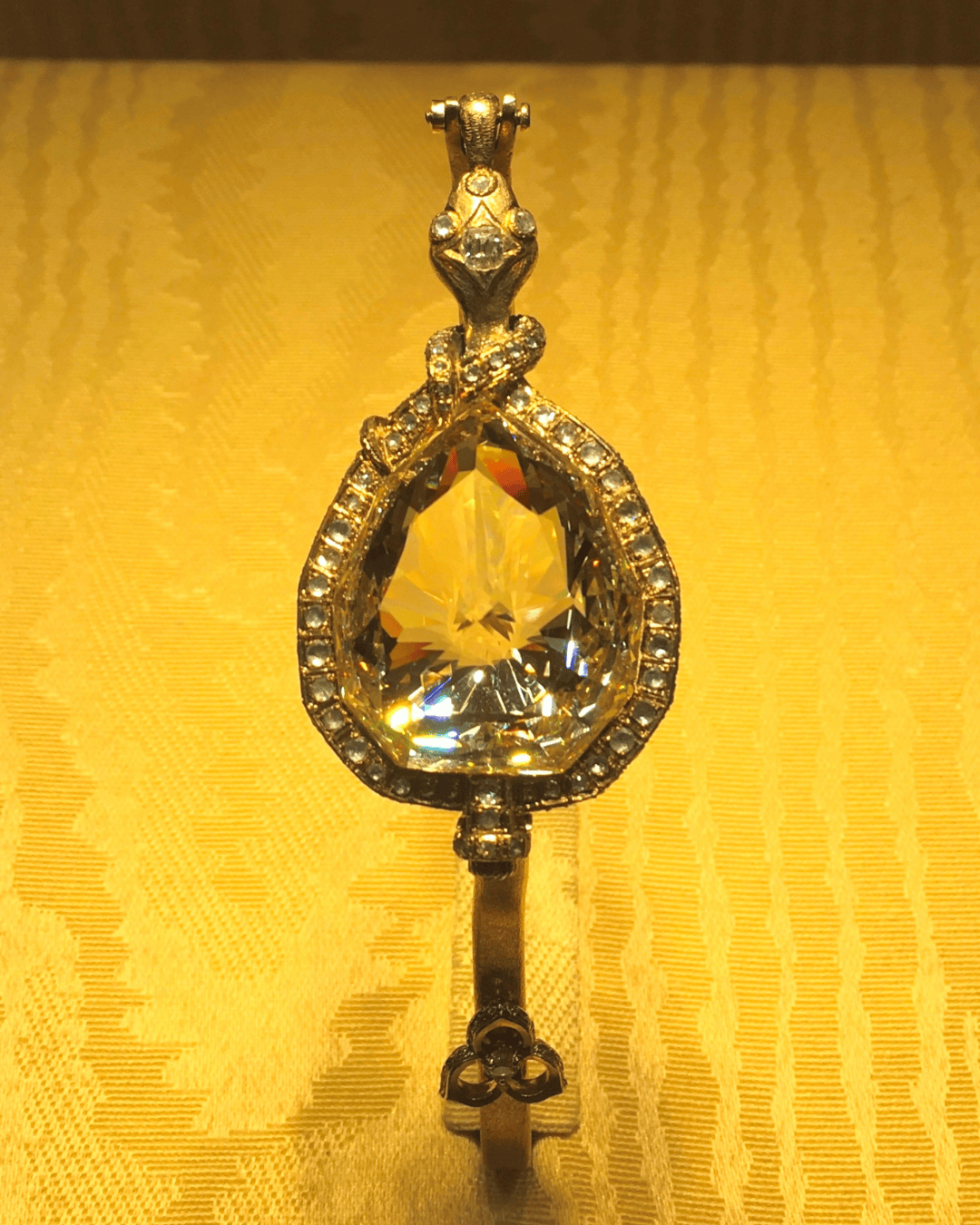
When the great traveler and merchant Jean-Baptiste Tavernier described great yellow diamonds he encountered in India during the 17th century, he could hardly have imagined a stone as exceptional as the Cora Sun-Drop diamond ever existing. When it first appeared publicly in 2011, it immediately became one of the most talked-about diamonds in the world. At 110.03 carats, it is the largest known Fancy Vivid Yellow pear-shaped diamond ever graded, and its discovery, cutting, museum debut, and eventual sale placed it firmly among the most important natural fancy color diamonds of the modern era.
Even today, more than a decade later, the Cora Sun-Drop diamond remains one of the greatest yellow diamonds ever to reach the auction stage.
Meet the Expert

- Grant Mobley is the Jewelry & Watch Editor of Only Natural Diamonds.
- He is a GIA Diamonds Graduate.
- He has over 17 years of jewelry industry experience, starting with growing up in his family’s retail jewelry stores.
What Is the Cora Sun-Drop Diamond?
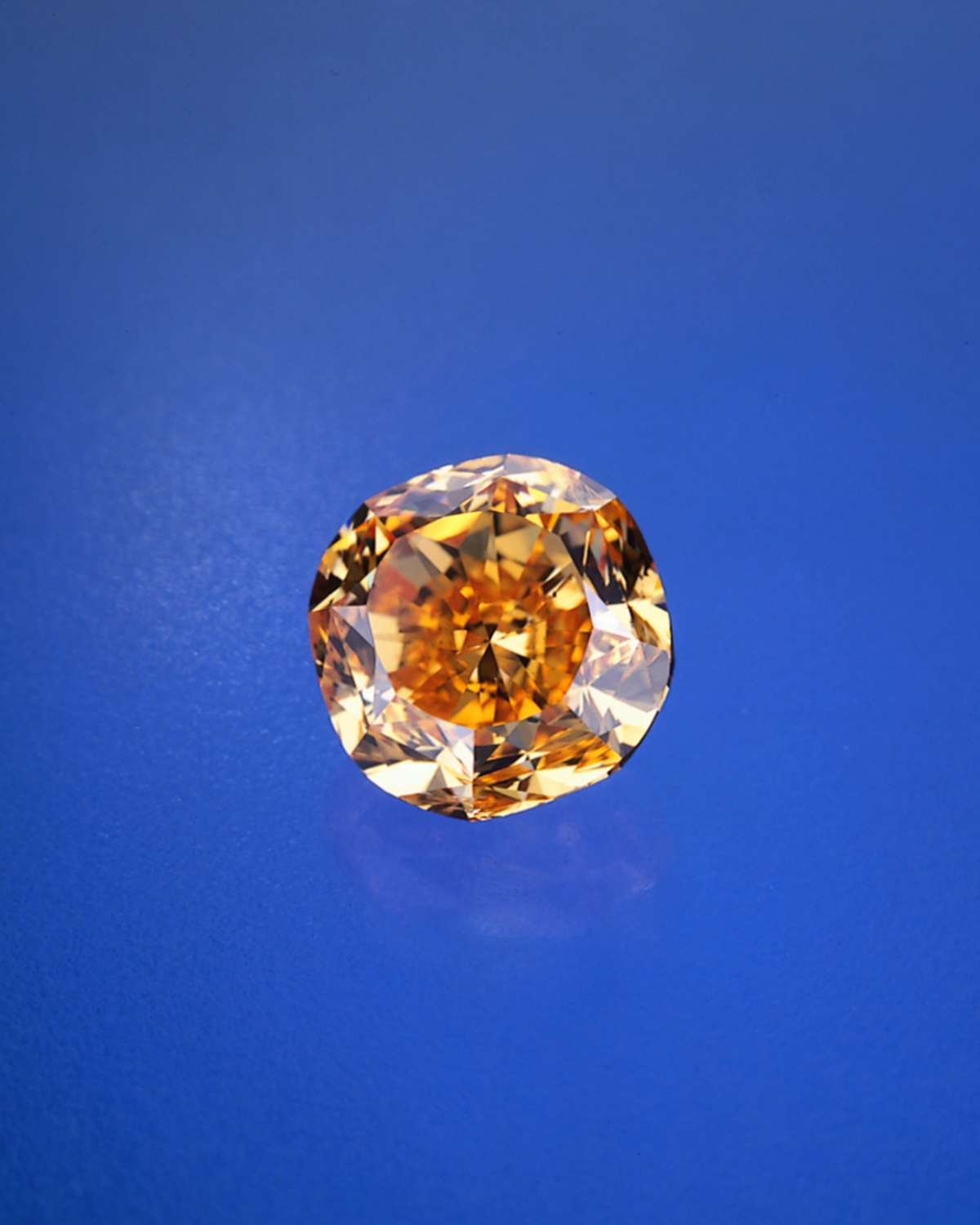
The Cora Sun-Drop Diamond is a 110.03-carat pear-shaped natural diamond graded Fancy Vivid Yellow and Internally Flawless by the Gemological Institute of America (GIA). At the time of its sale in 2011, it was the largest known Fancy Vivid Yellow pear-shaped diamond ever graded and the largest of its kind ever offered at auction.
Classified as a Type Ia diamond, its rich yellow color is caused by nitrogen atoms incorporated into the crystal structure during formation billions of years ago. That intense, evenly distributed saturation is what qualifies it for the coveted Fancy Vivid designation, the highest color grade for yellow diamonds.
The Origin of the Cora Sun-Drop Diamond
Like all natural diamonds, the story of the Cora Sun-Drop diamond begins deep inside the Earth. According to experts at the Natural History Museum in London, where the diamond debuted, the crystal formed between one and three billion years ago under intense heat and pressure.
As the diamond grew, nitrogen atoms became incorporated into its carbon structure. Those tiny impurities change how the crystal absorbs light, specifically filtering out blue wavelengths and allowing the stone to display a rich yellow color.
The diamond eventually traveled to the surface through ancient volcanic eruptions that carried it upward in kimberlite magma, where it lay hidden for millions of years until its discovery in South Africa in 2010.
Why the Cora Sun-Drop Diamond’s Fancy Vivid Yellow Color Is So Rare
Yellow diamonds appear more frequently than pink or blue diamonds, but stones with strong saturation remain extremely rare, especially at large sizes.
According to research published by the Gemological Institute of America (GIA), only a small percentage of yellow diamonds earn the coveted Fancy Vivid color grade, which represents the strongest and most saturated color classification available.
In fact, GIA studies have shown that only about four to six percent of yellow diamonds submitted for grading achieve the Fancy Vivid designation. As diamond size increases, the percentage drops dramatically.
Polished diamonds exceeding 100 carats, in any color, are already incredibly uncommon. Combine that size with vivid saturation, and you enter territory few diamonds ever reach.
This rarity explains why the Cora Sun-Drop diamond immediately drew global attention.
How the Cora Sun-Drop Diamond Was Cut and Crafted
After its discovery, the rough diamond traveled to New York-based manufacturer Cora International, which undertook the enormous responsibility of cutting the stone.
Cutting fancy color diamonds differs significantly from cutting colorless diamonds. With colorless stones, cutters focus on maximizing brilliance, symmetry, and size. With fancy colors, every facet angle directly affects how the color appears.
One wrong decision can cause color to weaken or leak from the stone, dramatically reducing value. Preserving both size and color intensity requires extraordinary planning and patience.
Expert cutters studied the rough for months before beginning work, ultimately shaping it into a perfectly proportioned pear shape that enhanced both brilliance and color saturation. The process required more than six months of careful craftsmanship.
The Cora Sun-Drop Diamond Debuted at the Natural History Museum

Rather than heading straight to market, the Cora Sun-Drop diamond made its public debut at London’s Natural History Museum, where it went on display in the famed Vault Gallery from February through August 2011.
Museum officials emphasized that visitors were witnessing both art and science. Alan Hart, head of mineralogy collections at the museum, remarked at the time that viewers saw not just a jewel, but the extraordinary geological forces responsible for creating it billions of years earlier.
Crowds lined up to see the diamond, and the exhibition cemented the Cora Sun-Drop diamond’s reputation long before it ever appeared on the auction block.
The Cora Sun-Drop Diamond’s Record-Breaking Sotheby’s Sale
In November 2011, Sotheby’s Geneva offered the Cora Sun-Drop diamond as the headline lot of its semi-annual jewelry sale. Expectations were high, with pre-sale estimates placing the diamond’s value between $11 and $15 million.
After competitive bidding, the diamond sold to an anonymous phone bidder for $12.36 million, setting a world auction record for a yellow diamond at the time. It has disappeared from public view ever since.
The result reinforced an important market truth: exceptional natural diamonds function as both objects of beauty and stores of value, particularly during periods of economic uncertainty.