Eight Natural Diamond Settings Redefining Modern Love Today
IMAGES: DHAMANI 1969 • MOI • MOUAWAD • AMARIS BY PRERNA RAJPAL • AURUS • JESSICA MCCORMACK • LA MARQUISE JEWELLERY • JAIPUR GEMS
When Travis Kelce got down on his knees for an elated Taylor Swift for the whole world to see, what also came to the fore was her brilliant Georgian cushion-cut natural diamond ring, set in a thick gold bezel band which surrounded the large stone protectively. Much like Kelce and Swift’s whirlwind affair which took from the rulebook of good old romance, their classic set ring took us back to a celebrated past of old Hollywood glamour and the allure of grand gestures – the stuff that material girl dreams are made of.
Meet the Author

- Upasana Das is an arts and culture writer.
- She has previously written for ArtReview, The Guardian, Dazed, Interview Mag, British Journal of Photography, Elephant Art, The New York Times, Vogue India, Harper’s Bazaar, and more.
Swift and Kelce are not the exceptions but rather the vanguards of a movement which is seeing young people opt for classic diamond settings, to set in stone their own love story. Like many others before them have done in the past like Anne Hathaway choosing a 6-carat emerald cut with a gentler cathedral pavé setting, reducing the supportive setting to mere lines. Culture evolves as the young and in love transform familiar settings they’ve encountered in heirloom trousseas or historical portraiture. Here, we follow the journeys of eight settings through time, which have returned to bejewelled hands time and again, from the classic to the contemporary:
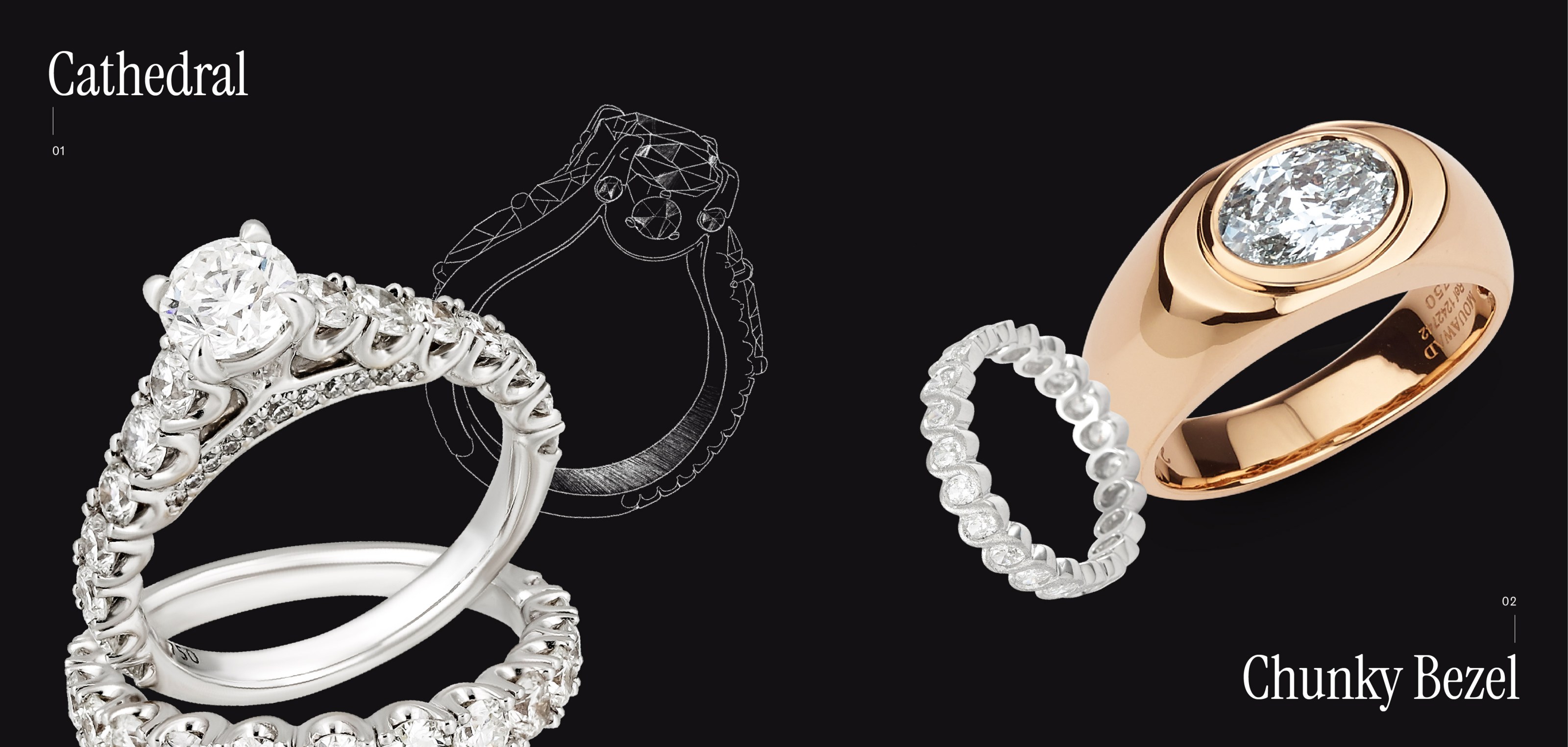
01. Cathedral
It is the arches on either side of a prong setting diamond, sometimes with a bezel-adjacent floating metal line running around the diamond, which sets this setting apart, by making it resemble cathedral architecture. The 1980s was the time when tall cathedral settings which uplifted large diamonds from the metal ring of the band, was popularised – their more pared down sister, the prong setting had already been around ever since Tiffany introduced them in 1886 through their classic six-pronged setting. This remains a classic style even today – Benny Blanco chose a more maximalist approach in his engagement ring to Selena Gomez featuring a solitaire marquise-cut diamond in a similarly minimal cathedral uplifted setting with an oversized brilliant-cut eternity band.
02. Bezel
The uniqueness of the bezel is in the amount of security it provides the stone as the edges of the metal are folded over the gem to fit its exact dimensions – all the while revealing the sharp cuts of the diamond to the light for the gem to sparkle and appear larger. This setting is an early technique with traces in the jewellery of ancient Rome and Greece where a groove was hollowed out from a metal band and the gem placed inside. Like Swift, Lily Collins’ engagement ring – which was famously stolen and recently found – was a rose-cut natural diamond set in gold bezel giving the illusion of a floating diamond. This setting’s minimal design crafted with precision is built for the woman on the go.
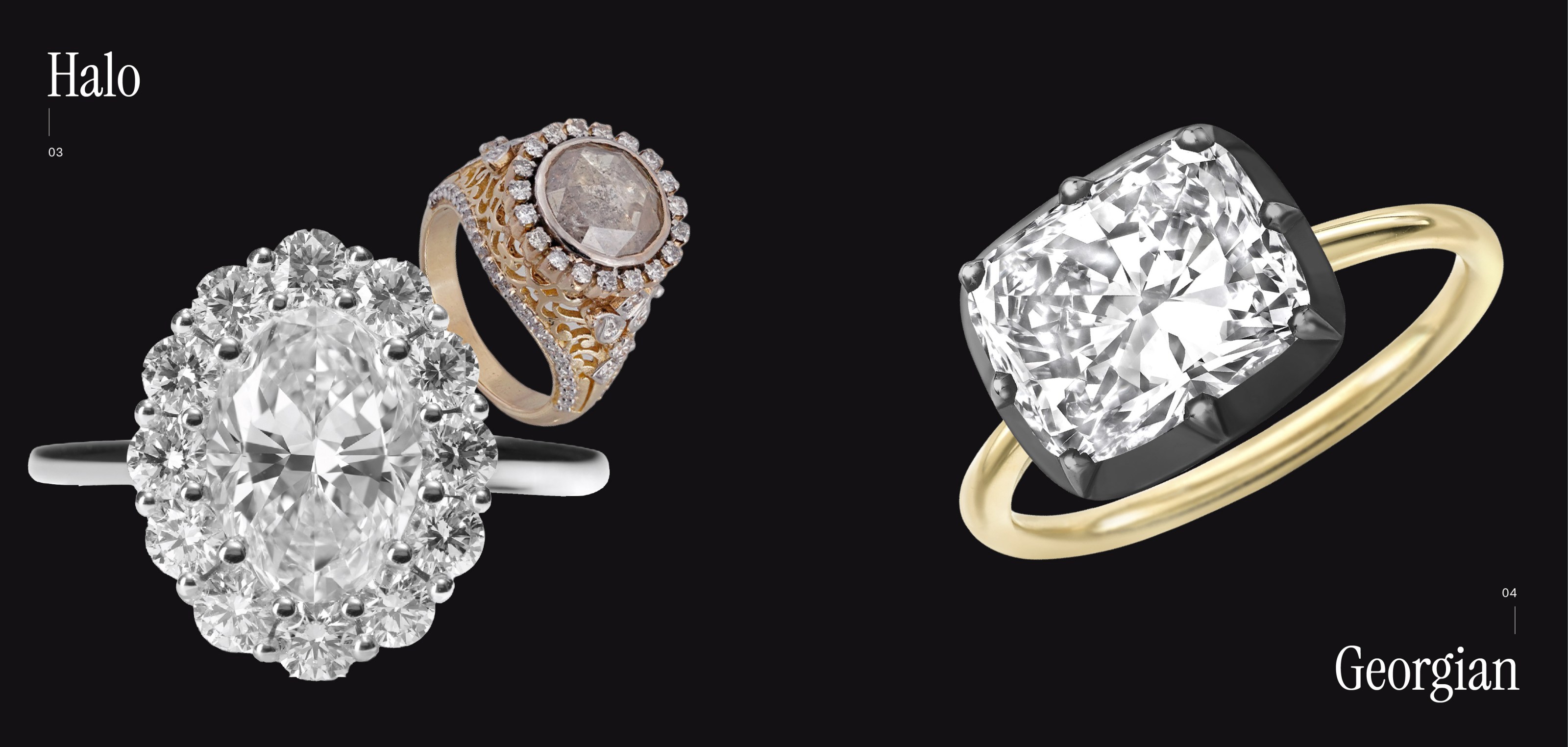
03. Halo
The halo typically has a central gemstone surrounded by smaller stones. This can also be traced to the Georgian era when jewellery was made with intricate details and using natural motifs like florals and leaves, like Victorian rings centered with an old mine-cut diamond surrounded by eight old mine cut smaller diamonds, emulating a flower.
Perhaps the most everlasting iteration of a halo was worn by Lady Diana Spencer where a 12-carat blue sapphire was surrounded by 14 solitaire diamonds – a design which has thereafter been emulated by Penelope Cruz whose three-carat, oval-cut blue sapphire is set in a white diamond halo with a protective bezel finish. Katrina Kaif’s engagement ring too echoed Lady Diana, with her cushion-cut tanzanite surrounded by two rows of natural diamonds instead of Spencer’s single row. The uniform halo was reinterpreted by Van Cleef & Arpels in 1970 where they closely-set irregular diamonds to surround a 5.38 carat Colombian emerald.
04. Georgian
The Georgian era (1714 – 1837) was a period of immense change in Britain with the discovery of the legendary Golconda mines in India and an inflow of diamonds from Brazil from the 1700s. This discovery led to an influx of natural diamonds in the market, making them more accessible for the elite. Therefore, Georgian jewellery is characterised by an opulence which is designed to be admired and decorative motifs like bows and ribbons – like in a pair of old cushion-shaped diamond tassels formerly in the collection of the Marquess of Anglesey, which went on auction at Sotheby’s.
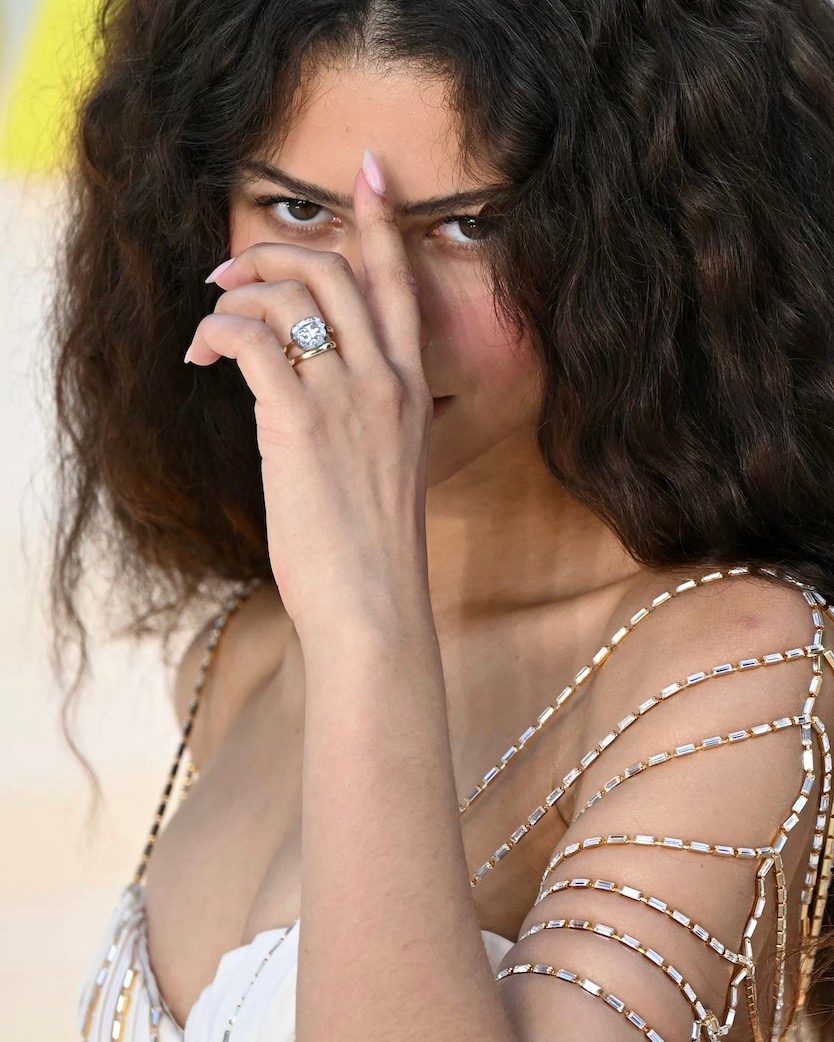
Today the extravagance of the Georgian style has been extracted into settings like their hallmark closed-back setting with coloured foil backing which focuses on the hues of the gemstones, which is supported on all sides by a strip of metal, leaving the gemstone to shine. This feature is still seen in jeweller Charlotte Sayer’s Georgian foil-backed rings. This has been transformed into Zendaya’s structural 5.02 carats, east-west cushion cut with the Georgian button-back setting by London jeweller Jessica McCormack.
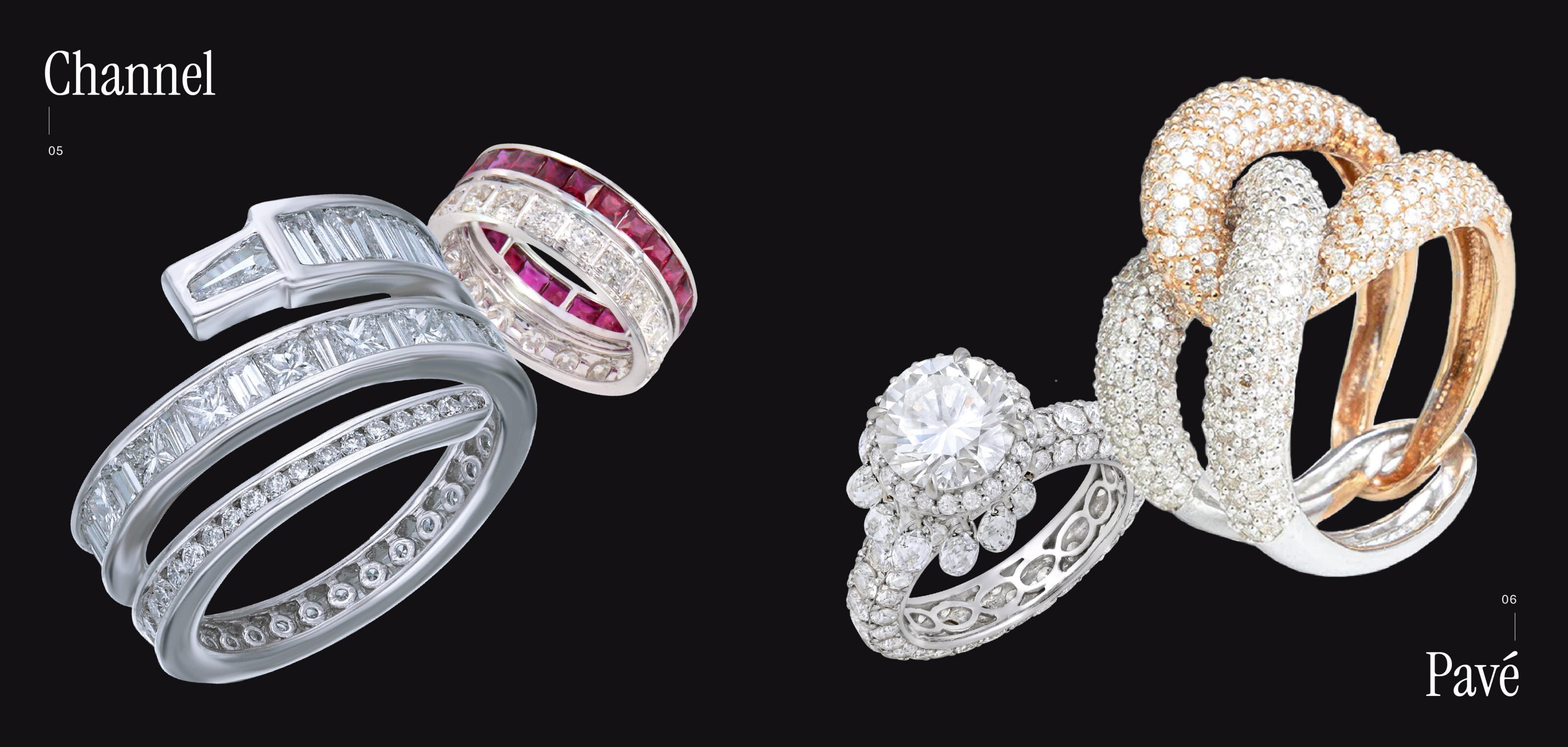
05. Channel
The channel setting with diamonds nestled into a ‘channel’ or groove secured within two bands of metal, which eliminates the necessity of prongs, while also being designed to offer more protection than the halo. This might seem like a signature of the geometric Art Deco era – but it flourished in the eighteenth and nineteenth centuries as evidenced by the abundance of diamonds required in this setting. This setting is used today in eternity bands set with a continuous line of stones. The ring has been seen on Angelina Jolie which had a chunkier outlook with the primary 16-carat emerald-cut diamond surrounded with custom-cut trapezoid and baguette diamonds within a platinum band.
This setting was also beloved by young Bollywood in the noughties like Kareena Kapoor Khan’s 5-carat round cut diamond encircled by two rows of channel-set diamonds or Shilpa Shetty’s 20-carat brilliant-cut diamond set on a platinum band fully encircled by a row of channel-set diamonds.
06. Pave
Derived from the French word pavé which means ‘paved’, implying the diamonds set closely together resemble a cobblestone street, it originates in the 1700s, yet remains modern and contemporary. Predictably this style flourished with the inflow of natural diamonds after empire building in the Georgian and Victorian eras – and later during Art Nouveau and Art Deco movements which favoured symmetry and flowing lines.
The minimalism yet elegance of this style has continued in modern interpretations particularly through Ranbir Kapoor’s engagement ring to Alia Bhatt designed by Van Cleef & Arpels where an 8-carat oval-cut diamond is flanked by eight smaller stones supported with metal balls – a nod to Kapoor’s lucky number – engraved on the inside with the nickname ‘Mrs Hipster’. A similar pronged iteration was seen for Kiara Advani’s engagement, an oval-cut solitaire on a pavé diamond band.
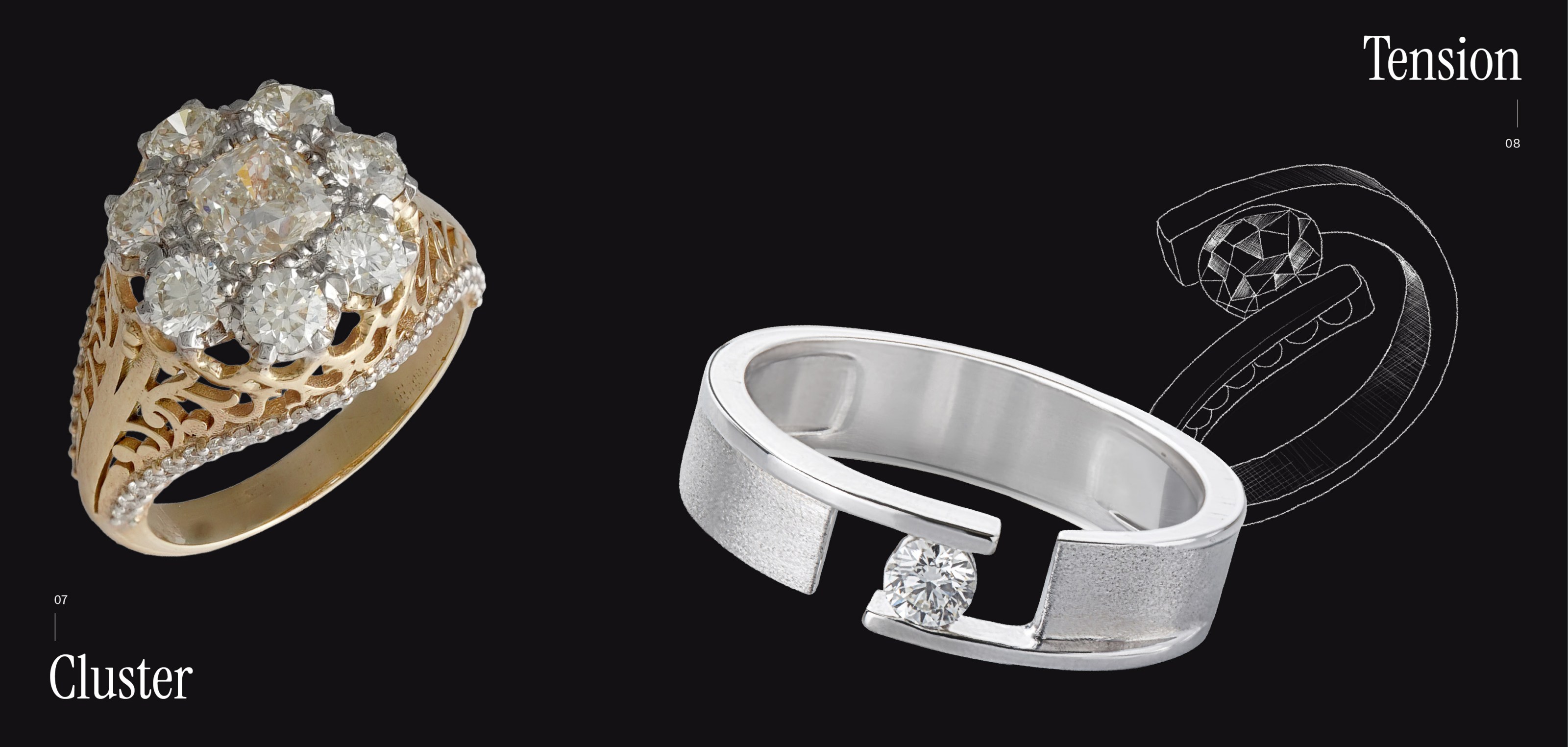
07. Cluster
A cluster setting features multiple smaller diamonds grouped closely together to create the appearance of a larger, unified design, often arranged in floral or geometric motifs, sometimes surrounding a central stone. Popularised during the Georgian era, the design of cluster rings changed according to era. A perfect example of their floral motif would be the step-cut emerald mounted in a closed setting within a border of cushion-shaped diamonds, that was presented by Queen Charlotte to Simon, 1st Earl of Harcourt upon the occasion of her marriage to George III.
This would of course change to sharp geometric lines and bold symmetry – in a stark contrast to vintage cluster settings – in the Art Deco era. Tiffany and Co. would reinterpret the cluster in a streamlined nine diamond cluster supported by prongs over a platinum band, basing it loosely on Art Deco geometry. This style was also what was chosen by Romain Dauriac for his engagement ring to Scarlette Johansson which had three round-cut natural diamonds laid vertically with geometric structures connecting them. Another iconic interpretation was by Harry Winston reforming the Spencer sapphire and diamond combination into a cluster of three marquise and pear-shaped sapphires and four marquise and pear-shaped diamonds, arranged in whimsy, emulating foliage.
Culture evolves, as it’s meant to – undergoing a shift with its fascination with an older era of refinement and polish allied to royalty and privilege – as we’ve seen in the past two fashion seasons. With young love being steadily sealed in stone by an evergreen classic era of ring-making, this practice is set to take over setting trends in the wedding industry, and it would be interesting to see what alternate natural diamond settings might be chosen, based on historical references, family archives or personal connections.
08. Tension
This setting holds a diamond gently between two strips of metal, exuding contemporary minimalism as the first tension diamond rings were forged in gold in the 1970s. It was made in the German town of Vreden through a collaboration between Ursula Exner – the granddaughter of the founder of the century-old goldsmith house Niessing – and the sculptor Walter Wittek. After being cast as gold bars, they are rapidly heated and cooled to generate the tension and hardness required to lock the diamond in between – instead of the usual prongs – to give it the illusion of flotation.
This setting has been embraced by Dua Lipa for her classic solitaire diamond engagement ring crafted in a tension setting within a wide cigar gold band – a choice emblematic of the chunky shift in diamond rings. However, it also provides additional safety to the gemstone.
The legendary jewellery designer Stephen Kretchmer also had his own version of the tension setting, with multiple gemstones held in a delicate tension balance, sometimes rendered in a more modern desigsn or even transferring this setting into golden earrings.
Newsletter