8 More Diamond Settings to Know: Part Deux
From romance to rebellion, explore eight natural diamond settings that reveal stories of innovation, craftsmanship, and changing ideals of romance
SRD JEWELS • THE GEM PALACE • DHAMANI 1969 • JALANDHAR JEWELLERY HOUSE • RK JEWELLERS • NORNAMENT • ROSE • MOKSH
A diamond ring and a piece of poetry. These were the two gifts Constanzo Sforza offered to his bride Camilla D’Aragona on their wedding day in 1475.
Meet the Author

- Medha V is an independent editor and writer based in Delhi, India.
- She previously worked with the editorial team at the digital magazine FiftyTwo.in and was part of the national desk at Mint, the business daily.
- She writes creative non-fiction essays, some which have been published in literary magazines like The Hammock and Ethnographic Marginalia, and a hardbound print edition of the Nivaala.co x Alipore Post anthology on food and memory.
“Two wills, two hearts, two passions are bonded in one marriage by a diamond,” the poem went. From that first ever documented instance of the usage of diamond in an engagement ring, the stone began a journey that would see it become synonymous with love, romance, and lasting commitment.
When it comes to engagement rings and fine jewellery, the diamond itself often gets the spotlight. But the setting—the way a stone is secured and presented—plays an equally important part in defining the character of the ring. From romance to rebellion, the history of diamond setting is as fascinating as the gemstones themselves. From Miley Cyrus’ cushion-cut diamond set in an unconventional yellow gold gypsy ring to Kareena Kapoor Khan’s solitaire diamond in a prong-mounted basket setting, diamond setting techniques continue to evolve alongside changing tastes and cultural narratives. Here, we trace the history of eight such diamond settings that continue to influence modern jewellery design.
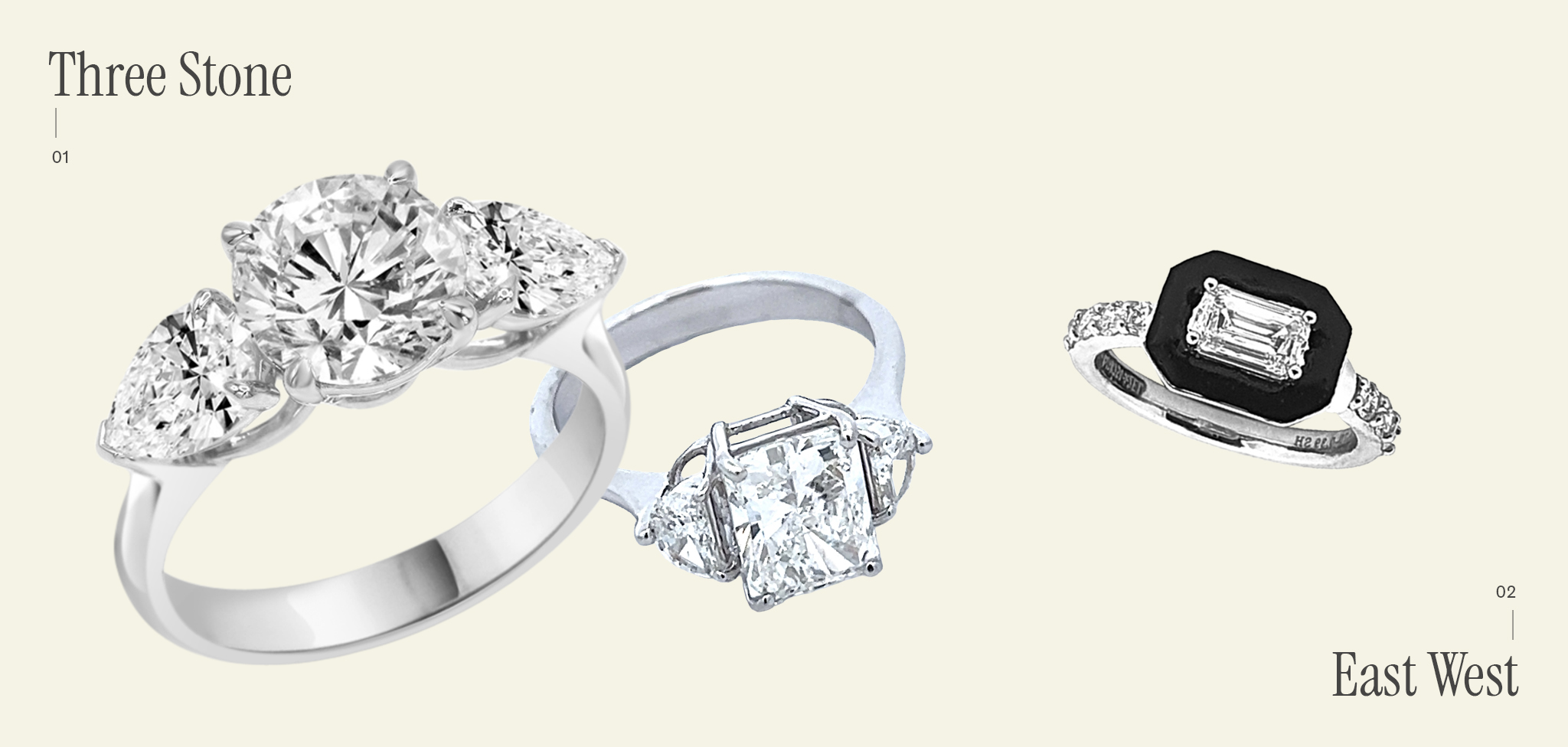
01. Three Stone-Trilogy
The three-stone setting, often referred to as a trilogy ring, features a central diamond flanked by two side stones. Beyond its visual balance, the style is rich in symbolism, with the three stones commonly representing a couple’s past, present, and future—an idea that was popularised in the Victorian era, sometime around the mid 1840s. It witnessed a resurgence during the Art Deco era, and later became all the rage in 2001 when DeBeers brought it back to the mainstream.
Modern interpretations of the three-stone setting often mix diamond cuts or incorporate coloured gemstones, creating a piece that feels both meaningful and highly personal. Actor Nupur Sanon’s engagement ring, for instance, features an elongated marquise-cut center diamond and two natural stones on its either side. There is also Emily Ratajkowski’s divorce ring, a piece she fashioned out of her engagement ring, which is a princess-cut diamond flanked by two trapezoid-cut natural diamonds.
02. East West
When Zendaya stepped onto the Golden Globes red carpet last year, it was also the public debut of her engagement ring: the most stunning cushion-cut, button-back, 5.02-carat diamond ring. An east-west setting, where the stone was set horizontally across the finger, instead of the conventional vertical placement of an elongated diamond.
The setting originated in the 15th century, but became popular during the Art Deco movement of the 1920s and 1930s. It was an era of newfound modernity, and its influence didn’t stop at art and architecture—it shook up conventional ideas of ring design too. The movement brought bold, industrial geometry and sleek architectural lines to popular aesthetics, replacing the soft, organic curves of the Edwardian era.
Oval, emerald-cut, marquise and pear-shaped diamonds lend themselves beautifully to east-west interpretations. It also works well for more complex, multi-stone pieces. The east-west setting, while not an entirely unconventional engagement ring style, is perfect for those who seek a slight sense of playfulness.
03. Gypsy
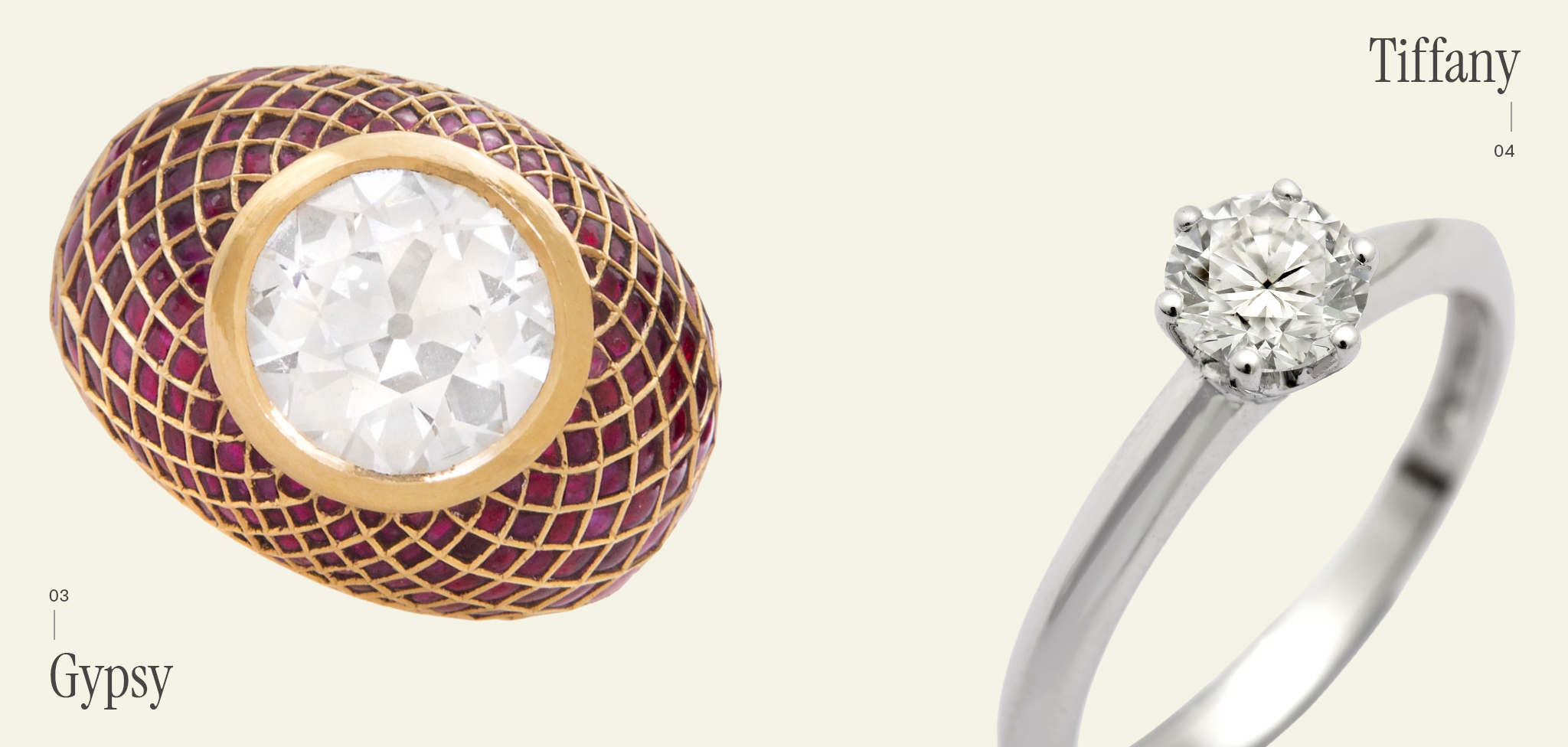
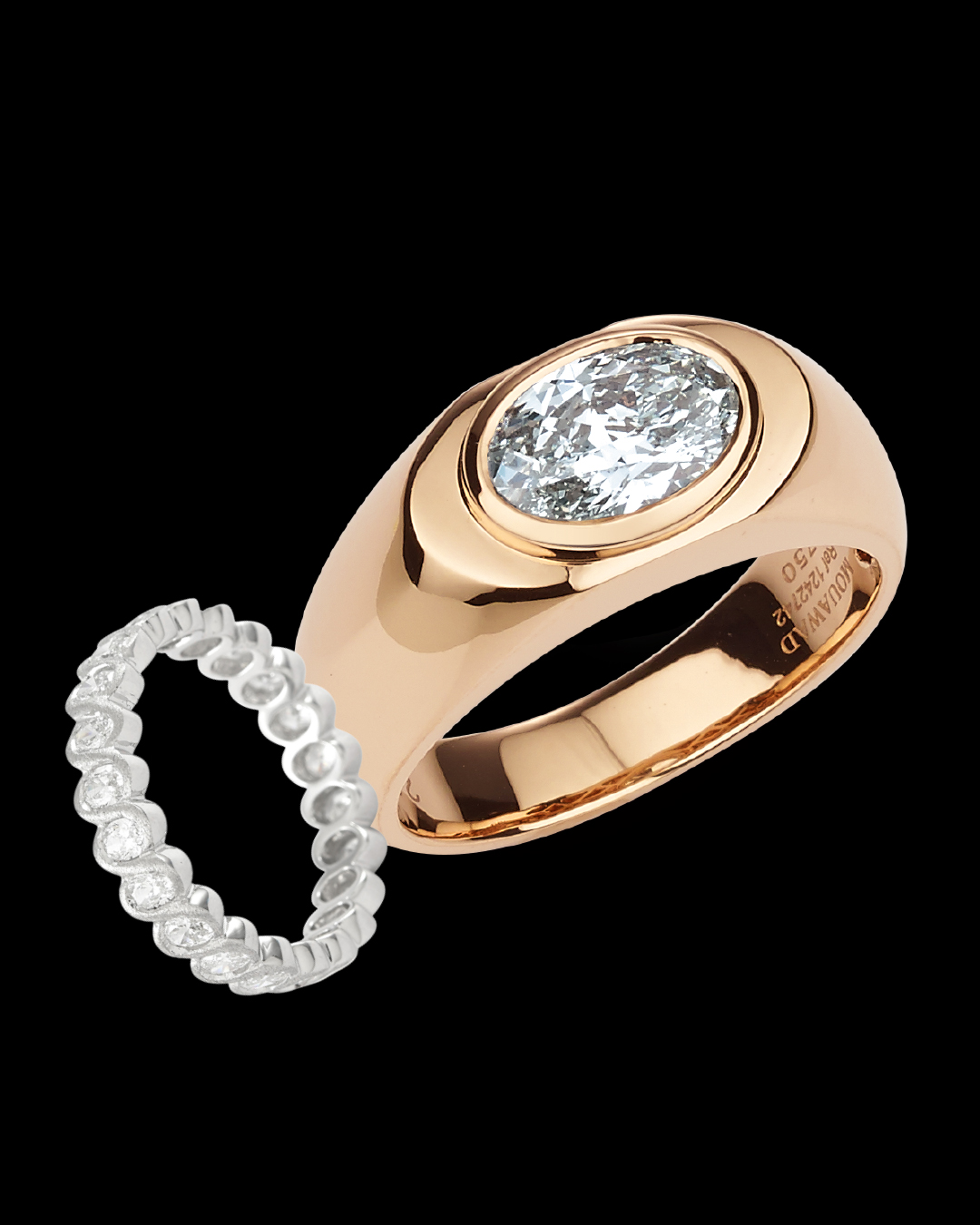
The gypsy setting embeds the diamond directly into the metal band so that the stone sits level with the surface. While some settings have backstories akin to unreal fairy tales, this has one mired in dissent and rebellion. During the Victorian era, the gypsy setting was worn almost as a counter-response to the excessively flowery styles that were common at the time. It also held other symbolic meanings: men and women wore the ring on their left pinky fingers to tell the world that they don’t care for marriage. A rebellious concept in the highly conservative Victorian society.
What a twist of fate then that this style has found its way to engagement ring design now, like in Miley Cyrus’ custom cushion-cut diamond, set in a chunky, 14-karat yellow gold gypsy ring. The design’s unadorned, minimalist style and sturdy construction are especially relevant today, reflecting broader cultural shifts toward androgynous designs and everyday wearability.
04. Tiffany
The introduction of this classic setting marked the beginning of an era of modern diamond engagement rings. The year was 1886, and the man behind this mission was Charles Lewis Tiffany—founder of the now iconic Tiffany & Co. In true American fashion, he is said to have popularised the design through mail-order catalogues sent out across the country which also had inside it a paper ring sizer!
What is now known as the Tiffany setting is a deceptively simple design which consists of a round diamond above a gold band with six prongs that let lots of light into the natural stone. One gets to see more of the stone in this setting, unlike other settings where there’s more metal surrounding it. Grace Kelly famously wore a Tiffany-inspired solitaire engagement ring before receiving her iconic emerald-cut ring from Prince Rainier III, helping cement the design’s association with elegance and royalty. Now, more than a century after its launch, the Tiffany setting is often referenced by luxury maisons seeking to capture classic American glamour. It has inspired generations of brides all over the world.
05. Prong
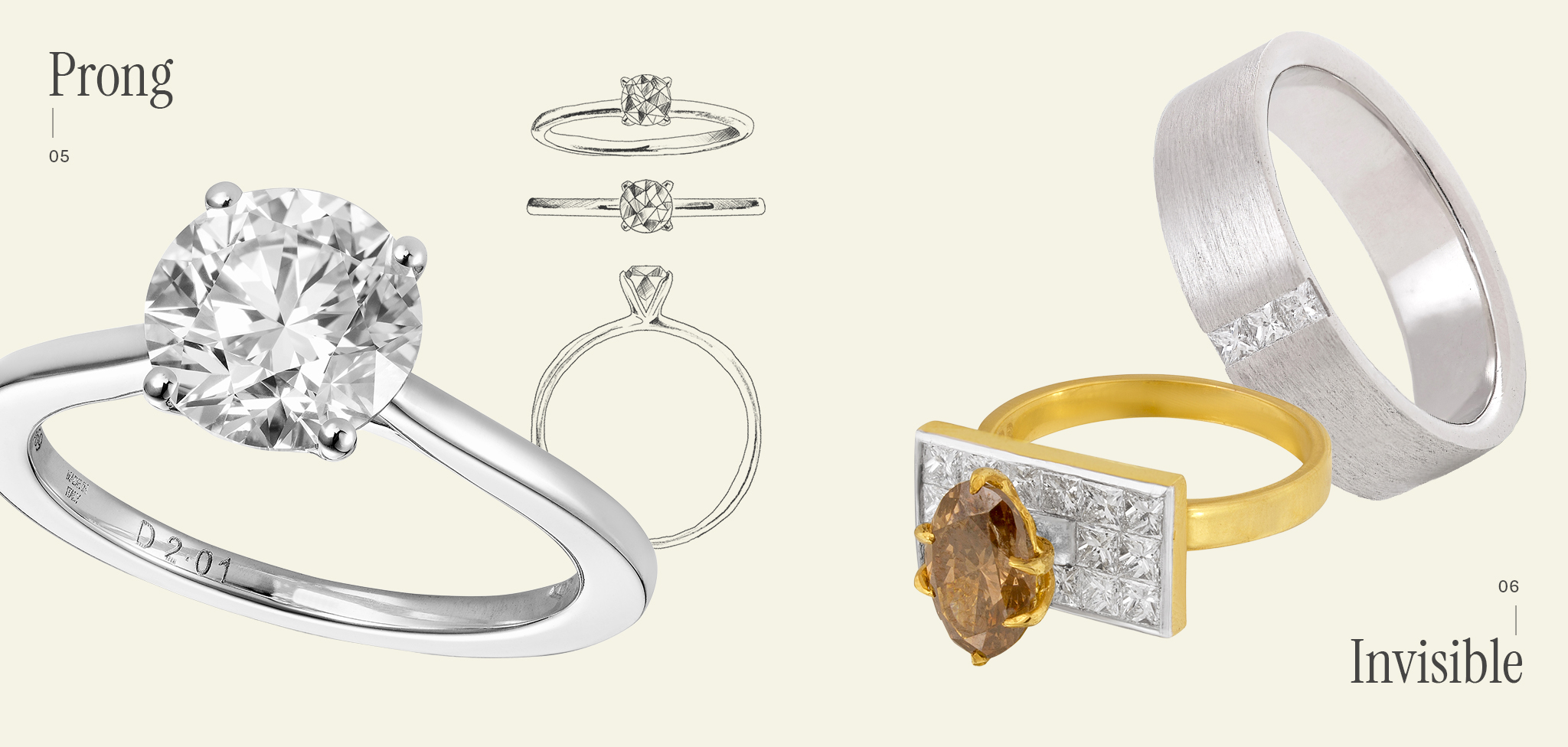
Typically featuring four, six or more metal claws that hold the diamond in place, the prong setting is perfect for solitaire engagement rings. Their minimalist structure also makes diamonds appear larger than they actually are. Actor Sonakshi Sinha’s engagement ring, for instance, which has a round brilliant-cut solitaire diamond at the centre is set in a classic six-prong gold band. Another example would be actor Aditi Rao Hydari’s engagement ring—a romantic Toi et Moi design featuring a round diamond and a pear-shaped diamond set side by side. The round diamond is secured with traditional prongs, while the pear-shaped diamond is held with a combination of prongs.
The function of the prong is to elevate the stone above the band and allow for natural light to hit it from different angles. The more the light, the more the sparkle.
06. Invisible
The invisible setting is a technical feat that creates the illusion of a continuous surface of diamonds with no visible metal between the stones. Commonly used with princess-cut diamonds, the technique allows multiple stones to fit together like a mosaic, producing an uninterrupted field of brilliance. The setting requires extraordinary craftsmanship, as each stone must be precisely cut and fitted into a hidden framework.
This style was developed by high jewellers in France about 200 years ago, and its clean appearance appeals to those who appreciate understated luxury and meticulous craftsmanship. In 1933, luxury jeweler Van Cleef & Arpels patented its revolutionary Mystery Set (Serti Mystérieux), a method in which specially cut gemstones are mounted on hidden rails beneath the surface. Elizabeth Taylor was known to have had several exquisite invisible-set rings in her collections, one of which was a luminous ruby and diamond ring.
07. Basket
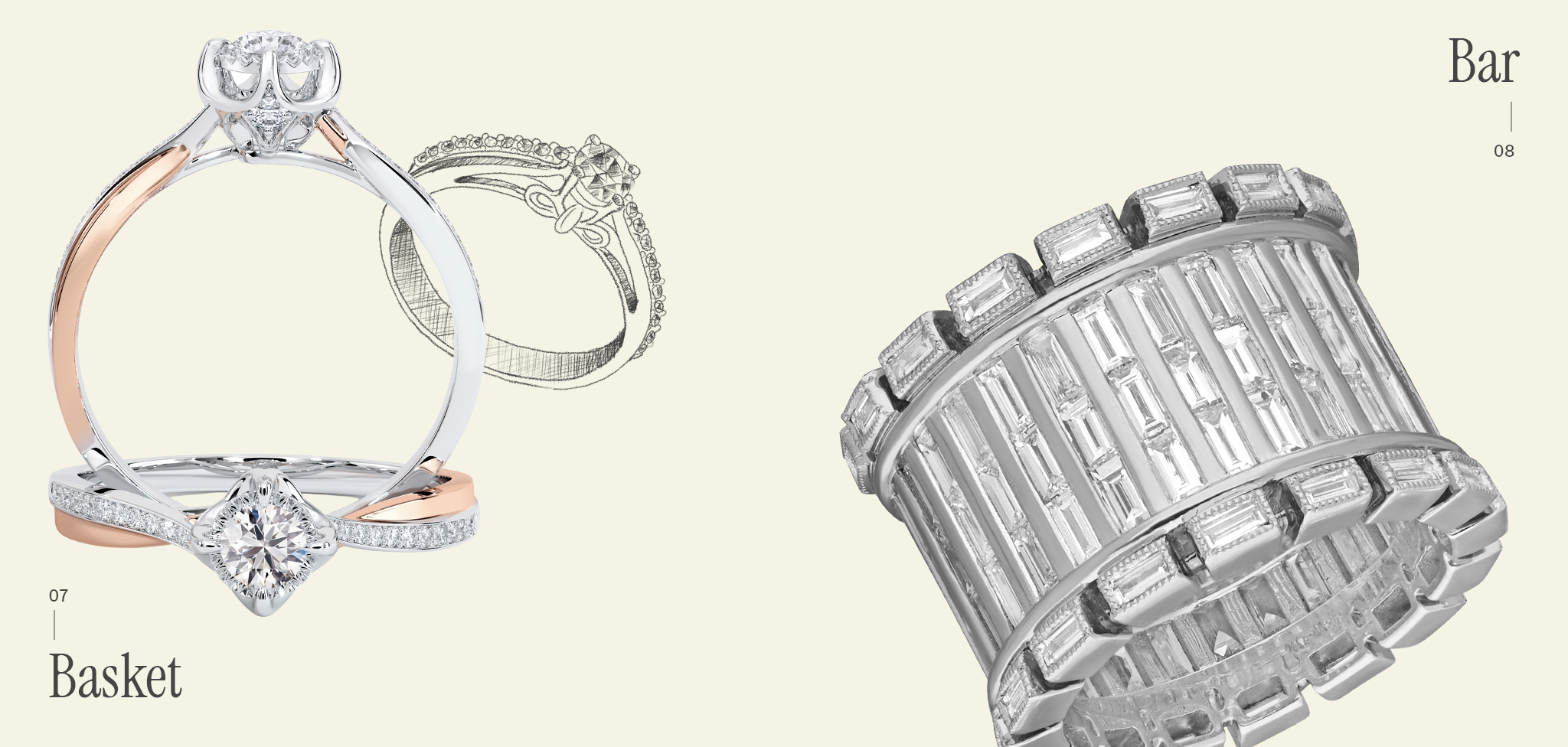
There was a time when diamonds were not associated with lustre. They were painted black in medieval and early Renaissance paintings: gem cutters at the time did not have the tools to create the exact facets needed for the stone to reflect light. This meant that even natural, colourless stones were opaque and dark. It is the advancement in natural diamond cutting and setting techniques that gave the gemstone its signature shimmer. The basket setting, which cradles the diamond in a basket-like metal framework, is one such technique that evolved through the 18th and 19th centuries.
The design offers more edge support than simple prongs, and lets light touch the diamond from multiple sides. The basket setting became even more popular in the later years, as more and more jewellers began using platinum to craft rings. Kareena Kapoor Khan’s engagement ring, which features a 5-carat round brilliant solitaire diamond, is set in a prong-mounted basket on a diamond-encrusted platinum pavé band. In proof that this design also suits more minimalist ring styles, there is Sobhita Dhulipala’s gorgeous engagement ring—it has a solitaire diamond placed high in a four-prong basket setting on a tapered cigar-style gold band.
08. Bar
Another design that emerged during the Art Deco era, the bar setting comprises diamonds held in place by vertical metal bars positioned between adjacent stones. The setting is a true testament to the period’s fascination with precision and geometry, particularly when used with rows of diamonds in bracelets, eternity bands, and cocktail rings.
Unlike traditional prong settings that visually separate each gemstone, bar settings create a cleaner, more structured look while still allowing significant light exposure. The resultant look is geometric, streamlined and modern. Because of its minimal look, rings with bar settings are easily stackable and make for perfect everyday jewels.
Newsletter