< Historic Diamonds / Royal Stories
Step Inside the Glittering World of Marie Antoinette Style and the Jewels That Define It
Only months remain at the V&A exhibition, Marie Antoinette Style, to experience the opulent legacy of history’s most stylish queen.
Published: December 12, 2025
Written by: Josie Goodbody
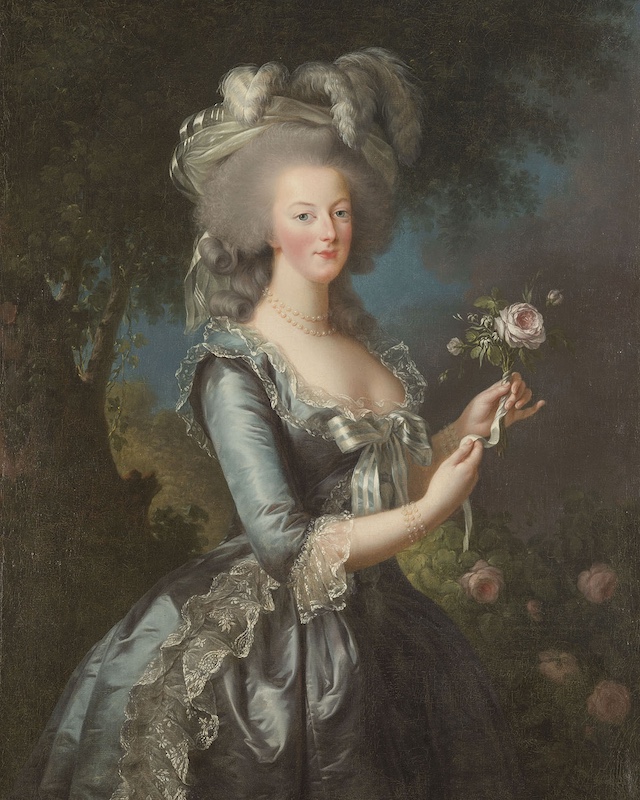
Barely a year goes by without the tragic teen queen being fêted in some way—whether through the auction of a piece of her jewelry or an exhibition exploring her life and influence. Extraordinarily, however, for a queen who was an eager Anglophile, there has never been an exhibition devoted entirely to her in the United Kingdom, until now.
London’s magnificent Victoria & Albert Museum, having recently closed the doors on its formidable Cartier retrospective, has unveiled an exhibition, Marie Antoinette Style, dedicated to history’s most talked-about Queen Consort, complete with some truly spectacular and scandalous diamonds.
Meet the Expert

- Josie Goodbody is a jewelry historian, novelist, and communications specialist with a passion for storytelling and the world of high jewelry.
- Goodbody is the author of the Jemima Fox mystery series, blending intrigue with dazzling jewels, and her work has appeared in the Daily Mail and Rapaport.
Ahead, discover the extraordinary jewels of Marie Antoinette Style, and the fascinating history behind them.
Marie Antoinette Style: A Wedding Dress Fit for a Dauphine
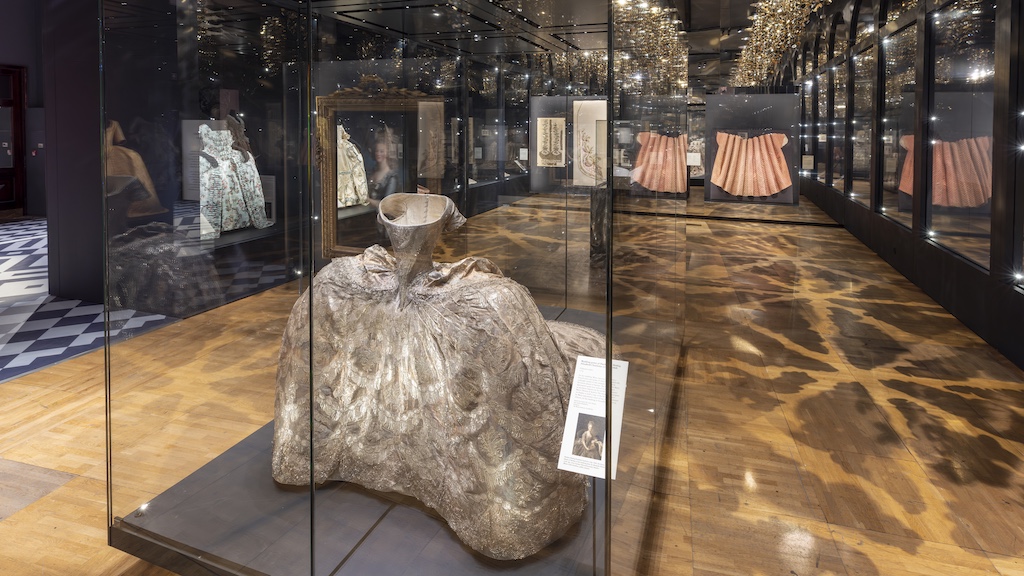
One of the first items in the Marie Antoinette Style exhibition, cleverly displayed in a mirrored room that subtly recalls Versailles’s Hall of Mirrors, is a spectacular silver wedding gown, glistening with thousands of silver sequins intricately sewn into already shimmering fabric. The whale-boned bodice, set within an enormously wide skirt, renders the waist so tiny it’s almost unimaginable. The gown would originally have been adorned with hundreds of diamonds, part of her dowry, which would’ve been sewn onto the skirts and her train.
Although not the fourteen-year-old dauphine’s own wedding dress, as no dress of hers remains intact, this example, worn in 1774 by the future Queen of Sweden, was modeled on the gown of Marie Antoinette’s sister, who no doubt emulated her older sister’s dress from four years earlier.

When the Austrian princess, who had already been married by proxy before leaving her homeland, walked through the famous Hall of Mirrors to the Royal Chapel for her public wedding, the diamonds on her gown and in her hair were said to have sparkled “a thousand times over” in the candlelight. In the Marie Antoinette Style exhibition’s accompanying book, Sarah Grant explains that the Duchess of Northumberland, visiting from England, wrote in her diary (apparently the only surviving account of the wedding): “The Dauphine was very fine in Diamonds. […] She really had quite a Load of Jewels”.
After all, as the queens of France were never crowned, it was their wedding dress that would be their most significant treasure.
The Diamonds That Were Her Downfall
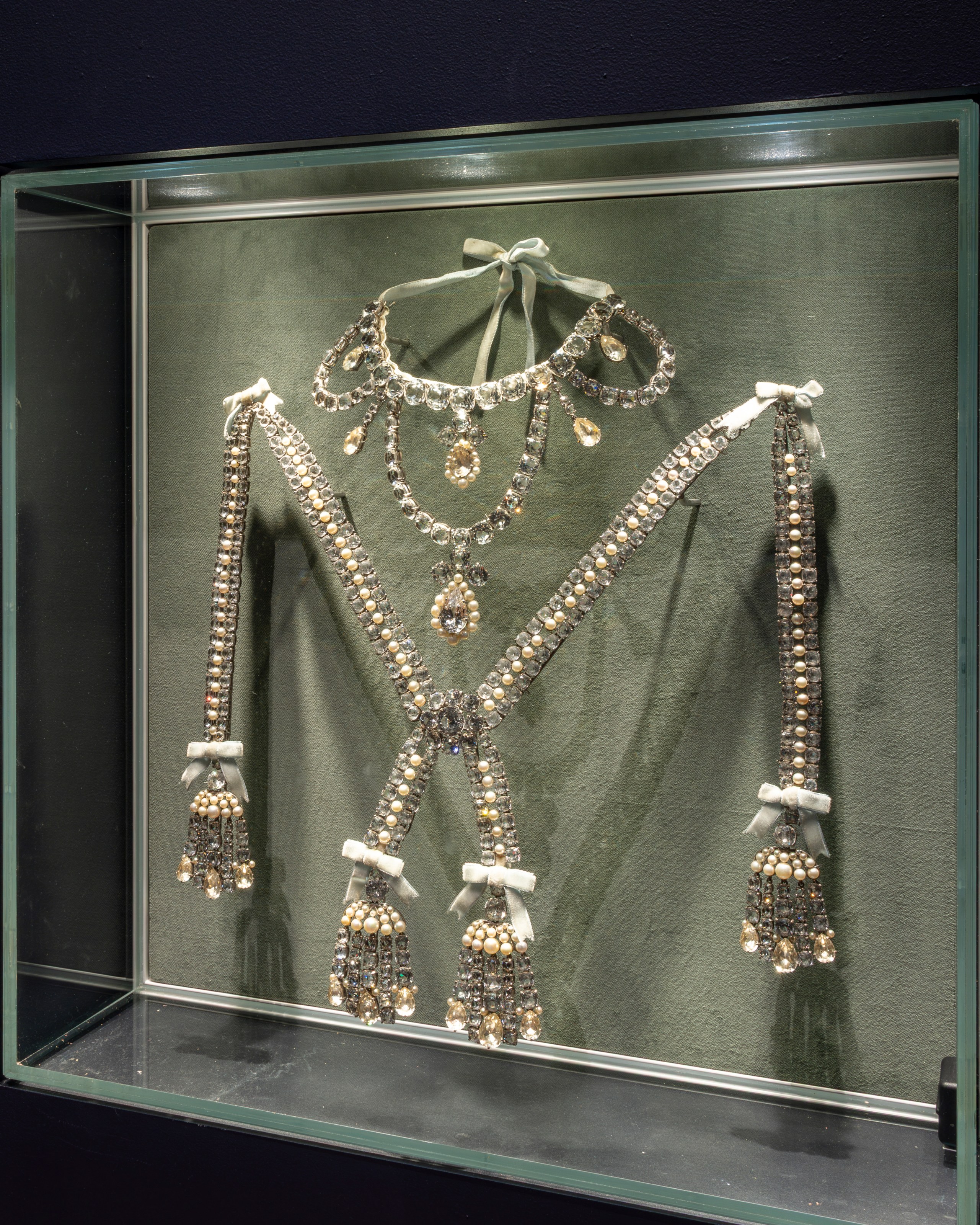
The story of “The Affair of the Necklace” is almost as famous as its protagonist. Indeed, there are numerous novels, including Dumas’s 1848 The Queen’s Necklace, Jean Plaidy’s 1958 The Queen of Diamonds, as well as films such as The Affair of the Necklace (2001) starring Hilary Swank, and Ocean’s 8 (2018) with Anne Hathaway, Cate Blanchett, and Sandra Bullock. These works are either based on or reference the tale, so it seems almost futile to recount it. For those who have been living in a vacuum (!), here it is.
In 1772, a diamond necklace, valued at $17.5 million in 2024, was commissioned by Louis XV from the crown jewellers, Boehmer and Bassange, for his mistress, Madame du Barry. However, before it was completed, the king died in May 1774, and the mistress was sent into exile. The dauphin became Louis XVI, and the dauphine became queen, and it is at this point that the tale took a sinister turn, one which the Queen’s lady-in-waiting Madame Campan later wrote in her posthumous memoir, “attacked the Queen’s character and assailed the majesty of the throne”.

Later in 1774, Madame Campan recounts how the Queen purchased jewels from Boehmer worth 360,000 francs, and not long afterwards, the King bought his wife “a set of rubies and diamonds of fine water”. The Queen, Campan notes, told Boehmer that she considered her jewel case “rich enough” and had no desire to add to it. According to Sarah Grant, she also found the great necklace far too elaborate for her taste.
But the jewelers had invested a considerable sum in sourcing diamonds to create a necklace that would “surpass all others,” and they were determined to find a buyer. They approached Madame Campan’s husband, imploring him to persuade the queen to purchase it, but he refused. The jeweler next approached the King’s first gentleman, who also declined, repeating what the Queen had already said: that “she already had very beautiful diamonds”.
Boehmer did not give up. A year or so later, he begged the Queen himself, claiming he would be ruined if she refused to buy it and even threatening to throw himself in the Seine. The Queen sent him away, but this was far from the end of the story.
After a further series of twists and turns, one involving an Ottoman Sultan and another the Cardinal de Rohan, the Comtesse de Lamotte-Valois cunningly managed to acquire the necklace using the Queen’s name. Although innocent, Marie Antoinette was accused of deceiving the Crown Jewellers and, consequently, became linked to a scandal that contributed to the implosion of the French Revolution.
But what became of the diamonds set in this notorious necklace? Visit Marie Antoinette Style at the V&A and see for yourself.
The Sutherland Diamonds
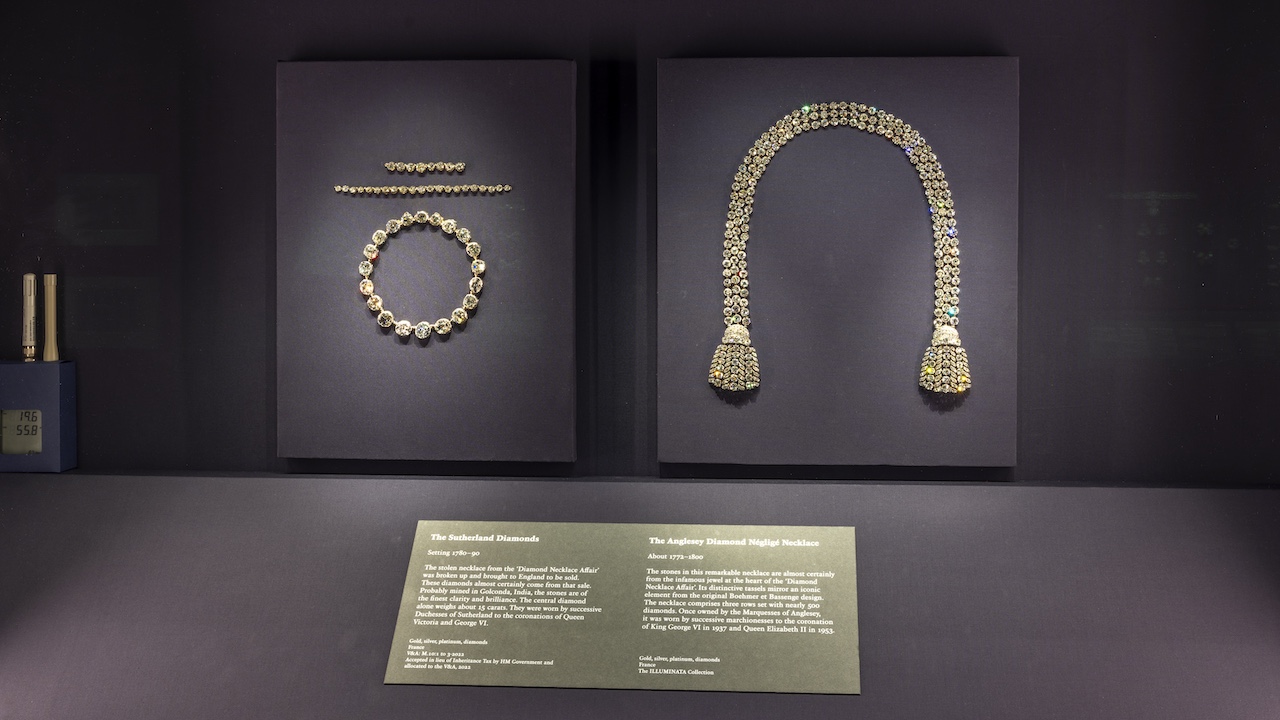
At the center of this superlative vitrine devoted to the world of the “diamond queen” is not only a 1960s replica of this elaborate festoon but also two natural diamond necklaces that were once part of it.
The Sutherland Diamonds may be one of the two surviving souvenirs of the Boehmer necklace, both of which are included in the Marie Antoinette Style exhibition. It is believed that the con-artist countess, de la Motte, smuggled the diamonds to London, where a bona fide British countess, the countess of Sutherland, who had been a friend of the queen while her husband served as an ambassador in Paris, purchased the choker and its two extensions from one of a pair of Piccadilly jewellers who had acquired the broken-up necklace from the French thief.
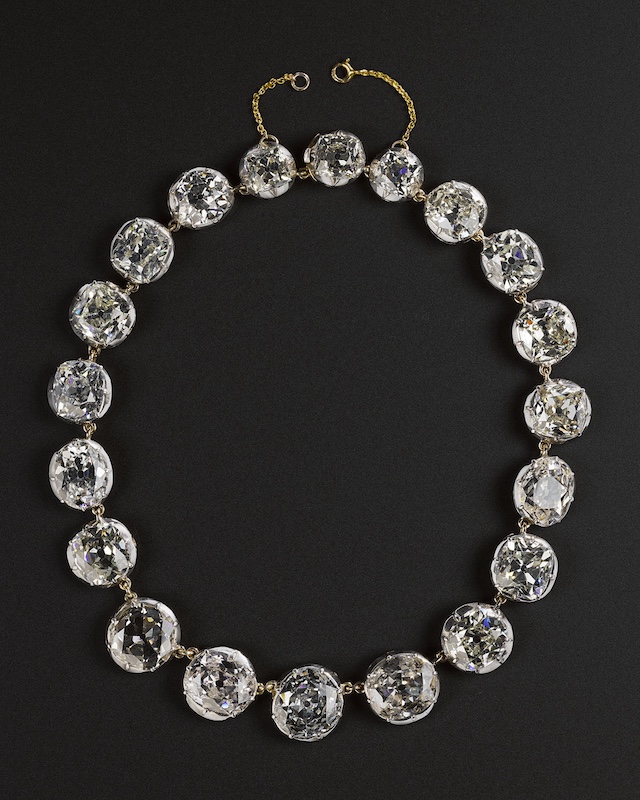
Sarah Grant describes the diamonds in the Sutherland necklace as Indian in origin and of such “quality and exceptional clarity and brilliance and beauty that would make that feasible”, that is, that the Sutherland Diamonds are indeed from the Boehmer necklace. They were worn at three British coronations, including those of Queen Victoria in June 1838 and Queen Elizabeth II in June 1953. They still belong to the Duchess of Sutherland but are on permanent loan to the museum.
The Jewels of Marie Antoinette Style: Diamonds, Pearls, and Bows
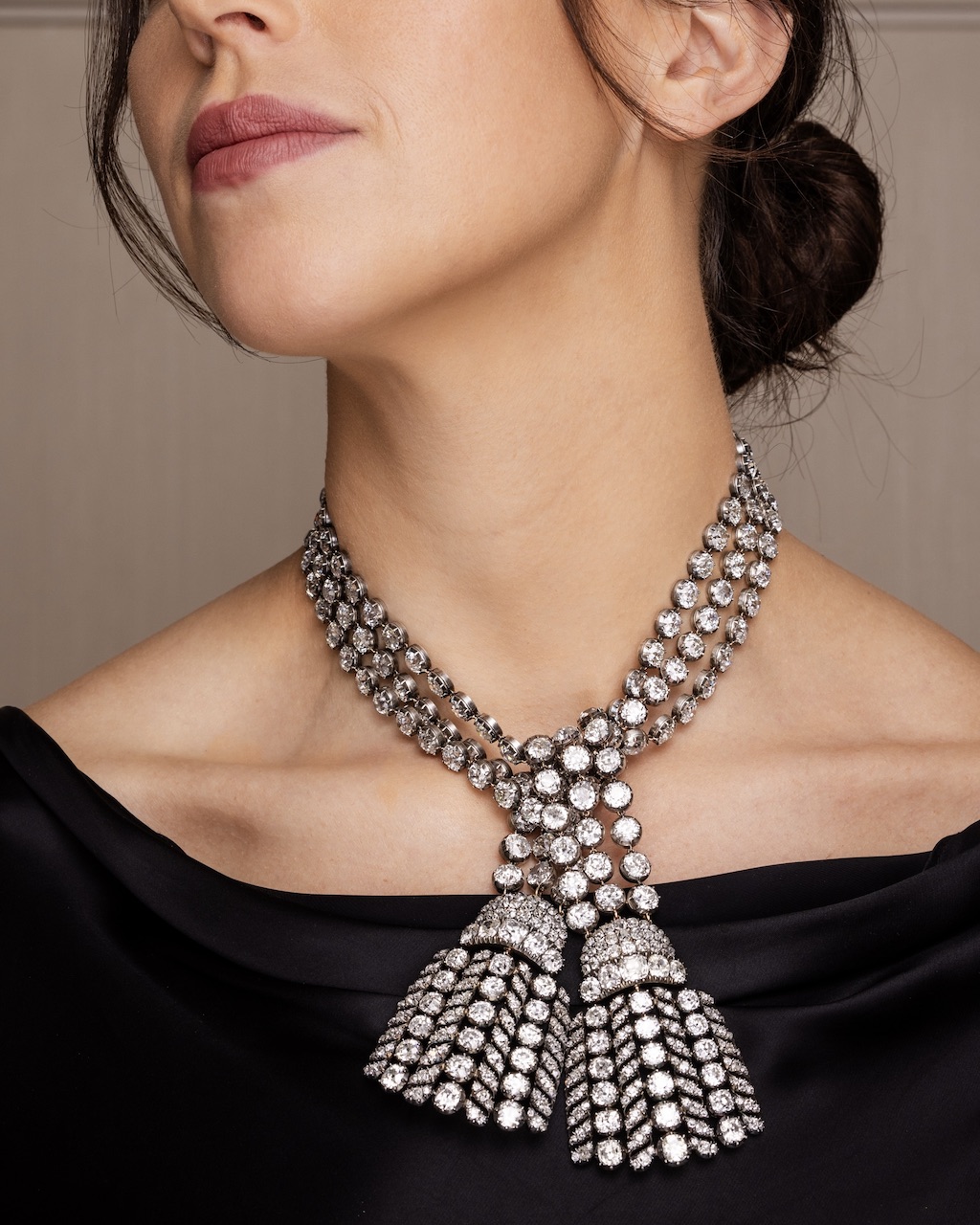
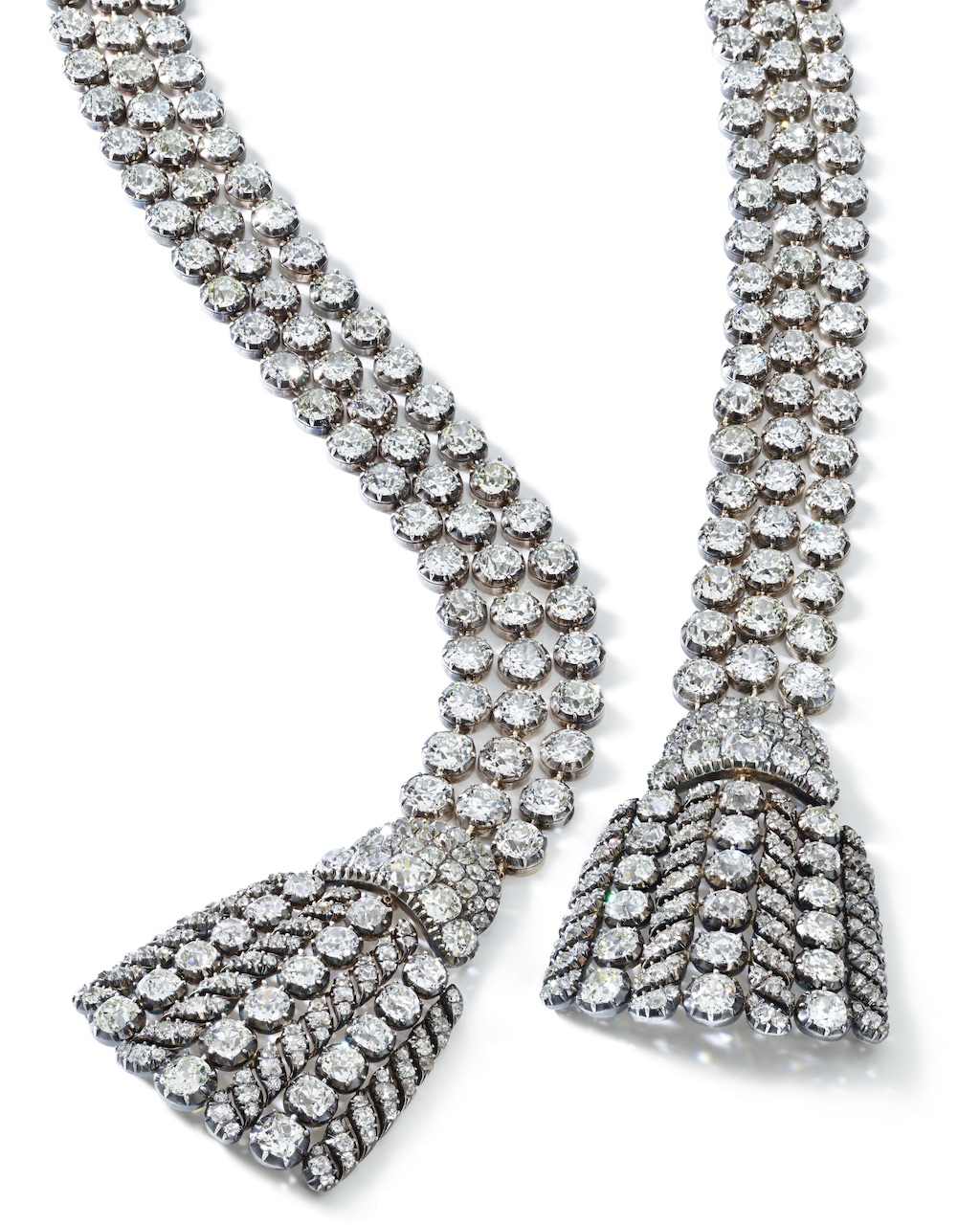
Last year at Sotheby’s, a Georgian diamond tassel necklace sold for an astonishing $4.8 million, partly because its provenance was believed to link it to another part of the ill-fated Collier de la Reine. The necklace, composed of three rows of diamonds in collet settings with twin diamond tassel terminals, was not dissimilar to those included in the “mother” jewel and had belonged to the Marquessate of Anglesey. Its history includes the eccentric “Dancing Marquess,” who was known for his flamboyant taste and was prone to wear the piece as part of feminine-like costumes.
Of course, these two jewels were “saved” before the Revolution, but the exhibition also includes equally exquisite jewels that truly belonged to Marie Antoinette in the exhibition, some of which she had managed to have smuggled out by the Austrian ambassador for her daughter, Marie-Thérèse, Madame Royale. Among the exhibits is a baroque natural pearl suspended from a sweet diamond bow, originally fastened to a three-row pearl necklace by a yellow diamond, and sold at Sotheby’s for $36.2 million in 2018. Also on display is a double ribbon bow brooch with a pear-shaped yellow diamond pendant. Further bow ornaments, set with brilliant cut diamonds in silver, sparkle from the cabinets.
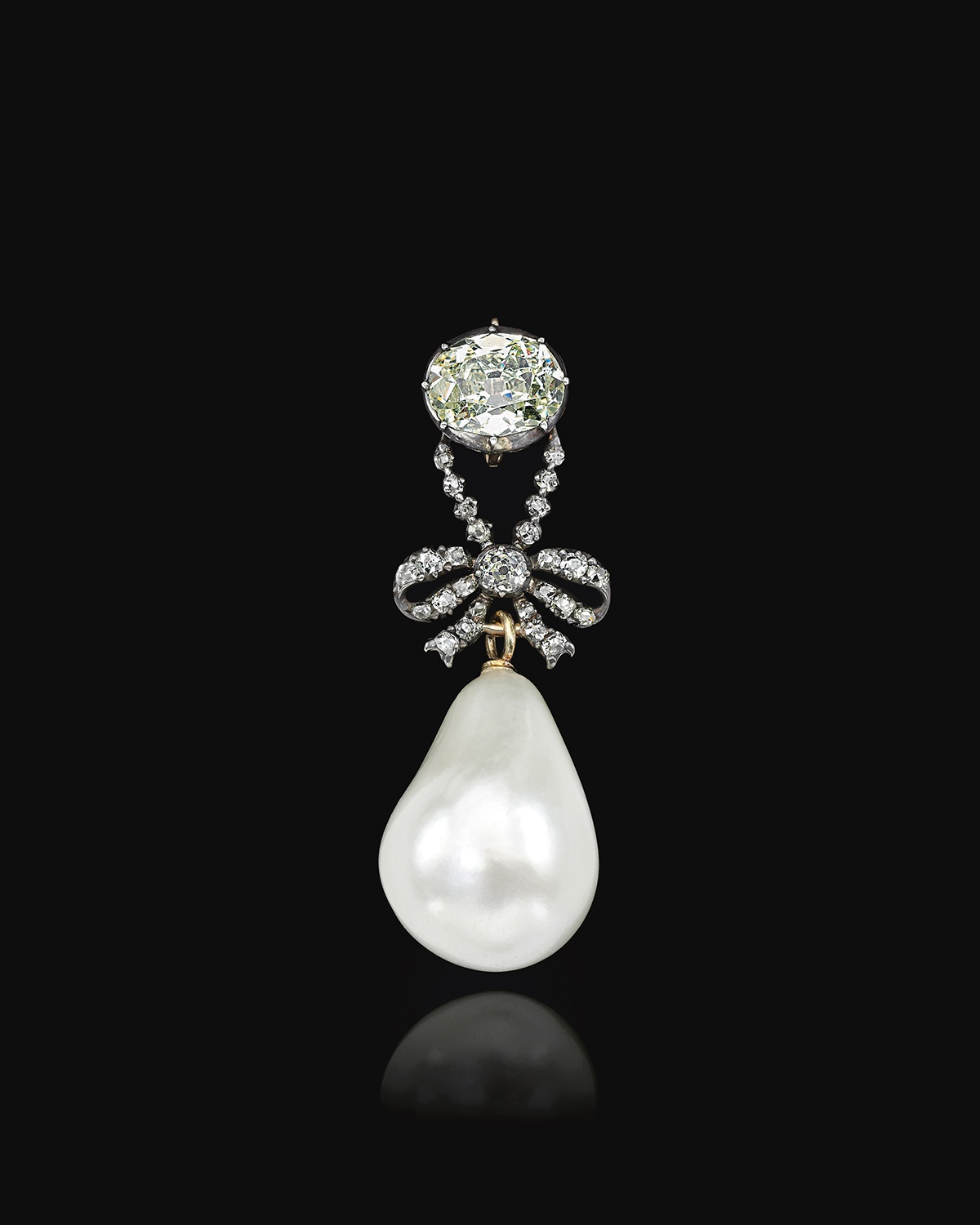

c.1770.
There is also a pair of diamond bracelets, made two years after she became queen, each set with three rows of old cut diamonds and five diamonds along the clasp; they sold in 2021 for $8.2 million. Additionally, two oval bracelet clasps with her monogram set in diamonds on blue paste, made not long after she arrived in France in 1770, are included in the display.
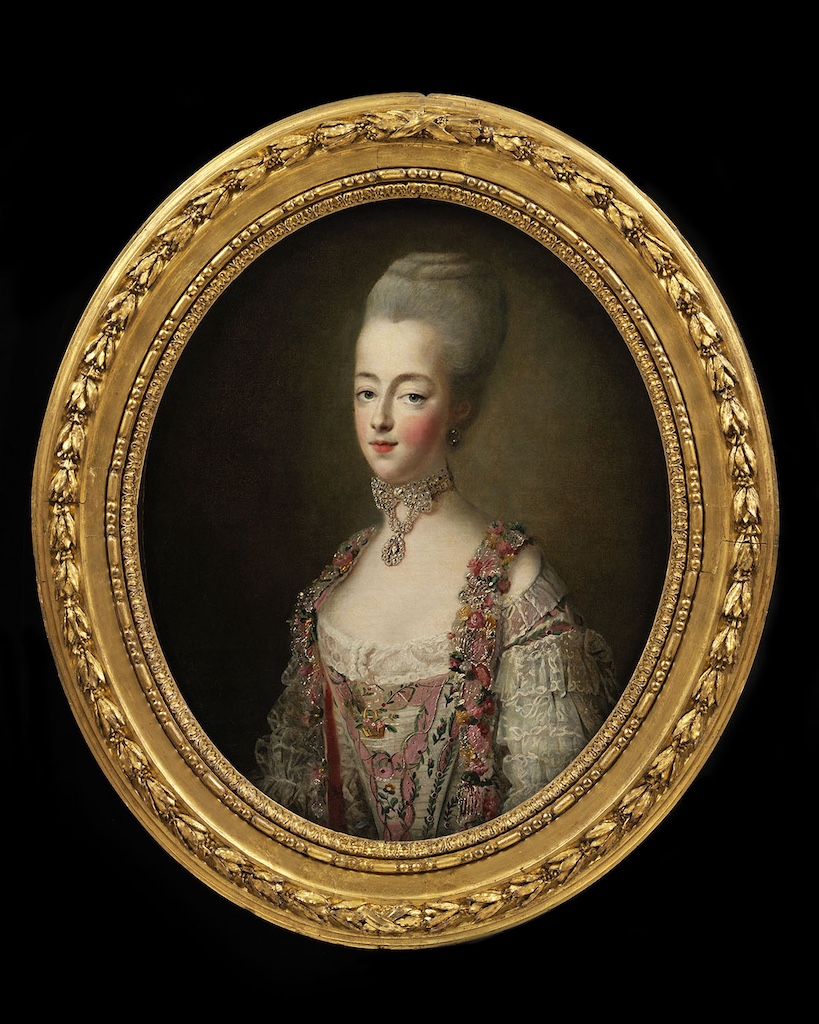
An elegant jewelry box made of rosewood and oak, adorned with Sèvres porcelain plaques, and given to the Dauphine by her grandfather-in-law, Louis XV, has been borrowed from Versailles, as has a portrait of Marie Antoinette by François-Hubert Drouais, painted when she was 17 or 18. In this lovely portrait of a beautiful young woman, the artist depicts her wearing a diamond-set bow choker, while another of her favorite portraitists, Élisabeth-Louise Vigée Le Brun, portrays her wearing pearls.
Marie Antoinette‘s Signature Style
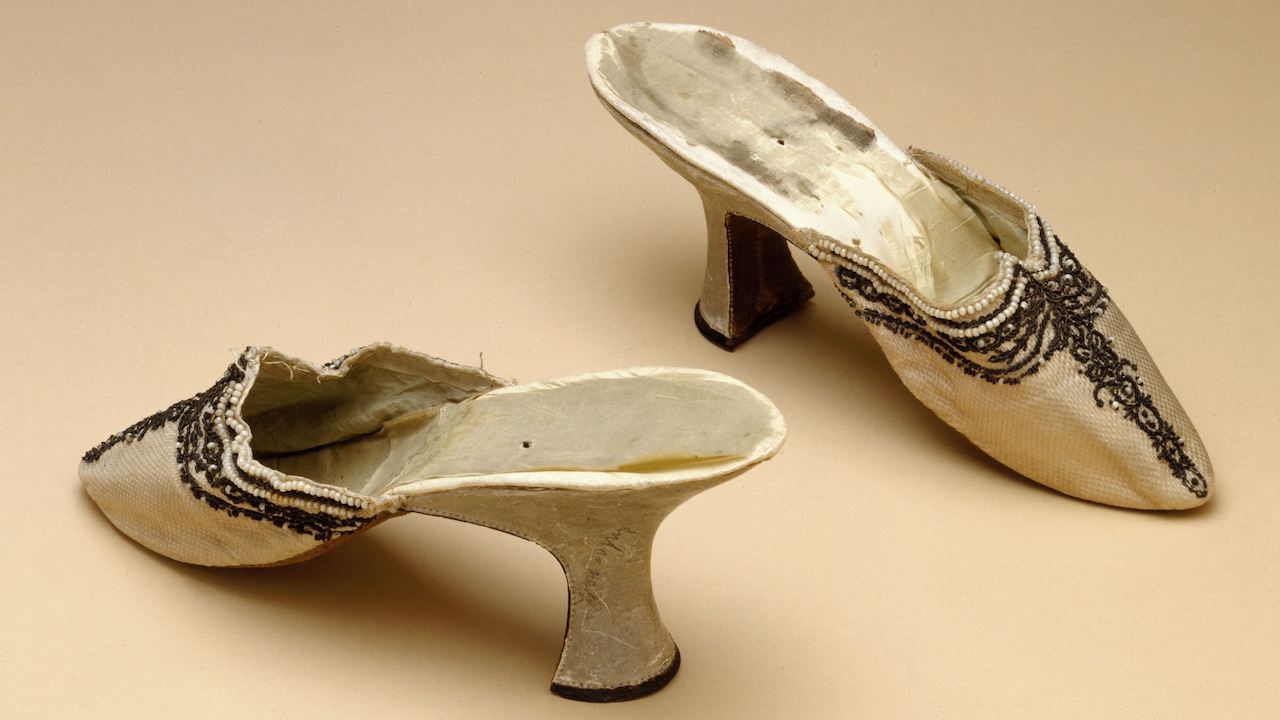
Further items include rare remaining fragments of her court dress, beautifully painted fans, and tiny beaded slippers, displayed alongside the opulent dresses worn by the French aristocracy before their downfall in 1789. The Marie Antoinette Style exhibition also features costumes from Sofia Coppola’s 2006 film Marie Antoinette, sketches by Manolo Blahnik, and contemporary fashion by designers such as John Galliano during his tenure at Dior. There are also examples of the fragrances she wore, the letters she wrote, and the satirical cartoons that ridiculed her.

Crystal flask with label ‘Eau de Cologne from the ‘Nécessaire de voyage’, belonging to Marie Antoinette on display at the Marie Antoinette Style exhibition. (© Grand Palais RMN (musée du Louvre) / Michel Urtado.)
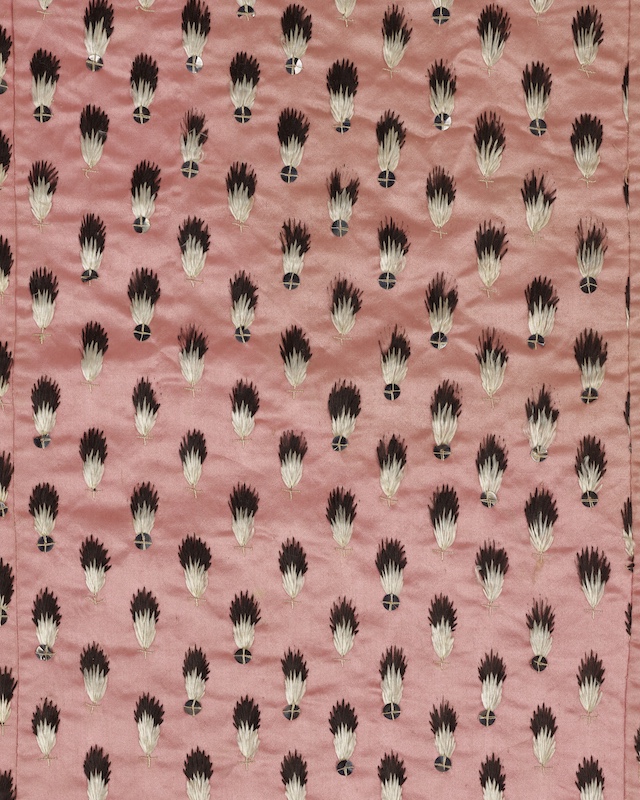
Fragments of a court gown belonging to Marie Antoinette on display at the Marie Antoinette Style exhibition. (© Victoria and Albert Museum, London)
The exhibition took four years to research, source, and assemble, but Marie Antoinette Style at the V&A is unquestionably worth a visit. Bringing together jewels, garments, artworks, accessories, and cultural artifacts from across Europe and beyond, it offers a rare and intimate glimpse into the life, legend, and lasting influence of France’s most mythologized queen.
The exhibition runs until Sunday, 22 March 2026, at the V&A Museum in South Kensington, London.