< Historic Diamonds / Famous Diamonds
The Diamonds of a Swan: Babe Paley’s Iconic Jewels
From impeccably edited Verdura commissions to statement diamonds worn with studied restraint, explore how Babe Paley used jewelry to refine the modern American ideal of taste.
Published: January 23, 2026
Written by: Meredith Lepore
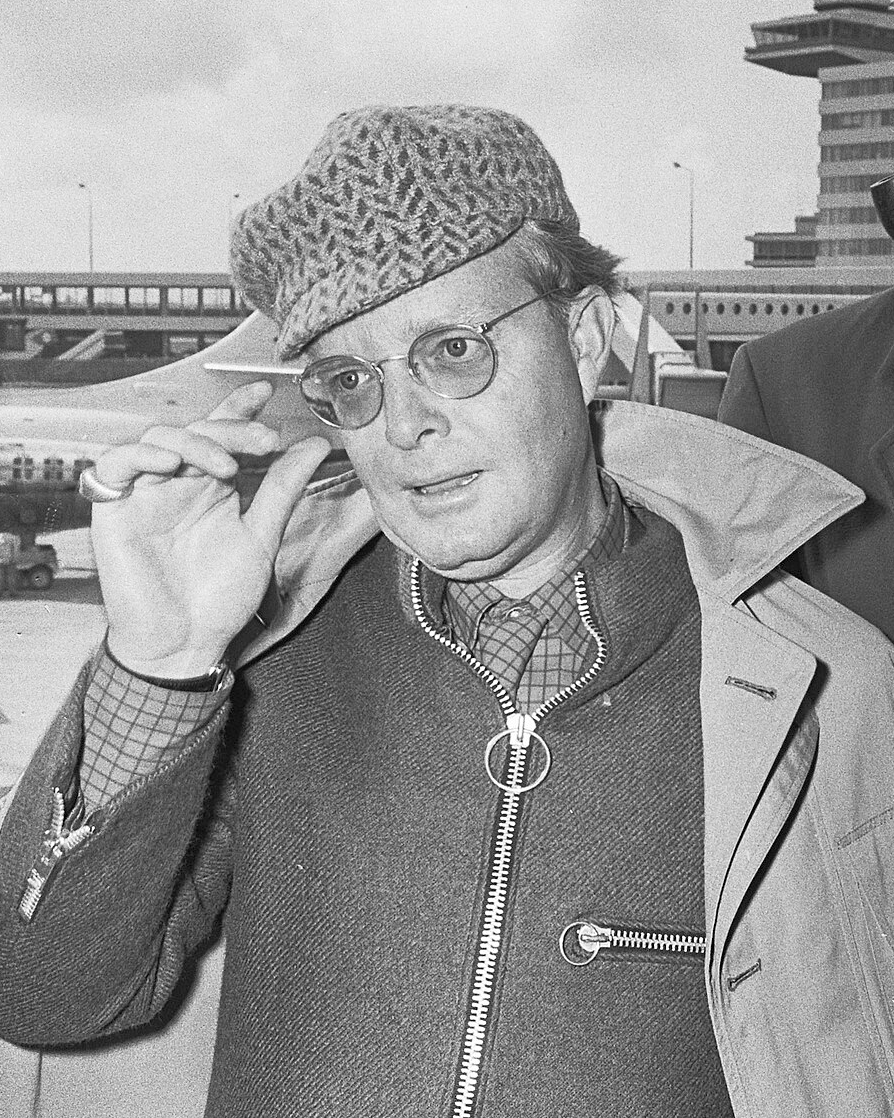
Author Truman Capote, Babe Paley’s once most-trusted confidante, famously said of her that she “had only one fault: she was perfect. Otherwise, she was perfect.” Known for her elegant beauty and impeccable taste —she was a regular fixture in Vogue—Paley combined the polish of an accomplished socialite with intelligence, wit, and, not least, genuine talent as a designer, all backed by undeniable panache (you have to be something to pull off the name Babe, after all). She would go down in history as the ultimate mid-century style icon.
Though she is known for her beautiful fashion sense—Balenciaga, Valentino, and Givenchy were her go-tos—and in 1941, Time magazine named her the world’s second-best-dressed woman, after Wallis Simpson. Her jewelry collection was also immaculate, serving as a true throughline of her elegance. An emphatic patron of Verdura, Tiffany & Co., Van Cleef & Arpels, and Cartier, Paley built an incredible and highly personal collection of jewels that elevated both her everyday style and her most dramatic statement looks. Her famous maxim, “The affairs end, but the jewelry remains,” could not ring truer.
Justin Daughters, Managing Director of Berganza, says of her jewelry, “Babe Paley shifted the socialite myth away from ‘inherited dusty heirlooms’ toward ‘curated personal style.’ Before her influence, socialites often wore what their grandmothers wore. Babe, alongside her contemporaries, made jewelry feel current.”
Meet the Experts

Justin Daughters is the Director of Berganza, a UK-based antique and vintage jewelry dealer renowned for sourcing and presenting rare, museum-quality pieces. With a deep expertise in historic jewels, Daughters oversees a collection distinguished by exceptional provenance and authenticity.

Tracy Lamourie is an internationally recognized publicist, media commentator, and cultural historian with expertise in jewelry, fashion, and celebrity legacy. With over two decades of experience, she is frequently quoted by global media and is an accredited Cannes Film Festival professional, widely regarded as an authoritative voice on influence, image-making, and cultural legacy.
Ahead is a detailed look at the remarkable life of Babe Paley and how her museum-worthy natural diamond jewels helped shape her public imag, along with the mythology of the American socialite in the mid-20th century.
How Babe Paley Defined American High Society
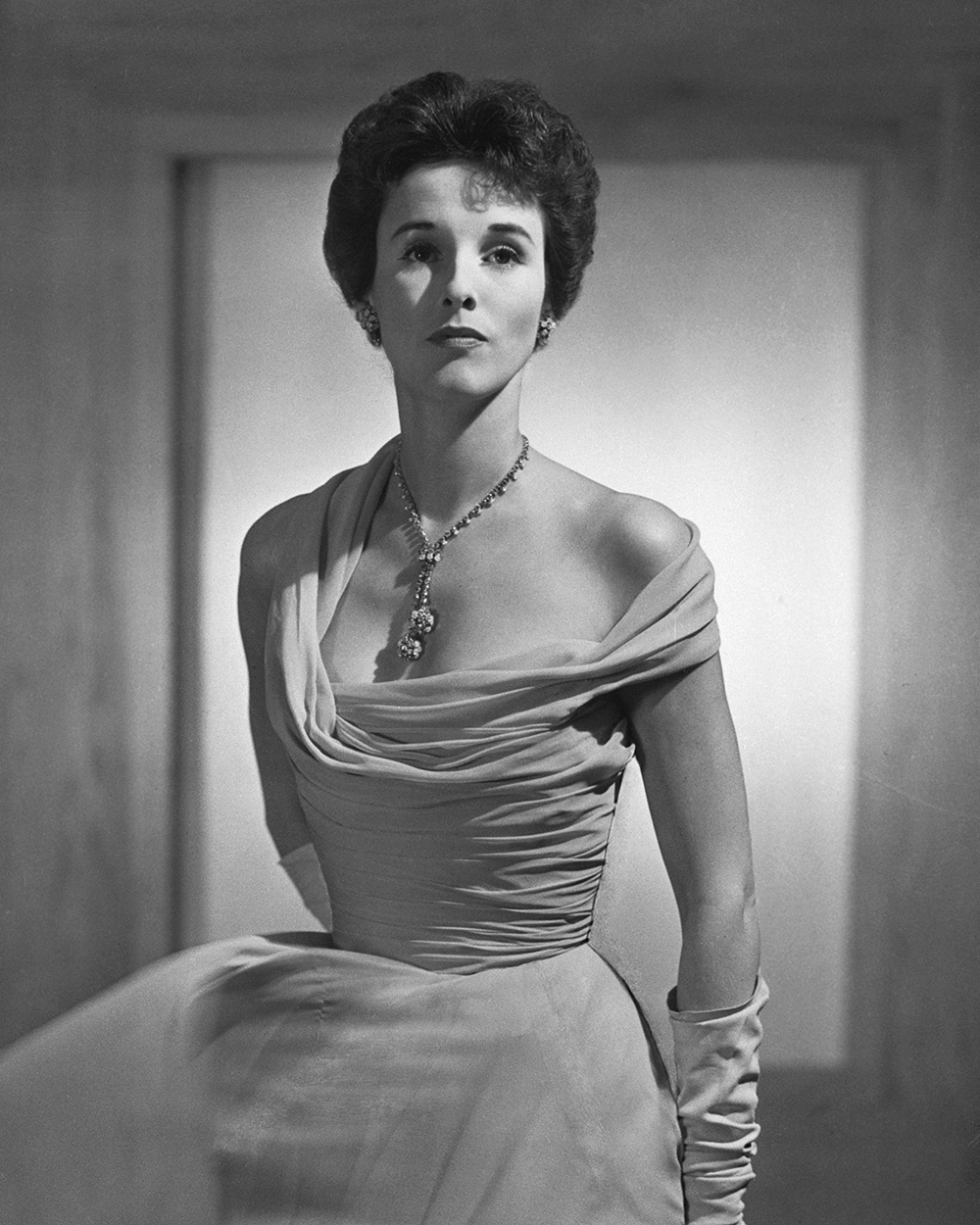
Babe Paley was born Barbara Cushing on June 5, 1915, in Boston, to a wealthy family as the youngest of four daughters. Despite being the baby of the family, she distinguished herself early on for her exceptional taste and innate sense of style, setting her apart from her sisters.
She would go on to enter a quintessential high-society marriage with Stanley Grafton Mortimer Jr., a sportsman and advertising executive born in Tuxedo Park, New York, to another blue-blood family, in 1938. Though they had two children, the marriage proved short-lived, and the couple divorced in 1946.
Following the divorce, Paley began a new chapter with a move to New York City, where she quickly entered the most rarefied social circles and became a fixture at the famed Café Society and La Côte Basque, emerging as the very embodiment of the “ladies who lunched.” It was around this time, in 1947, that she met and married William S. Paley, the founder and longtime chairman of CBS, a union that catapulted her social influence into the rapidly expanding world of media and television.
Together, they became one of the most powerful—and most photographed—couples of the era. It was also during these years that Paley became one of Truman Capote’s original “Swans,” the impeccably dressed, socially dominant women who served as both his muses and confidantes, admired for their beauty, polish, and control.
She became an editor at Vogue in 1938 and worked consistently until she married William S. Paley, though she continued to contribute intermittently to the publication over the years. In a 1944 essay for the magazine titled “I Like Tradition,” Paley wrote of her deep affection for color, luxurious fabrics, and oversized handbags. Among the many trends she helped popularize, Paley became known for tying Hermès scarves to her handbags, according to Vogue writer Elise Taylor.
In the essay, Paley wrote that she tended to shy away from perfectly matched outfits, finding them uninspired and dull. She also offered an intimate look at her philosophy on jewelry, including her preference for antique pieces and her love of natural diamonds. She wrote:
“Antique jewels—little, ingenious pieces—appeal to me far more than anything massive and modern. One of my best-beloved bracelets is a gold rope, dangling a clump of precious old gadgets: a hand of coral and gold, a heart paved with diamonds, a turquoise bauble, a tiny enameled watch, shaped like a beetle.”
Paley understood jewelry and the power of restraint over excess. Her jewelry embodied a carefully calibrated balance of discipline and daring. “Babe Paley used jewelry to express authority and autonomy,” says Tracy Lamourie, a cultural historian with a focus on jewelry, fashion, and celebrity legacy.
“Her diamonds conveyed legitimacy and social power at a time when women’s influence was most readily communicated visually, even if it was not always acknowledged outright. Her restraint signaled control and self-possession. She didn’t use jewelry merely as decoration or spectacle; it reinforced a coherent and unmistakable identity. In essence, her appearance said, ‘I belong here.’ That message was profoundly powerful. Paley used jewelry less as adornment and more as confirmation.”
Babe Paley’s Most Important Jewelry Pieces
Here is a detailed look at some of Paley’s most notable jewelry pieces that helped define her unique vision of glamour. Daughters says of her choices, “She helped create the image of the ‘effortless’ aristocrat, the woman who could wear a massive Verdura cuff while gardening or a diamond clip whilst hailing a cab. This ‘approachable opulence’ defined the mid-century dream; it suggested that if one had the taste, the jewellery would follow. She made the spectacular feel sensible.”
Babe Paley and Verdura: The Jewelry Partnership That Defined Her Style
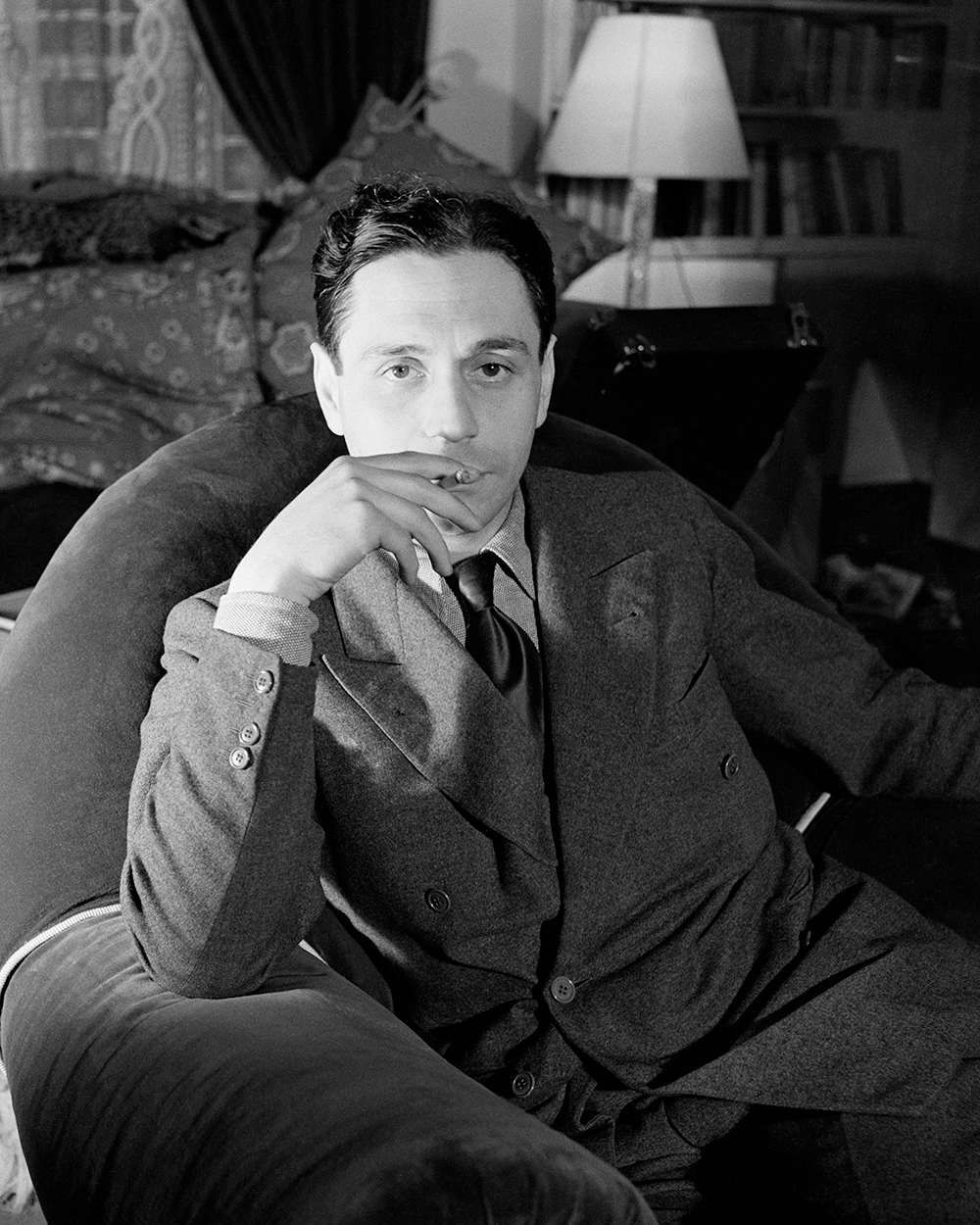
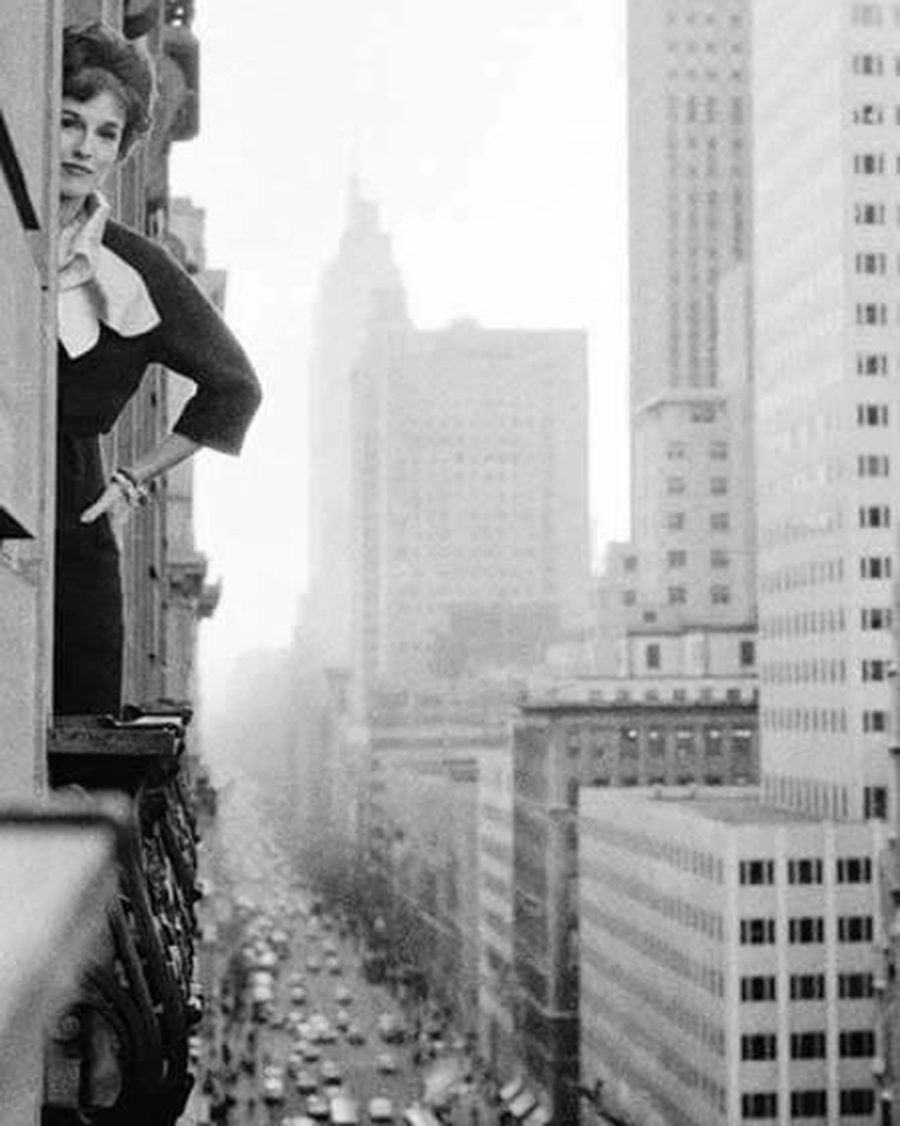
When you talk about Babe Paley, you cannot discuss her without discussing Verdura. Established in New York in 1939 by Duke Fulco di Verdura, the jewelry house quickly distinguished itself as one of the most influential of the 20th century. By ushering in bold color, modern sculptural forms, and a new confidence, Verdura was embraced by high society for its striking contrast to the more traditional jewelry houses of the era.
A Sicilian aristocrat, Verdura had long moved within elite social circles thanks to his talents, even creating jewelry and accessories for Cole Porter early in his career. It was Porter who introduced him to Coco Chanel, who recognized his talent and brought him to Chanel in Paris, first as a textile designer and later to oversee the house’s costume jewelry.
He thrived there and eventually made his way to the United States, where, after working with jewelry designer Paul Flato and expanding his clientele to include Hollywood’s elite—among them Greta Garbo—he opened his own jewelry salon in the early 1940s. It was during this period that Paley and fellow socialite Slim Keith (later dubbed part of Truman Capote’s “Swans”) became influential patrons of Verdura.
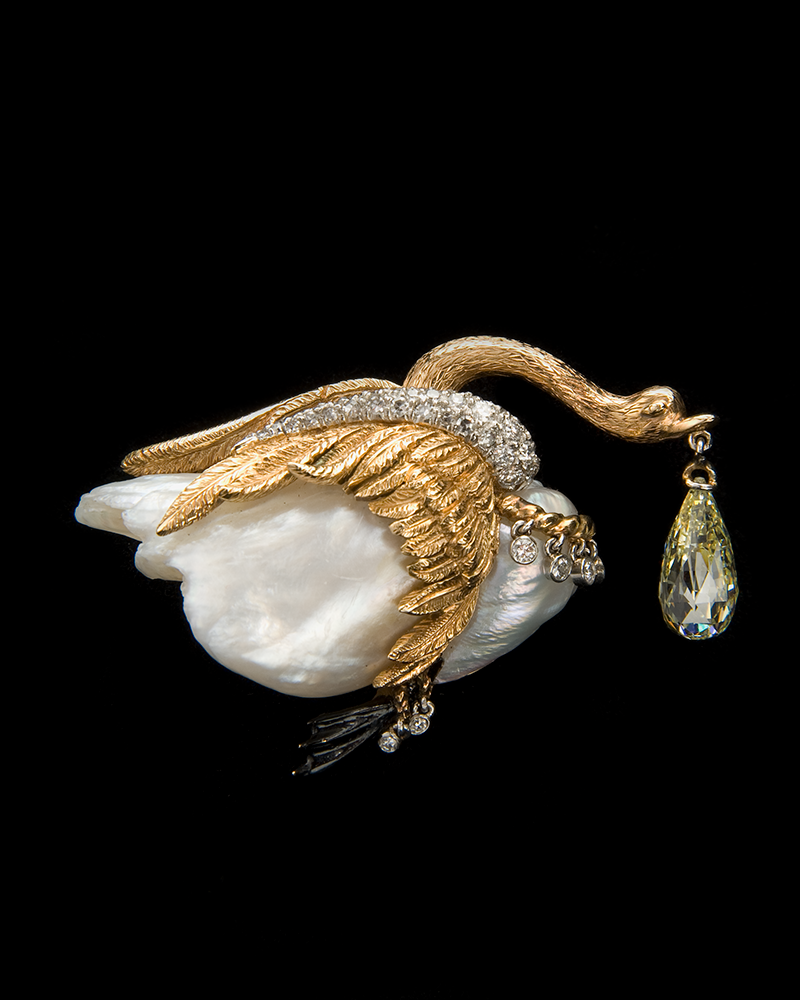
Verdura Swan Brooch with Hanging Diamond Briolette
As mentioned, Paley was one of Truman Capote’s “Swans,” a remarkable group of glamorous and socially influential women that included Slim Keith, Lee Radziwill, C.Z. Guest, and Gloria Guinness. Jacqueline Kennedy Onassis occasionally appeared within this circle, though she was not formally counted among the Swans. Though all of them are now deceased, these women received renewed attention for their style and extraordinary jewels when Feud: Capote vs. The Swans, produced by Ryan Murphy, debuted. The series focused on Capote’s infamous fallout with this circle after he wrote about their private lives in his unfinished novel Answered Prayers. The jewelry was widely cited as one of the show’s highlights.
This swan brooch, inspired by Apollo’s swan and commissioned by William S. Paley early in his marriage to Babe Paley, proved an especially apt symbol. Among Capote’s Swans, Paley was often regarded as the most elegant, even as she privately struggled with health issues and a complicated personal life.
The swan’s body is made from a single baroque pearl, accented with a pavé diamond collar, while a faceted diamond briolette hangs below, catching the light with subtle movement. Onyx-clad legs finished with diamond bands complete the design.
Verdura 21-Carat Canary Yellow Diamond Cocktail Ring
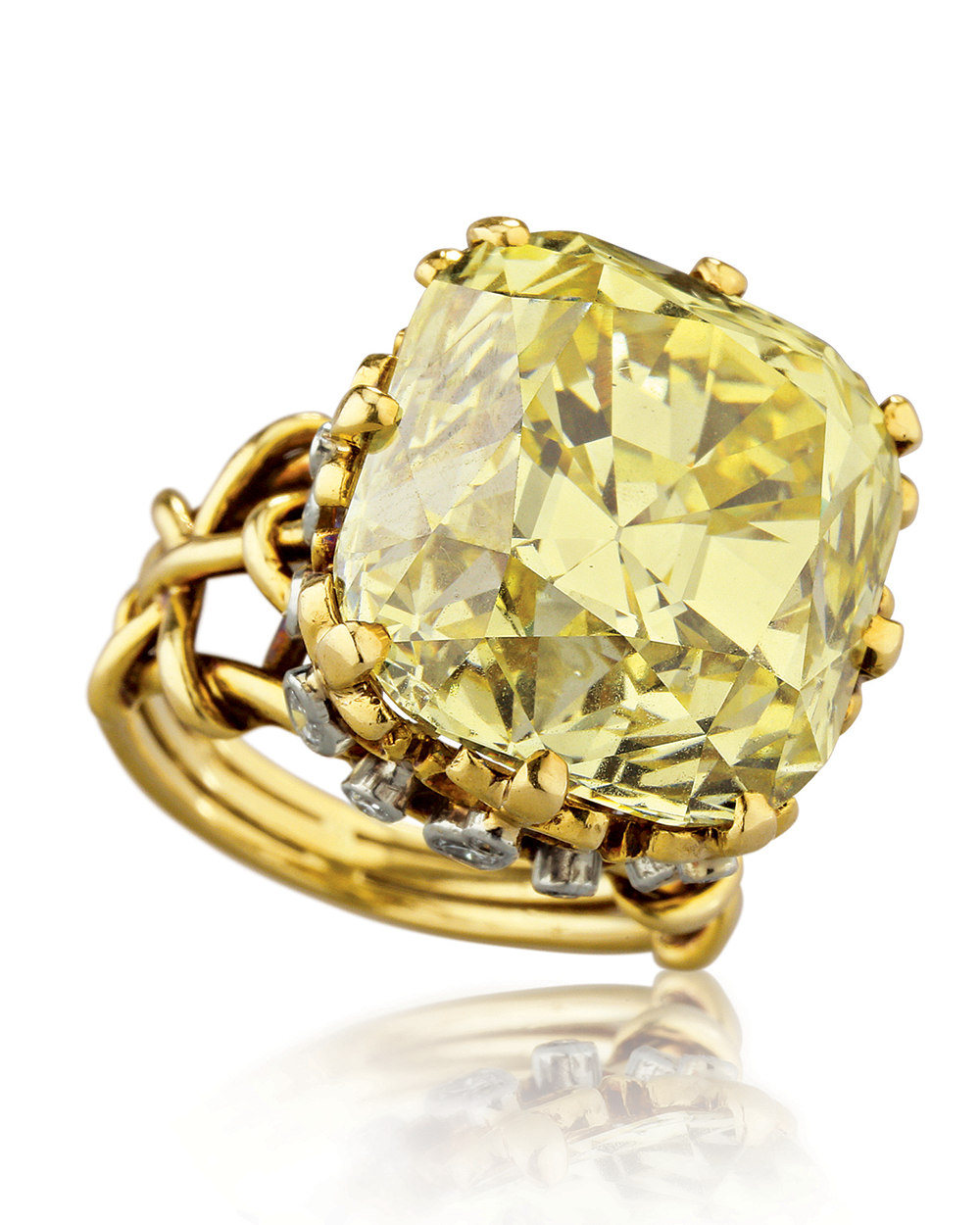
An exceptional yellow diamond ring, both monumental in scale and saturated in color, was quintessentially Verdura in spirit. Fulco di Verdura designed the mounting to be deliberately restrained—clean, architectural, and engineered to let the extraordinary 21-carat natural diamond command attention (at 21 carats, how could it not?) Though bold, the design felt effortless, mirroring Babe Paley’s famously pared-back elegance.
While period imagery of Paley wearing the ring is scarce, the design’s significance endured: Verdura later recreated the ring in platinum with a colorless diamond, underscoring the timelessness of the setting, and the piece was eventually offered at Christie’s, cementing its place in both jewelry and social history.
Verdura Diamond “Fan” Earrings
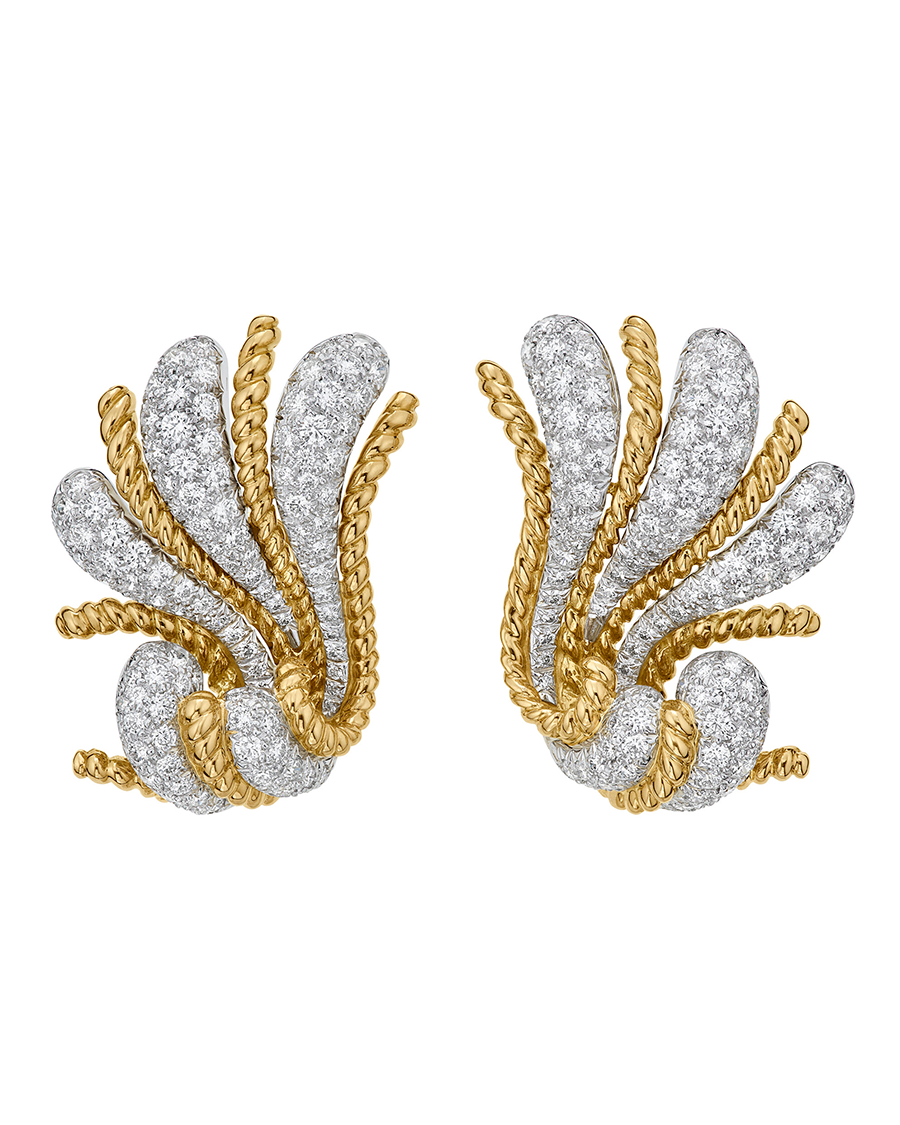
The Verdura Diamond “Fan” earrings are sculptural, statement-making pieces crafted in 18k yellow gold and platinum and set with approximately 5.25–5.75 carats of round diamonds in a bold, swirling design that evokes the shape of an unfolding fan. In the mid-20th century, Verdura’s fan-style earrings were embraced and popularized by high-society figures like Babe Paley, whose impeccable style and frequent appearances wearing Fulco di Verdura’s creations helped cement the jeweler’s reputation as a must-have luxury brand among New York’s elite.
Verdura Rubellite Pebble Tourmaline
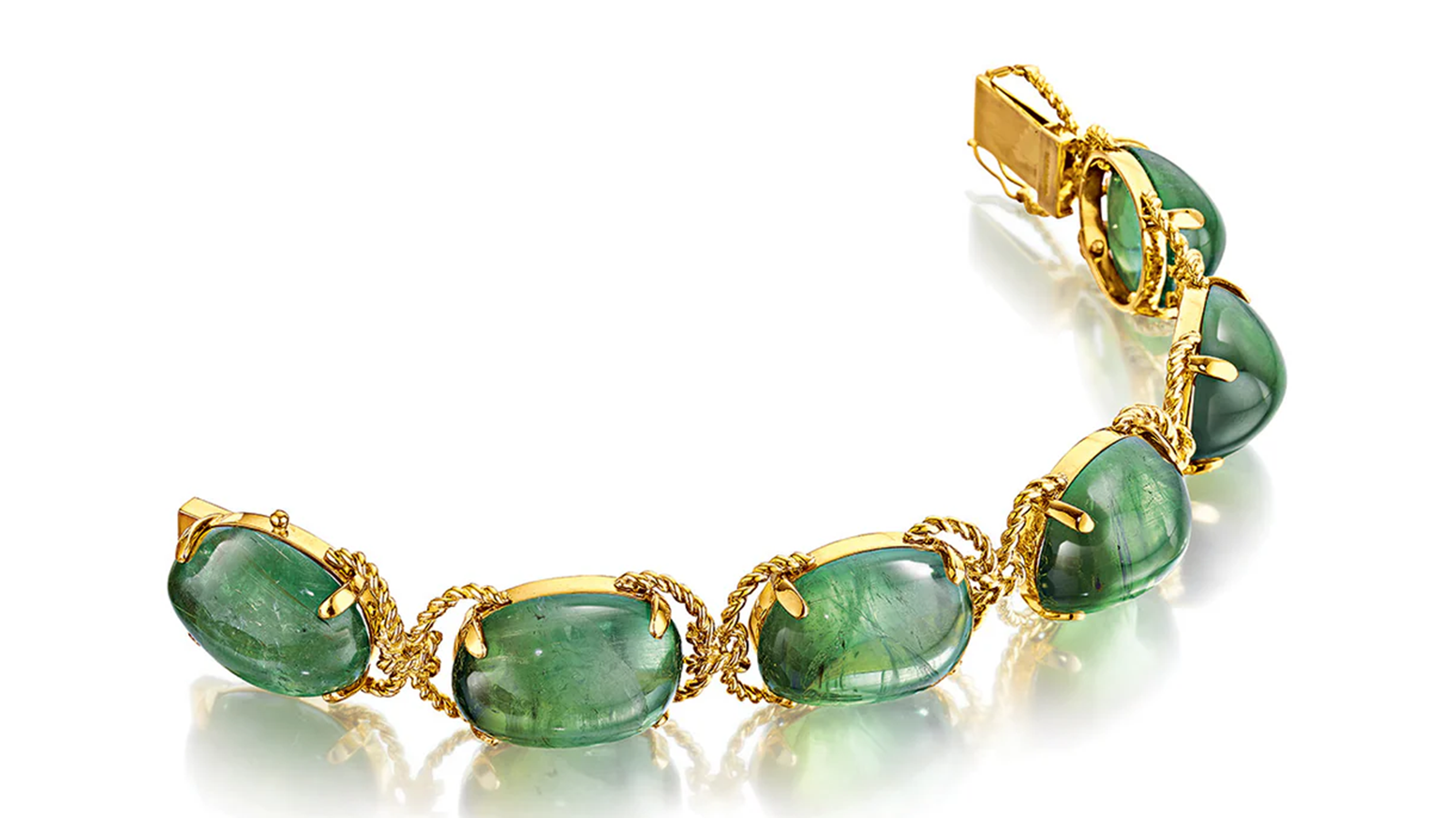
Another stunner by Verdura, the bracelet features oval green tourmaline cabochons set in rich 18k yellow gold as part of the house’s signature “Pebble” aesthetic, inspired by the jeweler’s love of polished semi-precious stones and bold color.
In Feud: Capote vs. The Swans (FX), a Verdura pebble bracelet is used in a fictionalized scene where Babe Paley (Naomi Watts) tells Slim Keith (Diane Lane) that one was given to her to atone for an affair by her husband — specifically an affair with Happy Rockefeller — and Keith quips, “The affairs end, but the jewelry remains.” That moment is part of the series’s creative storytelling and not documented as a historical fact.
Both Paley and Keith were real high-society friends as well as long-time clients of Verdura, and jewelry plays a central thematic role in Feud to reflect status and relationships. However, the specific narrative about gifts tied to personal indiscretions and the exact bracelet exchanges are dramatic embellishments for the show rather than verified historical events.
Babe Paley, Jean Schlumberger, and Tiffany & Co.: Nature Reimagined Through Design

While Paley’s friendship with Verdura is legendary, she also had a profound appreciation for the work of Jean Schlumberger at Tiffany & Co., as well as for Cartier and René Boivin. Daughters says, “Schlumberger’s work in her collection was distinguished by its organic, almost whimsical nature. Consider his intricate enamel work and botanical motifs, such as the famous ‘Tassel’ necklace. Where Verdura was bold and architectural, Schlumberger provided the ‘flora and fauna’ that softened her image.”
Tiffany & Co. Turquoise and Diamond Tassel Necklace
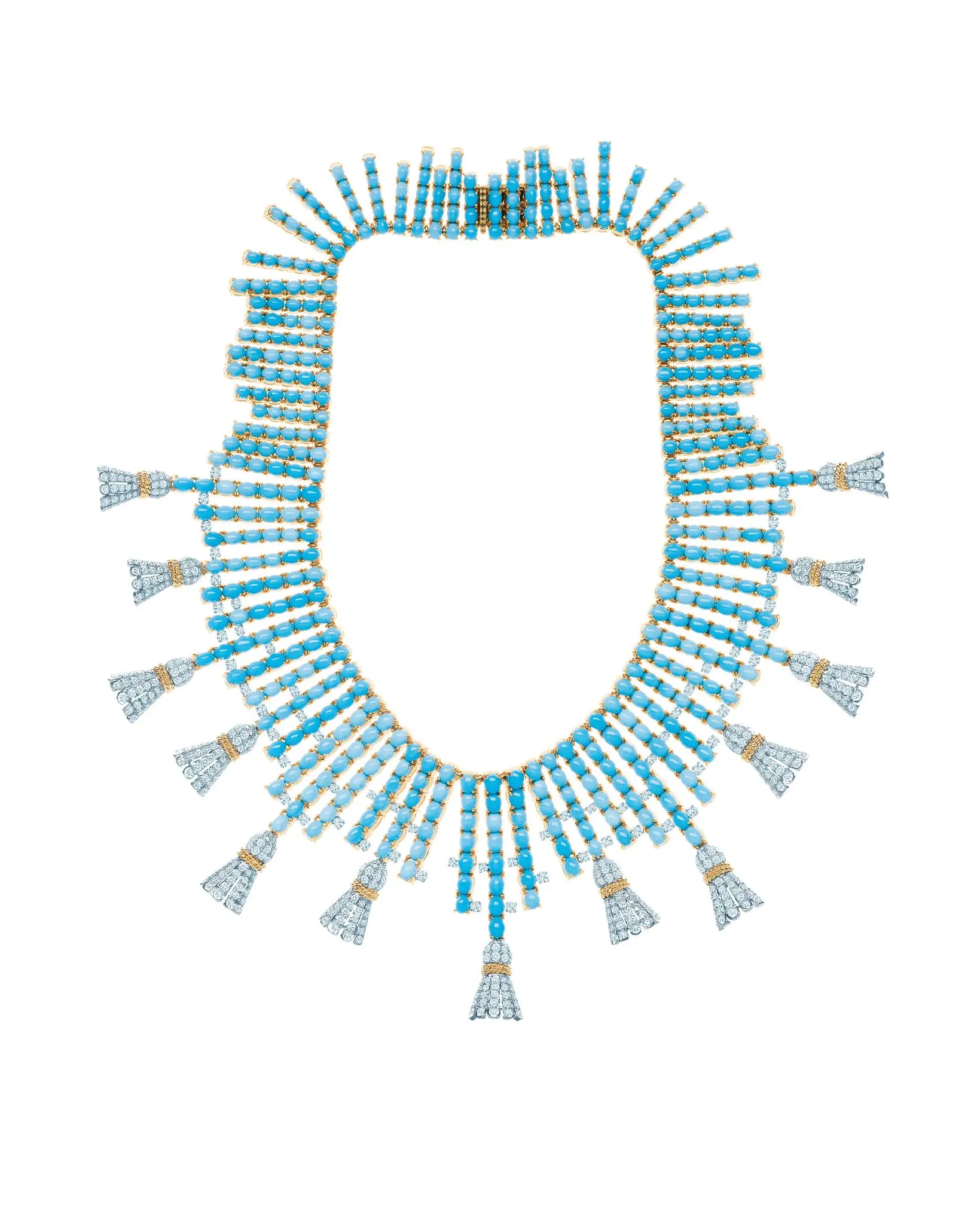
Perhaps the most notable Schlumberger creation worn by Paley was a turquoise tassel necklace by Tiffany & Co., which she wore to President Dwight D. Eisenhower’s inaugural ball in January 1957. The appearance was widely photographed, and Schlumberger was often credited in contemporary fashion and jewelry coverage with helping reintroduce turquoise as a glamorous, high-jewelry material.
The necklace consisted of multiple strands of turquoise beads arranged in a cascading formation, along with 18-karat gold tassels that anchored the piece and gave it a fluid, fabric-like appearance. The design was further enhanced with natural diamonds—reported to number 661 round brilliants totaling approximately 49 carats—set in gold and platinum, consistent with Schlumberger’s mixed-metal technique.
Tiffany & Co. Étoile de Mer (Starfish) Brooch
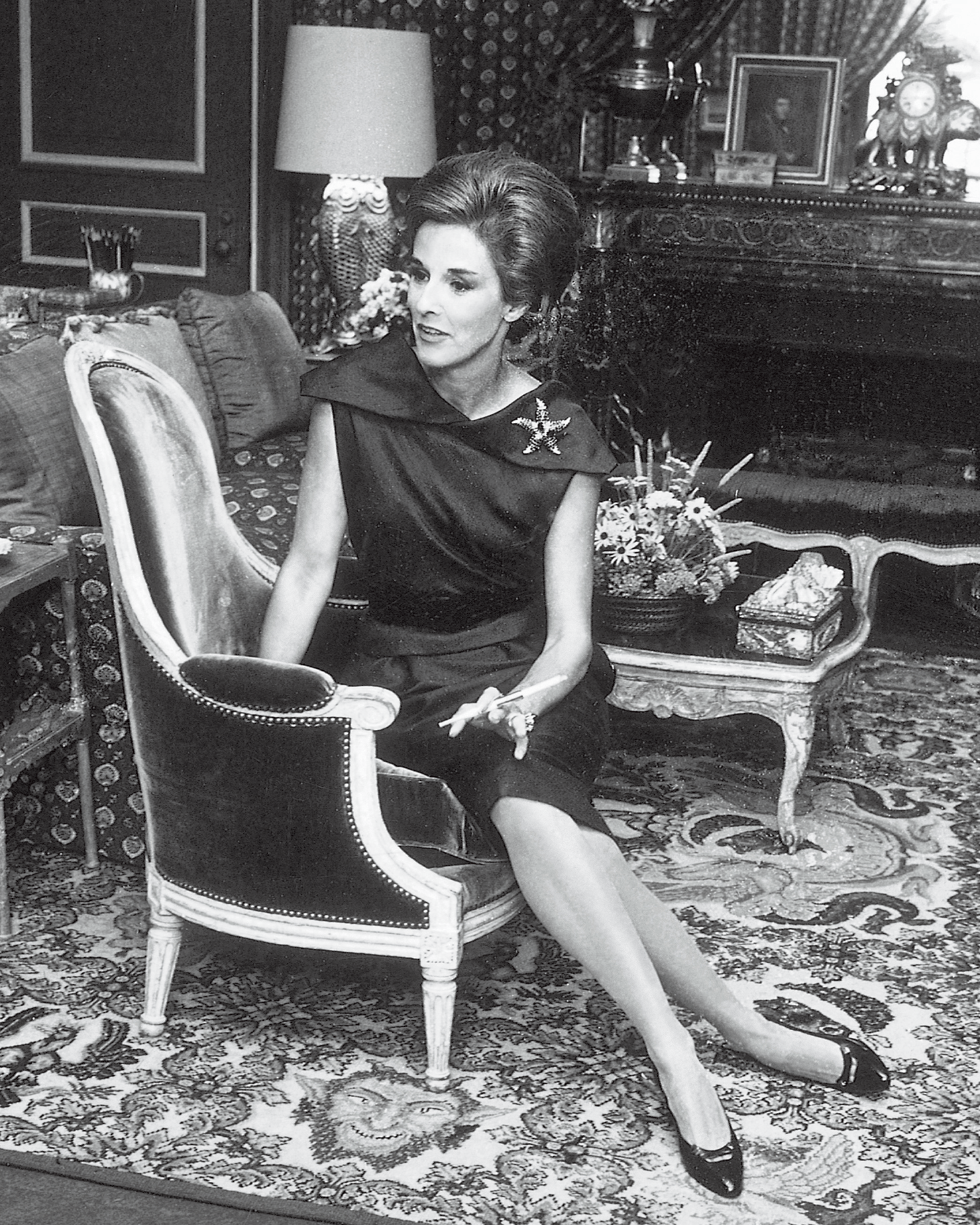
Paley loved statement brooches, particularly for everyday activities such as setting menus, planning parties, and lunching with friends. She was photographed wearing this brooch at her New York home in 1963, underscoring how seamlessly she incorporated extraordinary jewelry into daily life.
This brooch was made of 18-karat gold in a convex starfish form, set with over 8 carats of diamonds and more than 39 carats of sapphires, with garnet accents. The design reinforces Schlumberger’s enduring fascination with nature, a theme also seen in the collections of Bunny Mellon, another of his close patrons.
“She had a remarkable affinity for Georgian and Victorian-era brooches, mid-19th-century diamond sprays, and René Boivin convertible clips, necklaces that could transform into brooches. These pieces exhibit a softness in the metal and a unique glow in old-mine and European-cut diamonds that modern stones simply cannot replicate. They reveal the private Babe: a woman who appreciated the history, craftsmanship, and ‘soul’ of a jewel, not just its carat weight or price tag. These intimate, exquisite choices show her sophistication and deep understanding of jewellery beyond mere spectacle.”
Babe Paley, Cartier, and Van Cleef & Arpels: Architects of Formal Power
According to Daughters, Cartier and Van Cleef provided the ‘architectural anchors’, the impeccably set diamonds and rubies that served as the backbone of her formal wardrobe. Paley chose jewelers who were artists first and merchants second, often commissioning one-of-a-kind pieces that perfectly mirrored her own individuality.
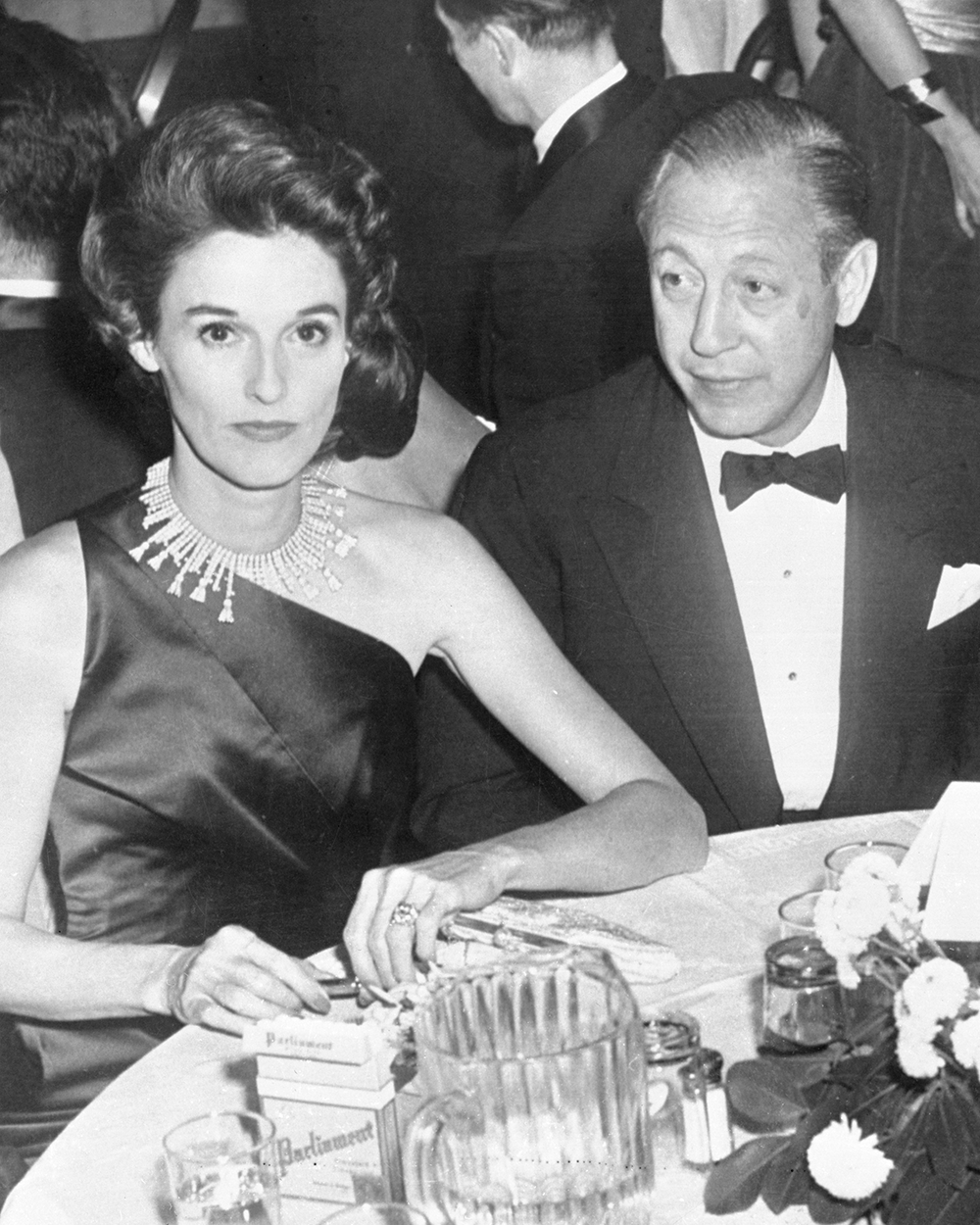
Van Cleef & Arpels 217-Carat Diamond Necklace
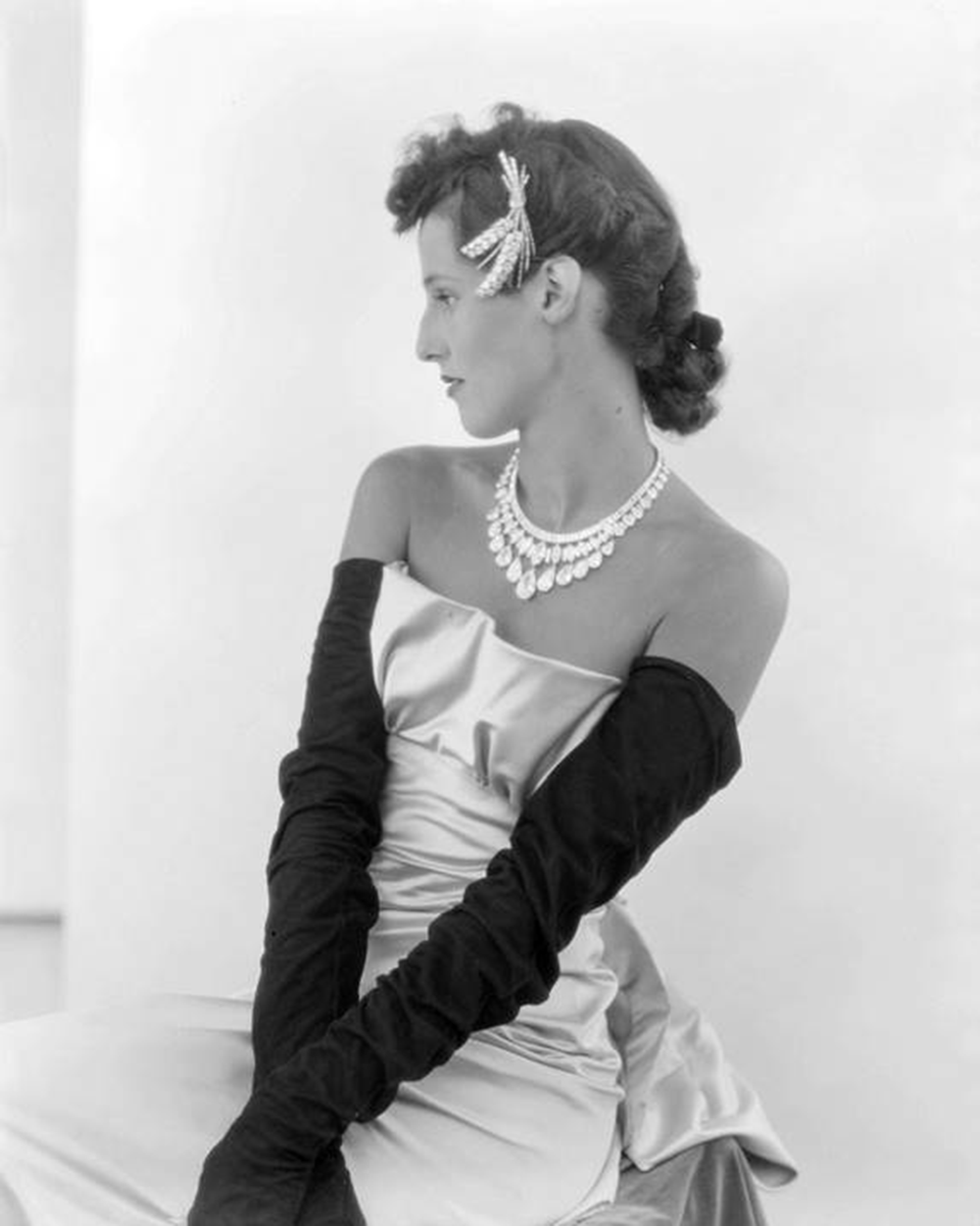
While the stunning Van Cleef & Arpels necklace depicted in the portrait above was technically a loan, it remains one of the most iconic images of young Babe Paley—and one of the most memorable (and sizeable) diamond pieces she ever wore.
The necklace is composed of graduated brilliant, baguette-cut and pear-shaped diamonds, arranged in a fluid, architectural flow that sits high on the neck and falls delicately onto the collarbone. Closely set in platinum to maximize light and flexibility, the stones create a continuous surface of brilliance that moves with the wearer. The necklace is widely cited as totaling approximately 217 carats, making it a veritable “wall of diamonds.”
Daughters describes it as a “marvel of mid-century opulence, and its presence in 1930s and 50s photography has cemented its legendary status. Its provenance is rooted in an era where sheer scale was seen as a celebratory return to glamour.” He notes that Paley often paired it with Van Cleef & Arpels clips, with the diamonds catching the light at her usual haunts, including The Stork Club and The Plaza Hotel.
“At the time, it was perceived as the ‘gold standard’ of success. It wasn’t just jewellery; it was a statement of the Paley empire’s dominance. While the world was beginning to flirt with modernism, this necklace looked backward to the grand court style of Europe, effectively crowning Babe as the ‘Queen of New York’ in the eyes of the public,” Daughters says.
Van Cleef & Arpels Turquoise, Diamond, Sapphire, and Gold Brooch
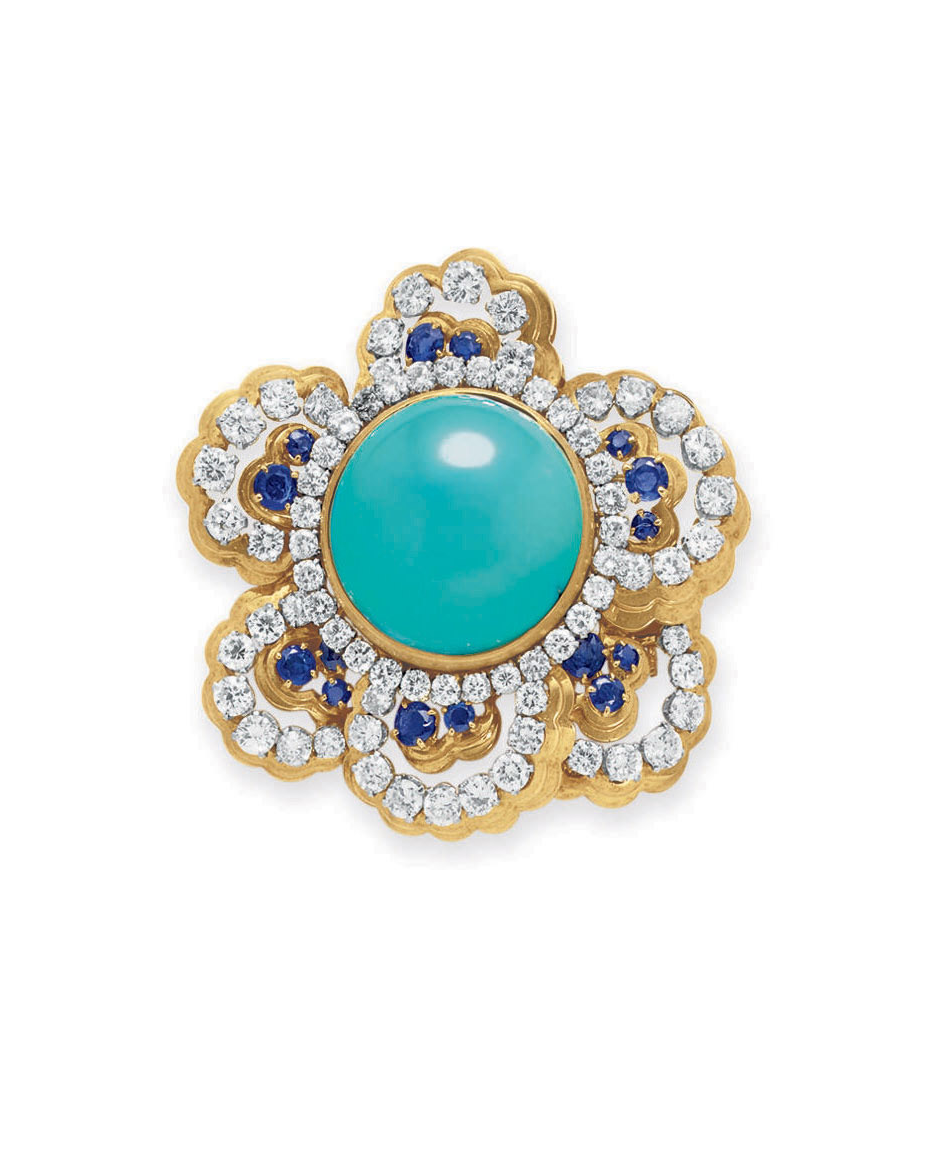
Another beloved brooch of Paley’s, this floral design was created by Van Cleef & Arpels and features a cabochon turquoise at its center, encircled by round brilliant-cut diamonds. Openwork petals set with circular-cut diamonds and sapphires radiate outward, framed by sculpted 18-karat gold accents.
The brooch is signed by Van Cleef & Arpels, consistent with the house’s practice for high-jewelry creations of the period. Its combination of symmetry, color, and precise stone-setting exemplifies the maison’s reputation for elegance rooted in structure, reinforcing Paley’s preference for jewelry that conveyed authority and composure rather than ornament alone.
Cartier Coral and Diamond Rams Head Bracelet
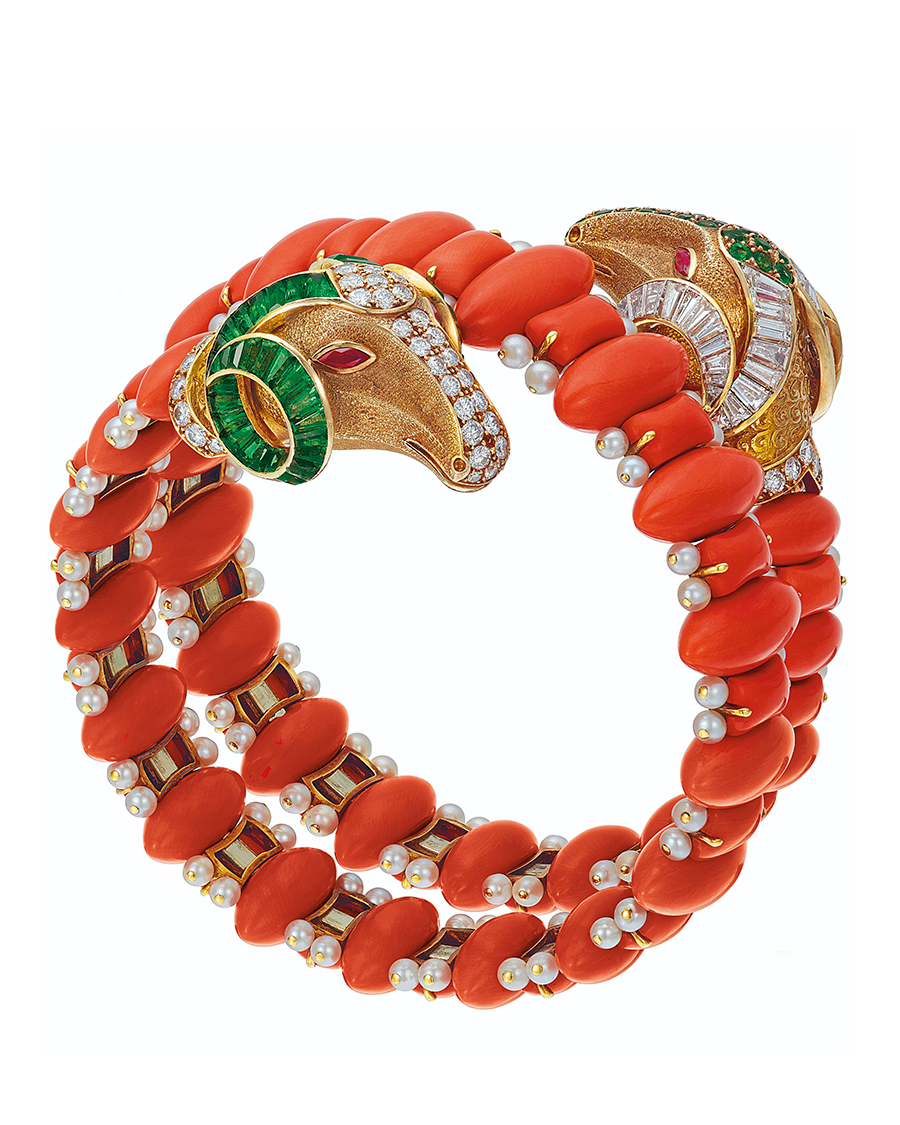
The coral and diamond Rams Head bracelet by Cartier introduced a more primal, sculptural energy into Paley’s jewelry wardrobe. The design reflects Cartier’s long-standing fascination with symbolic animal motifs, particularly those associated with strength and mythology.
The bracelet is comprised of carved coral plaques and navette-shaped coral beads, set alongside baguette- and circular-cut diamonds, as well as circular- and baguette-cut emeralds, marquise-cut rubies, and seed pearls. The ambitious mix of materials and cuts underscores Cartier’s technical mastery and its ability to balance bold symbolism with refined execution, making the piece both commanding and highly controlled.
Babe Paley and René Boivin: Transformable Jewelry and Quiet Power
Though she is perhaps best known for her close relationship with Verdura, one of Paley’s most renowned jewelry pieces was the work of René Boivin, founded in Paris in 1890. While René Boivin established the house, its most influential period—including pieces associated with Paley—was shaped under the creative leadership of Jeanne Boivin, who guided the maison after her husband’s death.
René Boivin Transformable Clip Brooches / Necklace
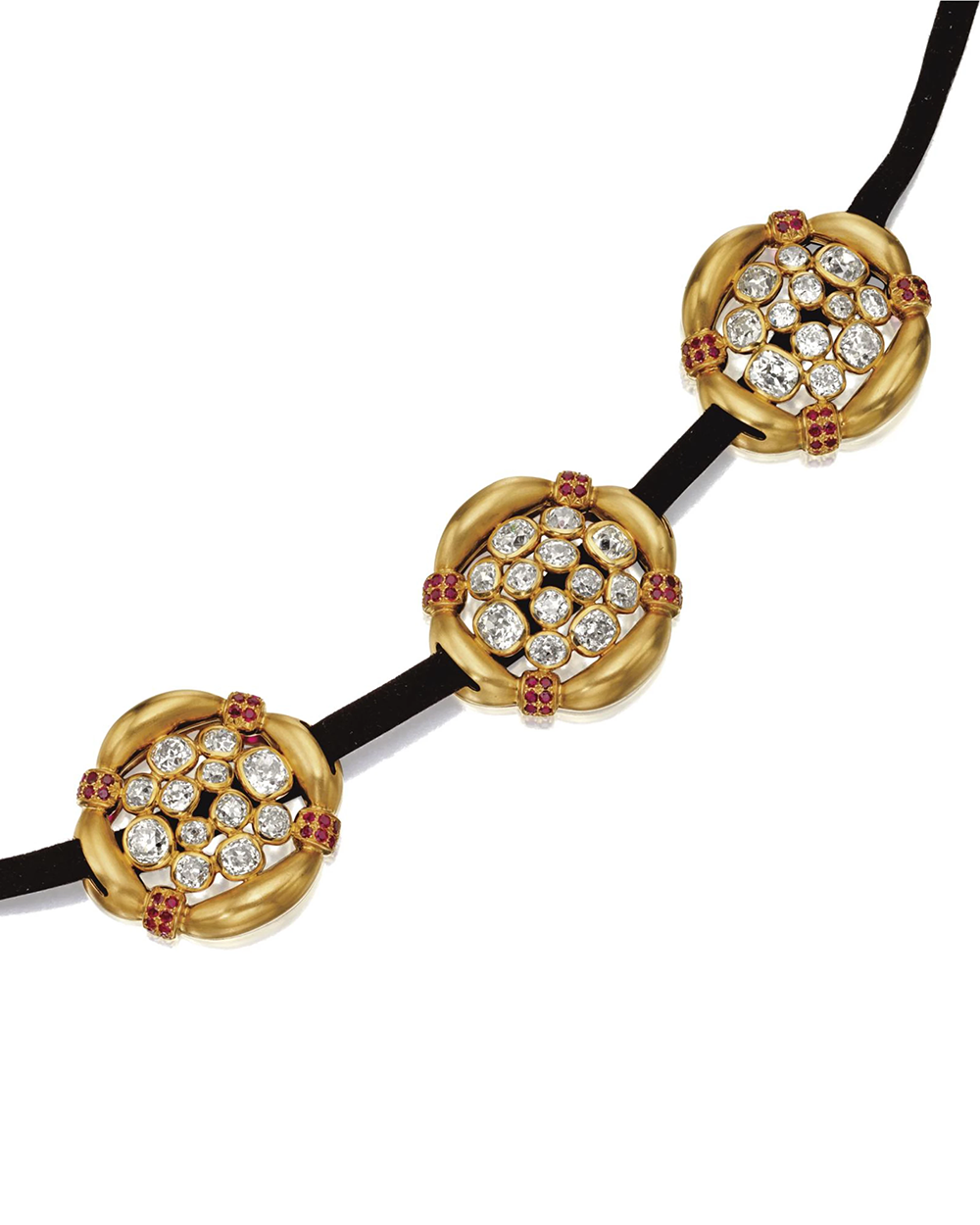
One of Paley’s favorites, these transformable clips captured the sense of delicacy she wrote about in Vogue during the 1940s. The design consists of three large matte-gold quatrefoil links, each centered with clusters of collet-set cushion-cut diamonds and accented with bands of small round rubies. The gems are strung on a black suede necklace with an 18-karat gold buckle.
A highly versatile, transformable design, the three clips can be worn together as a necklace or individually as brooches, perfectly suited to Paley’s ability to adapt her jewelry across social settings while maintaining a coherent personal style.
Why Babe Paley and Her Jewels Will Always Matter
Paley had a sophisticated understanding of how to use jewelry strategically. “Babe Paley was a master of understated glamour. She used jewellery to carefully curate both her public persona and private identity, favouring pieces that combined elegance with personal meaning. Her choices were never ostentatious for their own sake; instead, each piece complemented her style, projecting sophistication, confidence, and timeless taste. In this way, jewelry was not just adornment, it was a tool to craft an image that balanced celebrity with refined discretion,” says Daughters.
She possessed a singular sense of elegance, and while Truman Capote famously implied that everything she touched turned to perfection, her style was not innate alone—it was cultivated over time, sharpened through education, observation, and collaboration with the great designers of her era. Her jewels endure not because of their carat weight, but because of the woman who animated them, transforming objects of luxury into lasting symbols of taste, power, and restraint.