Lucy in the Sky:
The Largest Diamond in the Universe
By Sreejita Biswas, Updated: January 22, 2026
Natural diamonds have always been treasures of the Earth—
until 2004, when scientists discovered one in the stars.
Could diamonds exist beyond our planet? Let’s find out.
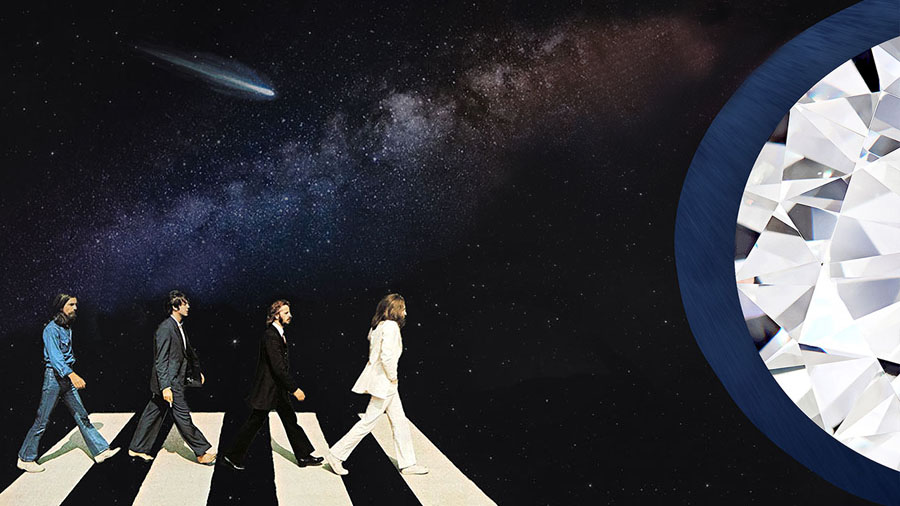
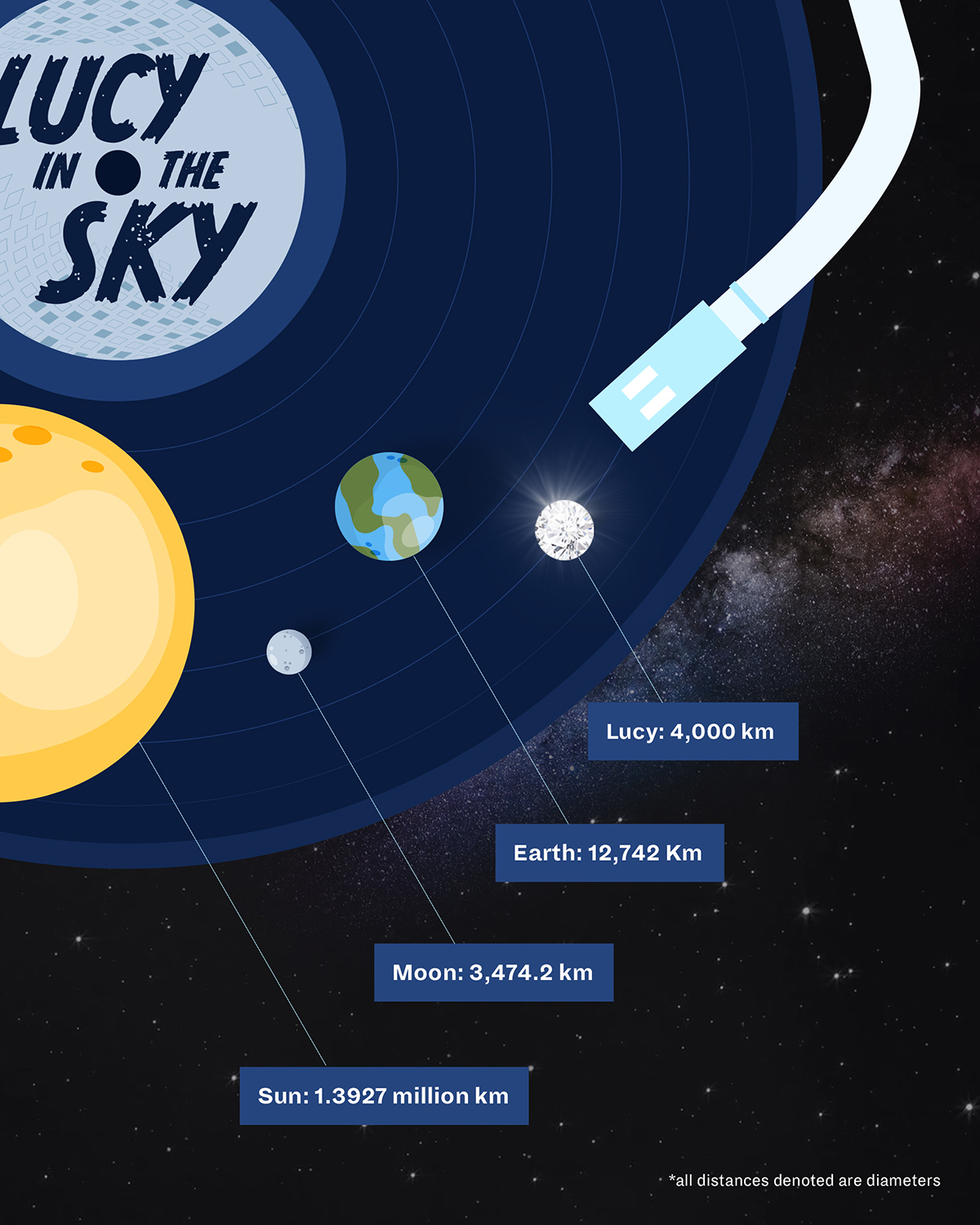
“Lucy in the Sky with Diamonds,” written by The Beatles in 1967, later inspired the name of Lucy—the largest diamond in the universe—discovered by astronomers in 2004. (Creative rendition by artist)
In 1967, The Beatles released one of their greatest hits, Lucy in the Sky with Diamonds. Originally, the song was inspired by a portrait drawn by John Lennon’s son, Julian, depicting a girl among the stars that glittered like diamonds. In 2004, astronomers at the Harvard-Smithsonian Center for Astrophysics made a startling discovery and created a prophetic connection of the iconic Beatles’ song to what could very well be the largest diamond in the known universe.
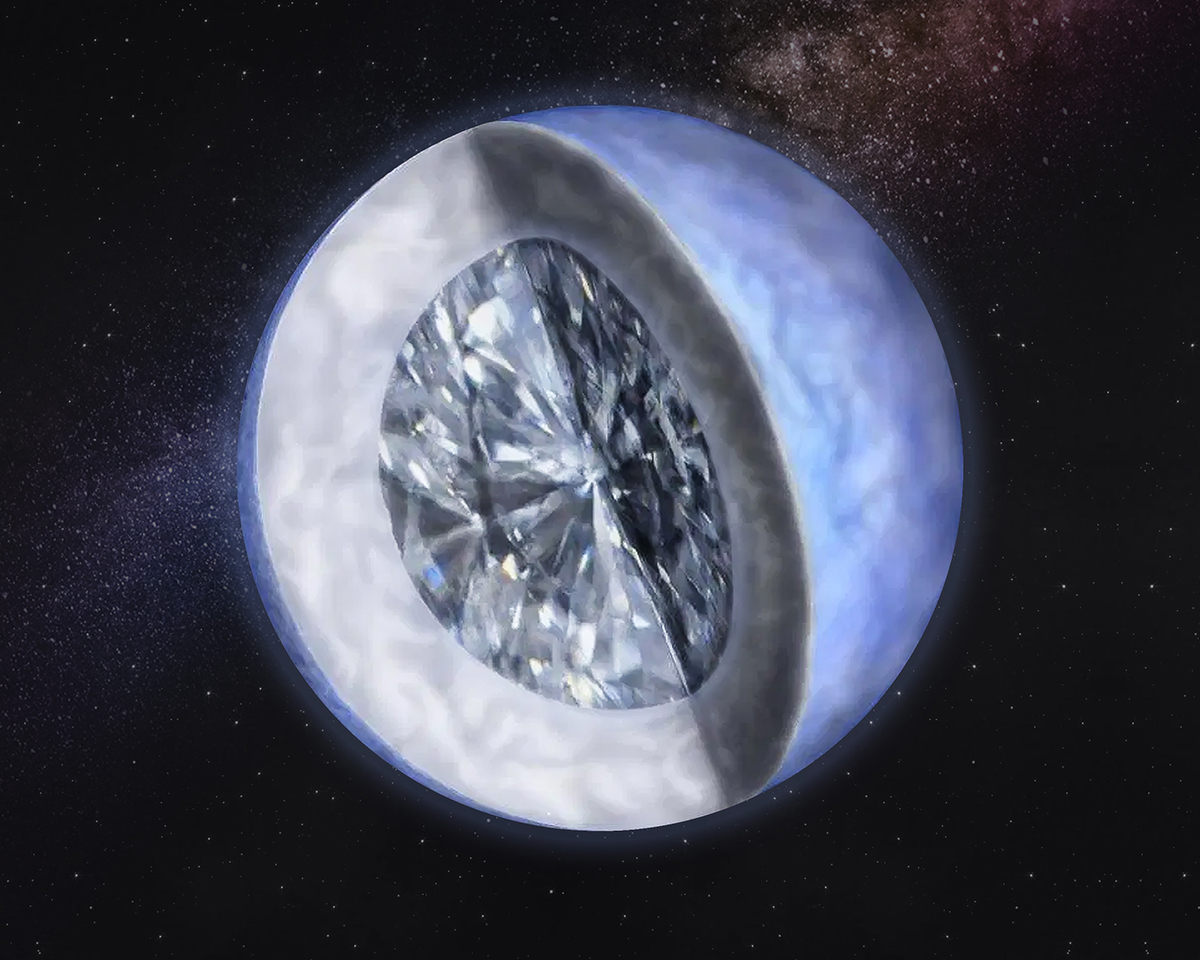
In this case, “Lucy in the sky” refers not to a metaphor, but to a crystallized white dwarf star—nicknamed Lucy—whose carbon-rich core has solidified under extreme pressure, effectively forming a planet-sized diamond drifting through space.
Meet the Expert

- Abhijeet Borkar, Ph.D. is an Astrophysicist & Post-Doctoral Researcher at the Astronomical Institute of the Czech Academy of Sciences in Prague.
- With over 12 years of research experience in astrophysics, Dr. Borkar specializes in the study of white dwarfs, pulsars, and stellar evolution.
Diamonds Beyond Earth
While diamonds are most closely associated with Earth’s deep mantle, scientists believe they can form throughout the cosmos under the right conditions of pressure, temperature, and chemistry. Several types of “space diamonds” are thought to exist:
- Planetary diamonds
On ice giants like Uranus and Neptune—and potentially Saturn—extreme pressures may compress carbon-rich compounds into diamond rain. Laboratory experiments suggest that methane deep within these planets breaks apart under pressure, allowing carbon atoms to crystallize into diamonds that fall like hail through the planet’s interior. - Extraterrestrial (meteoritic) diamonds
Tiny diamonds have been found inside meteorites that predate our solar system. These nanodiamonds are thought to form in supernova explosions or within carbon-rich stellar environments, later becoming trapped in asteroids that eventually fall to Earth. - Stellar diamonds
Under the most extreme conditions, entire stars can crystallize. When a star exhausts its nuclear fuel and collapses into a white dwarf, immense pressure can force its carbon-rich core into a diamond-like lattice—a process unlike anything possible on Earth.
It is this final, most dramatic category that leads to one of the most astonishing diamond discoveries ever made.
Lucy: The Largest Diamond in the Universe
Identified initially as V886 Centauri or BPM 37093, this white dwarf is about 4000 km across and is possibly the largest natural diamond anyone has ever seen. Inspired by The Beatles, the scientists who discovered her christened her Lucy, quite literally in the sky with diamonds.
Its size? A staggering 10 billion trillion trillion carats, which makes the largest natural diamonds on planet earth seem invisible by comparison. It shone so brightly that it could be seen all the way from the constellation Centaurus, almost fifty light-years away from us. Scientists had been observing a low hum from the constellation, which was confirmed in 2004, to be a white dwarf – a giant dying star, whose surface has completely crystallized into diamonds.
The Largest Diamond Compared to Earth’s Biggest Gems
Among earthly diamonds, the most expensive known natural diamond also happens to be the largest. At 3,106 carats, the Cullinan was discovered in the small Premier Mine in Pretoria, South Africa. Extracted in 1905, it weighed roughly 1.3 pounds. Although it has been cut into 9 large stones and several smaller stones now, the largest gem, the Cullinan 1, at around 530 carats, is still considered to be the largest colourless diamond on this planet, its price soaring beyond $400 million, while the Parent Gem itself would be worth over $2 billion.
The largest coloured diamond on earth is the Golden Jubilee, weighing in at 545.76 carats. Consider that for a second, the Golden Jubilee is a little bigger than a golf ball. Lucy, at 10 billion trillion trillion carats, is significantly larger than the Moon. It would need a jeweler’s loupe the size of the Sun to produce a diamond grade!

Lucy, the largest diamond in the known universe, would need a jeweler’s loupe the size of our sun to grade it.
(Photograph of Elon Musk, adapted from Elon Musk at the 2019 Tesla Annual Shareholder Meeting by Steve Jurvetson, is used under a Creative Commons license.)
How the Largest Diamond in Space Was Formed
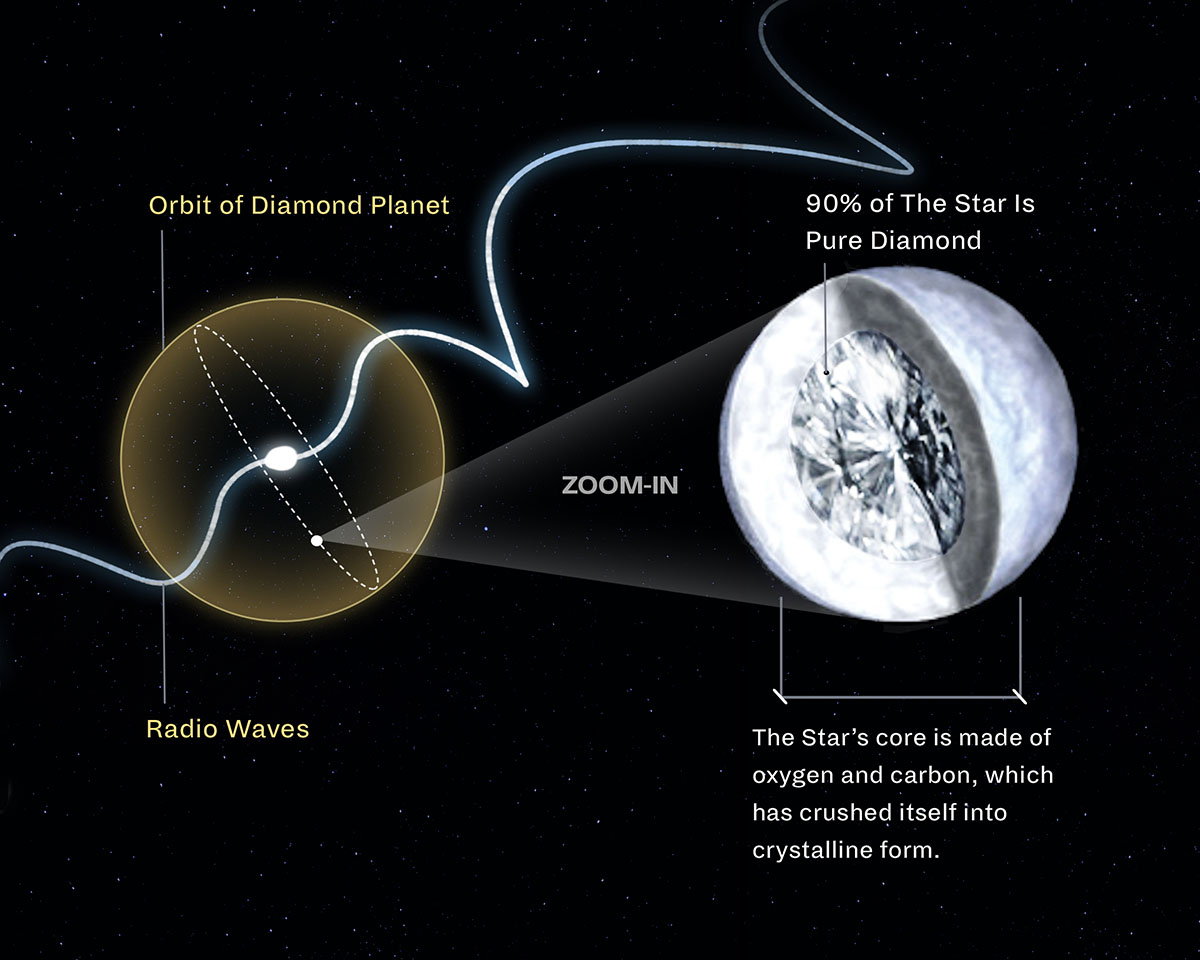
Identified only as a “chunk of crystallized carbon” by its discoverers at the Harvard-Smithsonian Center for Astrophysics in 1992, Lucy was later observed to have a pulsating aura as a result of its core temperature dropping below 12,000 degrees Fahrenheit (6,600 Celsius). Scientists went on to study the star’s frequency spectrum to determine its composition, using an emerging science called asteroseismology. They used radio waves to understand that the star’s core was turning into diamonds, in a process similar to how geologists study the interior of the Earth during earthquakes and other such natural phenomena.
Continued research studies showed that after years of reacting to its carbon core, close to 90% of Lucy’s nuclear mass had crystallised into a diamond. She had assumed the shape of the largest diamond that is quite simply out of this world.
Could Our Sun Become the Next Largest Diamond?
Abhijeet Borkar, Ph.D., a Post-Doctoral Researcher at the Astronomical Institute of the Czech Academy of Sciences, Prague says, “White dwarfs are remnants of dead stars, and their ultra-dense cores are primarily made up of carbon and oxygen. Over the course of billions of years, the hot core eventually cools down, turning liquid elements into solid, and converting the majority of its carbon into a crystal, under pressure from the enormous gravity of the white dwarf. This process is quite similar to that of forming diamonds on Earth.
We have seen evidence of diamonds on Earth, and of nano-diamonds in meteorite samples, and the discovery of Lucy points to the possibility of diamonds among the stars.
It is a remarkable end to the long life of a star and a poetic end to a massive celestial process. It’s very possible that our own sun might turn into a massive natural diamond, billions of years from now!”
And although Lucy might be the first of her kind, she definitely isn’t the only one. A similar crystallized white dwarf, the 11-million-year-old PSR J2222-0137, has been spotted almost 900 light-years away. Given its temperature, scientists theorise that it could be older than the Milky Way galaxy!
The Largest Diamond as a Muse: From The Beatles to Hollywood
Though it was The Beatles who inspired the nickname Lucy, the star has proven to be a muse for many in her own right. As featured in the visions of directors and screenwriters alike, in Jim Jarmusch’s 2013 release, Only Lovers Left Alive, immortal vampires speak of a diamond “up there”, almost as big as a planet that “emits the music of a gigantic gong”. In John C. Wright’s science fiction novel, Count to a Trillion, we hear of the Diamond Star, where the first human interstellar journey is destined to head.
Considering the numerous poems, songs, and movies that exist, it is evident that artists have been enthralled by the charm and nostalgia of both natural diamonds and stars for ages. Lucy, nestled in a galaxy far, far away, is indeed a star from the past, shining on. And if you ever decide to look through the skies above Canberra, you’ll see her twinkling smile from across the universe.