Crocodile Rock: The Unbelievable History of the Cartier Crocodile Necklace
With an origin story almost too extraordinary to believe, the Cartier Crocodile necklace has lived on as a prime example of the duality of diamond jewelry as fine art.

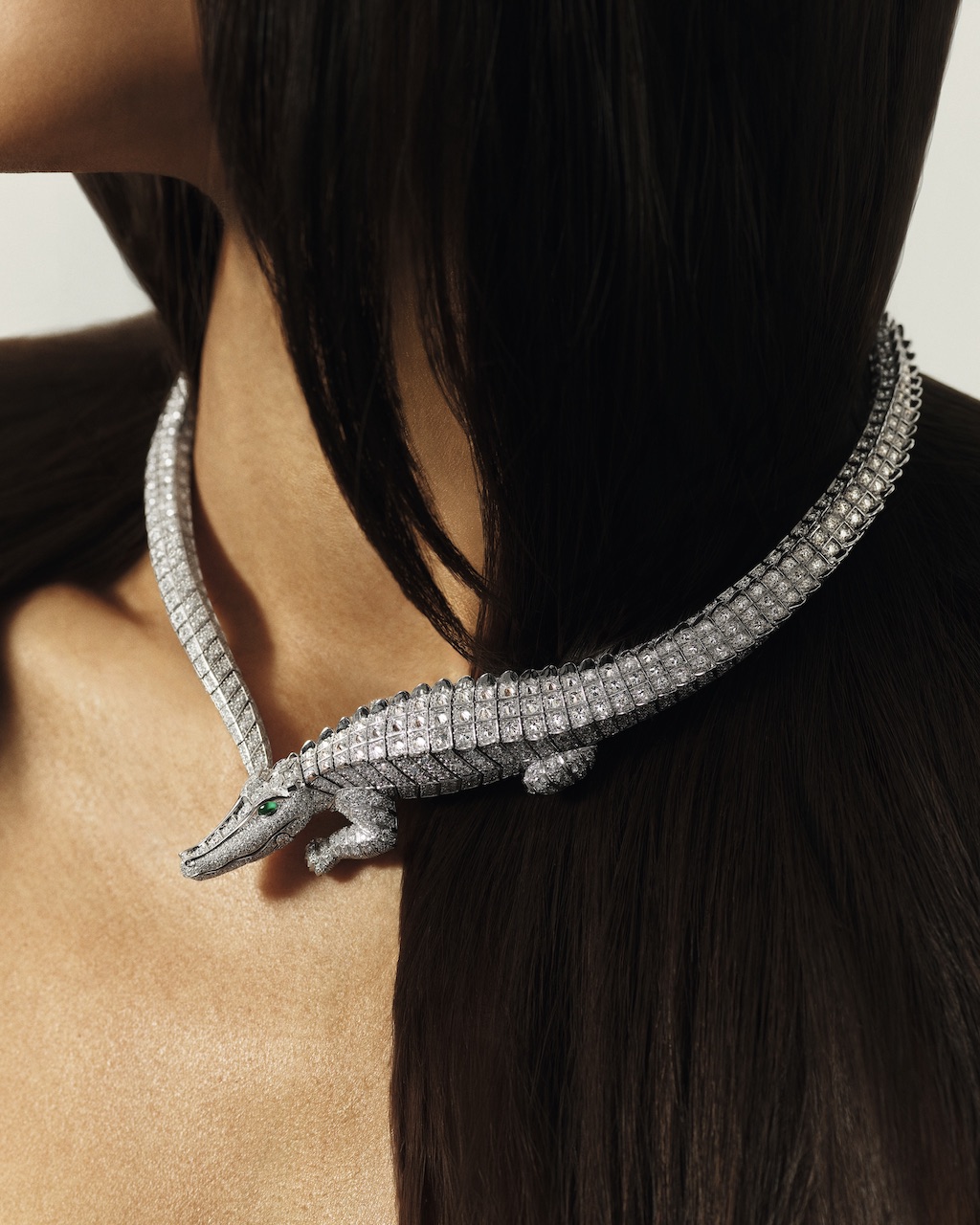
Actor Jay Ellis Wears a Cartier Crocodile Necklace Photographed by Daniel Jack Lyons for Only Natural Diamonds
The reptilian brain is the oldest, innermost part of the human brain, responsible for primal survival functions. It’s where our instinctual behaviors originate, where our fight or flight response kicks in. It’s only fitting, then, that the famed Cartier Crocodile necklace triggers an instinctual response of its own—with an extraordinary backstory and craftsmanship so impeccable it takes your breath away.
More than 50 years after it was first commissioned by Mexican actress María Félix, the Cartier Crocodile necklace remains one of the most extraordinary creations in high jewelry. Composed of thousands of emeralds and yellow diamonds, the spectacular piece is matched only by its origin story: a remarkable tale you can really sink your teeth into. “There’s nothing really like it in the world,” says jewelry historian Helen Molesworth.
Cartier has an enduring passion for the natural world. The historic French luxury jeweler maintains a vision of glamorous wildlife, using expert knowledge of stones, dynamic shapes, and daring colors to depict its menagerie of Flora and Fauna motifs. The iconic Panther, for example, was reimagined by Cartier in 1948 for the Duchess of Windsor. Cartier’s storied Director of Fine Jewelry, Jeanne Toussaint, is even said to have asked designers to spend time at the Paris Zoo for design cues.
Meet the Expert

Helen Molesworth is a renowned jewelry historian, gemologist, and best-selling author. Her 25-year career has spanned the global gem and jewelry industry from auction houses to academic posts. She acted as a jewelry specialist for Sotheby’s and Christie’s, where she researched and managed iconic jewelry collections. As the Senior Curator of Jewelry at the Victoria and Albert Museum in London, she acted as Lead Curator of the blockbuster exhibition, Cartier, and released a book on the subject, also titled Cartier, with V&A Publishing in 2025.
“Lions, and tigers, and bears, oh my!” gets a diamond-studded makeover with panthers, tigers, snakes, and yellow diamond crocodiles. Here, discover the extraordinary history behind the iconic Cartier Crocodile necklace.
The Surprising Origin Story of the Cartier Crocodile Necklace
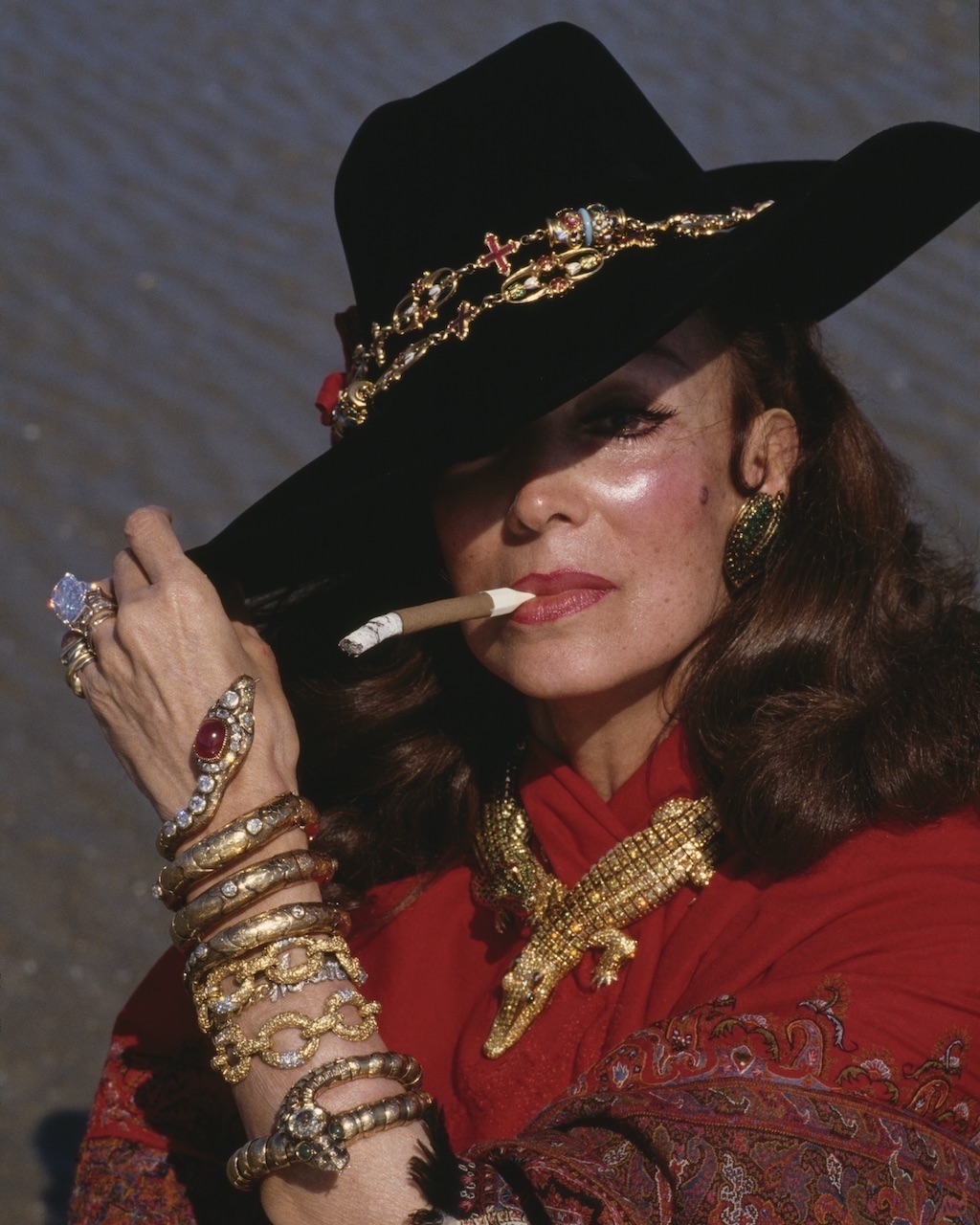
In 1975, María Félix strolled into the Cartier boutique at 13 Rue de la Paix in Paris to request a special order. As the legend goes, the Mexican actress was accompanied by a real baby crocodile for the designers to use as inspiration. She wanted Cartier’s expert jewelers to replicate the crocodile’s features as accurately as possible.
“She obviously loved very bold jewelry and decided that she wanted Cartier to make her this Crocodile necklace,” says Cartier author Helen Molesworth. “She turned up to Cartier Rue de la Paix in Paris with a baby crocodile and said, ‘Make it like this.’”
While some claim she carried a live baby crocodile in a jar, others have described the enclosure as an aquarium. Rumor has it she even suggested her little pets stay at Cartier for a while for further inspection as a design reference. As the Lead Curator of the V&A’s blockbuster Cartier exhibition and author of its accompanying tome, Molesworth has heard every rendition of this incredible tale.
Pierre Rainero, Cartier’s director of image, style, and heritage, told Artnet he personally asked Félix about the grandiose story back in 1999, and she confirmed. However, he notes she had a reputation for embellishing.
“It’s magnificent,” shares Molesworth. “When you look at the crocodiles, you can see that they must have been modeled very close to real-life examples,” she explains. “There’s just something in their faces that is so realistic.”
Many credit Cartier and Félix’s close relationship with providing new and exciting opportunities to explore cutting-edge jewelry design. Félix was dedicated to using her famed jewelry collection to represent her native Mexico, where Morelet’s crocodiles and the American crocodile freely roam. The commission went on to become the most extravagant and emblematic jewel of her collection.
Realistic Reptiles: How the Cartier Crocodile Necklace Was Made
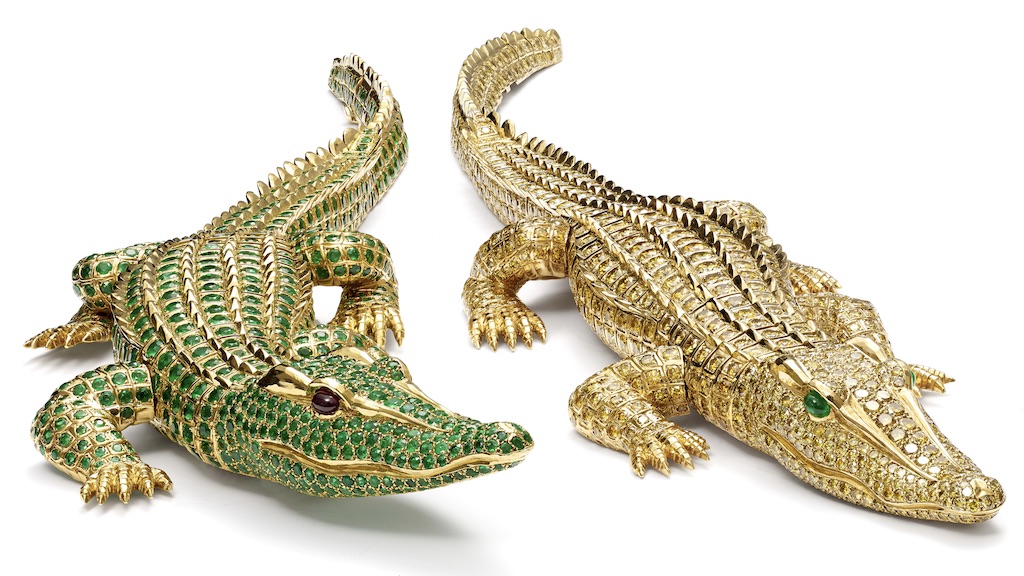
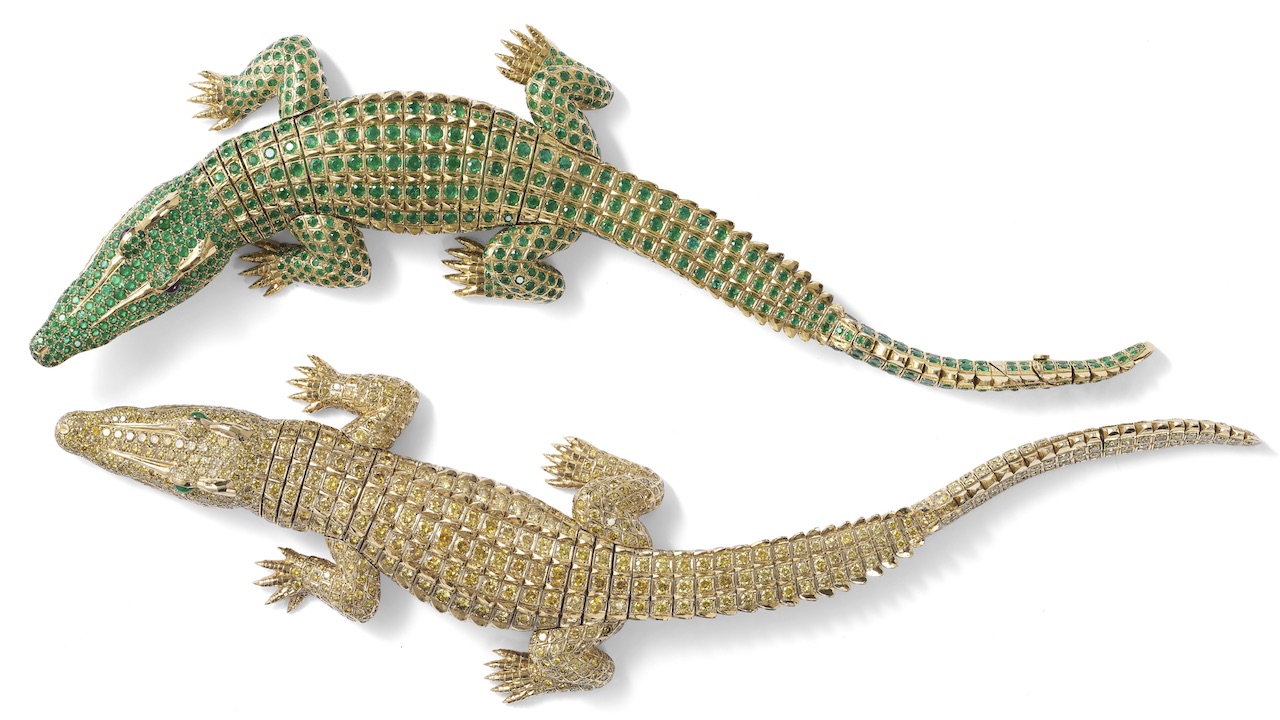
After meticulous study and endless hours of sketching, Cartier’s revered artisans masterfully executed a necklace featuring two gold articulated crocodiles, hugging around the neck. One consists of 1,060 emeralds and two cabochon rubies for its eyes, while its twin is paved with 1,023 yellow diamonds.
Molesworth says, “The snout of one of them reaches up ever so slightly more than the other. They’ve got this lovely curve to the snout, they’ve got this crown over the eyes, and the movement in the tail, with the fatness of the body. The way they’ve been built, it’s very lifelike. You look at their faces, and you can genuinely imagine a real crocodile in the water.” She continues, “It feels like they’re actually going to raise their head and bite you. They look very realistic.”
Each half of the necklace can even be removed and worn separately as two three-dimensional brooches. The perfect example of jewelry as art, the impeccably constructed jewel doubles as a stunning sculpture. Félix reportedly even used them as captivating table ornaments to display as décor during dinner parties.
While Félix’s iconic commission lives on as by far the most memorable Cartier crocodile, reptiles and crocodiles have had their place in the menagerie of the historic French jewelry house since the early 20th century.
Who Has Worn the Cartier Crocodile Necklace?

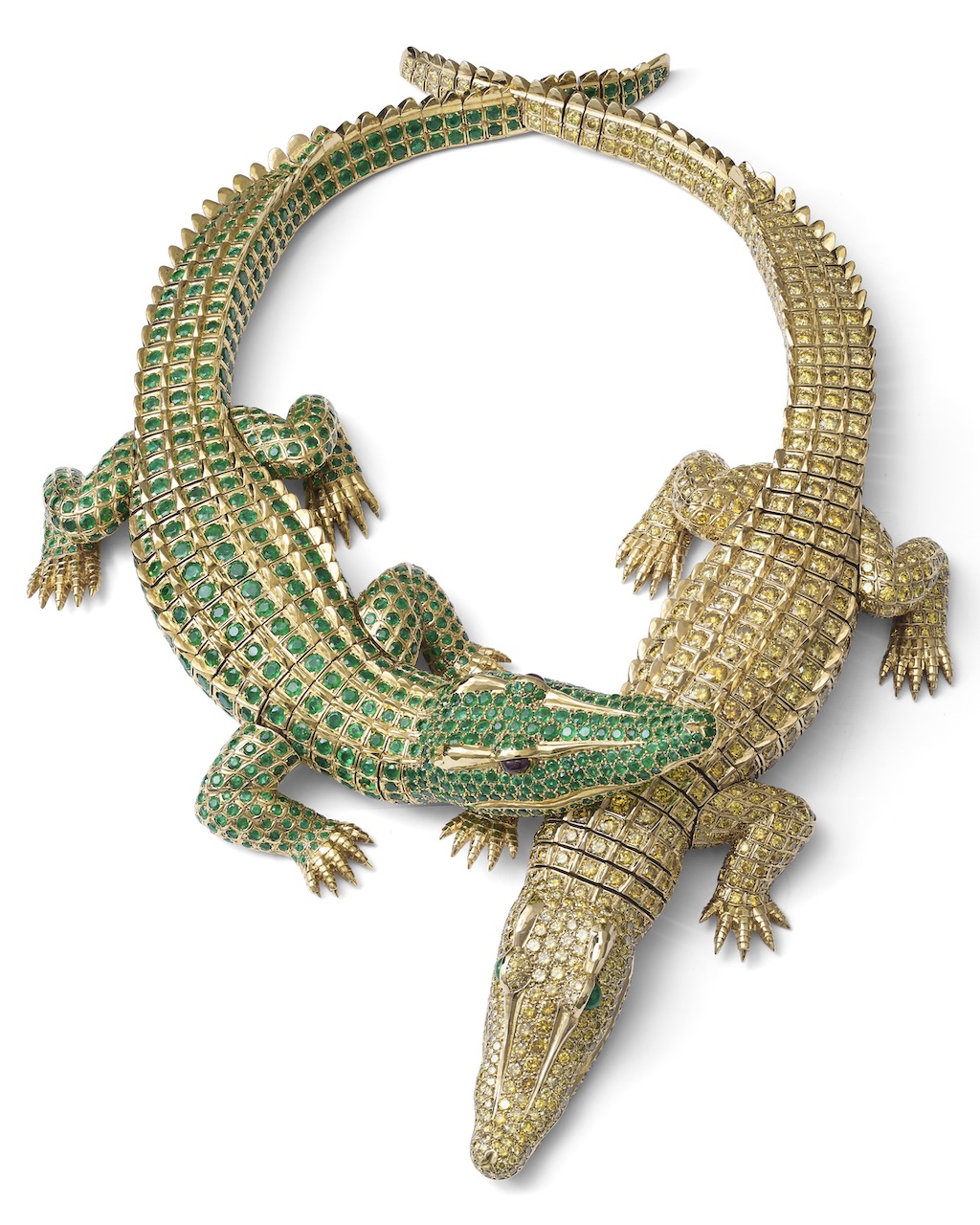
María Félix sold most of her jewelry right before she died in 2002. Cartier then reacquired the emerald and yellow diamond crocodile jewel, now included in the jeweler’s patrimonial collection. After Félix, Italian actress Monica Bellucci became the second person to ever wear the legendary necklace. She walked the red carpet at the Cannes Film Festival in 2006, wearing a crisp white button-down shirt, left open at the top to properly display the jewel.
Since then, Egyptian actress and model Yasmine Sabri wore the piece to a Cartier event in 2021, and Mexican actress Mabel Cadena sported the necklace for her March 2023 Vogue México cover shoot, making for a total of four women in the world to don the exquisite masterpiece.
Cartier Crocodile Necklace Revival in Modern High Jewelry

In 2019, Cartier revisited the design with a High Jewelry suite, paying homage to Félix and her remarkable necklace. Reimagining the original motif, Cartier called upon the very same artisanal sculptor who crafted Félix’s crocodiles to be involved in the new design. The Maison worked with a rare collection of 14 cabochon-cut emeralds from Colombia, totaling 46.45 carats, for the updated suite, including a necklace, a matching bracelet, earrings, and a ring.
That same year, Monica Bellucci kept tradition alive, walking the red carpet at the Cannes Film Festival, again, in a Cartier Crocodile necklace. The María Félix Tribute necklace is rendered in white diamonds with one crocodile, featuring emeralds on its back, meeting in the middle with a fringe of even more cascading emeralds.
Simultaneously predatory and protective, these reptilian beasts are depicted guarding exquisite emeralds and natural diamonds. Along with their live reptilian models, Cartier found inspiration in the gods. In ancient Egypt, the crocodile-headed deity, Sobek, represented strength, fertility, and protection.
Natural diamonds, too, have been revered for millennia as protective talismans believed to ward off evil spirits or curses. Many ancient cultures viewed them as symbols of strength, courage, and invincibility, often wearing them into battle or to ensure divine protection. The Ancient Egyptians believed diamonds represented the sun and signified power and courage.
The crocodile continues to inspire the jewelry house to this day.
The Lasting Legacy of the Cartier Crocodile Necklace

In 2023, Cartier announced a new exhibition – Cartier Design: A Living Legacy – which took place at the Museo Jumex in Mexico City. As a specialist in modern and contemporary Mexican design, Ana Elena Mallet curated the Mexico City edition of the exhibit of historical collections.
One of the largest retrospectives in Cartier’s history, the exhibit marks its first in Mexico in over two decades. In 1999, the Cartier Collection was presented there for the first time at the Palacio de Bellas Artes.

Exploring the rich history of Cartier design, nearly 160 pieces were showcased, ranging from 1847 to the present day. However, what set this exhibition apart was its deeply researched focus on the House’s creative partnership with María Félix.
Two of Félix’s most impressive Cartier pieces were featured as coveted trophies in the show. Her 1968 articulated natural diamond snake necklace and her renowned Cartier Crocodile necklace are the perfect illustrations of her commitment to representing her native country through an extravagant diamond-embellished lens.