
Diamond Report Series
Diamonds of Canada

The Canadian diamond industry is a spectacular story of discovery, growth, and benefits. Discover the story of some of the oldest diamonds in the world, and the impact they have had on key innovations in the industry.
Published: September 25, 2024


Overview
Environment
Canada’s diamonds are the oldest in the world at
3.5
Billion Years1
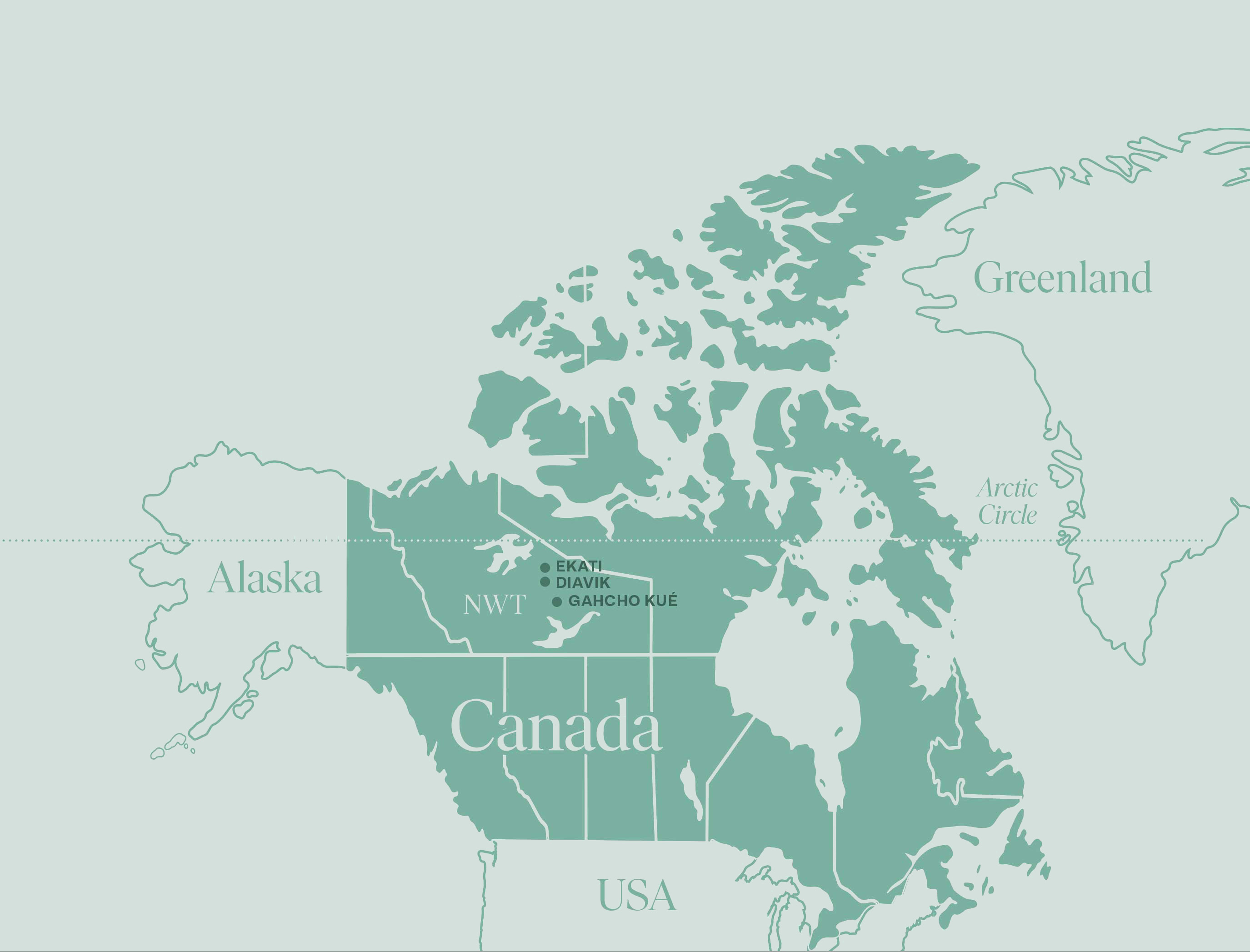
Most of Canada’s diamonds are produced in the Far North, in the Northwest Territories (NWT), currently at three mines.
The Northwest Territories is home to 11 official languages, with more than half of the 45,000 population identifying as Indigenous.
Canadian diamonds were discovered in 1987.
Diavik, one of Canada’s diamond mines, has developed the largest off-grid solar facility in Canada’s three territories2.
Canada is the 3rd largest diamond producing country in the world.

Diamond mining companies partner with Indigenous communities to monitor fish habitats and water quality.
1.4M trees were planted as part of the Victor mine closure3.
People and
Communities
Mining companies have programmes to support education from children’s schooling to business administration, environmental sciences, engineering and law, as well as leadership training, and apprenticeship schemes. 1,251NWT students benefited from the programmes in 2022-238. 70,000 books have been provided to youth in Indigenous communities near NWT operations9.
74,210 person years of cumulative employment since 2996
74,210
person years7
Supporting the economy in the Northwest Territories (NWT)
C$27.7B
(US$21.8B*)
The diamond mines in NWT have contributed a total of C$27.7B (US$21.8B*) to the economy since 1996, of which C$8.63b (US$6.8B*) went to Indigenous-owned local companies4.
Since the beginning of diamond recovery in 1996, 70% of procurement spend has been allocated to NWT-based businesses, amounting to C$19.3 B5(US$15.2B).
NWT corporations supporting diamond mines span sectors including aviation, engineering, trucking and logistics.
* Values in the report referring to 1996-2023 converted to US$ using the average exchange rate for the period of US$1=C$1.27.
All other values converted using the average exchange rate for 2023 of US$1=C$1.35
52%
Diamond mines have contributed 52% of the Government of NWT’s revenues from corporate income tax, property tax, fuel tax and carbon tax in the past three years6.


Introduction
The legacy so far
Diamonds were formed billions of years ago, and scientists believe the oldest found in the world to date are from Canada, at 3.5 billion years old. Yet commercial diamond deposits were discovered in Canada just over 40 years ago.
Since the opening of the first diamond mine in Canada in 1998, the rise of the country’s diamond sector has been meteoric. By 2004, Canada was the third largest producing country in the world. Today, Canada produces 14% of the global natural diamond supply10.
As of 2024 all of Canada’s diamonds are recovered from its far North, in the arctic region known as the Northwest Territories (NWT). Called Denendeh, or “Land of the People11” in the Dene languages, the NWT is home to 11 official languages, with more than half of the population identifying as Indigenous.
The diamond mines are working closely with governments, local communities and Indigenous Peoples, to optimise their socio-economic contributions and environmental stewardship, observe a stringent health and safety culture and ensure that the operations leave enduring benefits long after mines have closed. These beautiful gifts from deep beneath the earth are creating a powerful legacy of innovation, collaboration and preservation.

In many ways diamonds gave us a model of how development could be done. The role of government, the role of Indigenous people, the role of northern people; of the federal government, the government of the NWT and the mine itself.
Stephen Kakfwi,
Premier of the Northwest Territories (2000-03)12
C$27.7B
(US$21.8B*)
Since 1996, diamond mines in the NWT have spent C$27.7B (US$21.8B*), with more than C$19.3B (US$15.2B) spent with Northern businesses, including C$8.6B (US$6.8B) with Indigenous businesses.13.
Current Diamond Mines
Diamond mines
in Canada
There are currently three operational
mines in Canada. They’re all in NWT.
Current Diamond Mines
Diavik
Owner: Rio Tinto Group. Opened in 2003, estimated life to 2026
- The largest diamond mine in Canada
- Has produced more than 140 million carats of rough diamonds including the largest rough diamond found in Canada at 552.70 carats
- Self-contained site equipped with state-of-the-art water treatment facilities, solar power, wind turbines and accommodation
- Approx. 1,330 employees including contractors, around 36% of whom are Northern
- In 2023, Diavik spent C$374M (US$ 277M*) with Northern businesses, including C$144 M (US$ 107M*) with Northern Indigenous businesses, and donated over C$ 650,000 (US$480,000*)16
- Since 2011, the Traditional Knowledge (TK) Panel, made up of community Elders and youths, has guided Diavik with 263 recommendations on mine operations and closure planning.15
Gahcho Kué
Owner: De Beers Canada Inc. and Mountain Province Diamonds Inc. Opened in 2016, estimated lifeto 2031.
- Gahcho Kué means “place where you find large rabbits or hares” in the Indigenous Chipewyan language
- Winner of local and national safety awards14
- In May 2024, achieved a milestone C$2B (US$1.5B*) spent with NWT and Indigenous companies to build and run the site15
Ekati
Owner: Burgundy Diamond Mines, opened in 1998, estimated life to 2028
- Canada’s first diamond mine
- “Ekati” in Tłı̨chǫ means Fat Lake. The Tłı̨chǫ people are a Dene First Nations people and one of the traditional land users in proximity to the mine site.
- The Government of the Northwest Territories signed its first Socio-Economic Agreement (SEA) with Ekati back in 199617
Closed Diamond Mines
Snap Lake
Location: NWT
Owner: De Beers Group
Opened: 2008 / Closed: 2015
- Snap Lake was Canada’s only completely underground diamond mine
Victor
Location: Ontario
Owner: De Beers Group
Opened: 2008 / Closed: 2019
- Ontario’s first and only diamond mine
- Spent more than C$680M (US$500M*) with Indigenous and northern Ontario businesses
- Produced a 102-carat diamond
Renard
Location: Northern Quebec
Owner: Stornoway Diamonds
Opened: 2017 / Closed: 2023
- Mine was sold to a lithium mining company in 2024
Jericho
Location: Nunavut Territory
Opened: 2006 / Closed: 2008
- First diamond mine in Nunavut
Oversight and Agreements
Vital foundations
for all stakeholders
A large majority of the private lands in NWT are owned by First Nations peoples, who have historically relied on hunting, trapping and fishing to sustain their communities. Diamond mining companies have always worked collaboratively with stakeholders to make sure their operations have minimal impact on traditional practices and protect the delicate balance of the pristine ecosystem. For example, De Beers Group collaborates with 26 key partners, including Indigenous community development corporations, to inform its stakeholder engagement plan18. Stakeholder mapping is an ongoing process and new stakeholders are identified as the operations evolve. Diamond mining companies have helped to create laws that cement this commitment to contributing to local communities and respecting the lands. The Government of the Northwest Territories (GNWT) has also implemented several measures to ensure any natural resource project, including diamond mining, is responsible and mutually beneficial.
Injecting prosperity into the Northwest Territories
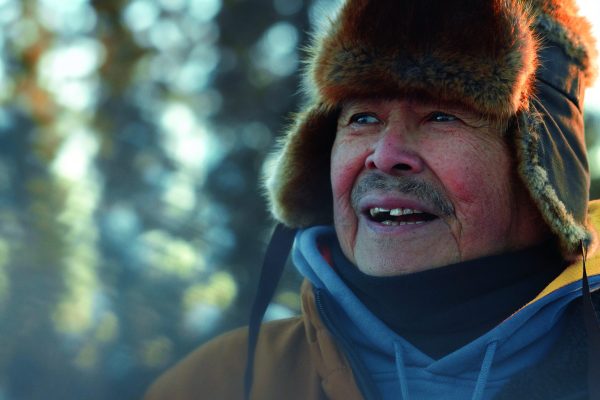
In the early 1990s, the NWT’s communities were battling economic instability. Then Chief of the Yellowknives Dene First Nation, Jonas Sangris, worried how it would impact his people.
His elders reassured him something would turn their fortunes around and just one year later, diamonds were discovered in the region. Many who were forced to move away in search of work returned and the NWT’s economy began to flourish.
Sangris believes natural diamonds are “good for the people of the North” and hopes more are discovered in the future22.
- Royalties, taxes and revenue sharing – The GNWT collects royalties on all non-renewable resources, like diamonds, that are extracted from the region. Each business must also pay corporate income tax, property tax, fuel tax and carbon tax, and follow revenue sharing rules.
- Socio-Economic Agreements (SEAs) – SEAs signed by the GNWT and mining companies commit both parties to show how a project (such as a diamond mine) will bring economic and social opportunities through local jobs, procurement and training to the NWT.
- Impact and Benefit Agreements (IBAs) and Participation Agreements (PAs) – These private agreements are more region-specific than SEAs. They are arranged in collaboration with a mineral resource developer and Indigenous stakeholders to make sure operations benefit the region’s land and waters. The topics in these agreements reflect the interests and priorities of different Indigenous governments and beneficiaries. Aligning with IBAs and PAs is prioritised over SEAs. Ekati has signed four IBAs19, Gahcho Kué six20, and Diavik five PAs21. Key diamond mines no longer in operation also had IBAs.
- Mackenzie Valley Resource Management Act (MVRMA) – This empowering piece of legislation brings together the Land and Water Boards of the Mackenzie Valley (LWBs), the Mackenzie Valley Environmental Impact Review Board (MVEIRB), Renewable Resource Boards and Land Use Planning Boards. Together, these Boards make up a co-management system that ensures a holistic and integrated approach to renewable and non-renewable resource management.
- Towards Sustainable Mining (TSM) standard – Developed by the Mining Association of Canada, this globally-recognised programme supports mining companies to manage key environmental and social risks. Its approach is to help translate high-level risk factors into on-the-ground action.

Exploration & Innovation
The race to find diamonds
Diamonds are extraordinarily difficult to find. Most are embedded in volcanic structures called kimberlite pipes. The last volcanic explosion that propelled diamonds to the Earth’s surface is believed to have occurred 40 million years ago.
It has been estimated that geologists have found 7,000 kimberlite pipes over the last 150 years, but only 1,000 of these have contained diamonds. Just 60 pipes have held enough diamonds to be viable to mine.
Given the vastness of Canada, the quest to find these kimberlite pipes wouldn’t feel out of place in Hollywood.
It was highly competitive as different parties vied to tap into the region’s potentially enormous diamond potential. Exploration for Canada’s diamonds began in 1960 when De Beers teams began to search for kimberlite. They were attracted to the country’s craton geology, which is similar to southern Africa, where diamonds were discovered about a century earlier.
Over the next 40 years, De Beers explored across the country, focusing in on northern regions. Other geologists joined the race, carrying out clandestine prospecting for decades. Years of gruelling work in sub-zero temperatures and remote, inhospitable lands eventually paid off. In 1987 De Beers discovered Canada’s first commercial diamond deposit about 90 km west of Attawapiskat in Northern Ontario (which eventually became Victor mine opening in 2008). This was followed by discoveries in the NWT and the opening of Ekati and then Diavik mines.
Innovation has made mining in some of the world’s most unforgiving yet delicate lands a realistic and safe prospect.
For 10 months of the year, the NWT diamond mines were accessible only by air until the diamond mining companies created a solution23. Every winter, the companies rebuild a 400-kilometre stretch of winter road to connect the Ekati, Diavik and Gahcho Kué sites to the road at Tibbitt Lake, close to Yellowknife.
The Winter Road is believed to be the longest heavy haul ice road in the world. It transports essential supplies that would be impossible or inefficient to deliver by air.
Majority Indigenous companies like Nuna Logistics and Det’on Cho play major roles in the road’s the construction and security each year24. It is funded by diamond mining companies but used by locals and Indigenous people, cutting down their travel time to cultural areas and hunting grounds.
I commend Rio Tinto for the completion of the largest off-grid solar plant in Canada’s North at the Diavik mine. The project demonstrates Rio Tinto’s leadership when it comes to reducing emissions, and signals potential for leadership in the renewable energy sector in and by the North.
Caroline Wawzonek
Northwest Territories’ Minister of Infrastructure
Driving innovation
Leaders in cold climate renewable technology
Rio Tinto has established an award-winning wind farm to power its Diavik mine site, saving the equivalent of 135,000 tonnes of CO2 emissions since its installation in 201225.
More recently, it has installed a solar farm, which stands as the largest off-grid solar facility in Canada’s three territories. It generates energy from direct sunlight and light reflected off the snow. With a capacity of 3.5 megawatts, the 6,620 solar panels will generate approximately 4.2 million kWh of electricity annually, cutting emissions by 2,900 tonnes of CO2 equivalent.
Rio Tinto is currently working with the GNWT and community partners to determine how its renewable energy infrastructure can best benefit the region once the mine has closed.


Canadian Diamond Characteristics
The oldest diamonds
in the world
Typically icy white in colour and with low levels of impurities, Canadian diamonds are prized for their quality and appearance. Yet there is much history within the sparkles. Some of the oldest diamonds ever formed and found were discovered in Diavik and Ekati. Miners have also found fossils and petrified wood here, and the stones reflect this unique glance into Earth’s geology.
Diavik diamonds
Diamonds from Diavik mine are recovered from beneath a frozen lake. They are predominantly classic white, octahedrons in shape. Less than 1% of Diavik’s production is rare Fancy Yellow diamonds.
Diavik has produced a number of notable rough diamonds weighing more than 100 carats, including the 187.7-carat Diavik Foxfire in 201526, and a 552-carat yellow diamond recovered in 201827.
Ekati diamonds
Ekati diamonds range from whites to cape, a warm yellow hue. In 2022, an exceptional 71.26-carat fancy vivid yellow diamond was found at Ekati28.
Gahcho Kué diamonds
Type 2a diamonds, which account for just 1-2% of all diamonds mined globally29, have been recovered from Gahcho Kué. These gems have no measurable nitrogen or boron trace elements and are usually colourless. With strong florescence, meaning they glow blue when exposed to long-wave UV light, they mirror the aurora borealis that lights up Northern Canada’s night skies.
Other Canadian diamonds
Other mines have recovered diamonds of similar exceptional quality. For example, a 271-carat rough diamond recovered at Victor mine in 2018 was later sold once cut and polished for a record US$15.7 million in 202030.Ekati diamonds range from whites to cape, a warm yellow hue. In 2022, an exceptional 71.26-carat fancy vivid yellow diamond was found at Ekati28.
When you have diverse geological sampling across three sites, you can’t help but see that the Earth imparts its personality and history on the diamonds.
Benjamin King,
Diamonds de Canada
From day one, Canadian diamonds have been the most tracked and traced diamonds in the world. There have been many different brands of Canadian diamonds backed by these have been different types of tracking systems that followed Canadian diamonds on their journey of discovery, to auction, manufacturing, and wholesalers/retailers and ultimately to the consumers. It’s been a source of pride for the ones that own it and are aware of their journey of their diamond.
Kevin Vantyghem,
Canadian Jewellers Association
Diavik diamonds
The Polar Bear insignia is the oldest brand in NWT. It is owned by the GNWT and has been licensed for use by select companies over the years. Today, Diamonds de Canada is the only licensee that can produce Polar Bear diamonds.
Any diamond laser inscribed with the logo and unique identification number must be mined, cut and polished in NWT. Diamonds de Canada has committed to producing no more than 20,000 of these exclusive diamonds match the number of polar bears in Canada1. It will allocate a portion of its proceeds to government research into bear protection.
Partnering with local communities
Transforming the region’s economy
NWT residents have made up 47.5% of all employment in NWT diamond mines since 1996 including 23% who are Indigenous31. Diamond mines have stimulated all areas of the private sector economy, with demand for employment and business development being the key drivers.
The GNWT collects 100% of resource revenues paid in the NWT. A percentage of the total is shared with Indigenous governments under modern treaty agreements. Subject to a cap, the GNWT splits the remaining resource revenues 50-50 with the Federal government. The GNWT then shares 25% of its portion with the Indigenous government signatories to the Northwest Territories Land and Resources Devolution Agreement. In the last three years the diamond mines have contributed 52% of the Government of NWT’s revenues from corporate income tax, property tax, fuel tax and carbon tax32. Additionally employees at the mines pay payroll tax and resident employees pay personal income tax.
Diamond revenues claimed in taxes and royalties are used to support public programmes and services. The natural diamond industry is also helping to establish essential infrastructure.
52%
of the Government of NWT’s revenues from corporate income tax, property tax, fuel tax, and carbon tax.
74,210
person years as
employment generated

In my experience, Indigenous Peoples are very proactive […], we take a balanced approach to development. Wildlife, water and nature are critical to us and we want to ensure that development does not have any adverse effect on the environment, so by actively participating we can help set the tone for the development of diamond mines and other resource development in the Northwest Territories. In terms of employment and business opportunities, Indigenous people in Canada and the NWT want to participate from the get-go, from the development to the operations right to the governance and reclamation of a mine33.
Darrell Beaulieu,
CEO of Denendeh Investments Incorporated (DII),
who has served three terms as the Chief of the Yellowknives Dene First Nation.
Providing skilled employment opportunities
NWT residents have made up 47.5% of all employment in NWT diamond mines since 1996 including 23% who are Indigenous31. Diamond mines have stimulated all areas of the private sector economy, with demand for employment and business development being the key drivers.
The NWT are dotted with remote towns and settlements, home to around 45,000 people (one person every 30 square kilometres), including large numbers of Canada’s Indigenous Peoples34. Due to the high cost of living for all, stable employment is essential.
With fewer opportunities than in more densely populated regions, NWT residents rely on industries like diamond mining and related sectors for meaningful career paths.
Mines have contributed the equivalent of 74,210 person years in total, but more importantly, have helped NWT residents build rewarding careers for life35. By supporting them to gain mining experience and skills, and access training in mechanics, carpentry and electrical engineering, the region’s people are equipped to thrive beyond a mine’s finite lifespan.
Through SEAs, diamond mining companies hold themselves accountable to ensuring their mining operations benefit the local people and economy.
Employment Generated (1996-2023) in Canada:
TOTAL:
74,210 PY
person years (PY)
NWT EMPLOYMENT:
34,762 PY
out of which
17,387 PY
Indigenous NWT Employment
Southern Canada Employment:
39,288 PY36
A platform for private businesses
NWT’s three diamond-producing mines do more than support their workers. They also provide income for local companies for everything from catering to construction to logistics. Taxes from revenue contribute to local services. By paying competitive wages, diamond mining companies also help ensure that money earned in the NWT is spent through local industries, like retail and entertainment.
In 2023, NWT mining companies spent close to C$847 million with NWT-based businesses, with two of the three mines allocating more than 60% of their spending to local companies37.
Fuelling business growth: Det’on Cho Group
Det’on Cho Group of Companies is a prime example of how the natural diamond industry has generated opportunities for Indigenous peoples in the NWT38. Founded with a C$15,000 (US $12,000) grant in 1988, it now generates annual revenues of approximately C$85 million (US$ 63 million). It comprises eight wholly-owned subsidiaries and 15 joint venture partnerships. It provides logistics, environmental consulting, camp management services, construction, waste management, transportation, food distribution, exploration, mine remediation, aviation, hospitality services, and more. Det’on Cho also focuses on career development and building capacity for its 1,300 team members.
Det’on Cho credits NWT’s diamond mines with laying the foundations for the group’s success. One of Det’on Cho’s first businesses, a catering and housekeeping company, Bouwa Whee Catering, began providing services at Diavik Diamond Mine in 2009. With Diavik’s support, the business could grow its teams and offer services to De Beers Group’s Snap Lake and Gahcho Kué mines. It now employs around 200 people, half of whom are Indigenous. Det’on Cho Logistics began servicing De Beers Snap Lake Mine in 2009 and, since that time, has added capacity through acquisition and now services all three operating NWT Diamond Mines as well as mining operations in Nunavut and Saskatchewan.
Outside of diamond mining, Det’on Cho is successfully diversifying to shore up its operations. It has acquired a waste management firm, a food distribution company, and multiple commercial properties in Yellowknife, NWT’s capital city, and continues to explore other investment opportunities in an effort to fulfill its purpose: to create prosperity for the Yellowknives Dene First Nation.
Giving back through education
Education, from children’s schooling to business mentorship, apprenticeships and leadership training, is key to improving the lives of workers and their families during a mine’s life and beyond. Leading diamond companies work with the GNWT and key institutions such as the Mine Training Society, Skills Canada and Aurora College to help NWT residents develop their skills and gain qualifications.
To ensure opportunities are not financially prohibitive, many mine operators offer scholarships to NWT residents. These include:
– Rio Tinto’s Diavik Diamond Mine Community Scholarship Fund
– De Beers Group’s STEM Scholarship Program for Women in Canada
– Ekati’s Plus Program Post-Secondary Scholarship Program39
70k
Books to youth in Indigenous communities
De Beers Group:
Literacy skills support
De Beers Group has long championed literacy development. Higher literacy rates increase the likelihood of accessing well-paid jobs as well as higher education and other educational opportunities.
Launched in 2003, De Beers Group’s Books in Homes programme delivers free books to young people in NWT communities to help build literacy skills. Since its launch, the programme has provided close to 70,000 books to youth in Indigenous communities near its NWT operations. De Beers has also partnered with Dolly Parton’s Imagination Library to inspire a lifelong love of reading among five-year-old children.
10k
Women to access
STEM sector
Promoting STEM careers for women and girls
Indigenous women represent less than one per cent of those working in the Canadian science, technology, engineering and mathematics (STEM) sector. Challenging the status quo begins with inspiring young women and girls to pursue these subjects from an early age. To spark possibilities in young minds, De Beers Group has held a number of four-day camps for girls from First Nations communities to experience various aspects of STEM fields. De Beers Group aims to give 10,000 girls and women access to STEM subjects by 203040.
Giving back through education
Employee-led charitable project
A group of employees at Diavik saw an opportunity to salvage copper wire, sell it and donate the funds to community groups. Management supported the idea, approving paid volunteering time. To date, the group has salvaged 405,500 pounds of copper and raised over C$880,000 (US$650,000*) for local charities like the Stanton Territorial Hospital Foundation, YWCA NWT, HomeBase Yellowknife, Yellowknife Women’s Society and other community organisations.
For this initiative, Diavik was recognised by the Mining Association of Canada in May 2023 with a Towards Sustainable Mining Award for excellence in community engagement41.
Wildfires support
Between May and September of 2023, at least ten NWT communities were under evacuation orders due to wildfires. When communities were under threat, all three NWT diamond mining companies made sizeable contributions to emergency funds. These ranged from individual mine contributions of C$10,000 (US$7,000*) to parent company contributions of C$250,000 (US$185,000*). The mines also contributed funding to help evacuate more than 19,000 people.
Beyond monetary donations, NWT diamond mining companies provided resources to support the response. They deployed emergency teams, equipment and volunteers from mines to help build firebreaks and set up water cannons. The diamond mines also helped their employees evacuate safely, providing support payments to affected workers and additional days off to be with their families42.
Forging a positive legacy
The end of a mine marks a new beginning, where eco-tourism, scholarship programmes and funding for entrepreneurs create a wealth of opportunities for local communities. Before a proposal to open a diamond mine is put forward, rigorous research and planning to prepare for the mine’s closure is undertaken (subject to strict requirements from local authorities and communities).
Passing future opportunities to the local community6
Snap Lake, NWT
Snap Lake, operated by De Beers Group, is NWT’s first mine to enter active closure. Under the SEA, Snap Lake is prioritising hiring efforts to hire experienced and skilled NWT residents to carry out the highly specialist demolition work. 89% of Snap Lake’s closure spend in 2022-2023 was with NWT businesses. For example, MET/Nuna, an Indigenous community-led joint venture between the North Slave Métis Alliance and Nuna Logistics, was contracted to manage the site’s closure and rehabilitation. The partnership ensures that Indigenous communities can prosper for years to come. Snap Lake was awarded the Economic Leadership Award at the MAX Awards in November 2023 for its innovative approach to deconstructing the mine in a safe and environmentally friendly way.
Victor, Ontario
As Victor prepared to enter closure from 2015, De Beers Group held job search skills workshops and career fairs at the mine and offered a severance package that far exceeded legislated standards. By the time the mine closed, the majority of the workforce had already found new employment. During active closure, ACLP, a 100% Attawapiskat First Nation-owned company, continued to provide camp catering and housekeeping services. Members of the community have also been employed and trained to help meet the De Beers Group’s commitments to monitor the site’s environment for decades to come.
Diavik, NWT
Diavik will be ending production in 2026. As one of the largest employers in the NWT, Diavik has carried out extensive employee, community and business transition planning. Many existing employees will support the mine decommission and land rehabilitation, followed by scientific and Traditional Knowledge monitoring.
Diavik has also created an employee and contractor programme, MyPath, which is designed to help employees learn new skills, move into new jobs, retire, change careers or start their own businesses.
Environmental Protection
Mitigating impact on
local environments
In NWT’s tundra region, glassy lakes dot the green land in summer and ice and snow leave the landscapes pristine in winter. Despite its barren appearance, wildlife thrives here. A wide range of animals, from bison and muskox to bears, caribou and wolves, call the region and its coastlines home.
As Indigenous Peoples have called the NWT’s lands and waters home for thousands of years, any mining activity must also avoid impacting their traditional ways of life and historic hunting grounds.
Before a site opens in Canada, mining companies must commit to protecting the biodiversity of the areas in which they operate and agree to restore the habitat to its original state post-closure. The focus for miners is on extracting precious resources without disrupting the delicate balance of each natural environment. Major environment and biodiversity studies are required before construction is allowed, which take place in consultation with Indigenous communities and local and regional governments. On average, for every acre of land used for diamond recovery, NDC council members set four aside for conservation43.

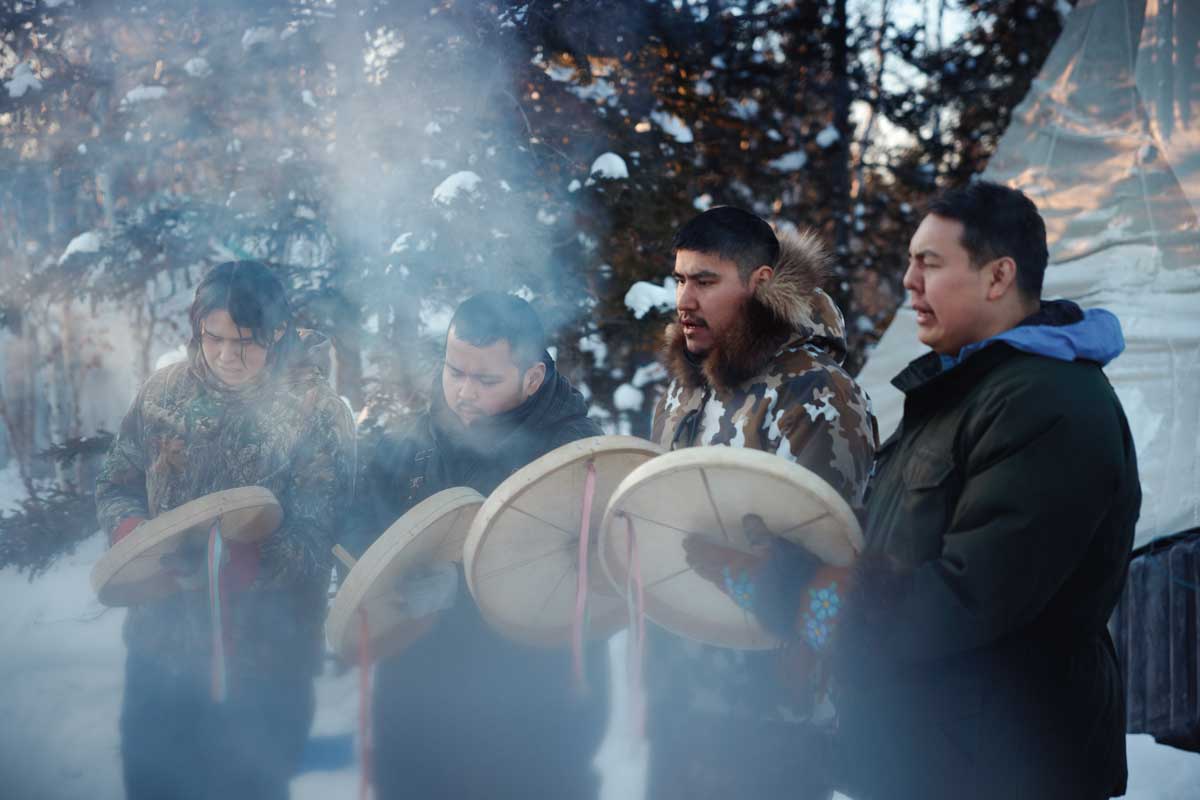
Using Indigenous knowledge to monitor the environment
NWT diamond mining companies realise that utilising Indigenous knowledge and practice should be the basis of successful environmental stewardship programmes.
At Gahcho Kué mine, Ní Hadi Xa is an agreement between six Indigenous Nations that ensures the mine operations “do not compromise the ability of the land to support those who rely on it”. Deninu Kųę First Nation, North Slave Métis Alliance, Northwest Territory Métis Nation, Tłı̨chǫ Government, Łutsel K’e Dene First Nation, Yellowknives Dene First Nation and De Beers Group work collaboratively to achieve the agreement’s goals.
They use traditional wisdom alongside modern tools to monitor environmental impact. Their work involves data collection on water quality, observing the mine’s activities and technical reviews of the environmental management plans.
Each year, elders from these six Indigenous Nations are invited to participate in the Ní Hadi Xa traditional monitoring programme, part of which involves fish tasting. Elders catch, examine and taste fish from waters downstream of the mine and use their deep knowledge of local ecosystems to confirm that mine activities are not impacting wildlife.
Reclaiming the land
post-closure
Preparing to hand a mine’s site back to nature begins long before it opens and evolves through the mine’s life. During operations, diamond companies gain a greater understanding of the location’s physical, geological, biological, social and economic context, which informs final decisions on the reclamation process. They also set aside hundreds of millions of dollars in escrow in order to fund proper closure of the mine.
Award-winning land restoration
At Victor mine, nearly 10 years of university-led research programmes informed efforts to return the site to its natural state. Indigenous communities also played a key role in examining many environmental factors including caribou herd migration, fish populations, indigenous plant life and air and water monitoring, to understand how the land could be returned to its original function of hunting and trapping.
As part of its plans, people from the nearest community, Attawapiskat, have helped grow and plant more than 1.4 million trees on the mine site.
The Victor mine team won the Tom Peters Memorial Mine Reclamation Award, presented by the Ontario Chapter of the Canadian Land Reclamation Association for its innovative post-closure strategy44.
Collaborating to better understand wildlife conservation
An important part of Canada’s ethical diamond framework is protecting the habitats of the Arctic animals that live in the country.
Our members dedicate time and resources to protecting and better understanding the natural world of the NWT. Diavik, Ekati and De Beers Group came together, along with the University of Calgary and GNWT, to study the movements and behaviour of wolverines and grizzly bears. Their goal was to ensure populations around the mines were healthy and stable, which was the case for both animals.
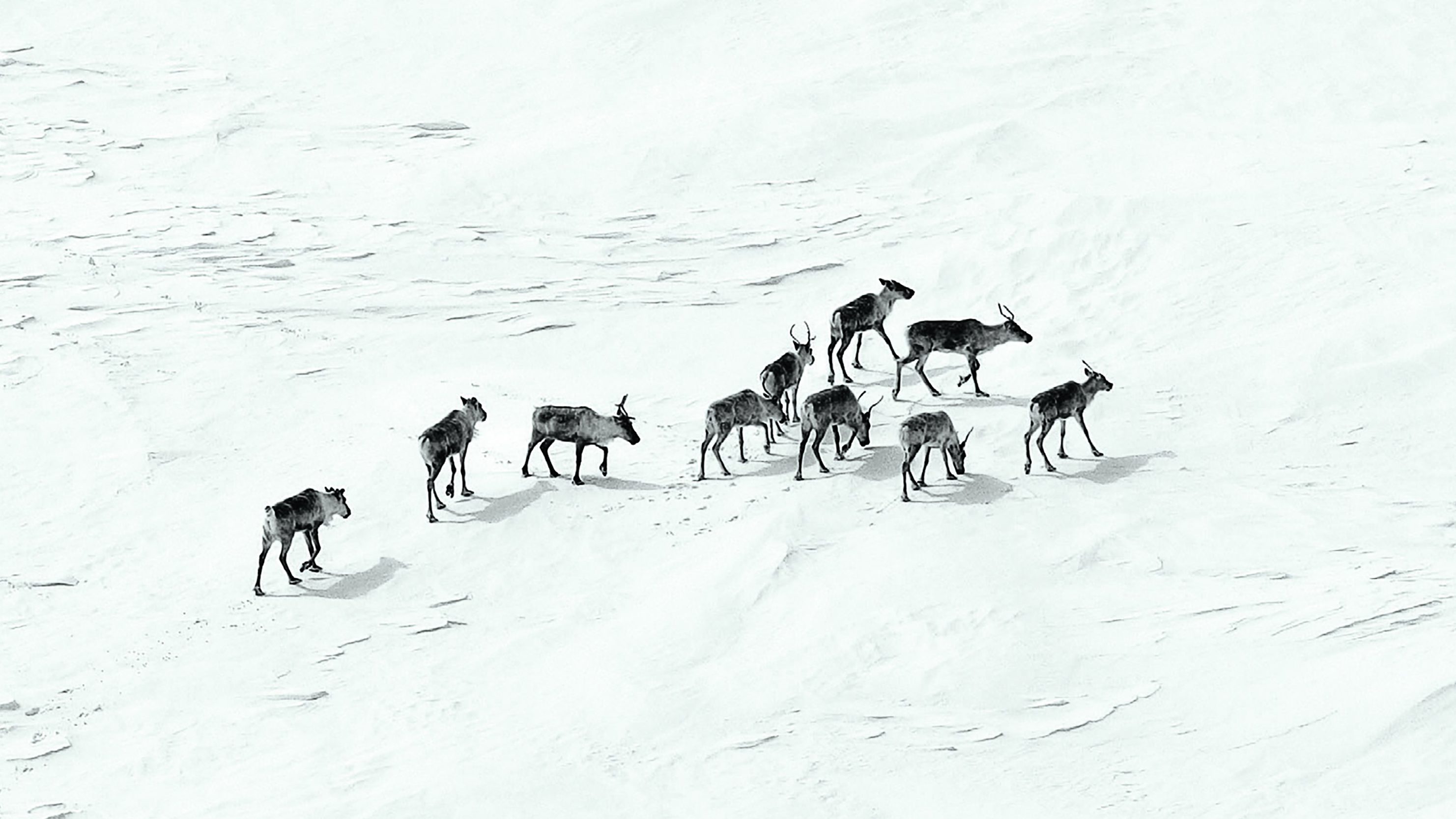
De Beers Group has also worked with the University of Calgary, GNWT and World Wildlife Federation (WWF) to track caribou via radio collars. The project aimed to gather important data about their movements, which could be used to help reverse their dramatic population decline45.
Wildlife at Gahcho Kué
Gahcho Kué has a wildlife management plan that outlines how the mine mitigates interaction with wildlife in and around the mine site.
In 2023, the caribou behaviour monitoring program took place along the 100 km winter road linking the mine to the main Tibbitt-Contwoyto road. The program involves ground-based observers monitoring groups of caribou and individual caribou. The team conducted 188 group surveys and 192 individual animal surveys during this time.
In addition, an aerial survey along the winter road was conducted in January 2023, during which the team counted more than 360 caribou in three groups.
They also record wildlife sightings within the mine site and in 2023 documented nearly 900 caribou on the mine site. A total of 55 different wildlife species were recorded on the mine site during the year, including 49 muskoxen, 3 wolverine, and 30 species of birds. The team also counted more than 650 Bank Swallows on site during 2023, mostly nesting in the coarse processed kimberlite facility. Bank Swallows are listed as Threatened in Canada and the team marks each nesting colony to ensure that no work is carried out in these areas during the nesting season.
Lily James discovers Canada’s Natural Diamonds
NDC’s Global Ambassador and celebrated actress Lily James visited the NWT to hear first-hand how natural diamonds have positively impacted the region.
She spent time with key figures from diamond businesses and local communities, including the community of Dettah’s youngest elected councillor and Yellowknives Dene First Nation member Kateri Lynn, and revered elder Jonas Sangris. They explained how the opportunities offered by diamond mining allow people to raise families in the places where they grew up, rather than being forced to move to find opportunities.
James experienced driving across the frozen Great Slave Lake, monitored the wellbeing of local caribou and took part in traditional community activities at B. Dene Camp. She also visited Gahcho Kué mine and participated in caribou monitoring on its ice road.
Nature-aligned mine closure at Diavik
Diavik is positioned on a 20 square kilometre island in Lac de Gras and through award winning technology has been mining its diamonds from beneath a frozen lake. In order to keep the pristine waters of Lac de Gras at bay, Diavik constructed innovative dikes. When the diamond pipes at Diavik are exhausted the dikes will be breached and what was mine, becomes the lake46.

Download This Report
Natural Diamond Council’s Diamond Report series covers trends, origin, and other particularities of the ultimate gemstone – natural diamonds. Created in collaboration with governments, communities, and experts, these reports empower consumers, media, and industry professionals with transparent insights and engaging facts.

Many thanks to the following contributors:
Avi Krawitz
Ray Ferraris
Diamcad
Edward Asscher And The Royal Asscher
Ilan Taché And Groupe Taché
De Beers Group
Lucara Botswana
Gemological Institute Of America (GIA)
Graff
Richemont
Chow Tai Fook
Sotheby’s
Christie’s
Smithsonian’s National Museum Of Natural History
Jackie Steinitz
SOURCES
2 – Rio Tinto, 2024, Rio Tinto completes construction of its solar power plant at Diavik Diamond Mine
3 – De Beers Group, 2023, Victor mine to receive reclamation award
4 – Unlocking Our Potential, Government of the Northwest Territories, International Kimberlite Conference 2023
5 – 2023 Socio-Economic Agreement Report, Government of Northwest Territories
6 – 2023 Socio-Economic Agreement Report, Government of Northwest Territories
7 – 2023 Socio-Economic Agreement Report, Government of Northwest Territories
8 – 2023 Socio-Economic Agreement Report, Government of Northwest Territories
9 – De Beers Group, Our 2023 Sustainability Report
10 – Kimberley Process Rough Diamond Statistics
11 – Northwest Territories Bureau of Statistics, August 2022
12 – Unlocking our Potential: 30 Years of Diamonds, Government of Northwest Territories, 2024
13 – 2023 Socio-Economic Agreement Report, Government of Northwest Territories
14 – Awards include national 2020 John T. Ryan Award for safety and NWT MAX Award for Environment, Social and Governance
17 – Burgundy Diamonds, Ekati Mine
19 – Burgundy Diamonds, Ekati Mine
20 – De Beers Group, Gahcho Kué Mine
22 – Natural Diamond Council, A Song of Ice & Diamonds, 2023
24 – De Beers Group, De Beers Group Awards Snap Lake Mine Closure Contract to NWT Company, 2021
25 – Rio Tinto, Rio Tinto completes construction of its solar power plant at Diavik Diamond Mine, 2024
26 – Smithsonian, The Foxfire Diamond Bedazzles as Smithsonian’s Newest Rock Star, 2016
27 – Phillips, A Diamond’s Journey: Unearthing the Historic ‘552’
28 – Financial Times, Stone rarities show scale of Tiffany’s newfound ambition, 2023
29 – GIA, Digging into Diamond Types
30 – Sotheby’s, Top 10 Standout Moments from Sotheby’s Autumn Auctions in Hong Kong 2020
31 – 2022 Socio-Economic Agreement Report, Government of Northwest Territories
32 – 2022 Socio-Economic Agreement Report, Government of Northwest Territories
33 – Natural Diamonds Council, The New Legends of the Diamond World
34 – 2022 Socio-Economic Agreement Report, Government of Northwest Territories
35 – 2022 Socio-Economic Agreement Report, Government of Northwest Territories
36 – 2022 Socio-Economic Agreement Report, Government of Northwest Territories
37 – 2022 Socio-Economic Agreement Report, Government of Northwest Territories
38 – 2022 Socio-Economic Agreement Report, Government of Northwest Territories
39 – 2023 Socio Economic Agreement Report, Government of Northwest Territories
41 – 2023 Socio Economic Agreement Report, Government of Northwest Territories
42 – 2023 Socio Economic Agreement Report, Government of Northwest Territories
43 – ERM (2022) Natural Diamond Council members sustainability overview
44 – Victor Mine – De Beers Canada
45 – Natural Diamond Council, 2021, Caribou… Wolves… and Diamond Experts (?!)
46 – Diavik Rio Tinto
40. Interviews with Edward Asscher


